How to Keep a Welding Table from Warping
Learn how to keep a welding table from warping through heat control, balanced clamping, backstep weld sequencing, and structural underside frame bracing.
 By WeldGearLab Editorial
Updated October 10, 2026
By WeldGearLab Editorial
Updated October 10, 2026
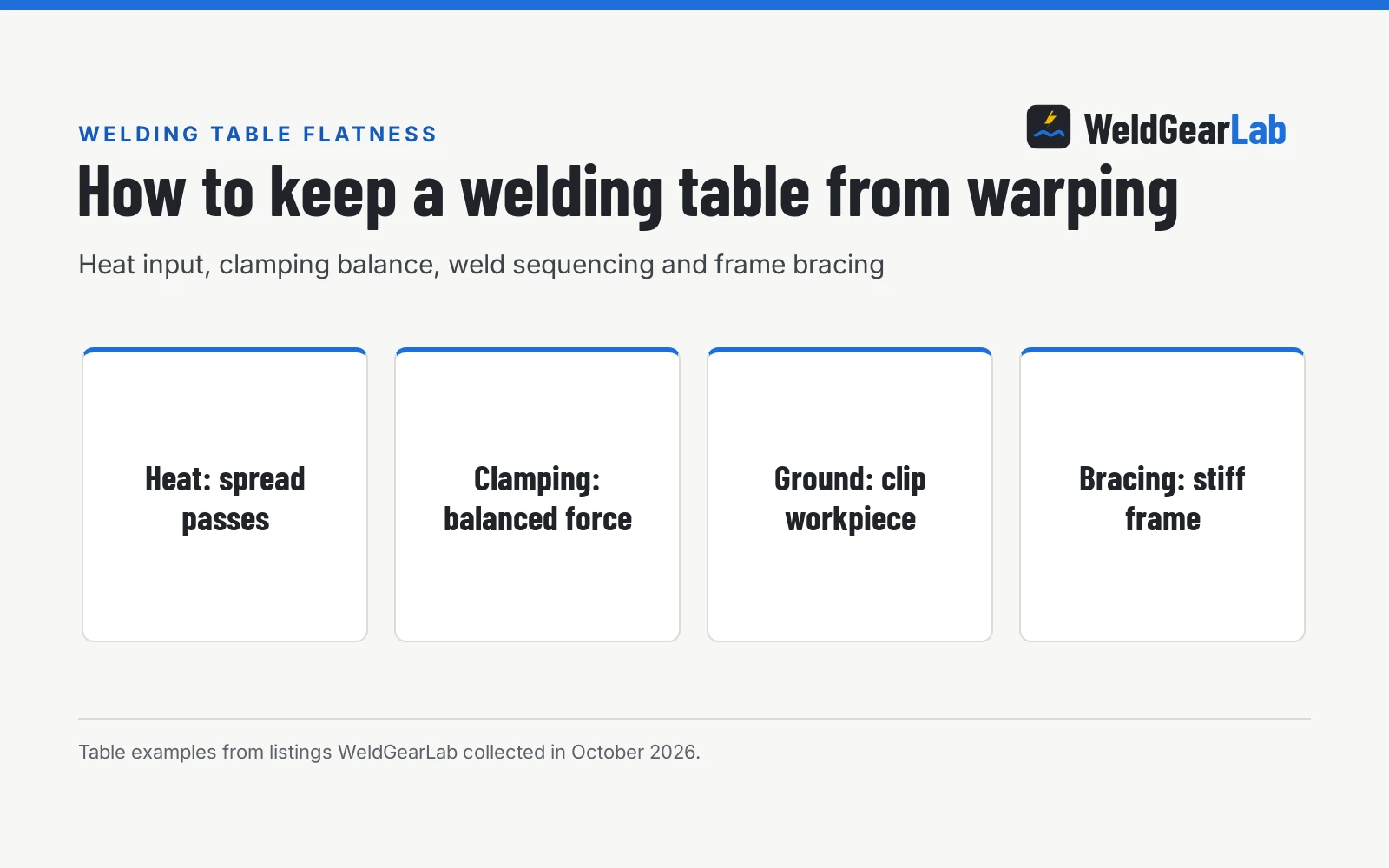
Learning how to keep a welding table from warping begins with controlling heat input into the metal, balancing clamping forces across fixture points, and sequencing weld passes on alternating joints. Welding tables distort when intense localized heat from the arc causes steel plate to expand and contract unevenly against surrounding colder material, or when excessive mechanical clamping force bows thin tabletop panels. By distributing thermal energy through skip welding, attaching ground clamps directly to workpieces rather than table frames, and reinforcing the underside with structural crossbeams, fabricators maintain a true, flat working plane. This guide explains how to keep a welding table from warping across common home shop and metal fabrication projects.
As an Amazon Associate I earn from qualifying purchases. This guide links to our product roundups, where WeldGearLab earns a commission when you buy through links, at no extra cost to you. Read our affiliate disclosure.
How to keep a welding table from warping
Thermal distortion occurs whenever metal heats and cools unevenly. During fabrication, heat from welding arcs and hot workpieces transfers into the tabletop, creating steep temperature gradients between the upper face and the underside of the plate. Because the hotter top surface expands more than the cooler bottom, the plate experiences thermal bowing. Additionally, as cooling weld beads on clamped workpieces contract, they exert powerful tensile forces. If a table lacks sufficient plate thickness or structural underside bracing, those shrinking weld joints can pull the tabletop out of alignment.
Table construction directly affects how a surface responds to thermal load. For example, SGOLAN lists a steel workbench featuring a 0.12-inch thick carbon steel surface supported by 4 sturdy beams and a 1200-pound load capacity. VEVOR lists a workbench measuring 36 by 24 inches with an 800-pound load capacity and 0.63-inch fixture holes spaced 2 inches apart. For portable setups, YESWELDER lists a folding workbench rated at 400 pounds, while Goplus lists folding tables with 400-pound and 1000-pound capacities. A relatively thin top such as a 0.12-inch plate has lower thermal mass than thick plate, allowing heat to concentrate more quickly. Maintaining welding table flatness requires disciplined heat management and rigid mechanical support.
Side by side
| Cast iron fixture platen | Solid steel plate workbench | Portable folding table | |
|---|---|---|---|
| Thermal mass | Very high mass absorbs substantial welding heat | High mass absorbs and spreads arc heat slowly | Low mass concentrates heat quickly in local zones |
| Resistance to thermal warping | High resistance to distortion under repeated thermal cycles | Maintains flat plane under typical shop fabrication | Vulnerable to crowning and heat distortion |
| Clamping force tolerance | Withstands heavy mechanical torque without flexing | Resists strong mechanical clamp force across spans | Can bow if high clamping force is concentrated |
| Underframe structural bracing | Deep ribbing and heavy structural casting ribs | Gusseted beams and heavy crossmembers support plate | Folding legs or lightweight perimeter beams |
| Ground return setup | Best grounded directly at workpiece or via dedicated copper bus | Direct workpiece grounding avoids surface arc marks on plate | Direct workpiece grounding protects thin or coated surfaces |
| Mobility and shop footprint | Stationary foundation for dedicated production spaces | Heavy rolling casters or stationary floor placement | Folds or rolls easily for compact garages and job sites |
| Best suited welding tasks | Precision fixturing, repeat runs, and heavy builds | Structural frames, general assemblies, and repairs | Light repairs, hobby assemblies, and portable jobs |
Tabletop thickness and underframe reinforcement dictate how forgiving a setup is during prolonged fabrication. Heavy plate surfaces absorb and dissipate heat gradually across broad dimensions, while thinner sheet metal tabletops demand disciplined welding sequences to avoid localized heat buildup and plate buckling.
Control heat input and weld sequencing
A primary method to prevent table distortion is managing total heat input into your assembly. Running continuous, heavy weld beads deposits excessive thermal energy into a concentrated zone, causing the joint and underlying table plate to expand unevenly. To maintain dimensional accuracy, fabricators employ skip welding and backstep techniques.
Skip welding distributes thermal load by placing short weld segments across alternating sections of the fabrication rather than welding continuously from edge to edge. By moving between opposite corners of the table, you give previous welds time to cool while keeping average surface temperatures balanced. Backstep welding involves depositing short beads in a direction opposite to overall joint progression. Each segment terminates into cooler, previously deposited metal, equalizing contraction stresses across the seam.
Whenever practical, clamp reusable aluminum or copper backing chill blocks beneath or adjacent to sheet metal joints. Conductive backing bars draw heat away from the welding zone rapidly, reducing the volume of thermal energy absorbed by the table plate.
Balance clamping pressure across fixture points
Clamping holds workpieces firmly against the tabletop, preventing components from shifting during tacking and final passes. However, excessive or improperly placed clamping force can actually induce severe table warping. Mechanical clamps generate substantial leverage, and over-tightening a heavy screw clamp over an unsupported span can deflect thinner steel tops downward.
Distribute clamping points symmetrically around the joint rather than concentrating extreme clamping pressure in a single corner. Fixture tables feature pre-drilled holes to position hold-down clamps and locating pins directly above structural support members. For example, Goplus includes 2 bar clamps on its folding table, while SGOLAN provides 5/8-inch fixture holes for mounting modular tooling. When selecting a dedicated fabrication surface, our best welding table for home shop guide compares portable folding and rolling models designed with built-in fixture holes and support ribs.
Position clamp pads directly above underframe crossmembers whenever possible. Clamping metal over solid framework prevents the top plate from dishing under vertical pressure, ensuring the workpiece stays flat while weld beads contract.
Reinforce table framework and underside bracing
A flat top plate requires a rigid underlying structure to resist the immense mechanical forces generated by cooling welds. Even quality steel plate will sag or bow over time if supported only by perimeter framing. Underside cross bracing, diagonal gussets, and longitudinal ribbing divide the table into smaller unsupported spans, multiplying resistance against thermal warping.
The SGOLAN table, for example, integrates 4 sturdy beams beneath its 36 by 24 inch carbon steel top to maintain rigidity across its 1200-pound load rating. Welded or bolted structural ribs beneath the work plane act as an external skeleton, preventing localized thermal expansion from distorting overall table geometry. Fabricators building or upgrading a shop table frequently add boxed tubing or angle iron grids beneath the surface to eliminate flex. For detailed guidance on structural plate selection, see our resource on how thick should a welding table top be.
Attach the ground clamp directly to the workpiece
A common shop mistake that damages welding tables is clamping the ground lead to the table leg or frame rather than directly to the metal being welded. When welding current must travel through the table frame to reach the arc, current passes through contact points between the workpiece and tabletop plate.
Poor contact resistance causes electrical micro-arcing between the table surface and the workpiece. These micro-arcs generate tiny, intense hot spots that pit the surface and transfer concentrated thermal energy directly into the tabletop plate. Furthermore, many commercial workbenches feature protective finishes. Goplus, for instance, lists galvanized metal tabletops, while Migoda lists nitriding table surfaces. Arcing across coated surfaces damages corrosion resistance and creates erratic arc voltage. Always clamp your ground return directly to clean, bare metal on the workpiece to eliminate stray current across the table.
Manage cooling and post weld stress
How an assembly cools after welding is just as crucial as how heat is applied. Quenching hot welds with water or blasting assemblies with compressed air creates extreme thermal shock. Rapid cooling causes steep temperature gradients that warp both the workpiece and underlying table steel, while promoting brittle microstructure in the weld joint.
Allow fabrications to air-cool naturally at ambient shop temperature. Maintain moderate clamping engagement while the weld puddle solidifies and passes through initial cooling, which keeps parts aligned without applying extreme bending loads to the tabletop. Avoid rapid quenching with water, which causes severe thermal shock and uneven contraction. Once the joint cools below hot working temperatures, relax clamping pressure gradually to allow residual stresses to equalize safely.
Workshop safety and thermal hazards. Metal fabrication involves intense arc rays, spatter, and radiant heat. Clear sawdust, oily rags, and solvent containers away from the welding table before striking an arc. Wear flame-resistant welding gloves, leather sleeves, and safety glasses under your welding hood. When welding on or near galvanized surfaces, such as galvanized tabletops listed on select portable workbenches, maintain active mechanical ventilation or work in well-ventilated areas to avoid breathing zinc oxide fumes. Always ensure work leads and ground clamps remain firmly connected during operation.
Frequently Asked Questions
Can a warped welding table top be flattened again?
Mild thermal warping on steel plate can sometimes be corrected through flame straightening or mechanical pressing. Applying controlled torch heat to the high side of a crowned surface causes localized expansion that upsets the steel, shrinking and pulling the surface back toward flat as it cools. However, thin sheet metal tops that have buckled or stretched from severe overheating are difficult to reshape completely, making underside structural reinforcement or plate replacement more practical.
Does clamping a workpiece too tightly warp the table?
Excessive clamping pressure frequently distorts unsupported areas of a welding table. Heavy mechanical clamps generate tremendous vertical leverage that can bend thin steel plate downward between framework beams. Symmetrical clamping with moderate holding pressure keeps workpieces aligned without deflecting the underlying table plane.
Why should the ground clamp attach directly to the workpiece?
Clamping your ground lead directly to the workpiece prevents current from arcing across the table surface. When ground current flows through the table plate, poor electrical contact produces micro-arcs that pit the finish and create localized hot spots. Direct clamping preserves table flatness, protects surface coatings, and provides a stable welding arc.
How does table top thickness prevent heat distortion?
Thicker steel plate provides substantially greater thermal mass and mechanical stiffness than thin sheet metal. Greater mass absorbs and distributes arc heat across a broader area, preventing sharp temperature spikes in localized zones. Rigid plate also resists the strong tensile contraction forces exerted as cooling weld beads shrink.
Should you weld directly on a portable folding table?
Portable folding tables handle tacking, assembly, and light fabrication when used within their published load limits. YESWELDER lists a 400-pound load capacity on its folding workbench, while Goplus lists folding models with ratings of 400 pounds and 1000 pounds. Lighter portable tables benefit from disciplined skip welding and controlled heat input to prevent localized thermal distortion across the tabletop.
Related: best welding table height for standing work, how thick should a welding table top be, and the welding tables and carts hub. Also see our guide on how to build a welding table.
About the author
WeldGearLab Editorial is the editorial team behind WeldGearLab. We research product listings, specifications, safety listings and warranty terms, score every pick with the published Gear Score method, and correct errors when readers report them. We do not run our own shop trials; see How We Pick for exactly how picks are made.