Welding Duty Cycle Explained: What 30% at 90A Really Means
What a welder duty cycle rating means, how to turn it into minutes of welding, why two ratings are often not comparable, and how rarely listings state one.
 By WeldGearLab Editorial
Updated October 4, 2026
By WeldGearLab Editorial
Updated October 4, 2026
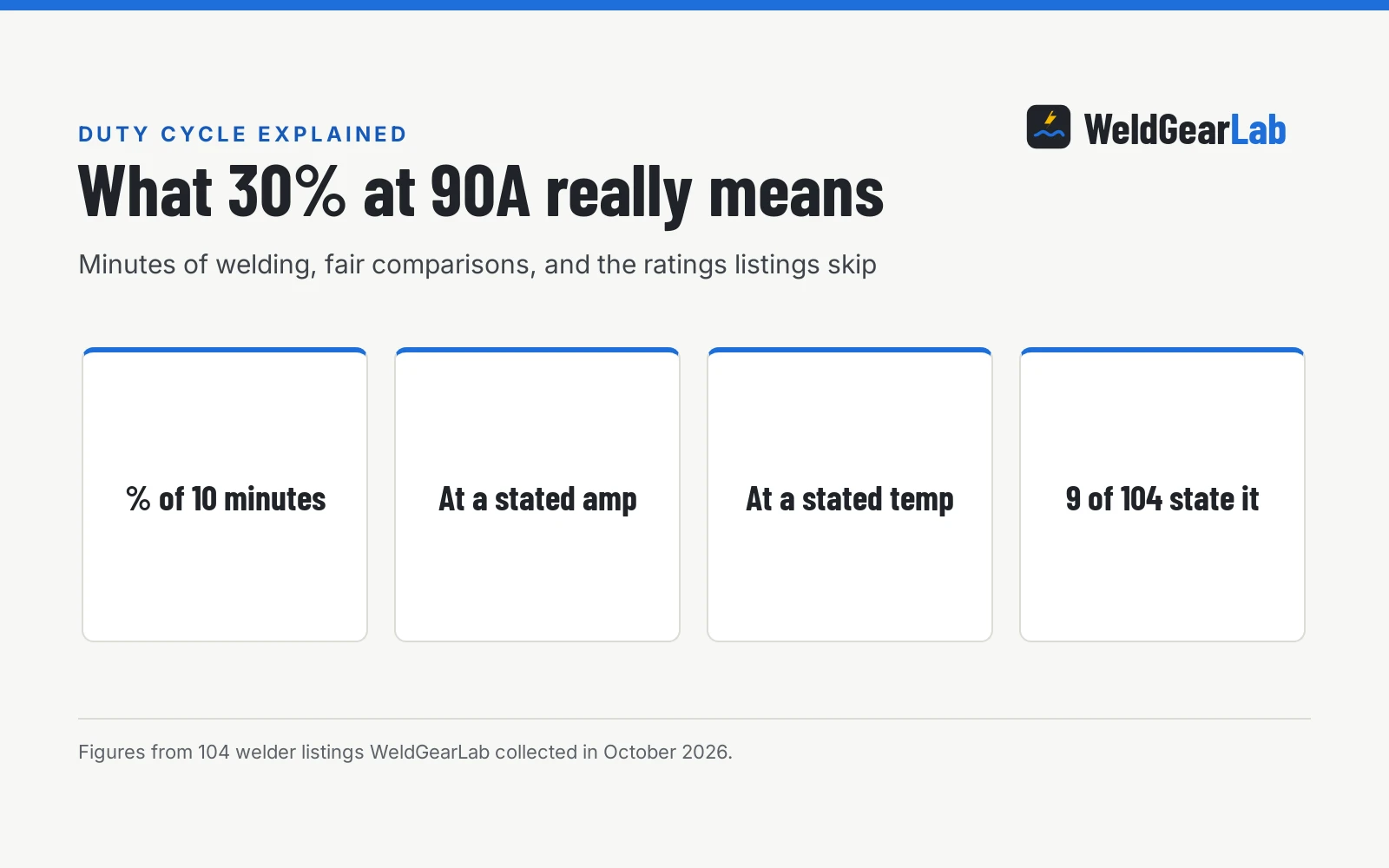
Duty cycle is the welder spec that matters most for long seams and gets published least. It tells you how long a machine can weld at a given output before it has to stop and cool. This guide explains how to read the rating, turn it into minutes, and compare two machines fairly, using the ratings we found across 104 welder listings collected for our guides in October 2026.
This guide links to our product roundups, where WeldGearLab earns a commission when you buy through links, at no extra cost to you. Read our affiliate disclosure.
What duty cycle means
A duty cycle rating has two parts: a percentage and an amperage. The percentage is the share of a 10 minute period the machine can weld at that amperage. The rest of the 10 minutes it needs to cool, usually with the fan running.
- 30% at 90A: about 3 minutes of welding at 90A, then about 7 minutes to cool.
- 60% at 160A: about 6 minutes of welding at 160A, then about 4 minutes to cool.
- 100% at a given amperage: the machine can weld continuously at that setting.
The 10 minute basis comes from the IEC 60974-1 standard for arc welding power sources, which rates duty cycle at an ambient temperature of 40 C, or 104 F. Some listings state the test temperature, as LOTOS does for its LTP8500 plasma cutter; most do not.
A percentage without an amperage means nothing
Many listings say 60% duty cycle and stop there. Without an amperage, the figure cannot be compared with anything, because every machine has a higher duty cycle at lower current. In our sample, 9 of the 104 welder listings stated a duty cycle with an amperage, and several more gave a bare percentage. We treat a bare percentage as not stated when we score machines.
Ratings we found
A selection of the duty cycles stated with an amperage in the listings we reviewed, plus one plasma cutter for comparison. They are manufacturer ratings, collected 4 October 2026.
| Machine (as listed) | Stated duty cycle | Welding time per 10 min | Input stated |
|---|---|---|---|
| Eastwood MIG 180 | 30% at 90A | About 3 minutes | 120V |
| Lincoln Weld-Pak 90i FC (kit listing) | 30% at 90A | About 3 minutes | 120V |
| Lincoln Weld-Pak 225i | 30% at 225A | About 3 minutes | 230V |
| Weldpro 200A AC/DC TIG | 40% at 200A | About 4 minutes | Not stated |
| TOOLIOM MIG-180 PRO | 60% at 180A | About 6 minutes | Not stated |
| WELDPRO MIG160 | 60% at 160A | About 6 minutes | 220V |
| LOTOS LTP8500 plasma | 60% at 63A, 104 F | About 6 minutes | Not stated |
Two things stand out. The ratings are taken at very different amperages, from 63A to 225A in this table, so the percentages alone do not rank the machines. And several do not say which input voltage the rating applies to, which matters on dual voltage machines.
How to compare two ratings fairly
To compare machines, you need their ratings at the same amperage. Manufacturers rarely publish that, so welders use a rule of thumb: heating in the machine rises with the square of the current, so duty cycle falls roughly with the square of the amperage. As a formula, the duty cycle at a new current is about the rated duty cycle times (rated amps divided by new amps) squared, capped at 100%.
Worked example: a machine rated 30% at 90A would be roughly 30 x (90 / 70) squared, or about 50%, at 70A. Treat this as an estimate for comparison only. The manual’s duty cycle chart, if it has one, is the figure to trust, and real machines vary with fan design and the parts that heat first.
What happens when you exceed it
Modern inverter welders have thermal overload protection. When internal parts get too hot, the machine stops the arc, usually shows a warning light or error code, and runs its fan until it cools. You lose time, not usually the machine. Repeatedly forcing a machine past its rating in a hot shop is still hard on components, which is one reason a stated warranty matters.
Does duty cycle matter for you?
- Tacking, brackets, short repairs: rarely. You stop to reposition long before the limit.
- Fence runs, trailer frames, long seams: yes. A low rating means waiting mid seam.
- Thick plate at high amperage: very much. That is where the rating applies, and where 120V machines run out first.
- Hot garages in summer: yes. Ratings assume 104 F at most, and a closed garage can exceed that.
What to ask the seller
If a listing gives no duty cycle, or gives a bare percentage, ask for the rated duty cycle at a stated amperage, the input voltage it applies to, and the ambient temperature. A brand that can answer all three usually publishes a manual with a full rating chart.
For machines in our guides that do state a rating, see the best MIG welder under $1000, best stick welder for farm use and best welder for beginners.
Heat and the machine. Keep the welder’s vents clear and out of direct spatter, leave space around it for airflow, and let it cool with the power on so the fan can run. Never cover a hot machine. See the OSHA welding overview and our Safety Disclaimer.
Frequently Asked Questions
What is a good duty cycle for a home welder?
For hobby and repair work, a rating around 20% to 30% at the amperage you use most is usually workable, because home welds are short. For long seams, look for 60% or more at your working amperage.
Is 60% duty cycle good?
It depends entirely on the amperage. 60% at 160A means about 6 minutes of welding in every 10 at 160A, which is a strong rating for a home machine. 60% with no amperage tells you nothing.
Is duty cycle the same on 120V and 240V?
Not necessarily. Machines often reach a given amperage more easily on 240V. Several listings in our sample did not say which input their rating applied to, so ask before relying on it.
What happens if I exceed the duty cycle?
Inverter welders stop the arc and cool down with the fan running, then let you continue. Repeated overheating can shorten the life of components, so plan breaks on long jobs.
Do plasma cutters have a duty cycle?
Yes, rated the same way. In our plasma sample only 2 of 14 listings gave one with an amperage, including LOTOS at 60% at 63A at 104 F; see our best plasma cutter under $1000.
Related: how to choose a MIG welder, 120V vs 240V welder, and the welders hub.
About the author
WeldGearLab Editorial is the editorial team behind WeldGearLab. We research product listings, specifications, safety listings and warranty terms, score every pick with the published Gear Score method, and correct errors when readers report them. We do not run shop tests; see How We Pick for exactly how picks are made.