Best Welding Fume Extractor for Home Garage (2026)
Five benchtop fume extractors for a home garage, compared on airflow, filtration stages, capture distance, noise, housing materials, and stated warranty terms.
 By WeldGearLab Editorial
Updated October 9, 2026
By WeldGearLab Editorial
Updated October 9, 2026
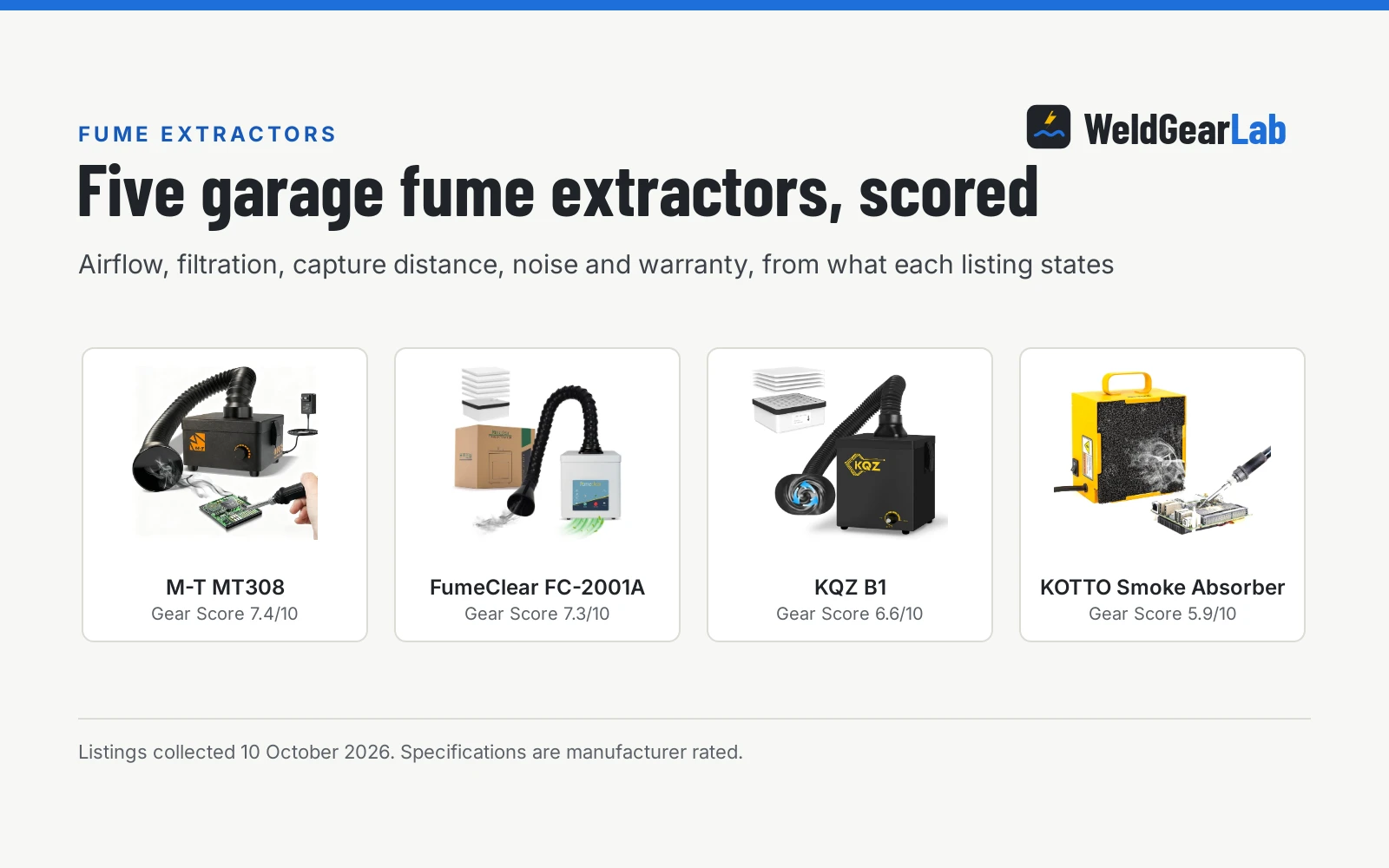
Choosing the best welding fume extractor for home garage projects requires matching airflow volume, filtration media, and capture reach to your workspace. For small garage shops, compact benchtop units with flexible ducting and multi-stage filtration capture fumes and particulate right at the joint before smoke disperses into the room. This guide compares five portable extractors using only checkable specifications published on their Amazon listings.
As an Amazon Associate I earn from qualifying purchases. WeldGearLab earns a commission when you buy through links on this page, at no extra cost to you. Read our affiliate disclosure.
Quick picks
- Best Overall M-T MT308: An 80W motor delivering 168 m³/h airflow, triple-layer H13 HEPA and activated carbon filtration, a 360-degree adjustable hose, and the only stated warranty here at 3 years. Check price on Amazon
- Highest Airflow FumeClear FC-2001A: Delivers 70 to 106 CFM (120 to 180 m³/h) from a brushless motor, with an all-metal housing, True H13 HEPA, and activated carbon rated at 600 to 800 mg/g iodine value. Check price on Amazon
- Best Value Gooseneck KQZ B1: A metal-body extractor with 168 m³/h airflow, a 66 mm flexible gooseneck tube, H13 HEPA filtration, and 5 included pre-filters. Check price on Amazon
- Most Compact Fan KOTTO Smoke Absorber: A 2.2-pound desktop fan with a 3000 RPM motor, 0.4-inch activated carbon filter, and rubber mounting feet. Check price on Amazon
Compare the picks
| Model | Gear Score | Airflow | Filtration | Hose / Duct | Power | Housing | Warranty |
|---|---|---|---|---|---|---|---|
| M-T MT308 | 7.4/10 | 168 m³/h | Triple-layer H13 HEPA, carbon | 360° hose (7-25 in) | 80W, 100-240V | Metal | 3 years |
| FumeClear FC-2001A | 7.3/10 | 70-106 CFM (120-180 m³/h) | True H13 HEPA, carbon | Semi-rigid bamboo pipe, hood | Brushless, 100-240V | Metal | Not stated |
| KQZ B1 | 6.6/10 | 168 m³/h | H13 HEPA, carbon | 66 mm gooseneck tube, hood | 110-220V | Metal | Not stated |
| KOTTO Smoke Absorber | 5.9/10 | Not stated (3000 RPM) | 0.4 in activated carbon | None (fan box) | 30W, 120V | Plastic and rubber | Not stated |
| ToolBud TB-SAS-DY-01 | 5.5/10 | Not stated | Activated carbon | None (magnetic flaps) | AC (wattage not stated) | Iron | Not stated |
Specifications are manufacturer rated, as published on each listing and collected 9 October 2026.
The picks
| Award | Product | Gear Score About the Gear ScoreThe Gear Score runs from 0 to 10 and weighs performance (35%), build (25%), value (25%), safety (10%, where it applies) and warranty (5%), using only what the manufacturer and the listing publish. How we pick › | |
|---|---|---|---|
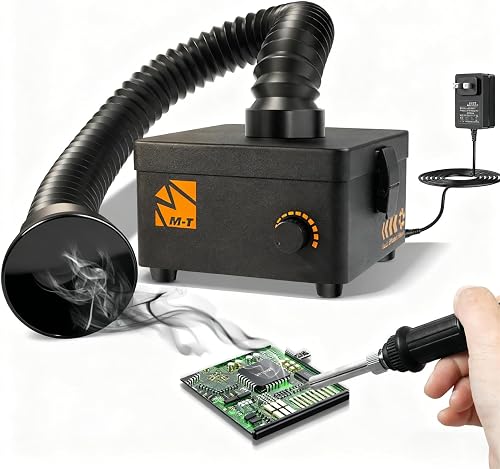 M-T Solder Fume Extractor
|
7.4/10 | Check price on Amazon | |
 FumeClear FC-2001A Solder Fume Extractor
|
7.3/10 | Check price on Amazon | |
 KQZ B1 Solder Fume Extractor 168m³/h Smoke
|
6.6/10 | Check price on Amazon | |
 KOTTO Solder Smoke Absorber Remover Fume Extractor
|
5.9/10 | Check price on Amazon | |
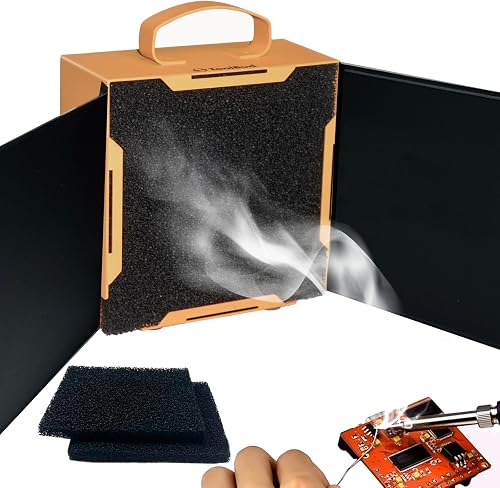 Upgraded ToolBud Solder Fume Extractor
|
5.5/10 | Check price on Amazon |
M-T Solder Fume Extractor
An 80W extractor with 168 m³/h airflow, triple-layer H13 HEPA and activated carbon filtration, a 360-degree adjustable hose, and a stated 3-year warranty.
Pros
- Rated 168 m³/h airflow with a 15,000 RPM motor and 3-speed adjustment
- Triple-layer filtration combining high-density fiber, carbon cotton, H13 HEPA, and activated carbon
- 360-degree adjustable extraction hose extending from 7 to 25 inches
- Backed by a stated 3-year manufacturer warranty
Cons
- Listing notes noise reaches up to 60 dB at higher speeds
- Bullets specify 100 to 240V adapter while the spec table lists 120 volts
- Effective capture distance is limited to within 5 inches of the source
- No electrical safety certification such as UL or ETL is stated
FumeClear FC-2001A Solder Fume Extractor
A 9.03-pound all-metal fume extractor offering 70 to 106 CFM suction, a brushless motor, True H13 HEPA filtration, and high-iodine activated carbon.
Pros
- Highest stated suction here at 70 to 106 CFM (120 to 180 m³/h)
- High-efficiency True H13 HEPA plus activated carbon with 600 to 800 mg/g iodine value
- Brushless motor with 3-speed control and an effective range up to 15 cm
- All-metal housing with semi-rigid bamboo pipe, hood, and 5 included pre-filters
Cons
- No manufacturer warranty term is stated in the listing
- Heaviest unit in the group at 9.03 pounds
- Voltage is listed as 100 to 240V in the text but 110 volts in the spec table
- No electrical safety certification such as UL or ETL is stated
KQZ B1 Solder Fume Extractor 168m³/h Smoke
A 4-pound metal desktop extractor equipped with a 168 m³/h centrifugal motor, H13 HEPA and coal-based carbon filtration, and a 66 mm gooseneck tube.
Pros
- Centrifugal motor rated at 168 m³/h airflow
- Dual-layer filtration with 9 mm thick pre-filter and H13 HEPA coal-based carbon cartridge
- 66 mm 360-degree adjustable gooseneck hose and extraction hood
- Includes 5 pre-filters, efficiency filter, tube, and hood in the box
Cons
- No manufacturer warranty term is stated in the listing
- Only single-speed one-touch operation, lacking variable speed control
- Listing indicates 110 to 220V wide voltage while the spec table states DC power source
- No electrical safety certification such as UL or ETL is stated
KOTTO Solder Smoke Absorber Remover Fume Extractor
A lightweight 2.2-pound desktop fan utilizing a 3000 RPM motor and a 0.4-inch activated carbon filter to absorb fumes from 5 to 6 inches away.
Pros
- High-speed 3000 RPM fan rated for low-noise operation
- 0.4-inch thick activated carbon filter captures smoke and gases
- Equipped with 4 heavy-duty rubber feet and a built-in carrying handle
- Includes one spare smoke trap replacement filter
Cons
- No manufacturer warranty term is stated, only a 30-day return period
- Contradiction on voltage: bullets state 120V while the spec table lists 220V
- Wattage contradicts between 30W in bullets and 30.5W in the spec table
- Lacks ducting or a flexible hose, relying purely on open face airflow
Upgraded ToolBud Solder Fume Extractor
A compact 2.23-pound iron-cased desktop extractor featuring two detachable magnetic flaps designed to widen smoke capture coverage.
Pros
- Two detachable magnetic wings to expand smoke capture coverage
- Sturdy iron housing construction
- Compact, lightweight build at 2.23 pounds
- Includes 2 carbon filters in the package
Cons
- No manufacturer warranty term is stated in the listing
- Airflow rate, motor RPM, and capture distance are not stated
- Spec table omits electrical voltage and wattage ratings
- Uses carbon filter pads without an H13 HEPA stage
How we scored them
Each unit is scored out of 100 on performance, build, value, safety listing and warranty, with the weights published on our How We Pick method page. None of the five extractors state an electrical safety listing like UL or ETL, so every unit scores zero on that criterion; the ranking comes from the other four.
| Product | Gear Score | Perf. /35 | Build /25 | Value /25 | Safety /10 | Warranty /5 |
|---|---|---|---|---|---|---|
| M-T MT308 | 7.4 | 28 | 21 | 21 | 0 | 4 |
| FumeClear FC-2001A | 7.3 | 30 | 22 | 20 | 0 | 0 |
| KQZ B1 | 6.6 | 26 | 20 | 20 | 0 | 0 |
| KOTTO Smoke Absorber | 5.9 | 20 | 19 | 20 | 0 | 0 |
| ToolBud TB-SAS-DY-01 | 5.5 | 18 | 19 | 19 | 0 | 0 |
Buying guide: best welding fume extractor for home garage
Airflow and capture volume
Airflow determines how effectively an extractor pulls fumes away from your breathing area. The units compared here range from basic fans without a published airflow figure to high-output extractors stating 168 m³/h, and up to 70 to 106 CFM (120 to 180 m³/h) on the FUMECLEAR. For light benchtop welding or soldering in a home garage, units that specify airflow give you a measurable benchmark for source capture.
HEPA versus carbon filtration
Welding and soldering produce both solid particulate and gaseous odors. A basic 0.4-inch carbon filter, such as the pad on the KOTTO, absorbs odors and chemical vapors but allows fine dust through. Units like the M-T, KQZ, and FUMECLEAR combine activated carbon with True H13 HEPA filters to capture fine particles down to 0.3 micrometers. For metalworking fumes, a multi-stage system with pre-filters and HEPA provides far more complete particulate removal.
Ducting and capture distance
Effective fume collection depends heavily on how close the intake sits to the workpiece. Listings that specify capture distance indicate effective ranges between 5 inches and 15 cm. Ducted models with 360-degree adjustable hoses, such as the 7 to 25 inch tube on the M-T or the 66 mm gooseneck on the KQZ, allow you to position the hood right above your joint. Flat desktop fans lack ducting and require placing the entire machine 5 to 6 inches from the work.
Workshop noise levels
High-speed blower motors create audible noise in a confined home shop. The M-T listing notes sound levels under 60 dB across its 3-speed settings, powered by a 15,000 RPM motor. Extractors with variable speed settings allow you to dial back fan speed when working on lighter tasks to keep the garage quieter.
Electrical supply and voltage
Home garages in the United States operate primarily on standard 120V circuits. Check the listing details carefully, as several products show voltage discrepancies between their bullet points and specification tables. For example, KOTTO notes 120V in its bullets but lists 220V in its spec table, while M-T and FUMECLEAR feature universal 100 to 240V power adapters designed to handle voltage variations.
Use as directed. Source capture equipment helps pull fumes and particulate away from your breathing zone, but it does not replace adequate workshop ventilation. According to OSHA and NIOSH guidance on welding fumes and ventilation, welders should position intake hoods close to the weld pool and exhaust or filter air before it recirculates. Always wear appropriate personal protection as outlined in our welding safety gear checklist for beginners, and refer to our Safety Disclaimer.
Frequently Asked Questions
What is the best welding fume extractor for home garage work?
The M-T MT308 earns our top Gear Score because it combines a stated 168 m³/h airflow, triple-layer H13 HEPA and carbon filtration, and an adjustable 360-degree hose. It is also the only model in this comparison backed by a stated 3-year manufacturer warranty. The FUMECLEAR FC-2001A offers the highest stated airflow at 70 to 106 CFM, making it another capable option for bench fabrication.
How close should a fume extractor hood be to the weld?
Manufacturer listings for these benchtop extractors indicate effective capture distances between 5 inches and 15 cm. Positioning the hood within that range captures smoke before it rises into your breathing zone or dissipates into the garage. Moving the intake further away allows thermal plumes to escape the intake airflow.
Do I need an H13 HEPA filter for welding fumes?
An H13 HEPA filter captures fine solid particulate down to 0.3 micrometers, which standard activated carbon pads cannot trap. Carbon excels at adsorbing gases, flux odors, and chemical vapors, but welding generates airborne metallic oxides that require mechanical HEPA filtration. Choosing a multi-stage unit that includes both pre-filters and HEPA provides balanced air cleaning.
Can a compact benchtop extractor handle MIG or TIG welding?
These portable extractors are designed for localized benchtop source capture on small projects, light welding, and soldering. They pull smoke directly from a single joint but do not exchange the total air volume of an entire garage. For larger fabrication or production welding, dedicated high-volume exhaust systems or ducted shop ventilation are recommended.
Does a fume extractor replace a welding respirator?
A source-capture extractor does not eliminate the need for personal respiratory protection when welding in confined or enclosed spaces. Extractors pull fumes away from the workpiece, while a fitted respirator provides direct respiratory filtration for the welder. You can read more about fitted protection in our guide to the best respirator for welding fumes.
Related: best respirator for welding fumes, how to weld galvanized steel safely, how to set up a welding area in a home garage, and the welding safety gear hub. Also see our best welding respirator for under a helmet. Also see our best welding blanket for home garage.
About the author
WeldGearLab Editorial is the editorial team behind WeldGearLab. We research product listings, specifications, safety listings and warranty terms, score every pick with the published Gear Score method, and correct errors when readers report them. We do not run our own shop trials; see How We Pick for exactly how picks are made.