True Color vs Regular Welding Lens: Which One Should You Buy?
True color and regular green welding lenses protect eyes equally well, but true color delivers a clearer view of the weld puddle with realistic arc colors.
 By WeldGearLab Editorial
Updated October 9, 2026
By WeldGearLab Editorial
Updated October 9, 2026
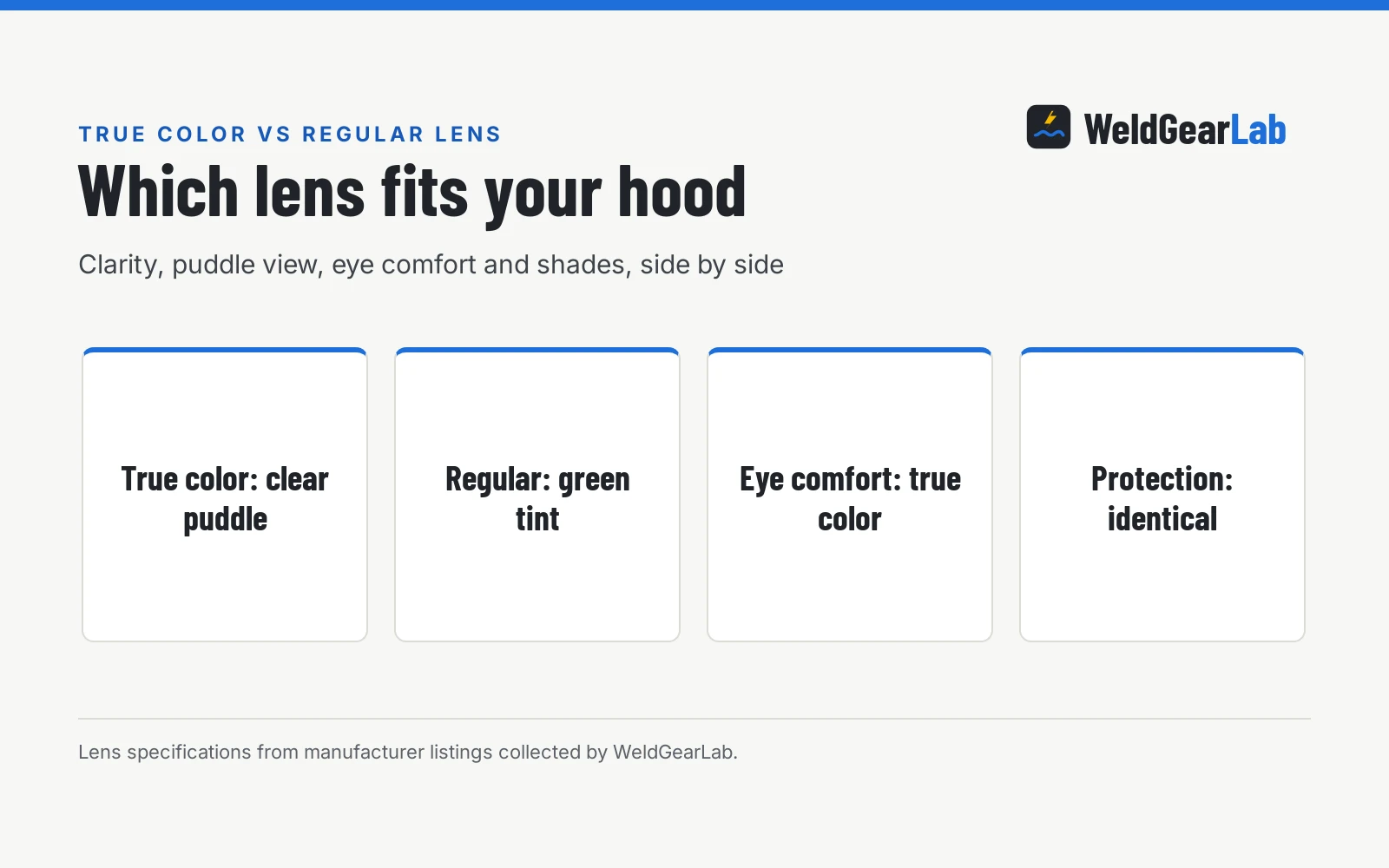
When choosing between a true color vs regular welding lens, a true color lens is the better buy for almost every welder because it provides a realistic view of the weld puddle without the harsh lime green tint of traditional glass. Both lens styles provide identical ultraviolet and infrared radiation protection, but true color technology allows you to see puddle edges, seam alignment, and heat tint clearly while reducing eye fatigue. If you weld frequently or work on precise joint fitups, upgrading to a true color filter is worth the small cost premium, while a standard green lens remains a serviceable, low-cost option for rough farm repairs. This guide explains how the optical technologies differ, compares their practical strengths, and helps you decide which filter fits your hood.
As an Amazon Associate I earn from qualifying purchases. This guide links to our product roundups, where WeldGearLab earns a commission when you buy through links, at no extra cost to you. Read our affiliate disclosure.
The difference in one paragraph
Traditional welding lenses rely on green-tinted passive glass or basic liquid crystal filters that absorb light across most of the visible spectrum and transmit primarily a narrow lime green band. This heavy green cast shields your eyes from glare but flattens contrast between the molten puddle, floating slag, and surrounding parent metal. Modern true color lenses use broadband optical coatings and multi-layer liquid crystal technology to pass a balanced spectrum of visible light. The result is a natural, clear view with crisp contrast, allowing you to see actual arc hues, puddle boundaries, and glowing heat gradients without sacrificing radiation safety.
True color vs regular welding lens: Side by side
| True Color Lens | Regular Green Lens | Verdict | |
|---|---|---|---|
| View color | Natural arc and puddle color with neutral or pale blue tint | Monochrome lime green tint | True color |
| Puddle clarity | Clear view of puddle boundary, liquid pool, and arc cone | Puddle, slag, and base metal blend together in green hue | True color |
| Light state view | Brighter, natural view for workpiece setup and torch positioning | Darker green light state or fixed dark shade between welds | True color |
| Optical technology | Broadband optical coatings reduce green flare and balance spectrum | Traditional green infrared and ultraviolet absorbing glass | True color |
| Eye strain | Reduced visual fatigue during extended shop fabrication sessions | Eye fatigue from staring into high-glare monochrome tint | True color |
| UV and IR protection | Full ultraviolet and infrared radiation protection at all times | Full ultraviolet and infrared radiation protection at all times | Tie (identical) |
| Defect detection | Easier to spot undercut, seam alignment, and puddle contamination | Harder to distinguish puddle edges from surrounding molten slag | True color |
| Replacement cost | Higher replacement filter cartridge cost | Lower cost replacement filter plates | Regular lens |
Both lens types deliver identical protection against harmful ultraviolet and infrared radiation; the difference lies strictly in visible light transmission and contrast. Always ensure your auto-darkening cartridge or passive filter plate is seated properly behind an undamaged clear cover lens.
When a true color lens is the better choice
- Precision joint fabrication and TIG work. When a lens has suitable sensor ratings, controlling a small puddle benefits from clear visibility of the joint seam and the arc cone. Filtering out lime green glare makes it much easier to guide filler rod smoothly without accidental dipping.
- Reading heat tint and puddle consistency. True color optics let you monitor heat accumulation in the base plate and distinguish liquid weld metal from swirling slag before flaws become trapped.
- Reducing eye fatigue during long sessions. Staring through a high-glare green filter strains optical muscles over full work shifts. A neutral or cool blue view feels more natural and eases eye strain.
- Faster tacking and setup. Modern true color cartridges offer bright light states, allowing you to align parts, inspect fitup, and position your torch without constantly flipping your hood up and down.
For example, Tefuawe lists a light state rating of 2.5 on its 2×4 1/4 inch auto-darkening replacement cartridge, while Ridge Products rates its King 2.0 lens down to 5 Amps for precision TIG work. Our best true color welding helmet guide reviews full hoods built with wide-view true color optics.
When a regular welding lens is the better choice
- Rough outdoor stick welding. When burning stick electrodes on heavy farm equipment, structural pipe, or rusty trailers, maximum visual clarity is less critical than simple, rugged arc shielding.
- Tight budgets and spare hoods. Traditional passive green filter plates cost very little, making them practical, durable spares to keep in a toolbox for field repairs.
- Harsh environments with extreme spatter. In heavy flux-cored welding or overhead gouging with severe spatter, low-cost replacement filters avoid the risk of ruining a premium high-clarity cartridge.
- Familiarity for veteran welders. Some experienced fabricators spent decades looking at a green puddle and prefer the visual familiarity of a traditional shade.
Our best fixed welding lens guide covers traditional passive filter plates and durable glass options for standard hoods.
How to spot true color specs on a welding lens
Not every auto-darkening filter delivers genuine true color performance. When shopping for replacement cartridges or new hoods, look for these specific indicators in the manufacturer specifications:
- Broadband optical coatings or true color designations. Manufacturers describe these filters under various trade names, highlighting reduced green tint and natural arc color. For instance, TrueArc lists high-definition true color filtering on its shade 10 replacement lens designed for 2″ x 4-1/4″ hoods.
- Optical clarity ratings. Top-tier auto-darkening filters publish European standard optical clarity scores. TRQWH specifies a 1/1/1/1 optical clarity rating alongside 4 arc sensors on its 4.49 by 5.24 inch automatic cartridge.
- Switching speed. Quality auto-darkening lenses react in fractions of a millisecond. Preruner lists an auto-darkening response speed of 0.01 ms on its slim 0.2-inch Core Series lens, while TrueArc lists reaction in under 0.5 milliseconds.
- Shade adjustment range. Single-shade auto-darkening cartridges stay at a set darkness such as shade 10 or shade 11, while adjustable models offer variable ranges such as shade 5-13 for different processes.
Choosing the right shade for your welding process
Whether you choose a true color or regular green lens, selecting the proper dark shade protects your retinas from arc glare. A lens that is too light causes squinting and eye fatigue, while a lens that is too dark obscures the puddle and causes you to wander off seam.
For wire feed welding, our guide on what shade for MIG welding explains how to match lens darkness to your operating amperage and shielding gas. Many auto-darkening cartridges provide a variable dark state across shade 9, shade 10, shade 11, or up to shade 13, allowing you to tailor darkness as amperage increases.
Arc sensor performance is equally critical on low-current processes. For example, Ridge Products cautions that its Heir 1.0 lens is not recommended below 90A on TIG welding because it can lose detection and flash the welder, whereas its King 2.0 model is rated down to 5 Amps for low-current TIG work.
Is a true color welding lens worth it?
For most welders, upgrading to a true color lens is well worth the modest investment. Seeing the puddle in natural color allows you to control the bead shape more precisely, spot defects before they solidify, and finish longer welding sessions with noticeably less eye strain. Even if you already own a favorite pancake or pipeliner hood that uses standard 2×4.25 drop-in cartridges, you can swap in an auto-darkening true color filter plate without replacing your entire helmet shell. For complete hood recommendations, browse our best welding helmet for MIG welding roundup.
Eye safety and arc radiation. Both true color and traditional green welding filters incorporate ultraviolet and infrared blocking layers that protect your eyes from arc radiation, and auto-darkening models maintain UV and IR protection even in their light state. When using an auto-darkening cartridge, never strike an arc without confirming that your sensors are unobstructed and that your lens is set to the correct shade for your process. Always wear ANSI Z87.1 approved safety glasses with side shields beneath your welding helmet to protect against flying spatter and grinding debris. Check the safety standards and proper fit on our welding safety gear checklist for beginners.
Frequently Asked Questions
Does a true color lens protect against arc eye as well as a green lens?
Yes. Both true color and traditional green lenses provide identical protection against harmful ultraviolet and infrared radiation. The optical coatings that block UV and IR wavelengths operate independently of the visible light tint. The true color designation only affects visible spectrum balance, allowing you to see natural colors without reducing eye safety.
Can I install a true color auto-darkening lens into an older welding helmet?
Most standard welding hoods, including classic pipeliner and pancake designs, accept drop-in cartridges measuring 2″ x 4 1/4″. Manufacturers offer slim true color auto-darkening filters engineered specifically to slip into these standard retaining brackets. Check the thickness of your hood’s lens slot to confirm a snug fit before purchasing a replacement cartridge.
Why do traditional welding lenses look lime green?
Traditional welding glass filters light using green-tinted formulations because human eyes perceive green wavelengths readily in high-contrast environments. While effective at reducing overall glare, this monochrome cast eliminates color contrast in the molten puddle. True color filters overcome this limitation by using modern optical bandpass coatings that transmit natural blues, yellows, and reds.
How do I know what optical clarity rating a lens has?
Manufacturers mark optical clarity according to EN379 standards using a standardized score such as 1/1/1/1. These ratings measure optical distortion, light diffusion, shade consistency across the lens, and angle dependence. The top score in each class represents high optical clarity with minimal blurriness or visual distortion.
Is a true color lens suitable for low-amperage TIG welding?
Yes, provided the cartridge features sensitive arc sensors rated for low-current detection. For example, Ridge Products rates its King 2.0 lens down to 5 Amps for stable TIG arc detection. If a lens lacks sensitive sensors, low-current arcs may fail to trigger the dark state, causing the filter to flicker during delicate welds.
Related: best true color welding helmet, best fixed welding lens, best welding helmet for MIG welding, and the welding helmets hub. Also see our guide on welding helmet optical clarity rating explained.
About the author
WeldGearLab Editorial is the editorial team behind WeldGearLab. We research product listings, specifications, safety listings and warranty terms, score every pick with the published Gear Score method, and correct errors when readers report them. We do not run our own shop trials; see How We Pick for exactly how picks are made.