Do You Need a Welding Helmet for Plasma Cutting?
A welding helmet is not always mandatory for low-amperage plasma cutting, but full face protection or a hood with cut mode is essential against sparks and arc radiation.
 By WeldGearLab Editorial
Updated October 9, 2026
By WeldGearLab Editorial
Updated October 9, 2026
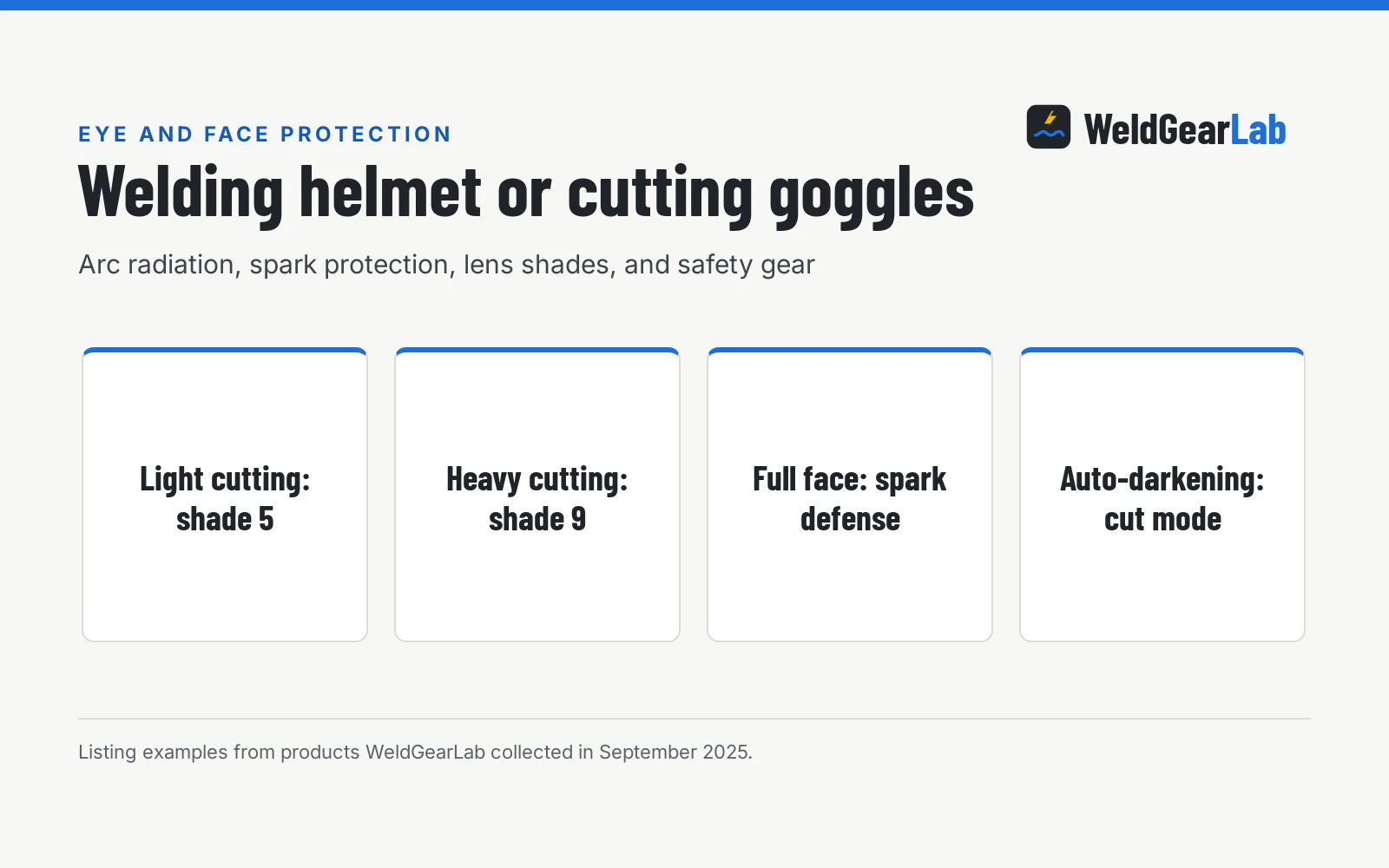
You do not always need a full welding helmet for handheld plasma cutting, but you do need approved eye protection with the correct shade filter. If you wonder do you need a welding helmet for plasma cutting, the answer depends on your amperage, whether you are piercing or gouging, and how much flying slag your cut produces. For low-current cutting on thin sheet metal, shade 5 safety glasses with side shields are common, while heavy cutting and piercing demand a full welding helmet or face shield to protect your skin from arc radiation and hot dross. This guide compares these protection options for home, farm, and hobby work, and explains how to pick the right protection for your shop.
As an Amazon Associate I earn from qualifying purchases. This guide links to our product roundups, where WeldGearLab earns a commission when you buy through links, at no extra cost to you. Read our affiliate disclosure.
The difference in one paragraph
An electric plasma arc produces intense visible light, ultraviolet radiation, and infrared energy alongside a shower of high-velocity molten metal dross. A standard welding helmet encloses your entire face, forehead, ears, and neck beneath a protective shell, shielding skin from arc burns and deflected sparks while housing an auto-darkening cartridge or fixed filter. Cutting glasses protect only the direct line of sight with dark tinted lenses, leaving facial skin, cheeks, and neck exposed to radiant energy and stray spatter. Choosing between them comes down to shielding your entire face from heat and spatter or relying on lightweight eye protection for quick cuts.
Side by side
| Auto-Darkening Helmet | Cutting Face Shield | Cutting Safety Glasses | |
|---|---|---|---|
| Coverage Area | Full face, neck, and ears | Full face and forehead | Eyes only (facial skin exposed) |
| Stated Shade Range | Variable shade 5 to 9 or 9 to 13 | Fixed shade 9 on Iwinna listing | Fixed shade 5.0 on listed models |
| Radiation Protection | UV and IR protection up to DIN16 listed | Blocks 99% of radiation listed | UV and IR filter shade 5.0 listed |
| Spatter Protection | Full face shell deflects flying dross | Full face visor shields from sparks | Protects eyes only; skin remains bare |
| Optical Standard | ANSI Z87.1 or 1/1/1/1 optical clarity listed | Polycarbonate face shield listed | ANSI Z87.1 rating listed |
| Weight (Listed Specs) | 1 to 2.4 pounds across helmet listings | 300 g on the Iwinna shield listing | 34.02 g to 37 g on eyewear listings |
| Primary Application | Heavy cutting, piercing, and gouging | Continuous plasma cutting and argon arc | Light handheld cuts on thin sheet metal |
| Hands-Free Operation | Remains lowered during positioning | Ratcheting headgear stays in place | Worn continuously without adjustment |
| Switching Response | 1/25000s to 1/30000 sec across listings | Passive filter, no switching required | Passive filter, no switching required |
Filter shades and optical ratings reflect general safety practice for thermal cutting; always verify the shade marked on your lens and follow the safety guidelines in your cutting machine manual. Operators switching between processes should ensure their auto-darkening hoods feature a dedicated cut mode before striking an arc.
When a welding helmet is the better choice
- Piercing and gouging. Piercing thick steel causes molten dross to erupt upward toward the torch nozzle. A full hood keeps liquid slag off your cheeks, nose, and neck.
- High-amperage cutting. Cutting thick plate generates powerful ultraviolet radiation that can cause skin redness and painful arc flash burns on exposed skin.
- Out-of-position work. Overhead cuts or horizontal trimming on automotive frames direct flying sparks toward your head and collar.
- Multi-process fabrication. Operators alternating between stick, MIG, and plasma cutting benefit from keeping one hood on without switching gear.
Our best auto darkening welding helmet guide reviews premium hoods with wide viewports and variable cut mode settings for heavy metal fabrication.
When cutting glasses are the better choice
- Low-current sheet metal cutting. Handheld cutting on clean, thin sheet at lower currents generates minimal radiant heat and manageable spark showers.
- Tight and awkward spaces. Crawling under vehicle chassis or into compact roll cages where a bulky hood shell bumps against tubing or obstacles.
- Comfort during warm weather. Lightweight safety spectacles allow airflow around your face and reduce neck fatigue during lengthy trimming sessions.
- Clear line of sight. Slim frames allow you to look closely along a straightedge or soapstone line without the chin of a helmet obstructing your view.
How to tell what protection your helmet supports
Not every welding helmet is suitable for plasma cutting. Many basic welding helmets only offer dark shades from 9 to 13, which can make it difficult to see your cut line during lower-current cutting. When examining equipment specifications, look for these key details:
- Dedicated cut mode. A versatile hood should provide a low shade range tailored for cutting. YESWELDER lists its LYG-M910D model with an intelligent auto-shade that dynamically shifts within Shade 5-8 for CUT mode and adjusts within Shade 9-15 for WELD mode, avoiding overly dark lenses that obscure your cut line.
- Multiple arc sensors and fast response. Plasma arcs can be partially shielded by the torch cup or workpiece edge. START PRO PROFESSIONAL TOOLS lists its auto darkening helmet with 4 arc sensors and a switching speed of 1/25000s, while VILSIN lists an auto darkening hood with 2 arc sensors and a 0.06ms response time for plasma cutting. Multiple sensors help maintain arc detection even if your torch hand or an angle blocks one sensor.
- Optical clarity and side viewing. Clear vision helps you follow cut guides accurately. YESWELDER lists its LYG-Q800D helmet with 1/1/1/1 optical clarity across a 3.94″ x 3.23″ main viewing area, along with non-auto-darkening DIN5 side view windows for enhanced peripheral awareness.
- Impact-rated safety eyewear. If you select cutting spectacles for light work, verify impact and radiation certifications. LANON Protection lists welding safety glasses with an ANSI Z87.1 rating and an IR Filter Shade 5.0 lens weighing 34.02 g, while gamegalaxy lists plasma cutting goggles with ANSI Z87.1 certification, Shade 5.0 protection, and a weight of 37 g.
- Full-coverage face shields. For operators who prefer dedicated non-darkening shields, Iwinna lists a head mounted plasma cutting helmet with a shading level at 9 that blocks 99% of radiation, cushioned by 3mm foam and 5mm sponge padding with an overall weight of 300 g.
Verify that your equipment states compliance with ANSI Z87.1 standards before beginning work, ensuring both impact resistance and proper radiation attenuation.
Which shade for plasma cutting
Plasma cutting generates an intense electric arc that requires darker filtering as amperage increases. Using a lens that is too light risks eye strain and retinal fatigue, while a lens that is too dark prevents you from seeing the cut line, kerf, and standoff distance.
For light cutting at low current on thin sheet metal, a fixed Shade 5.0 filter or variable shade 5 provides sufficient darkening while keeping your layout lines visible. As cutting current increases on thicker plate, or during gouging operations, transition to shade 8 or shade 9 for stronger protection against radiant intensity. If you are running high-amperage equipment on heavy steel plate, switch to shade 9 to 13 to safeguard your vision. For detailed shade recommendations across specific processes, review our guide on what shade for plasma cutting.
Do you need a welding helmet for plasma cutting?
The direct answer is that you do not always need a full welding helmet for plasma cutting if you are making brief, low-current cuts on thin sheet metal where flying sparks are minimal. In those specific scenarios, ANSI Z87.1 approved safety glasses with Shade 5.0 filtration and side protection will shield your eyes from optical radiation. However, whenever you increase cutting current, pierce thick plate, gouge metal, or make extended cuts, a full auto-darkening welding helmet with a dedicated cut mode becomes essential equipment.
A welding helmet provides crucial protection that safety glasses cannot match. It shields facial skin from ultraviolet radiation that causes skin burns, stops incandescent spatter from burning your cheeks, and prevents deflected dross from entering your ears. For home fabricators using a versatile plasma cutter for metal, pairing your machine with an auto-darkening hood offering shades 5 to 9 provides balanced visibility and full physical protection.
Plasma cutting arc flash and hot dross hazards. Never look at a plasma arc with unprotected eyes or regular sunglasses, which lack certified infrared and ultraviolet absorption. Flying dross and molten metal droplets can ricochet off work tables and cause severe skin burns. Always wear flame-resistant clothing, heavy leather gloves, and closed-toe leather boots alongside your eye protection. Ensure adequate shop ventilation or local exhaust to disperse airborne metal fumes. Consult your cutting machine operator manual for recommended safety clearances and personal protective equipment requirements.
Frequently Asked Questions
Can I use shade 5 safety glasses for plasma cutting?
Yes, shade 5.0 safety glasses are acceptable for light, low-current handheld plasma cutting on thin materials. They provide adequate ultraviolet and infrared filtration for lower radiant output while allowing you to see your layout marks clearly. However, glasses leave your face and neck exposed to hot dross, so a full helmet remains safer for heavy cutting.
Can I use grind mode on my welding helmet for plasma cutting?
No, you should never use grind mode for plasma cutting. Grind mode locks the lens in a light shade, typically DIN 4, and deactivates the auto-darkening sensors so the filter will not react to the arc. Plasma cutting generates intense optical radiation that requires active darkening, such as a dedicated cut mode adjusted between shade 5 and shade 8.
Do regular sunglasses provide enough eye protection for plasma cutting?
No, regular sunglasses do not provide adequate eye protection for plasma cutting under any circumstances. Sunglasses lack the optical density required to filter intense infrared radiation and dangerous ultraviolet wavelengths generated by a plasma torch. They also lack the ANSI Z87.1 impact rating needed to protect against high-speed molten spatter.
What shade is needed for a welding helmet during plasma cutting?
Most manual plasma cutting applications require a lens filter between shade 5 and shade 9. Lower cutting currents on gauge metal pair well with shade 5, while higher currents and plate severance require shade 8 or shade 9 to prevent eye fatigue. If your auto-darkening hood offers variable settings, start at shade 9 and adjust downward until you achieve clear puddle and cut line visibility.
Do I need a respirator under my welding helmet when plasma cutting?
Wearing a compact particulate respirator under your welding helmet is strongly recommended when cutting in an enclosed workshop. The high-temperature plasma stream vaporizes base metal and surface coatings, creating fine metal particulate and ozone. A low-profile respirator captures airborne contaminants and fits comfortably beneath a full-coverage welding hood.
Related: best true color welding helmet, plasma cutters hub, and the welding helmets hub. Also see our best welding respirator for under a helmet.
About the author
WeldGearLab Editorial is the editorial team behind WeldGearLab. We research product listings, specifications, safety listings and warranty terms, score every pick with the published Gear Score method, and correct errors when readers report them. We do not run our own shop trials; see How We Pick for exactly how picks are made.