What Shade Lens for TIG Welding: How to Choose the Right Lens
How to choose the correct shade lens for TIG welding across different amperages, from variable shade 5-13 filters to fixed shade 10 and 11 lenses.
 By WeldGearLab Editorial
Updated October 9, 2026
By WeldGearLab Editorial
Updated October 9, 2026
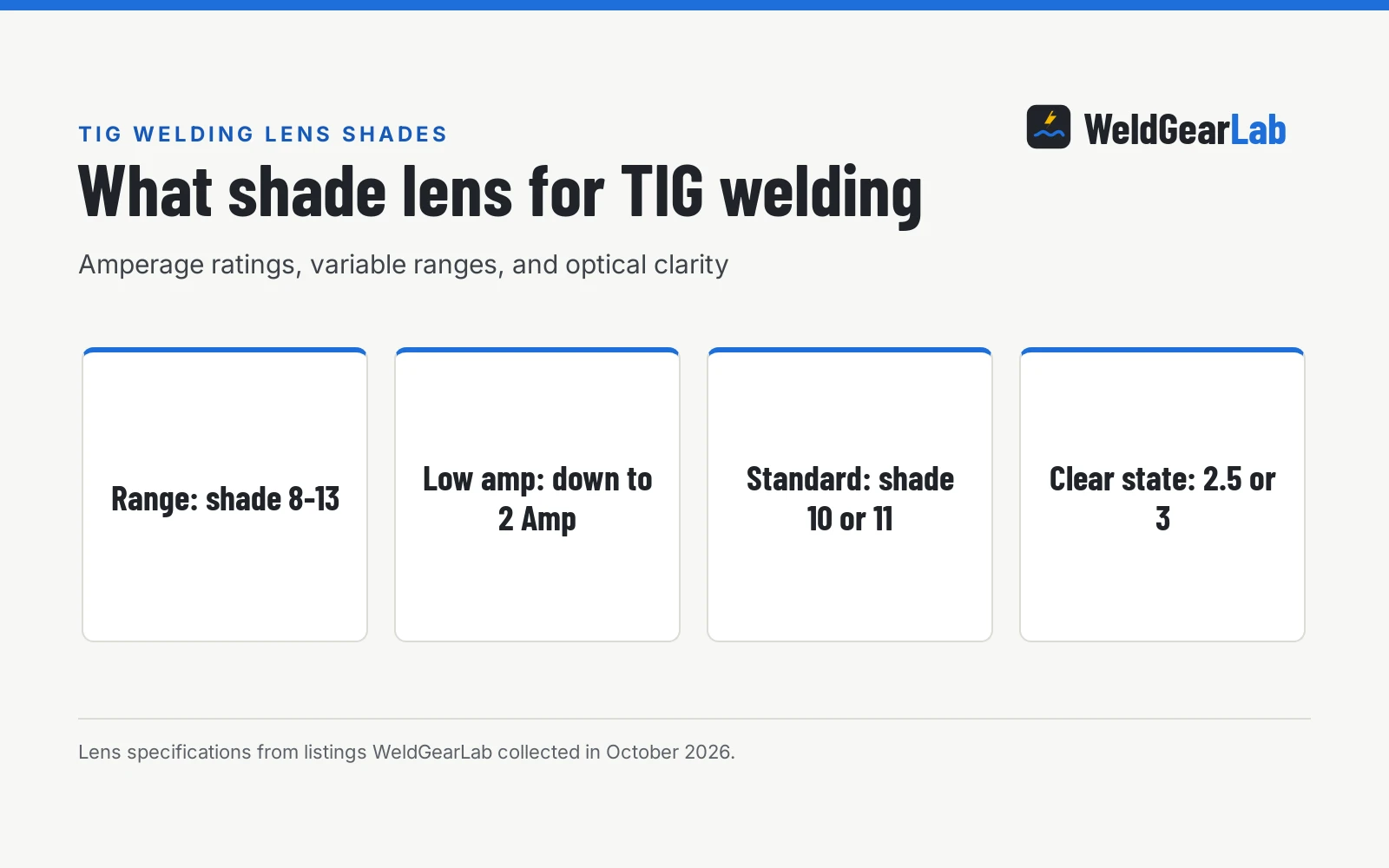
Choosing what shade lens for TIG welding depends primarily on your welding current and visual comfort, with shade 8 to 13 serving as the standard range for manual arc welding. For low-current work on thin metal, shade 8 or shade 9 provides sufficient glare reduction while keeping the puddle clear. For general fabrication at moderate amperage, shade 10 or shade 11 offers dependable protection against arc rays. Auto-darkening cartridges with variable settings from shade 5-13 allow quick adjustments across different weld joints without swapping filters.
As an Amazon Associate I earn from qualifying purchases. This guide links to our product roundups, where WeldGearLab earns a commission when you buy through links, at no extra cost to you. Read our affiliate disclosure.
What shade lens for TIG welding in one paragraph
TIG welding generates an electric arc that emits ultraviolet and infrared radiation, requiring a protective filter shade suited to the arc intensity. If a lens is too light, excessive visible light causes glare and eye strain; if it is too dark, you cannot see the joint seam, filler wire, or puddle edges clearly. The standard baseline for general TIG welding is shade 10, while lighter work down to 5 Amps or 2 Amp calls for shade 8 or shade 9, and heavy, high-amperage joints require shade 11 or shade 13. Certified filter cartridges adhere to ANSI Z87.1 safety standards and DIN16 ultraviolet and infrared protection to safeguard your vision regardless of the selected visible shade.
Side by side
| Specification | Variable Cartridges (5-13) | Fixed Shade 10 Cartridges | Fixed Shade 11 Cartridges |
|---|---|---|---|
| Shade adjustment | Variable shade 5-13 or 8-13 | Fixed dark Shade 10 | Fixed dark Shade 11 |
| Stated TIG rating | Rated down to 2 Amp or 5 Amps | Rated for 20A TIG | Rated down to 5A TIG |
| Arc sensors | 2 arc sensors on standard 2×4 | Automatic arc sensors | Solar panel and arc sensors |
| Light state view | Light state 2.5 or Shade 3 | Not stated on listing | Light state 2.5 |
| Optical clarity | Ratings such as 1/1/1/1 or 1/1/1/2 | True color optics | True Color high-definition view |
| Cartridge dimensions | 2×4 format, 0.19 inches thick | Standard 2×4 format | 2×4.25×0.22 inches (0.19 inches listed) |
| Power supply | Solar assist with battery (such as CR1025) | Listing title claims 100% solar, spec table lists batteries | Solar panel and internal battery |
| Safety standards | ANSI Z87.1 and DIN16 UV/IR | UV Protection listed | DIN16 UV/IR protection |
| Grind and specialty modes | Grind mode, tack mode, and delay settings | Continuous welding shade | Continuous welding shade |
Cartridge dimensions and shade ranges follow established industry formats, with the standard 2″ x 4 1/4″ size fitting most pipeliner and pancake hoods. Modern auto-darkening cartridges from makers like Ridge Products, Tefuawe, TrueArc, and SPARGOS offer true-color optics that replace older monochromatic green views with clearer blue or natural amber puddle visibility. When choosing between variable and fixed shades, consider whether you frequently switch amperages or prefer the simplicity of a dedicated filter.
When a variable shade lens is the better choice
A variable shade auto-darkening lens offers adjustable darkness across wide operating bands, typically spanning shade 5-13 or shade 8-13. This adjustability makes variable cartridges suitable for fabricators who tackle diverse materials and varying sheet thicknesses in the same workspace.
- Multiple welding processes. If you switch between low-amperage TIG, heavy stick welding, and wire feed MIG, an adjustable range like shade 5-13 allows you to dial in exact darkness without changing lenses.
- Varying joint thicknesses. Running an initial root pass on thin tubing followed by heavy fill passes requires different heat levels; an adjustable shade accommodates these current swings smoothly.
- Dedicated grinding mode. Many variable lenses include a grind mode or shade 5 setting, allowing you to clean welds with an angle grinder without removing your helmet.
- Fine-tuned delay and sensitivity. Variable units feature controls to adjust sensor responsiveness and darkening delay, preventing the filter from opening prematurely during pulse welding.
For welders working with multiple processes, our guide to the best auto darkening welding helmet details full-featured hoods with wide variable ranges and advanced sensor packages.
When a fixed shade lens is the better choice
A fixed shade lens provides a single, unchanging level of darkness, commonly shade 9, shade 10, or shade 11. While less versatile across broad amperage swings, fixed auto-darkening filters remain popular among pipe welders and dedicated fabrication specialists.
- Dedicated shade tuning. Fixed auto-darkening cartridges are tuned for a single darkness level, eliminating external adjustment dials that could be bumped during tight pipe or out-of-position work.
- Simplicity and fewer controls. Without external potentiometers or multi-mode switches, there are fewer settings to misconfigure before striking an arc.
- Compact dimensions. Fixed 2×4 auto-darkening cartridges, such as the Tefuawe F11 listed at 32 g and TrueArc units listed at 3.2 ounces, fit standard hoods easily. Note that listing details can vary: Tefuawe lists a 0.19″ thickness in bullets but 0.22″ in its spec table.
- Solar and battery configurations. Some fixed units emphasize solar operation, though buyers should verify listing specs. For example, the Ridge Products Heir 2.0 single shade 10 title claims 100% solar powered operation without batteries, while its spec table lists 2 C batteries.
If you prefer a dedicated filter for production welding, our roundup of the best fixed welding lens options compares top-rated single-shade cartridges for standard 2×4 hoods.
How to choose the right shade for your amperage
Selecting the proper shade corresponds directly to arc brightness. Because TIG arcs are concentrated and emit intense ultraviolet rays, matching the shade level to your current prevents eye strain while preserving joint visibility.
- Low-amperage TIG (down to 2 Amp or 5 Amp). Precision joints on thin sheet metal produce a small, subtle puddle. A lighter shade setting, such as shade 8 or shade 9, keeps the puddle edge distinct without blinding the operator.
- Medium amperage TIG. General fabrication on mild steel or stainless tubing generates moderate arc radiation. A shade 10 setting provides the classic baseline balance between glare reduction and puddle clarity.
- Higher amperage TIG. Heavy welds on thick aluminum or structural plate produce intense glare. Stepping up to shade 11 or shade 13 shields your eyes from the high luminous output.
When outfitting a home shop on a practical budget, our review of the best hobby welding helmet examines affordable hoods that provide reliable variable shade adjustment.
Why low-amperage TIG needs sensitive arc sensors
TIG welding places distinct demands on auto-darkening electronics compared to other arc processes. While MIG and stick welding generate turbulent, bright arcs with high spatter, TIG produces a smooth, stable arc that emits less visible light, especially when operating at lower current levels.
Standard auto-darkening cartridges calibrated primarily for MIG or stick can struggle to detect low-current TIG arcs. When an arc sensor fails to detect the arc, the cartridge can flicker or unexpectedly open to its clear state, causing sudden eye strain. To prevent this, look for lenses with verified low-current ratings. For example, Ridge Products rates its 2.0 series lenses for stable operation down to 5 Amps, while the Tefuawe Hand Series specifies a 2 Amp TIG rating. Cartridges designed for multi-process welding, such as the SPARGOS variable lens with 2 arc sensors and a 0.2ms reaction time, help ensure prompt darkening when striking low-current arcs.
Optical clarity also plays a decisive role in joint tracking. High-end cartridges carry optical ratings such as 1/1/1/1 or 1/1/1/2, minimizing angular distortion and blur around the tungsten electrode. Note that not every lens suits low-amperage TIG: for instance, TrueArc states on its Gold 9 listing that for TIG welding it recommends only its VPro Series. Welders seeking setup advice should follow manufacturer guidelines for sensor calibration and sensitivity adjustment.
Can one welding lens handle all your shop work?
For most multi-process fabricators, a single variable-shade auto-darkening cartridge can successfully manage TIG, MIG, stick, and plasma cutting tasks. A variable filter spanning shade 5-13 accommodates the full spectrum of shop jobs, from delicate sheet metal TIG to heavy stick welding and grinding preparation.
If your workload focuses heavily on wire-feed processes alongside TIG, review our comparison of the best welding helmet for MIG welding to evaluate options designed for higher spatter environments. Regardless of the process, personal eye safety remains vital. High-frequency arc starts, reflected rays, and hot metal spatter present ongoing workplace hazards. Always confirm that your lens cartridge carries certified ANSI Z87.1 impact resistance and DIN16 ultraviolet and infrared filtering. Inspect cover plates regularly for pitting and slag accumulation, replacing scratched outer lenses promptly to preserve optical clarity. For detailed personal protection guidelines, refer to established workplace safety standards.
Frequently Asked Questions
Can I use a shade 10 lens for all TIG welding?
A shade 10 filter works well for many mid-range TIG applications, but it may prove too dark for low-current work or too bright for high-amperage joints. At lower current settings, a shade 10 view can make the puddle edge and tungsten tip difficult to see. For variable shop projects, a variable-shade cartridge spanning shade 5-13 provides greater flexibility.
What shade is best for low-amperage TIG welding?
For low-amperage work down to 2 Amp or 5 Amp, shade 8 or shade 9 delivers adequate glare reduction while maintaining a clear view of the molten pool. Darker shades like 11 or 13 make dim arcs difficult to track. Using an auto-darkening cartridge with sensitive arc sensors prevents the lens from flashing or flickering at these low currents.
Can a fixed shade auto-darkening lens work for TIG welding?
A fixed shade auto-darkening lens works well if you weld consistent joint thicknesses within a predictable amperage band. Because it has no external adjustment dials, it offers simple operation and dependable clarity at a specific darkness level. However, fabricators who alternate between thin sheet metal and thick plate will find a variable cartridge more versatile.
What does light state 2.5 mean on a welding lens?
The light state refers to the resting shade level of an auto-darkening filter when no arc is detected. A light state 2.5 or Shade 3 offers a clear view through the helmet before striking an arc, making grinding and setup work easier. This brightness allows you to inspect your fit-up and tungsten placement without constantly raising the shield.
Why does my auto-darkening helmet flicker during TIG welding?
Flickering usually occurs when the welding current drops below the sensor sensitivity threshold of the cartridge, or when the torch hand blocks an arc sensor. Low-amperage TIG produces a subtle arc that can cause unrated sensors to lose detection and switch back toward the light state. Choosing a lens with a verified low-amperage rating down to 2 Amp or 5 Amp helps prevent unwanted flashing.
Related: how to use an auto darkening welding helmet, welding helmets hub, cheater lens for welding hood, and our guide to welding helmet solar vs battery hoods. Also see our roundup of the best welding helmet for outdoors.
About the author
WeldGearLab Editorial is the editorial team behind WeldGearLab. We research product listings, specifications, safety listings and warranty terms, score every pick with the published Gear Score method, and correct errors when readers report them. We do not run our own shop trials; see How We Pick for exactly how picks are made.