MIG Welding Stick Out Length Explained
MIG welding stick out length controls arc stability, penetration, and shielding gas coverage, making correct wire extension essential for clean welds.
 By WeldGearLab Editorial
Updated October 9, 2026
By WeldGearLab Editorial
Updated October 9, 2026
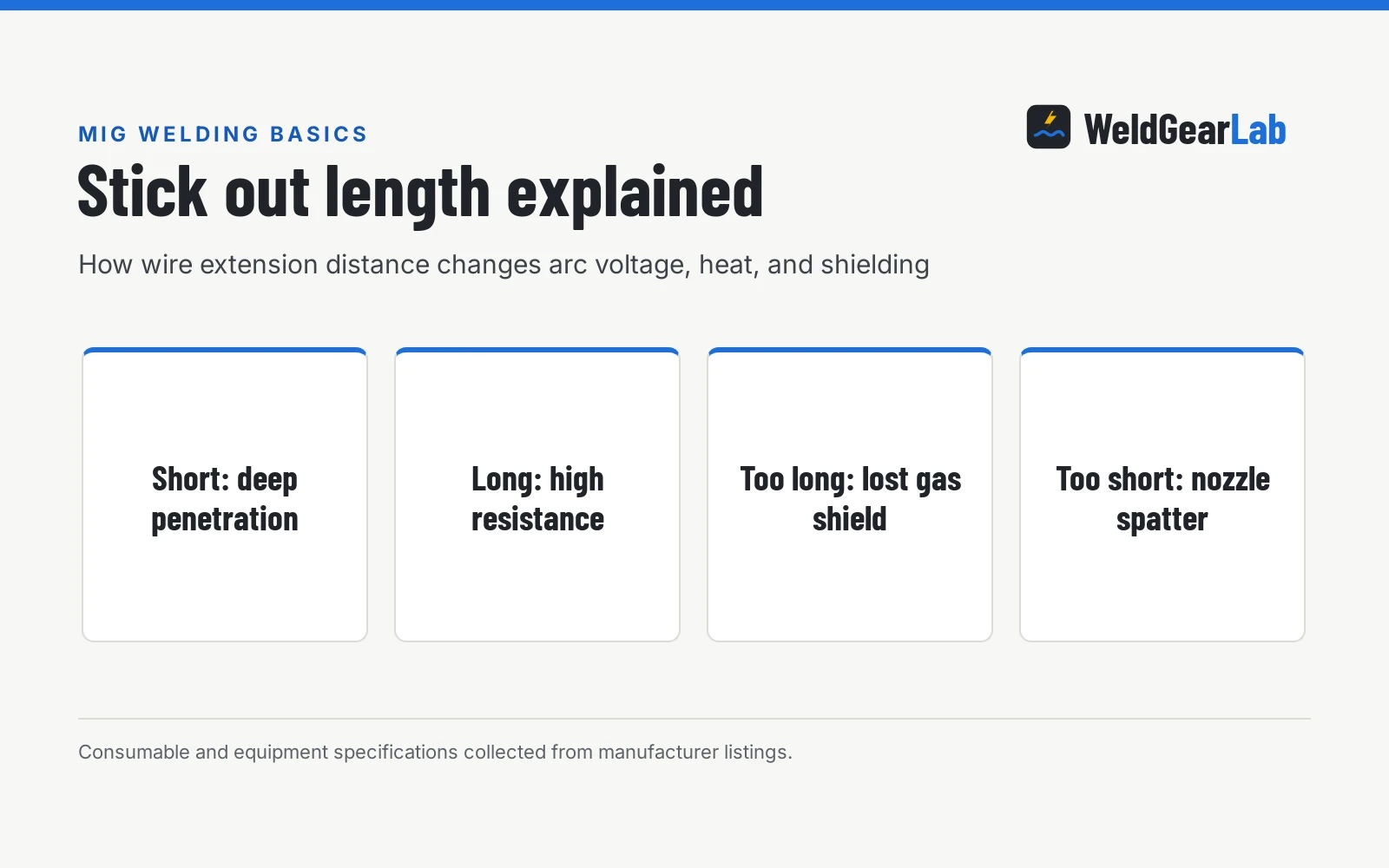
With MIG welding stick out length explained in plain shop terms, stick out is the distance the welding wire extends beyond the contact tip to the arc, and keeping it short and consistent is critical for maintaining arc stability and penetration. In gas-shielded MIG welding, extending the wire too far increases electrical resistance, which drops welding current, produces shallow penetration, generates spatter, and starves the puddle of shielding gas. Holding the wire extension steady allows the arc to maintain its set voltage, drive heat into the base metal, and keep the weld pool protected from atmospheric contamination.
As an Amazon Associate I earn from qualifying purchases. This guide links to our product roundups, where WeldGearLab earns a commission when you buy through links, at no extra cost to you. Read our affiliate disclosure.
MIG welding stick out length explained
Electrode extension, commonly called stick out, measures the length of unmelted welding wire between the contact tip where electrical contact occurs and the arc at the molten weld pool. In a constant voltage MIG system, the contact tip transfers electrical energy directly into the moving wire. As wire feeds out of the tip, the portion between the copper bore and the arc acts as an electrical resistor in the welding circuit. A shorter wire extension offers minimal resistance, allowing full current to flow into the base metal. As the distance between the contact tip and the workpiece grows, the extra wire length adds resistance, which cuts amperage and drops the actual heat delivered into the weld puddle.
Welders also distinguish between contact-tip-to-work distance and visible wire stick out. The total distance from the contact tip to the workpiece includes both the wire extension and the arc length itself. The position of the contact tip inside the gas nozzle sets this geometry. When the tip sits flush with the nozzle rim, the welder can gauge wire extension directly against the seam. When the tip is recessed inside the nozzle, the gas cup extends farther forward to shield the puddle, requiring careful torch positioning to avoid running an excessive electrical extension.
Side by side
| Too short | Correct stick out | Too long | |
|---|---|---|---|
| Electrical resistance | Very low | Moderate and balanced | High resistance |
| Current (amperage) | Very high current | Target operating current | Reduced current |
| Heat input into joint | Excessive heat input | Controlled heat input | Reduced heat input |
| Joint penetration | Deep with burn-through risk | Target penetration depth | Shallow penetration |
| Bead profile | Wide and flat | Smooth with washed-in toes | Narrow with tall crown |
| Shielding gas coverage | Dense but nozzle exposed to spatter | Optimal shielding envelope | Compromised, porosity risk |
| Contact tip condition | High spatter accumulation | Clean and protected | Cooler but erratic wire feed |
| Arc behavior | Violent puddle agitation | Crisp, steady arc | Wandering, stubbing arc |
Electrical resistance increases directly with wire length; always match your wire extension to the joint configuration and welding position to keep arc voltage and amperage balanced. Most MIG torches allow you to adjust nozzle placement to help maintain this distance.
When stick out is too long
- Loss of arc heat and penetration. Added electrical resistance along the extended wire drops welding current, resulting in shallow fusion that can fail on thicker joints.
- Loss of shielding gas coverage. Holding the nozzle far from the work allows ambient air to swirl into the puddle, causing porosity, pinholes, and bead oxidation.
- Excessive spatter and stubbing. A weak, unstable arc causes the wire to stub against the base metal rather than melting smoothly into the puddle, increasing post-weld cleanup.
- Wandering arc and poor bead shape. A long wire wanders off the weld seam, depositing a high, narrow crown with cold lap at the toes.
Welders setting baseline voltage and feed rates can reference our MIG welder wire speed and voltage chart to dial in their parameters before adjusting stick out.
When stick out is too short
- Contact tip spatter and nozzle clogging. Running the contact tip close to the molten puddle allows spatter droplets to fuse inside the nozzle and bridge across the tip.
- Mechanical contact and stubbing. When the torch is held too close to the work, the nozzle can bump the joint or submerge into the puddle, disrupting the arc.
- Radiant heat buildup. Excessive reflected heat damages internal gun diffusers, degrades nozzle insulators, and shortens consumable service life.
- Restricted joint visibility. Jamming the nozzle against the metal blocks your view of the leading edge of the puddle, making it difficult to follow the seam.
How stick out affects welding parameters
In constant voltage MIG welding, the power source works to maintain set voltage, while wire feed speed dictates amperage. Changing stick out length alters that electrical balance:
- Resistance preheating. Before wire reaches the arc, electrical current flows through the extending stick out length. Longer stick out preheats the wire through electrical resistance, requiring less arc energy to melt it, which drops welding current.
- Arc stability and stubbing. An overly long wire extension increases electrical resistance and drops welding current. With insufficient current to melt the incoming wire smoothly, the wire stubs against the base metal, resulting in an erratic arc and heavy spatter.
- Wire feed speed compensation. If you must extend the torch into a deep groove or restricted joint, you may need to increase voltage or adjust wire speed to maintain puddle fluidity.
Understanding these electrical dynamics helps troubleshoot problems when fine-tuning your machine; see our guide on why a MIG welder spatters and our checklist for why MIG wire burns back to the tip.
Consumables and wire diameters
Wire diameter and front-end consumables directly influence how stick out behaves in the weld puddle. For solid mild steel wire, listings specify exact operating parameters; for example, the maker states VEVOR ER70S-6 wire (available in 0.030-inch and 0.035-inch spools) works with 100% CO2 or an 80% Ar + 20% CO2 mixture. Thinner wire has higher electrical resistance per unit of length than thicker wire, making it sensitive to slight variations in stick out distance. Consumable kits from YESWELDER include gas diffusers, nozzles, and 0.030-inch contact tips designed to direct shielding gas smoothly around the feeding wire. Higher-output torches, such as an ARCCAPTAIN replacement gun rated for 250 A, include .035-inch and .045-inch contact tips to accommodate larger wires. When practicing bead consistency on JIEYIFAN 11 Gauge mild steel coupons (1/8-inch thickness), maintaining a steady wire extension ensures uniform fusion without burning through or leaving cold lap.
Nozzle position and practical shop setup
Achieving the correct stick out for MIG welding on every pass depends heavily on your nozzle relationship and torch angle. You can set up your gun with a flush contact tip, a recessed tip, or an extended tip depending on the application. For standard short-circuit MIG on thin sheet and general fabrication, a flush contact tip allows the gas nozzle to maintain close proximity to the weld pool without forcing an excessive wire extension. In tight corners or fillet joints where the nozzle cannot reach close to the root, a slightly extended contact tip helps maintain a short stick out while keeping the puddle visible. When selecting a machine for home and garage fabrication, compare features in our best welder for beginners and our best budget MIG welders.
Welding safety and spatter protection. Maintaining consistent stick out keeps the arc calm, but welding always generates ultraviolet radiation, hot sparks, and metal fumes. Always wear a shade-appropriate welding helmet, flame-resistant leather sleeves, and dry welding gloves. Clear all flammables from your workspace, keep a fire extinguisher nearby, and weld in a well-ventilated area to avoid breathing fumes. Inspect torch cables and ground clamps before striking an arc.
Frequently Asked Questions
What is the correct stick out for MIG welding?
For short-circuit MIG welding on steel, the correct stick out keeps the wire extension short and steady, balancing clean shielding gas delivery with enough clearance to see the weld puddle and keep spatter off the nozzle. Keeping the contact tip close to the workpiece provides a stable arc and deep penetration without wandering or stubbing.
Does longer stick out increase or decrease penetration?
Longer stick out decreases weld penetration. As the wire extends farther from the contact tip, electrical resistance along the wire increases, which causes welding current to drop. Lower amperage delivers less heat to the base metal, resulting in a shallow, crowned weld bead.
Why does my wire burn back to the contact tip?
Wire burnback occurs when the wire feed hesitates or stops while the arc remains energized, causing the wire to melt back into the copper contact tip. While running an excessively short stick out places the tip closer to the arc zone if feeding drags, burnback is primarily triggered by spool friction, a worn gun liner, incorrect drive roll tension, or excessive voltage for the wire speed.
How does stick out affect shielding gas coverage?
Stick out directly determines nozzle-to-work distance. If you pull the torch back to create a long stick out, the gas nozzle moves away from the puddle, allowing surrounding air to mix with the shielding gas. This loss of gas coverage causes porosity, nitrogen contamination, and weakened welds.
Does torch travel angle change stick out distance?
Steep push or drag angles make consistent stick out harder to maintain because the leading side of the nozzle sits closer to the metal than the trailing side. Keeping a moderate torch angle allows you to maintain an even wire extension and uniform gas flow along the entire seam; see our guide on push vs pull MIG welding.
Related: push vs pull MIG welding, how to set gas flow rate for MIG welding, how to choose a MIG welder, and the MIG welders hub. Also see our guides on why a MIG welder spatters and why MIG wire burns back to the tip.
About the author
WeldGearLab Editorial is the editorial team behind WeldGearLab. We research product listings, specifications, safety listings and warranty terms, score every pick with the published Gear Score method, and correct errors when readers report them. We do not run our own shop trials; see How We Pick for exactly how picks are made.