Push vs Pull MIG Welding: When to Push and When to Drag
Pushing and pulling produce different penetration, bead profiles, and puddle visibility during MIG welding, making torch direction vital for clean steel joints.
 By WeldGearLab Editorial
Updated October 9, 2026
By WeldGearLab Editorial
Updated October 9, 2026
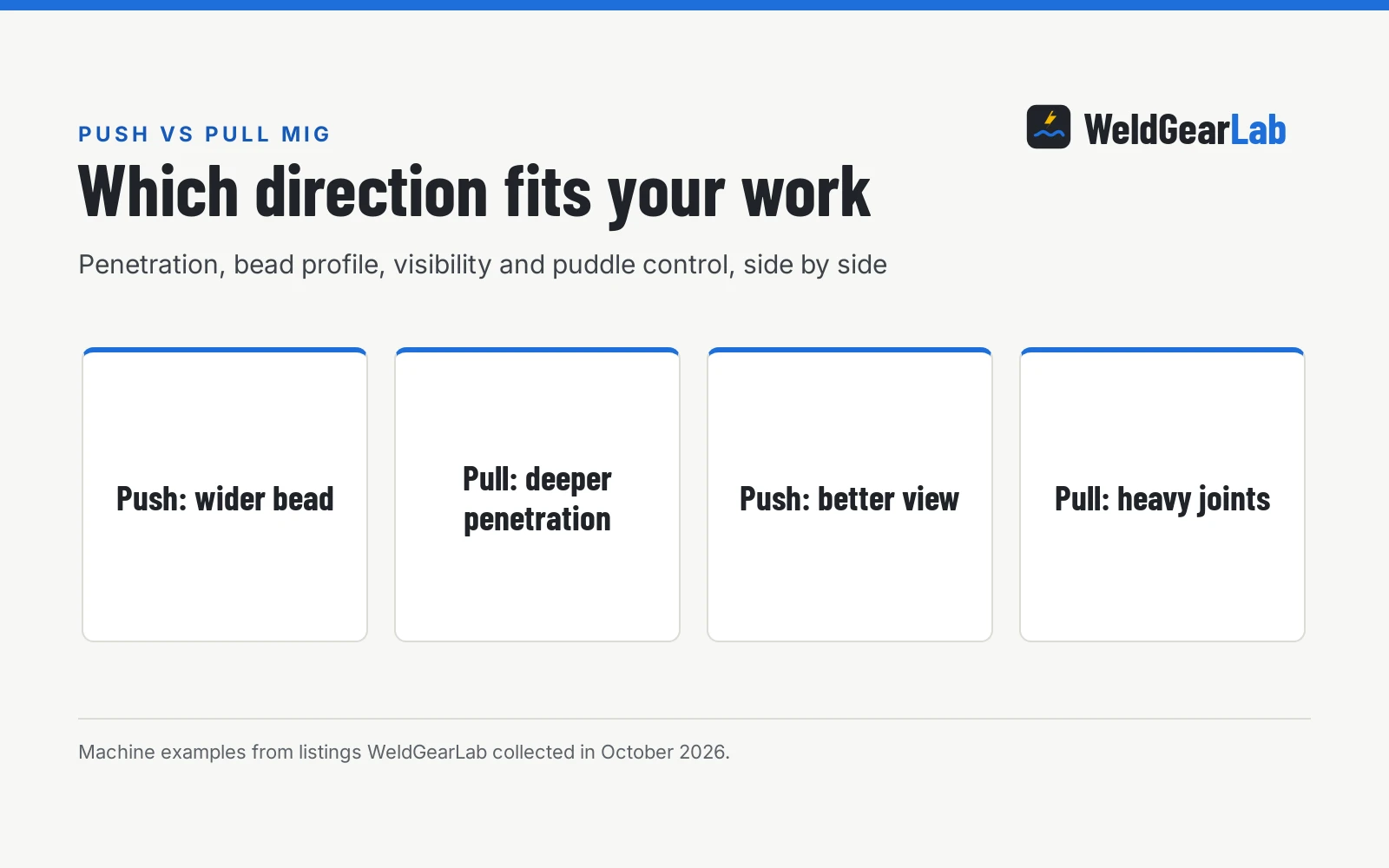
Push vs pull MIG welding comes down to penetration depth, weld bead shape, and the wire running through your torch. Pushing points the nozzle toward the direction of travel, creating a wider, flatter bead with shallower penetration that helps prevent burn-through on thin metal. Pulling, also called dragging, points the gun back toward the puddle, driving arc heat deeper into the joint for stronger fusion on thick steel. For flux core wire, dragging is necessary to avoid trapping molten slag inside the weld bead, while pushing is widely favored for sheet metal and aluminum. Solid wire on steel allows either technique depending on joint thickness and position. This guide explains how travel angle changes your puddle, when to choose each technique in a home or farm shop, and how to set up your equipment for clean results.
As an Amazon Associate I earn from qualifying purchases. This guide links to our product roundups, where WeldGearLab earns a commission when you buy through links, at no extra cost to you. Read our affiliate disclosure.
Push vs pull MIG welding: the difference in one paragraph
The core difference between pushing and pulling is where the welding arc directs its heat and arc force relative to the molten puddle. When pushing, the arc points forward onto the cold base metal ahead of the weld pool, spreading the puddle out into a flatter contour with moderate penetration. When pulling, the arc points backward toward the completed bead, allowing filler metal to build higher while arc energy penetrates deeply into the joint root. That single change in torch orientation determines whether heat stays concentrated or disperses across the surface, altering bead profile without changing wire speed or voltage settings on the machine.
Side by side
| Push technique (forehand) | Perpendicular (neutral) | Pull technique (backhand / drag) | |
|---|---|---|---|
| Torch travel angle | Tilted forward toward travel direction | Perpendicular to the joint seam | Tilted backward toward completed bead |
| Penetration depth | Shallowest penetration | Moderate penetration | Deepest penetration into root |
| Bead width and height | Wider, flatter weld bead | Medium width and moderate crown | Narrower bead with taller buildup |
| Puddle visibility | Clear view of seam and puddle | Nozzle partially covers weld area | Torch nozzle can block leading edge |
| Thin sheet metal | Best choice, minimizes burn-through | Acceptable with reduced heat input | Higher risk of burning through |
| Thick steel plate | Risk of cold lap or lack of fusion | Good fusion on medium plate | Best choice for deep root fusion |
| Shielding gas coverage | Sweeps gas ahead of molten pool | Direct vertical gas coverage | Blankets puddle and cooling bead |
| Flux core wire | Avoid, tends to trap slag in bead | Not recommended for slag wire | Required method to keep slag behind arc |
| Aluminum MIG | Standard practice with argon gas | Usable on flat butt welds | Avoid, causes soot and oxide defects |
Torch angle represents the tilt of the gun relative to the weld seam. Maintain a slight tilt off vertical rather than an extreme angle. Tilting the nozzle too far in either direction draws surrounding air into the gas shield, which leads to porosity and unstable arc transfer regardless of the travel direction selected.
When pushing is the better choice
- Thin sheet metal and auto body panels. Because pushing spreads the arc energy over a broader area, base metal absorbs less concentrated heat. This reduces burn-through on delicate repairs; see our guide on how to MIG weld thin sheet metal without burning through.
- Flat cosmetic seams. The pushing technique washes filler wire smooth against the parent steel, producing a flat crown that requires less grinding before paint or powder coating.
- Superior puddle visibility. With the nozzle tilted forward in the direction of travel, the welder has an unobstructed view of the joint seam ahead and the puddle edges behind the wire.
- Solid wire aluminum fabrication. Pushing is required when running aluminum wire with pure argon shielding gas to clean surface oxides and ensure complete gas coverage over the puddle.
When working on thin steel, pushing gives welders greater latitude before melting through the joint. Compact shop machines illustrate these boundaries: the Futelo 145A listing states an output range from 30A to 145A on 110V power for steel from 1mm to 5mm thick. When joining material near the lower 1mm mark, a pushing technique helps disperse arc force so the weld sits flat without blowing through the seam.
When pulling is the better choice
- Thick plate and heavy structural joints. Dragging directs the arc force deep into the joint root, achieving full penetration on heavy steel sections where structural strength is essential.
- Self-shielded flux core wire. If the wire produces slag, pulling is mandatory. Dragging ensures that the arc stays ahead of the slag pool, allowing slag to freeze harmlessly on top of the cooling bead.
- Fillet welds and tee joints. Directing arc energy directly into the corner of a tee joint prevents cold lap and builds adequate throat thickness along the seam.
- Gapped joints and heavy bevels. The deeper penetrating arc helps fuse root faces together when joining beveled plates.
Heavier metal demands deeper heat penetration to avoid cold fusion defects. For example, Acewelder lists its 140A flux core machine for mild steel plate up to 4.0mm thick, while the Futelo unit lists capability up to 5mm. On metal near those upper limits, pulling the torch keeps arc heat concentrated at the base of the joint to ensure full penetration across the entire thickness.
How torch angle affects penetration and bead shape
Travel angle refers to the angle of the MIG gun relative to the direction of travel along the joint seam:
- Pushing (forehand technique): Tilting the gun toward the path of travel pushes shielding gas and arc force ahead of the puddle. The molten metal flows into a wide, flat profile with a smooth transition at the weld toes, resulting in shallower penetration.
- Pulling (backhand or drag technique): Tilting the gun back toward the completed weld directs arc force into the puddle. The arc digs into the root, stacking filler metal into a narrower, convex bead with deeper center penetration.
- Shielding gas coverage: Pushing sweeps shielding gas forward over preheated metal, while dragging blankets the molten puddle and cooling bead behind the nozzle. Both provide effective shielding when the tilt angle remains modest.
- Gun nozzle visibility: Pushing directs the nozzle forward into the joint, giving the operator an unobstructed sightline along the unwelded seam. Dragging tilts the nozzle backward toward the bead, placing the nozzle body between your line of sight and the leading edge of the puddle.
Consistent wire delivery is vital regardless of gun orientation. The YESWELDER listing for its 150A 10 ft replacement torch specifies .030 inch and .035 inch contact tips to maintain arc stability. Similarly, the BESTMIG listing specifies its multi-process unit for mild steel up to 3mm (2/5 inch) thick using .030 inch solid wire, where maintaining a steady travel angle prevents irregular bead profiles.
Push vs pull with flux core wire
A classic shop rule dictates: if there is slag, you must drag. Self-shielded flux core wire contains internal flux ingredients that vaporize into shielding gas and produce a liquid slag crust over the molten steel. The travel direction chosen directly determines whether that slag stays on the surface or gets trapped inside the joint:
- Pushing flux core: Pushing points the arc ahead of the weld puddle, forcing molten slag into the cooler steel ahead of the arc. The arc then runs over the liquid slag, burying non-metallic inclusions beneath the steel bead. This causes internal porosity, weak joints, and excessive spatter; see our guide on what causes porosity in MIG welds.
- Pulling flux core: Dragging directs arc force backward across the puddle, keeping the molten slag pushed behind the arc. The lighter liquid slag floats to the surface of the cooling bead rather than washing into the root, allowing you to chip it away cleanly after cooling. Learn more in our article on can you MIG weld without gas.
For gasless flux core welding, always use a drag angle. In contrast, gas-shielded solid wire (MIG) produces no slag, giving welders the freedom to push or pull based on plate thickness and joint geometry.
Can you use both techniques on the same project?
Welders frequently switch between pushing and dragging on the same fabrication build. A steel equipment cart or utility trailer often combines thick tubing with thin sheet metal panels. In that situation, you pull the torch along the heavy tubing joints for deep root penetration, then push the torch along the thin sheet metal skin to avoid burn-through and reduce finish grinding.
Choosing versatile equipment makes switching between techniques seamless. Dual-voltage wire feed welders support both solid wire with shielding gas and flux-cored wire; see our guide to the best welder for beginners and our budget MIG welder guide.
Welding safety and ventilation. Both techniques generate intense ultraviolet radiation, sparks, and hot metal spatter. Wear a proper auto-darkening welding helmet, flame-resistant leather jacket or sleeves, and heavy welding gloves. Flux core welding produces substantial smoke plumes, while gas MIG can generate ozone and metal fumes. Always position your head out of the rising plume and weld in a well-ventilated space. Keep compressed shielding gas cylinders fastened upright with a safety chain, and clear all combustible materials from the work area.
Frequently Asked Questions
Does pushing a MIG weld make it weaker?
Pushing does not inherently weaken a weld if the base metal thickness matches the technique. On sheet metal and light tubing, pushing provides ample penetration while creating a smooth, flat bead profile. However, on heavy steel plate, pushing can lead to lack of fusion at the joint root because the arc does not dig as deeply as a dragging technique.
Should you push or pull flux core wire?
Always pull flux-cored wire. Dragging keeps the arc on the leading edge of the puddle, allowing the molten slag to float to the surface behind the arc. Pushing flux core forces molten slag ahead of the arc, where the filler metal rolls over it and traps slag inclusions inside the joint.
What angle should you hold a MIG gun?
Hold the MIG torch tilted slightly from vertical, pointing either forward for a push or backward for a drag. Avoid extreme tilt angles, which pull surrounding air into the shielding gas envelope and cause weld porosity. Keeping the nozzle close to perpendicular while maintaining a slight travel tilt provides the best balance of gas shielding and puddle control.
How does travel direction affect weld spatter?
In solid wire MIG welding, pushing typically produces less spatter because the arc force stays ahead of the puddle and creates a smooth bead transition. Pulling can increase spatter if the gun angle is tilted too far backward, which agitates the molten pool. With flux core wire, pushing causes heavy, violent spatter because the arc burns into molten slag, making a dragging angle essential for clean operation.
Which travel direction is easier for beginners?
Pushing is generally easier for beginners learning solid wire MIG on clean steel because the nozzle angle gives a clear view of the joint seam ahead. When learning with gasless flux core wire, however, beginners must practice the pulling technique to ensure proper slag management and sound welds.
Related: how to choose a MIG welder, flux core vs MIG welding, best 120V MIG welder, and the MIG welders hub. Also see our guide on why a MIG welder spatters.
About the author
WeldGearLab Editorial is the editorial team behind WeldGearLab. We research product listings, specifications, safety listings and warranty terms, score every pick with the published Gear Score method, and correct errors when readers report them. We do not run our own shop trials; see How We Pick for exactly how picks are made.