Can You Run a MIG Welder on a 15 Amp Circuit?
You can run a MIG welder on a 15 amp circuit for light gauge metal and lower power settings, but welding thicker steel demands a higher-rated branch circuit.
 By WeldGearLab Editorial
Updated October 9, 2026
By WeldGearLab Editorial
Updated October 9, 2026
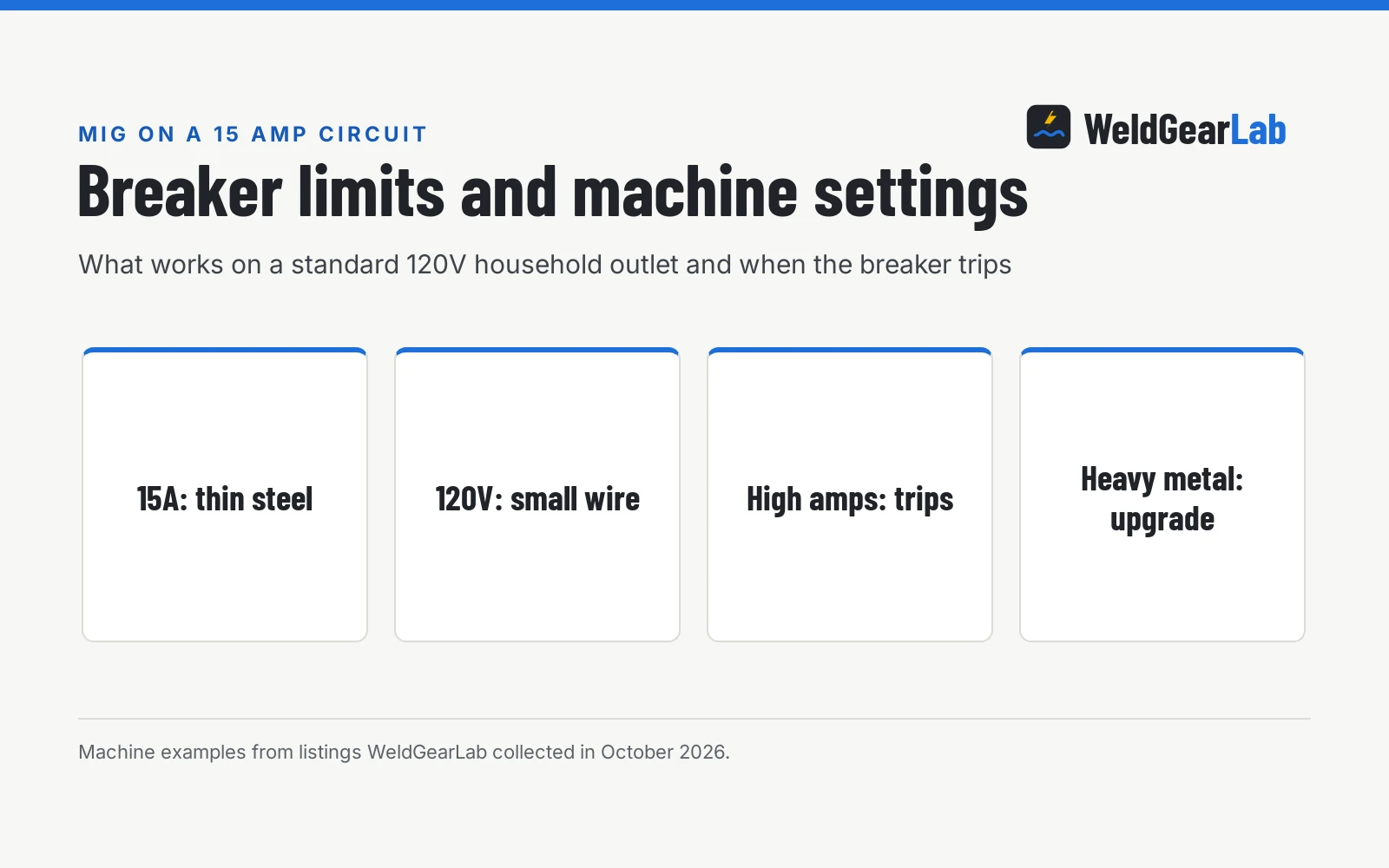
Can you run a mig welder on a 15 amp circuit? Yes, you can run a mig welder on a 15 amp circuit when working on thin sheet metal and keeping your machine output low. Standard household wall outlets in the United States operate on a 120V electrical supply protected by a 15 amp breaker, which provides adequate current for light repairs and small garage fabrication projects. However, pushing wire feed equipment to higher amperages causes the breaker to trip. This guide explains electrical circuit limits, wire diameter selection, and practical setup steps.
As an Amazon Associate I earn from qualifying purchases. This guide links to our product roundups, where WeldGearLab earns a commission when you buy through links, at no extra cost to you. Read our affiliate disclosure.
Understanding household circuit limits
A standard 15 amp branch circuit supplies alternating current at 120V to household outlets. When you strike an arc, the welder draws power from the wall receptacle to generate electrical current across the weld puddle. Modern inverter units convert incoming electricity with high operating efficiency, whereas older transformer machines draw heavier initial current surges. If total electrical demand exceeds breaker limits, the circuit breaker trips to protect building wiring from overheating.
Welding on a 15 amp circuit succeeds when operating within the lower output range of the machine. The limitation is not whether the unit will power on, but how much current you can pull through the arc before the circuit breaker interrupts the line. Understanding how wire diameter, arc voltage, and shared electrical loads impact total current draw keeps your work moving smoothly.
Side by side
| 15 Amp 120V Outlet | Dedicated 120V Line | 220V Workshop Outlet | |
|---|---|---|---|
| Primary use | Sheet metal and light autobody patches | General light repair and thin tubing | Thick structural plate and heavy equipment |
| Wire size | .023 inch or .030 inch wire | .030 inch or .035 inch wire | .035 inch or 0.040 inch wire |
| Material thickness | Thin sheet metal and light body panels | Stock within stated 120V machine limits | Heavy plate without multi-pass bevels |
| Machine output range | Low to moderate current | Moderate to high current | Full machine amperage capacity |
| Shared line tolerance | Breaker trips if tools share the circuit | Higher threshold before breaker interruption | Dedicated feeder isolated from household loads |
| Duty cycle impact | Limited by branch circuit heating | Matches rated 120V duty cycle | Runs full rated high-voltage duty cycle |
| Extension cord risk | Voltage drop triggers early breaker trips | Heavy gauge cord maintains stable voltage | Short dedicated run prevents voltage sag |
| Process fit | Light solid wire or gasless flux core | Solid wire MIG and flux core | High-heat solid MIG, flux core, or multi-process |
| Breaker trip risk | High when pushing machine output knobs | Low under typical garage welding tasks | Minimal under standard operating conditions |
Circuit limits reflect standard branch capacity; verify your breaker panel rating and machine specifications before tackling heavy joints. Running on an isolated branch circuit prevents household appliances from adding to total current draw during a weld pass.
When a 15 amp circuit works well
- Sheet metal and auto body repairs. Patch panels, floor pans, and thin body sheet require minimal arc voltage and lower wire feed speed, keeping electrical draw well below breaker limits.
- Light tubing and ornamental steel. Small brackets, furniture frames, and thin-wall tubing join cleanly without overloading household circuits.
- Short tack welds and stitch passes. Brief arc strikes produce minimal heat buildup along building wiring, reducing the risk of tripping the thermal mechanism in the breaker.
- Small diameter wire. Feeding thin wire keeps arc resistance and machine power consumption low.
For hobbyists outfitting a home workshop, our MIG welder under 500 guide reviews capable machines that operate effectively on household current. You can also explore our MIG welders hub for wire feed equipment and accessories.
Why a MIG welder trips a 15 amp breaker
Circuit breakers trip because of excessive current draw or thermal accumulation. Several distinct factors cause a wire feed welder to overload a 15 amp circuit:
- Inrush current during arc starts. The instant welding wire contacts the workpiece, an electrical short occurs before the arc stabilizes. This instantaneous current spike can trigger sensitive breakers.
- High wire feed speed and voltage. Increasing machine settings to penetrate thicker metal demands higher input current, which can exceed what a 15 amp circuit can sustain.
- Shared electrical appliances. Garage circuits frequently share wiring with shop lighting, refrigerators, freezers, or power tools. Any active appliance robs available capacity from the welder.
- Undersized extension cords. Long or light-duty extension cords create electrical resistance, causing voltage drop that forces the machine to pull additional amperage. Our best extension cord for portable welder guide explains cord construction for metalworking.
- Thermal buildup from continuous passes. Extended weld beads heat the thermal mechanism inside the breaker until it trips. Our welding duty cycle explained guide details how operating intervals affect heat accumulation.
Machine ratings and real-world power draw
Examining published equipment specifications clarifies the electrical demands of compact wire feed welders. The maker YESWELDER lists its MIG-140DS PRO with a 140A maximum output and a 3.6 KW power rating on 110V and 220V lines, offering wire feed speeds from 80 to 600 in/min.
Individual manufacturer claims outline the upper limits of compact machines. The maker migbloom claims its 110V welder reaches 145A for mild steel up to 2/5 inch thickness, with wire feed speed adjustable from 120 to 420 inches per minute on 0.030 inch wire. For portable shop work, ACEWELDER claims its 110V machine achieves 140A for mild steel plate up to 4.0mm thickness, feeding 2.2 pounds spools of .030, .035, and 0.040 inch wire. Larger multi-process machines like the ARCCAPTAIN 6-in-1 welder offer output up to 200A on dual-voltage inputs while handling .023, .030, .035, and .040 inch wire.
These published ratings demonstrate that while machines can draw substantial wattage at upper thresholds, dialling back the output keeps current draw within household limits. Our best 120V MIG welder roundup compares compact options, while our inverter welder vs transformer welder guide details how inverter technology reduces power consumption.
Can you run a mig welder on a 15 amp circuit for heavy steel?
Attempting to weld thick steel plate on a standard 15 amp circuit presents clear practical limits. Melting thick steel bevels requires elevated arc voltage and higher wire feed speed, which forces the welder to pull current beyond the trip threshold of a 15 amp breaker. When you push a machine past light sheet metal settings, the breaker will interrupt the circuit within moments of establishing the arc.
While multi-pass welding can join slightly heavier joints, running low amperage on thick steel risks cold lap and lack of fusion at the joint root. For structural repairs and thick steel, upgrading to a dedicated branch circuit with higher amperage or switching to a 220V outlet provides stable current and the heat required for sound penetration.
Electrical safety in the home shop
Welding on household electrical circuits requires strict attention to shop safety. Always connect the work clamp directly to bare, clean base metal close to the weld joint to avoid stray ground currents traveling through building wiring. Inspect the power cord, plug blades, and wall receptacle for signs of heat discoloration, loose connections, or cracked insulation before striking an arc.
Keep the workshop floor dry, clear flammable clutter from the welding zone, and maintain an approved fire extinguisher nearby. Wear appropriate leather gear, flame-retardant clothing, and a reliable auto-darkening helmet during all welding operations. Explore our welding safety gear section for essential protective equipment recommendations.
Frequently Asked Questions
What wire size is best when running on a 15 amp circuit?
Smaller wire diameters like .023 inch or .030 inch require less amperage to melt and maintain a stable arc puddle. Stepping up to .035 inch or 0.040 inch wire requires higher minimum current to sustain the arc, which quickly overloads a 15A circuit. Selecting .023 inch solid wire for sheet metal or .030 inch flux core wire keeps electrical draw within manageable limits.
Why does my circuit breaker trip immediately when striking an arc?
An immediate breaker trip typically points to inrush current spikes or shared electrical loads on the branch line. If lights, appliances, or workshop equipment share the circuit, the combined draw exceeds breaker capacity the moment arc current begins. Plugging into an isolated receptacle and verifying that no other appliances operate on the circuit resolves nuisance tripping.
Can I use an extension cord with a MIG welder on a 15 amp circuit?
Plugging directly into a wall receptacle is always preferred, but a heavy-gauge cord can bridge necessary distances. Thin household cords suffer substantial voltage drop under heavy load, causing the welder to draw excessive current and overheat the breaker. Use a short, heavy-gauge extension cord rated for portable shop equipment to maintain steady operating voltage.
Does flux core wire draw less power than gas MIG?
Flux core wire generally achieves deeper joint penetration at a given voltage setting compared to solid wire with shielding gas. Because of this penetration efficiency, you can weld slightly thicker metal without cranking machine current to maximum levels. However, total electrical draw remains tied to wire diameter and output amperage rather than shielding method alone.
What welder breaker size 120v is ideal for wire feed equipment?
While a 15 amp circuit handles thin steel at low power settings, running a 120V wire feed welder at its highest output capacity benefits from a dedicated branch circuit with higher amperage rating. A dedicated circuit provides sufficient electrical headroom to run extended passes without tripping breakers. Check your welder nameplate and user manual for manufacturer branch circuit recommendations before upgrading shop wiring.
Related: our best 120V MIG welder guide, inverter welder vs transformer welder comparison, welding duty cycle explained, and best extension cord for portable welder picks.
About the author
WeldGearLab Editorial is the editorial team behind WeldGearLab. We research product listings, specifications, safety listings and warranty terms, score every pick with the published Gear Score method, and correct errors when readers report them. We do not run our own shop trials; see How We Pick for exactly how picks are made.