Welding Rod 7014 vs 7018: Which One Should You Buy?
Welding rod 7014 and 7018 electrodes run on stick welders but differ in arc starting, joint crack resistance, slag cleanup, and moisture storage rules.
 By WeldGearLab Editorial
Updated October 9, 2026
By WeldGearLab Editorial
Updated October 9, 2026
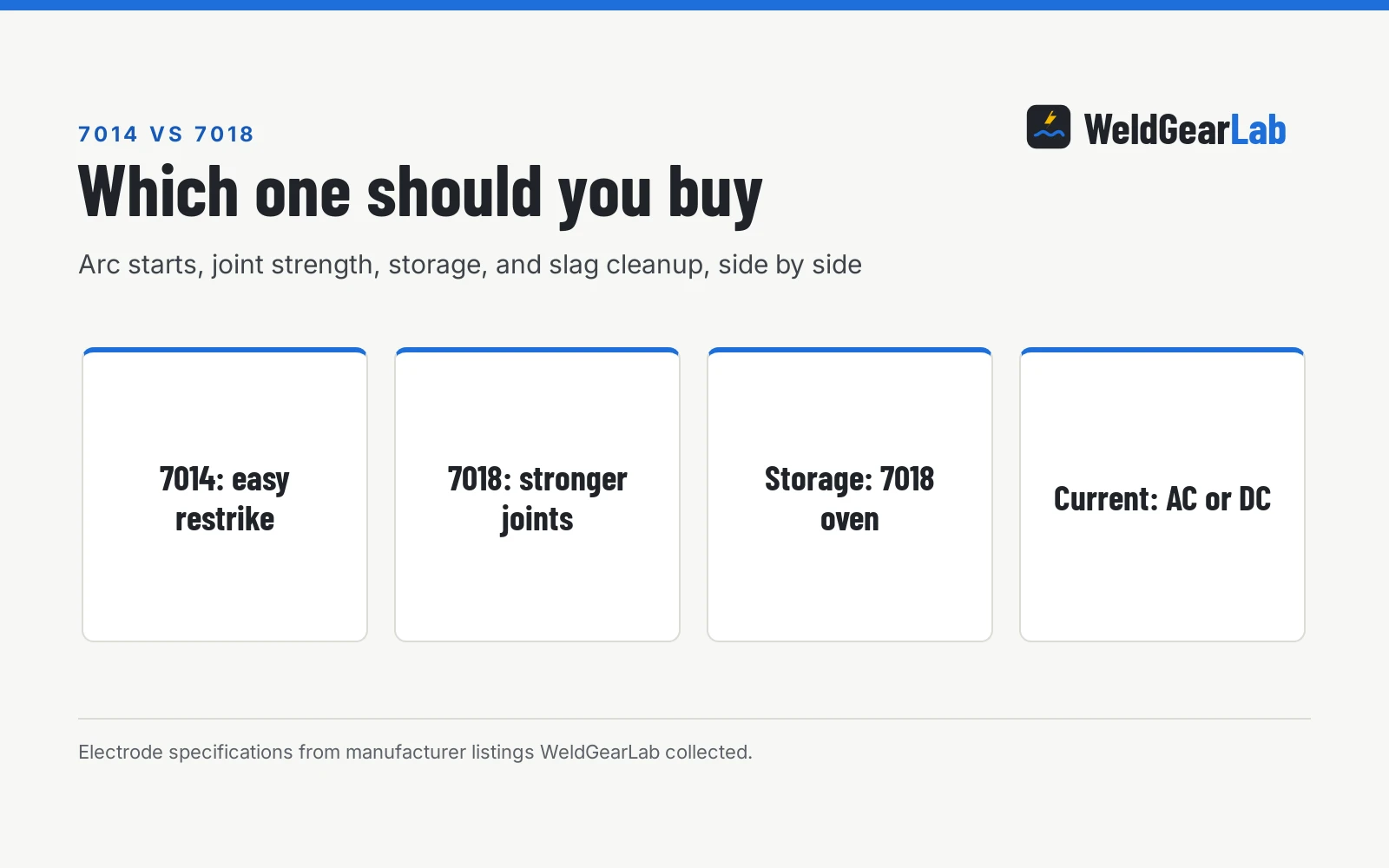
When deciding on welding rod 7014 vs 7018, the right electrode depends on your joint strength requirements and your shop storage setup. 7018 is a low-hydrogen electrode engineered for high crack resistance on structural steel, thick plate, and critical assemblies, but its coating absorbs moisture from humid air once opened unless kept in an airtight container or a heated rod oven. 7014 incorporates iron powder into a rutile coating that tolerates standard room storage, starts an arc smoothly, and restrikes easily on clean or lightly rusted steel. This guide compares both stick electrodes for home, farm, and shop fabrication to help you select the right rod for your welder.
As an Amazon Associate I earn from qualifying purchases. This guide links to our product roundups, where WeldGearLab earns a commission when you buy through links, at no extra cost to you. Read our affiliate disclosure.
The difference in one paragraph
Both electrodes produce welds rated for high tensile strength on carbon steel, but their chemical coatings create very different working characteristics. 7018 uses a low-hydrogen flux coating that deposits ductile, crack-resistant metal suitable for structural joints, heavy equipment frames, and code-certified welds where hydrogen embrittlement must be prevented. 7014 uses an iron powder rutile coating that creates a stable arc, easy puddle control, and fast slag cleanup without demanding moisture-controlled storage. In simple terms, choose 7018 when joint strength and code compliance are the priority, and choose 7014 when fast arc starts, easy restrikes, and simple storage are most important.
Welding rod 7014 vs 7018 side by side
| Feature | 7014 Welding Rod | 7018 Welding Rod | Practical Shop Takeaway |
|---|---|---|---|
| Electrode coating | Iron powder rutile | Low-hydrogen iron powder | 7018 requires dry storage |
| Tensile strength | 70,000 PSI | 70,000 PSI minimum | Matched nominal tensile ratings |
| Storage requirement | Normal dry room storage | Airtight container or heated rod oven | 7014 avoids heated oven requirements |
| Arc striking and restrike | Very easy strike and restrike | Easy initial strike, tip slag chips for restrike | 7014 excels on intermittent tack welds |
| Crack resistance | Moderate crack resistance | High crack resistance on restrained joints | 7018 protects crack-sensitive joints |
| Slag removal | Light slag, chips off cleanly | Heavy protective slag, requires chipping | 7014 cleans up faster with less chipping |
| Supported polarities | AC, DCEP, or DCEN | DCEP or AC | 7014 operates on AC or either DC polarity |
| Welding positions | All positions | All positions | Both electrodes support out-of-position joints |
| Common applications | Farm repairs, sheet metal, gate frames | Structural steel, pressure piping, heavy equipment | Match electrode to joint stress level |
Polarity and current settings depend on your specific welding machine and the electrode diameter. While both electrodes run in all welding positions, their arc action and slag characteristics dictate how forgiving they feel in practical shop use.
When 7014 is the better choice
- Quick arc starts and effortless restrikes. The iron powder in the 7014 coating conducts current effectively, allowing the arc to strike instantly and restrike without manually breaking a heavy flux crust off the rod tip.
- Standard shop storage. 7014 does not require an oven or sealed storage tubes. You can store opened boxes on a shop shelf in normal dry conditions without risking hydrogen contamination.
- Light rust and mill scale tolerance. For maintenance, gate repairs, and sheet metal fabrication where joint prep is minimal, 7014 handles surface imperfections smoothly.
- Smooth beads with light slag. The iron powder deposit leaves a flat bead profile with fine ripples and a light slag crust that chips off with minimal wire brushing.
For general shop projects and farm repairs on mild steel, 7014 delivers dependable results without specialized storage gear. Review our best welding rods for mild steel guide for an overview of everyday electrode options.
When 7018 is the better choice
- Structural steel and heavy equipment. Trailers, load-bearing frames, hitch receivers, and heavy machinery mounts require the crack-resistant ductility that low-hydrogen deposits provide.
- Restrained and rigid joints. Thick plates and rigid weldments create internal cooling stresses that cause cracking in standard flux welds. 7018 prevents underbead cracking under severe restraint.
- Higher-carbon and low-alloy steels. When welding metals prone to cracking, the low-hydrogen chemistry minimizes the danger of delayed hydrogen embrittlement.
- Code-certified welds and inspections. Bridge work, structural buildings, pressure piping, and pressure vessels require low-hydrogen electrodes specified by structural welding standards.
When safety and maximum joint integrity are critical, 7018 is the industry standard electrode. If you run an alternating current power source, consult our guide to the best welding rods for AC welder options to match electrode flux to machine output.
Understanding the electrode numbers and packaging
Under American Welding Society classification standards, the designation numbers identify the key physical characteristics of the filler metal. Hobart lists its 7014 stick electrodes with a tensile strength rating of 70,000 PSI across multiple package sizes, which aligns with the 70,000 PSI minimum tensile strength standard for both classifications. The digit 1 indicates that each electrode is rated for all welding positions, including flat, horizontal, vertical, and overhead.
The final digit distinguishes the coating composition and compatible current types. In 7014, the digit 4 denotes an iron powder titania flux that operates on AC, DCEP, or DCEN. In 7018, the digit 8 signifies a low-hydrogen iron powder coating designed for DCEP or AC operation. Electrode manufacturers package these rods in various diameters and weights to suit specific tasks:
- Hobart 7014: Available in 1/16-inch, 3/32-inch, and 1/8-inch diameters, in 1-pound, 5-pound, and 10-pound containers.
- Forney 7014: Packaged in 3/32-inch and 1/8-inch sizes in 1-pound, 5-pound, and 10-pound boxes, with amperage capacity ratings listed up to 145 A and general operating ranges listed from 35-125 amps.
- STARTECHWELD 7014: Offered in 3/32-inch and 1/8-inch diameters in 14-inch rod lengths in 5-pound and 10-pound packaging.
- YESWELDER 7018: Supplies 7018 stick electrodes in 1/8-inch diameter in 5-pound packages for multi-pass carbon steel fabrication.
Storage and moisture rules: Does 7018 need an oven?
The most significant practical difference between these two electrodes is moisture sensitivity. 7018 contains low-hydrogen minerals in its coating. When exposed to room air, the coating absorbs atmospheric moisture. In high-strength structural joints, this moisture dissociates into hydrogen in the arc puddle, diffusing into the cooling steel and creating micro-cracks under load.
To maintain low-hydrogen properties on structural work, shops keep hermetically sealed containers unopened until needed. Once opened, unused 7018 rods must be stored in a heated rod oven at the temperature recommended by the electrode maker. If left exposed to ambient humidity, rods must be re-baked according to manufacturer specifications before structural use.
In contrast, 7014 is not a low-hydrogen electrode and does not require an oven. Its iron powder rutile flux remains stable in standard dry shop air. As long as you keep the rods away from direct water, leaks, or extreme dampness, 7014 rods stored in a cabinet or plastic tube will strike cleanly without re-baking.
Can your stick welder run both?
Most stick welding machines can run both electrodes, provided the machine produces sufficient open circuit voltage and amperage for the chosen rod diameter. 7014 operates on alternating current or direct current on either polarity, making it compatible with small buzz boxes, entry-level inverters, and engine-driven welders. Hobart specifies that its 7014 stick electrodes run on AC, DCEN, or DCEP, giving fabricators maximum versatility across different power supplies.
Standard 7018 electrodes run best on DCEP, which provides a smooth arc, medium penetration, and a stable puddle. Basic AC transformer machines with low open-circuit voltage often struggle to maintain a stable arc with standard 7018 rods because the arc extinguishes each time the AC sine wave crosses zero voltage. For AC-only machines, fabricators use specialized 7018 AC formulations designed with arc stabilizers. If you are upgrading your shop machine, check our guide to the best portable stick welder and our detailed breakdown of stick welder AC vs DC operation.
Safety and fume precautions. Stick welding generates intense ultraviolet radiation, sparks, and airborne fumes. The heavy flux coatings on both 7014 and 7018 create smoke plumes that require adequate ventilation or local exhaust extraction. Always wear appropriate personal protective equipment, including a proper shade welding hood, leather welding gloves, and fire-resistant clothing. When chipping the glassy flux off completed beads, wear safety glasses under your helmet to protect your eyes from flying slag chips. Browse our recommended welding safety gear to outfit your workspace properly.
Frequently Asked Questions
What is 7018 welding rod good for?
7018 is designed for structural fabrication, pressure vessels, heavy equipment repairs, and thick carbon steel assemblies requiring high joint strength. Because its low-hydrogen flux resists underbead cracking and brittle failure, structural codes specify it for critical load-bearing joints. For non-critical repairs on dirty or thin steel, 7014 is generally easier to use because it does not require heated oven storage.
How do you weld with a 7018 rod?
To weld with a 7018 rod, strike the arc with a light scratch or tap, establish a tight arc length, and drag the electrode smoothly along the joint without excessive weaving. Holding too long of an arc introduces atmospheric moisture and air into the puddle, creating porosity and ruining the low-hydrogen deposit. When pausing and restarting, chip away the hardened flux crust covering the wire tip before attempting to restrike the arc.
Do 7018 welding rods need to be heated?
7018 electrodes do not need heating when freshly removed from an unopened, hermetically sealed factory container. Once exposed to ambient air and humidity, the flux coating absorbs moisture, which can cause hydrogen-induced cracking in high-strength joints. For code-certified structural work, opened containers must be kept in a heated rod oven or re-baked according to the manufacturer’s directions.
What does 7018 welding rod stand for?
Under the American Welding Society classification system, the designation E7018 identifies the electrode’s physical properties. The tensile designation indicates a minimum tensile strength of 70,000 PSI in the deposited weld metal. The digit 1 indicates the electrode can be run in all welding positions, while the digit 8 denotes a low-hydrogen iron powder coating designed for DCEP or AC current.
How long is a 7018 welding rod?
Electrode length for 7018 stick rods is not stated in the reference listings. In practical stick welding, consumable lengths depend on core wire diameter and manufacturer specifications, so always check the product packaging or technical data sheet for the exact electrode length.
Related: how to use stick welder, best stick welder for farm use, stick welder vs wire welder, and the stick welders hub. Also see our overview of welding consumables.
About the author
WeldGearLab Editorial is the editorial team behind WeldGearLab. We research product listings, specifications, safety listings and warranty terms, score every pick with the published Gear Score method, and correct errors when readers report them. We do not run our own shop trials; see How We Pick for exactly how picks are made.