6011 Welding Rod vs 6013: Which One Should You Buy?
6011 and 6013 stick electrodes run on common welders but suit different jobs, from digging through dirty farm steel to laying clean beads on thin sheet metal.
 By WeldGearLab Editorial
Updated October 9, 2026
By WeldGearLab Editorial
Updated October 9, 2026
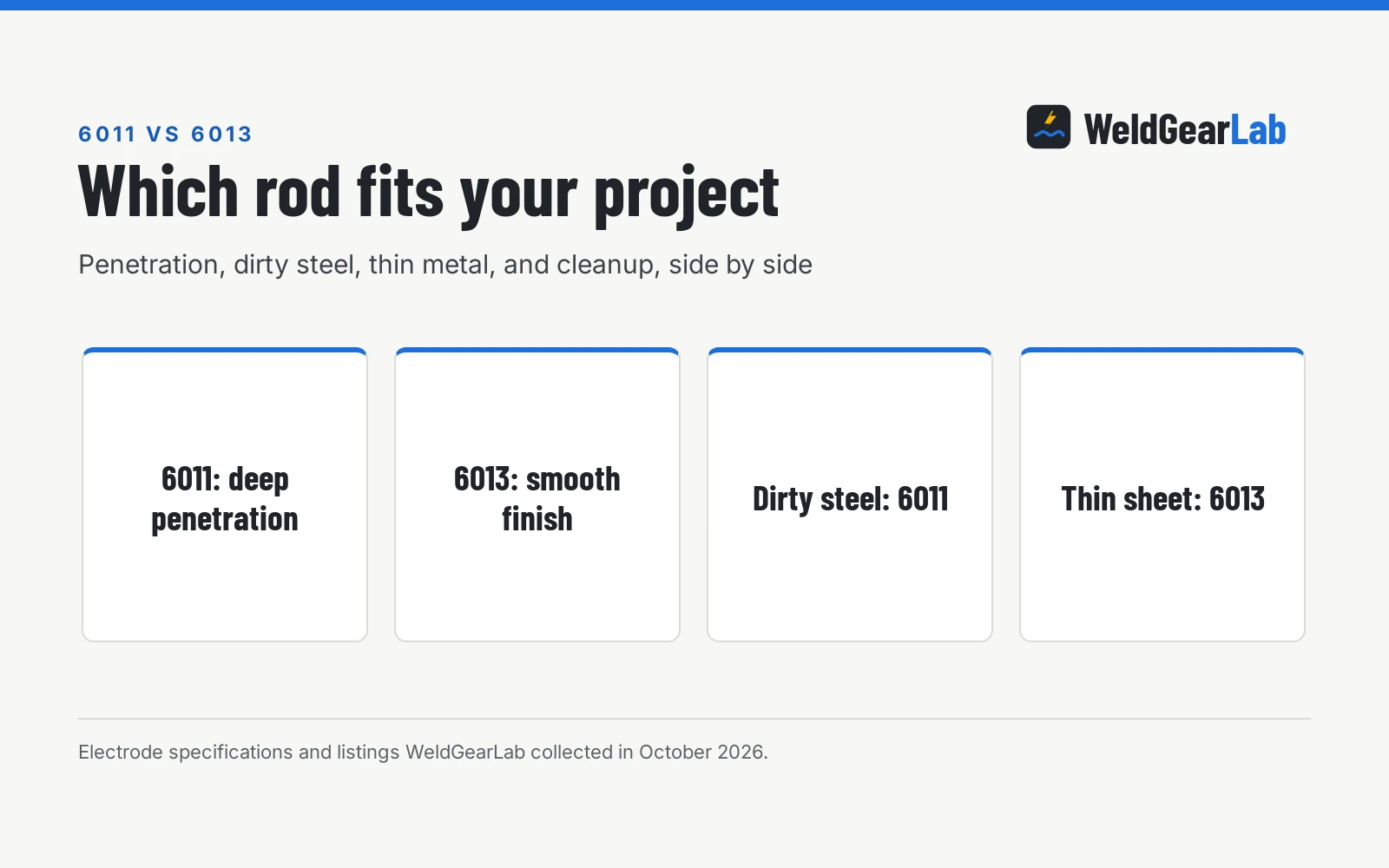
When comparing a 6011 welding rod vs 6013, choose 6011 when you need deep arc penetration to cut through rust, dirt, paint, or mill scale on heavy steel, and choose 6013 when you need a smooth, shallow bead on clean, thin sheet metal. The difference comes down to flux coating and puddle freeze: 6011 uses a cellulose potassium coating that produces a forceful, digging arc with a fast-freezing puddle, while 6013 uses a high-titania coating that yields a soft arc, fluid puddle, and clean-peeling slag. This guide breaks down welding rod 6011 vs 6013 and compares welding rods 6011 vs 6013 across arc force, dirty metal tolerance, sheet steel handling, slag cleanup, and machine polarity so you can select the right stick electrode for your shop or repair project.
As an Amazon Associate I earn from qualifying purchases. This guide links to our product roundups, where WeldGearLab earns a commission when you buy through links, at no extra cost to you. Read our affiliate disclosure.
The difference in one paragraph
Stick electrodes shield the molten weld pool using chemical flux coatings that burn and vaporize during welding. On an E6011 electrode, a thin cellulose potassium coating burns vigorously, generating a high-pressure gas jet that drives deep into the base plate, displaces surface oxides, and freezes rapidly. On an E6013 electrode, a thick rutile titania coating melts into a fluid, protective blanket of molten slag, providing a quiet, gentle arc with shallow penetration and a finely rippled finish. Both electrodes provide a minimum tensile strength of 60,000 PSI, but their puddle dynamics serve opposite welding challenges.
6011 welding rod vs 6013: side by side
| Feature | 6011 welding rod | 6013 welding rod | Application verdict |
|---|---|---|---|
| Arc penetration | Deep and digging | Shallow to medium | 6011 for thick joints and root passes |
| Flux coating type | Cellulose potassium | High titania (rutile) | 6013 for soft arc and quiet puddle |
| Dirty or rusty steel | Burns through rust, dirt, and paint | Requires clean metal | 6011 for farm repair and dirty joints |
| Thin sheet metal | High burn-through risk | Well suited, low burn-through | 6013 prevents blowing through thin steel |
| Puddle freeze | Fast freeze | Fluid puddle | 6011 freezes faster out of position |
| Slag and cleanup | Thin, light slag | Heavy slag, peels cleanly | 6013 chips away with minimal cleanup |
| Spatter level | Moderate to heavy | Very low | 6013 leaves cleaner bead margins |
| Bead appearance | Rougher, distinct ripple pattern | Smooth, clean, aesthetic finish | 6013 for visible cosmetic welds |
| Supported current | AC or DCEP | AC, DCEP, or DCEN | 6013 runs on DCEN for shallower penetration |
| Primary role | Heavy repair, root passes, outdoor welds | Sheet metal, light fabrication, hobby builds | Select rod based on joint cleanliness and thickness |
Operating characteristics reflect standard workshop experience across mild carbon steel joints. When running stick electrodes, always check the recommended current ranges printed on the packaging, as specific amperage windows vary by electrode diameter, manufacturer formulation, and machine power output.
When 6011 is the better choice
- Dirty, rusty, painted, or oily steel. Welding with 6011 rods allows operators to fuse contaminated steel without grinding down to bare metal. The aggressive, digging arc burns through surface grease, heavy rust, and galvanized coatings where other rods struggle with porosity or arc wandering.
- Farm equipment and outdoor fence repairs. Field repairs on tractor attachments, gates, trailer hitches, and cattle guards rarely present ideal joint prep. Because 6011 cuts through scale and dirt, it remains the standard choice for farm maintenance. Check our best stick welder for farm use guide for machines suited to rural repairs.
- Root passes and open root pipe joints. The forceful arc and fast-freezing deposit make 6011 ideal for penetrating through the root opening of a joint without blowing away the edges. Once the root pass solidifies, operators can clean the thin slag and complete the joint. Similar digging characteristics appear when welding with 6010 rod on DC generators.
- Out-of-position vertical and overhead welding. The puddle freezes rapidly as the arc moves forward, preventing molten metal from sagging or dripping out of vertical-up or overhead joints.
When 6013 is the better choice
- Thin sheet metal and light fabrication. Welding with 6013 rods produces shallow penetration, dramatically reducing the risk of burn-through on thin-gauge sheet steel, square tubing, and light ornamental ironwork.
- Clean cosmetic welds and visible shop projects. The high-titania coating stabilizes the arc, resulting in minimal spatter and a uniform, finely rippled bead contour that requires little post-weld grinding. See our best welding rods for mild steel guide for more fabrication picks.
- Effortless slag cleanup. Unlike the thin, adherent slag of cellulose rods, 6013 produces a thick, brittle slag crust that frequently curls off the bead by itself as it cools, or detaches with a light tap from a chipping hammer.
- Smooth striking and frequent arc restarts. The rutile coating contains conductive mineral elements that make striking an arc and restarting a partially consumed rod simple, even on small alternating current hobby machines. Our best welding rods for AC welder roundup highlights electrodes with easy arc initiation.
How to match rods to your welder
Selecting between these electrodes requires matching core rod diameter and amperage capacity to your power source. Manufacturer listings show distinct working parameters for common rod sizes. For 1/8-inch E6011 electrodes, TOOLIOM and YESWELDER both list a recommended range of 75A-125A on their 5LB and 10LB packs. Forney lists an amperage capacity of 130 A for its 1/8-inch 31210 electrode, and 90 A for its 3/32-inch 31101 electrode. Hobart lists both its 770458 (3/32-inch) and 770460 (1/8-inch) electrodes with 60,000 PSI tensile strength, designed to run on AC or DCEP.
In metric sizing, common shop equivalents include welding rod 6011 2.5mm (comparable to 3/32-inch) and welding rod 6011 3.2mm (comparable to 1/8-inch). For bulk workshop supply, HYW Products lists a 50 lb steel can for 1/8-inch E6011 stick electrodes measuring 14 inches in length. On 6013 electrodes, makers such as YESWELDER offer 3/32-inch rods in 5LB packs. Compact machines with modest output run 3/32-inch rods efficiently, while larger repair jobs demand 1/8-inch electrodes. For lightweight equipment options, explore our best small inverter stick welders guide.
Which polarity to run for each rod
Both electrodes run on alternating current (AC) and direct current (DC), but current selection alters bead shape and penetration depth. An E6011 rod functions on AC or direct current electrode positive (DCEP, reverse polarity). DCEP delivers the deepest penetration, whereas AC helps prevent arc blow when welding into deep corners or magnetic steel structures.
An E6013 rod runs on AC, DCEP, or direct current electrode negative (DCEN, straight polarity). Running 6013 on DCEN directs more heat into the electrode, yielding the shallowest penetration possible and making it the premier setting for sheet metal work. Read our stick welder AC vs DC guide to understand how output current alters your weld puddle.
Can one welder run both rods?
Yes. Any machine capable of running stick electrodes can burn both rods, provided the power source provides sufficient open circuit voltage. Because 6011 contains potassium in its cellulose coating, it strikes reliably on traditional AC transformer welders as well as modern inverter units. A standard home shop setup benefits from keeping both types on hand: 6011 for rough repair work, and 6013 for clean metal builds.
Stick welding safety and slag handling. Stick welding generates high arc radiation, hot spatter, and toxic fumes, particularly when burning through rust, paint, or galvanized coatings with 6011. Work outdoors or with adequate fume extraction, keep your head out of the rising plume, and wear a shade-appropriate helmet with impact-rated safety glasses underneath when chipping slag. Clear dry grass and combustible materials from your welding area before striking an arc. Consult our welding safety gear overview for protective recommendations.
Frequently Asked Questions
How to use 6011 welding rod?
To use a 6011 rod, strike the arc using a scratch start or tap technique and maintain a close arc gap. Operators frequently use a slight whipping or stepping motion, pushing the electrode forward into the root of the joint to penetrate and stepping back into the puddle to deposit filler metal. This technique allows the fast-freezing puddle to solidify between steps.
What size 6011 welding rod do I need?
Rod diameter depends on steel thickness and welder amperage capacity. A 3/32-inch rod functions well on lighter plate and smaller 90 A circuits, while a 1/8-inch rod handles heavier agricultural steel requiring 75A-125A or up to 130 A. For standard repair work, 1/8-inch remains the most versatile workshop size.
What is the best setting for 6011 welding rod?
The best setting matches your rod diameter and joint position. For a 1/8-inch 6011 electrode, setting your machine between 75A-125A on DCEP yields deep penetration on clean or rusty steel. If using AC on an older buzz box, dial near the middle of that range to maintain arc stability without burning through.
Can I run 6013 on dirty or rusty steel?
An E6013 electrode struggles on rust, grease, or heavy mill scale because its rutile flux lacks the digging action needed to burn away surface contaminants. Trapping oxides beneath fluid rutile slag results in porosity, slag inclusions, and weak fusion. Clean the metal down to bare steel before welding with 6013 rods, or switch to 6011.
How long do 6011 welding rods last?
Because E6011 electrodes rely on a small moisture content in their cellulose coating to generate shielding gas, they do not require heated rod ovens. Kept in a dry, sealed container away from direct humidity, 6011 rods last for years without degrading. Never bake cellulose electrodes in a rod oven, as drying out the flux ruins arc shielding.
Related: welding consumables, 6011 welding rod vs 6010, best welding rods for AC welder, best welding rods for mild steel, and the stick welders hub. Also see our guide on how to use a stick welder.
About the author
WeldGearLab Editorial is the editorial team behind WeldGearLab. We research product listings, specifications, safety listings and warranty terms, score every pick with the published Gear Score method, and correct errors when readers report them. We do not run our own shop trials; see How We Pick for exactly how picks are made.