6011 Welding Rod vs 6010: Which One Should You Buy?
Compare 6011 and 6010 stick welding rods across electrical current compatibility, arc penetration, and dirty steel performance to select the right electrode for your machine.
 By WeldGearLab Editorial
Updated October 9, 2026
By WeldGearLab Editorial
Updated October 9, 2026
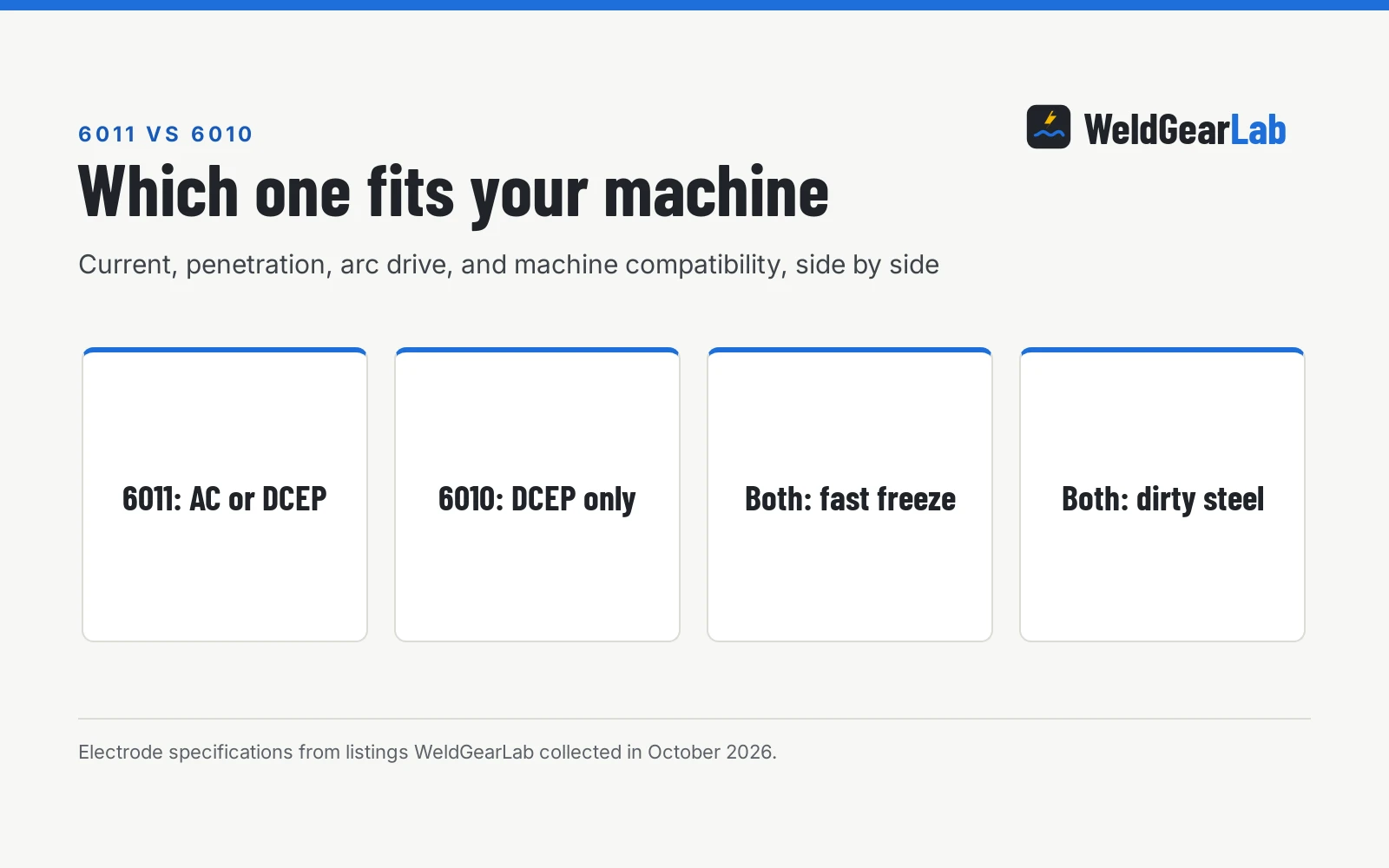
When comparing 6011 welding rod vs 6010, the primary difference is the electrical current your power source delivers. The 6011 welding rod runs on alternating current or direct current electrode positive, making it compatible with almost any stick machine, including basic transformer buzz boxes and compact inverters. In contrast, the 6010 welding rod operates exclusively on direct current electrode positive and requires a power source with sufficient arc force and open circuit voltage to sustain its stiff, digging arc. Both electrodes deliver forceful penetration through rust, mill scale, and paint, but 6011 delivers that performance across diverse shop machines while 6010 remains dedicated to specialized DC equipment.
As an Amazon Associate I earn from qualifying purchases. This guide links to our product roundups, where WeldGearLab earns a commission when you buy through links, at no extra cost to you. Read our affiliate disclosure.
The difference in one paragraph
Stick electrodes use flux coatings that vaporize under arc heat to create shielding gas and deposit a protective slag layer over the molten pool. The 6010 electrode utilizes a cellulose sodium coating that generates an aggressive, deeply digging arc on direct current electrode positive, producing rapid freeze rates favored on pipe root passes. The 6011 electrode alters that chemical formula by incorporating cellulose potassium, which stabilizes the arc when alternating current reverses direction. That chemical adjustment allows 6011 to mimic the penetration, freeze behavior, and contamination tolerance of 6010 while running reliably on AC transformers, utility power, and entry-level stick machines.
6011 welding rod vs 6010: Side by side
| 6011 welding rod | 6010 welding rod | 6013 welding rod | |
|---|---|---|---|
| Current and polarity | AC or DCEP (reverse polarity) | DCEP only (reverse polarity) | AC, DCEP, or DCEN |
| Power source compatibility | Runs on AC transformer or DC machine | Requires DC generator or high-OCV DC machine | Runs on any low-OCV AC or DC machine |
| Flux coating composition | Cellulose potassium | Cellulose sodium | High titania rutile |
| Arc characteristics | Forceful, smooth arc on AC or DC | Harsh, stiff, digging arc | Soft, smooth, low spatter arc |
| Penetration depth | Deep penetration | Deep, aggressive penetration | Shallow to medium penetration |
| Dirty and rusted steel | Burns through rust, dirt, and paint | Burns through rust, dirt, and paint | Requires clean, rust-free base metal |
| Freeze rate | Fast freezing puddle | Fast freezing puddle | Fluid puddle, slow freezing slag |
| Minimum tensile strength | 60,000 PSI | 60,000 PSI | 60,000 PSI |
| Primary use case | Farm repair, maintenance, general fab | Pipe welding, root pass, structural DC | Sheet metal, clean fabrication, hobby |
Both electrodes belong to the fast-freeze classification group, meaning the molten puddle solidifies rapidly after the arc moves forward. Polarity remains the critical boundary: 6011 functions on alternating current or direct current electrode positive, while 6010 requires direct current electrode positive. Always verify the polarity markings printed on your electrode container and check your machine output terminals before striking an arc.
When 6011 is the better choice
- AC buzz boxes and utility welders. If your shop runs an AC transformer without direct current rectification, 6011 is your primary option for deep joint penetration. A 6010 rod will extinguish repeatedly or struggle to establish an arc on alternating current.
- Rusted, dirty, or painted steel. The potassium-cellulose coating produces a forceful, focused arc that burns through mill scale, surface grease, rust, and paint without requiring extensive grinding preparation.
- General farm and equipment maintenance. Quick repairs on fence gates, implements, trailers, and structural brackets often happen in field conditions where cleaning the steel down to bright metal is impractical.
- Budget inverter machines. Many portable hobby inverters have moderate open circuit voltage that struggles to sustain a 6010 arc. An electrode like 6011 ignites easily and maintains arc stability across compact stick machines.
Our best welding rods for AC welder guide covers stick electrodes selected for reliable arc stability on alternating current machines.
When 6010 is the better choice
- Cross-country pipe and pressure joints. Pipe welding codes frequently specify 6010 for open-root passes because its sodium-based arc digs deeply, leaves flat root beads, and allows clear puddle visibility.
- Engine-driven DC generators. Professional pipeline rigs and generator units deliver pure direct current with high arc drive, which matches the aggressive operating profile of 6010 electrodes.
- Vertical-down root runs. In pipe fabrication, downhill welding with 6010 deposits thin, sound root passes rapidly while pushing through rust and joint fit-up variations.
- Radiographic inspection standards. When deposited on appropriate DC equipment by a skilled operator, 6010 creates dense weld deposits that satisfy structural radiographic standards.
For heavy farm repairs where equipment runs on direct current, review our best stick welder for farm use guide to evaluate machines capable of handling demanding structural tasks.
How to tell what your welder can run
Not every stick machine has the electrical architecture to burn both rod types. While almost any machine can strike an arc with 6011, running 6010 requires specific machine capabilities. Check these details on your welder faceplate and documentation:
- Current selector and output terminals. If your machine features only AC output terminals or a single current selector without polarity switches, stick with 6011. Running 6010 requires direct current electrode positive output.
- Inverter arc force controls. Modern digital inverters often provide dedicated cellulosic settings or adjustable arc force. Because 6010 demands high arc voltage, standard inverters without cellulosic programming will snuffer the arc when the rod touches the puddle.
- Open circuit voltage ratings. Cellulosic sodium coatings require elevated open circuit voltage to maintain an ionized arc path. Machines with lower open circuit voltage will experience arc stutter, rod sticking, and frequent outages when paired with 6010.
Electrode packaging listings demonstrate these electrical distinctions clearly. Forney lists its 31101 E6011 electrode in 3/32-inch diameter rated for an amperage capacity of 90 A, operating across an amperage range of 35-125, with 60,000 tensile strength in a 1-pound pack. For larger joints, Forney lists its 31210 E6011 electrode in 1/8-inch diameter with an amperage capacity of 130 A and 60,000 tensile strength in a 10-pound pack. Listing specifications can also contain internal discrepancies that require attention. For example, the Forney 31101 listing identifies the product in its title as an E6011 rod in 3/32-Inch diameter and 1-Pound weight, whereas its spec table mistakenly references E6010 and a 10 Pound package weight. Hobart lists its 770458 6011 electrode in 3/32-inch diameter with 60,000 PSI tensile strength running on AC or DCEP reverse polarity in a 10-pound pack, alongside its 770459 1/8-inch electrode in a 5-pound pack and 770460 1/8-inch electrode in a 10-pound pack. Check our stick welder AC vs DC guide to confirm machine output capabilities.
Current and polarity settings
Operating a cellulose-coated rod requires balancing current and travel speed to avoid excessive burn-through on thin sections while maintaining full joint penetration. On direct current electrode positive, 6010 produces a stiff, concentrated column of electrons flowing into the workpiece, generating deep root penetration and rapid heat transfer. Running 6011 on alternating current alternates the heat balance equally between electrode and base plate, yielding a stable puddle with slightly less directional force.
Operating ranges from manufacturer listings provide practical starting points. For 1/8-inch diameter rods (roughly 3.2mm in metric sizing), TOOLIOM lists its E6011 electrodes with recommended amperages of 75A-125A across 14-inch length rods in 5-pound and 10-pound containers. YESWELDER lists an identical 75A-125A operating recommendation for its 1/8-inch diameter, 14-inch long E6011 electrodes in 5-pound and 10-pound packages. For smaller joints or thinner material, 3/32-inch rods (corresponding to 2.5mm metric sizing) operate at lower amperage, as seen in Forney listing data specifying an amperage capacity of 90 A with an operating span of 35-125. HYW Products lists bulk packaging with a 50 lb steel can of E6011 electrodes in 1/8-inch diameter and 14-inch length under AWS A 5.1-04, noting 3/32-inch and 5/32-inch dimensions. Our best welding rods for mild steel guide details filler metal selection across additional joint configurations.
Can you switch between 6010 and 6011?
Yes, provided your welding machine provides direct current electrode positive output with adequate arc voltage. If you operate an industrial power source or an engine-driven generator capable of running 6010, you can substitute 6011 on DCEP without sacrificing joint integrity. Both filler metals share identical minimum mechanical tensile properties of 60,000 PSI, all-position welding capability, and fast-freezing puddle control. However, you cannot swap in the opposite direction on an AC transformer buzz box: attempting to run 6010 on alternating current results in immediate arc outage.
Cellulose fumes and arc spatter safety. Both 6010 and 6011 electrodes generate forceful arc spray, high spatter levels, and heavy smoke plumes due to their organic cellulose coatings. When welding through painted, galvanized, or oily steel, toxic fumes increase substantially. Always position your helmet and body outside the rising smoke plume, weld in open areas or beneath dedicated mechanical ventilation, and wear leather welding gear to shield against hot slag droplets and flying sparks. Clear dry vegetation and combustible clutter from the work perimeter before striking an arc.
Frequently Asked Questions
How do you use a 6010 welding rod?
To weld with a 6010 electrode, set your machine to direct current electrode positive and verify your power source delivers sufficient arc voltage. Strike the arc using a scratch method and maintain a tight arc length while employing a rhythmic whip-and-pause stepping technique. The forward whip preheats the joint while the pause fills the crater, allowing the fast-freezing puddle to solidify smoothly without undercut.
How do you weld with 6011 welding rods?
Welding with 6011 rods requires selecting alternating current or direct current electrode positive on your stick power source. Use a brief scratching stroke to initiate the arc, then apply a steady whip-and-pause motion or a subtle circular weave to advance along the seam. The aggressive arc cuts through surface rust and grime, depositing a flat bead with light, easily chipped slag.
Is 6011 a good welding rod for general repairs?
The 6011 electrode is one of the most versatile maintenance rods available for agricultural, automotive, and shop fabrication. Its ability to run on economical AC utility machines while penetrating dirty or rusty steel makes it indispensable for quick field fixes. With a minimum tensile rating of 60,000 PSI, it delivers sound, durable joints on structural carbon steel.
When should you use a 6013 welding rod instead?
Choose a 6013 welding rod when working on clean, thin sheet metal or when bead appearance takes priority over deep penetration. Unlike the aggressive digging arc of 6010 or 6011, the 6013 rod produces a soft, quiet arc with fluid slag coverage and minimal spatter. It operates smoothly on AC or DC machines but lacks the digging force required for heavy rust or mill scale.
How do you weld with 6013 welding rods compared to 6011?
Welding with 6013 rods involves a steady drag technique along the seam rather than the whip-and-pause manipulation customary with 6011. The heavy rutile slag of 6013 floats freely over the puddle to create smooth, polished bead ripples requiring minimal cleanup. However, running 6013 over contaminated or oily metal risks slag inclusions, making 6011 the superior choice for uncleaned repair work.
Related: best welding rods for AC welder, best welding rods for mild steel, stick welder AC vs DC, and the welding consumables hub. Also see our guides on how to use stick welder and stick welders.
About the author
WeldGearLab Editorial is the editorial team behind WeldGearLab. We research product listings, specifications, safety listings and warranty terms, score every pick with the published Gear Score method, and correct errors when readers report them. We do not run our own shop trials; see How We Pick for exactly how picks are made.