Flux Core Welding vs Stick Welding: Which One Should You Buy?
Flux core and stick welding both work outdoors without shielding gas, but they differ on metal thickness, wire feeding, cleanup, and machine setup.
 By WeldGearLab Editorial
Updated October 9, 2026
By WeldGearLab Editorial
Updated October 9, 2026
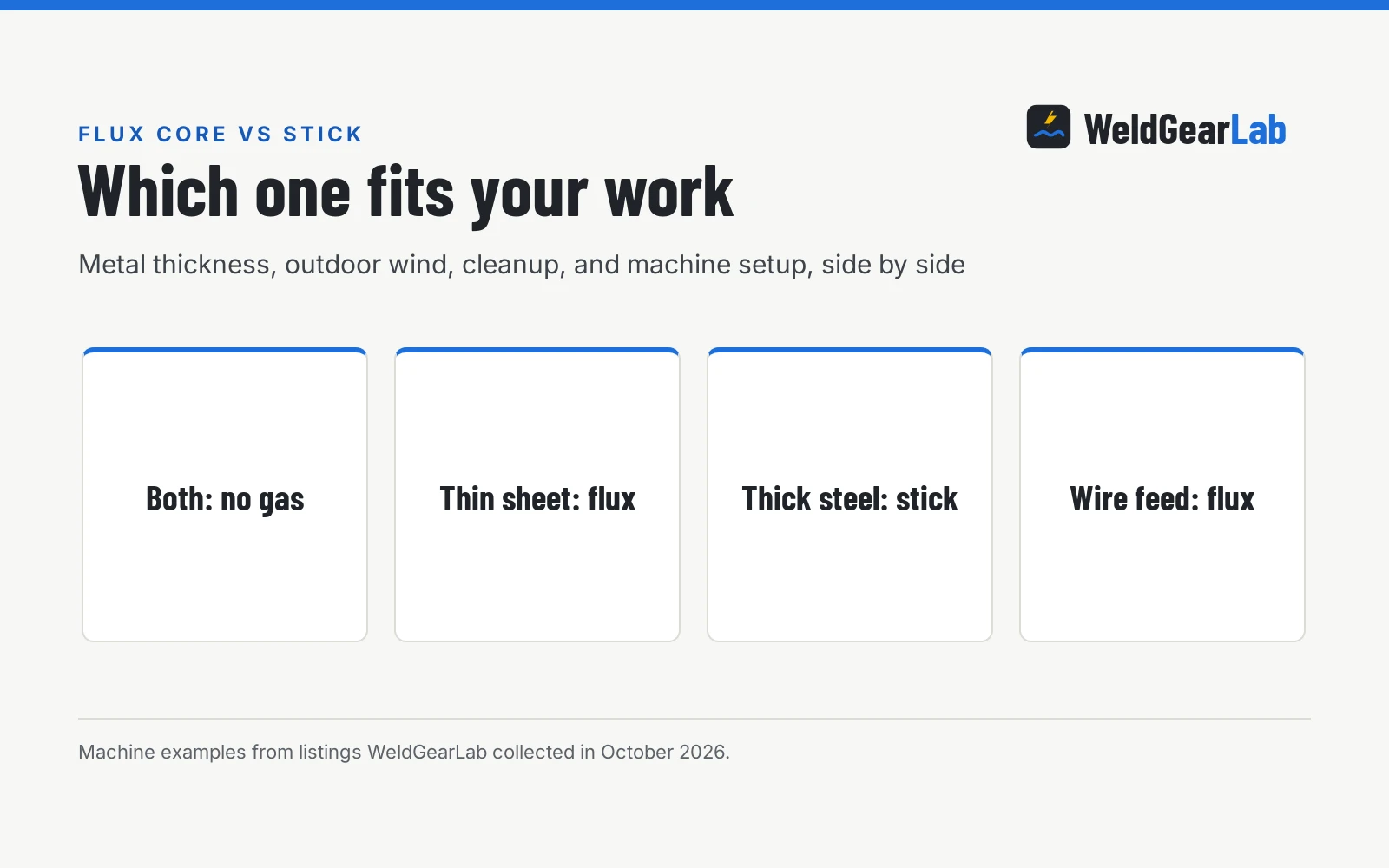
When deciding between flux core welding vs stick welding, the choice comes down to metal thickness, equipment portability, joint cleanliness, and whether you prefer continuous wire feeding or manual rod reach. Flux core welding feeds a continuous wire spool through a handheld gun, making it faster and easier to run on thin sheet metal and small home projects. Stick welding uses individual flux-coated rods clamped in an electrode holder, giving you deeper penetration on thick, rusty steel out in the field without any wire feed mechanisms to jam. Both processes run outdoors without external shielding gas cylinders. This guide compares flux core welding vs stick welding across setup, metal prep, joint thickness, and running costs to help you choose the right process for your shop.
As an Amazon Associate I earn from qualifying purchases. This guide links to our product roundups, where WeldGearLab earns a commission when you buy through links, at no extra cost to you. Read our affiliate disclosure.
Flux Core Welding vs Stick Welding: The Core Differences
Molten steel reacts rapidly with oxygen and nitrogen in ambient air, which causes porosity and ruins weld strength. Both processes solve this problem without requiring heavy compressed gas cylinders, but they deliver their shielding chemistry differently. Self-shielded flux core wire is hollow and packed with flux compounds that vaporize in the electric arc, creating a local gas shield while depositing a slag crust over the cooling puddle. Stick welding, formally known as Shielded Metal Arc Welding, uses a solid metal core wire covered with an extruded flux coating that burns as you consume the electrode. Continuous wire feeding gives flux core speed and ease of use on lighter materials, while manual rod feeding gives stick welding simplicity and brute penetration on heavy steel.
Side by side
| Flux core (self shielded) | Stick welding (SMAW) | Best choice | |
|---|---|---|---|
| Shielding | Flux inside continuous tubular wire | Flux coating on solid electrode rod | Both need no gas cylinder |
| Feeding method | Continuous spool feeding through torch | Individual rods changed by hand | Flux core for speed |
| Wind and outdoor work | Tolerates wind with no shielding gas | Tolerates heavy wind and weather | Stick handles rough weather |
| Dirty or rusty steel | Tolerates light rust and mill scale | Handles heavy mill scale and surface rust | Stick for rusty steel |
| Thin sheet metal | Easier on thin sheet with smaller wire | Difficult, high risk of burn through | Flux core prevents burn through |
| Thick steel penetration | Moderate, limited on small home machines | Deep penetration on heavy structural steel | Stick for thick plate |
| Spatter and cleanup | Slag to chip and fine spatter to clean | Heavy slag layer to chip and brush | Both require chipping |
| Typical polarity | DCEN (electrode negative) | DCEP (electrode positive) or AC | Depends on consumable |
| Learning curve | Easier trigger operation and wire feed | Harder arc strike and rod angle control | Flux core is easier to start |
Polarity depends on consumable classification; always follow the polarity printed on your wire spool or electrode packaging, as well as the machine manual. Self-shielded flux core wire runs on direct current electrode negative, whereas stick electrodes vary by rod type, running on direct current electrode positive, direct current electrode negative, or alternating current.
When flux core welding is the better choice
- Thin sheet metal and light fabrication. Small diameter wire fed continuously allows lower amperage operation and smaller weld beads, making thin sheet and tubular frames far less prone to burn through than stick electrodes.
- Long, unbroken weld beads. Because wire feeds automatically from an internal spool, you can complete long seams around frames or sheet metal panels without stopping to replace a burned-down rod.
- Gentler learning curve for hobbyists. Trigger-operated wire feeding allows beginners to focus on travel speed and torch angle without having to compensate for an electrode that continuously shrinks in length.
- Small home workshop projects. Compact wire feed machines designed for 110V household outlets, such as the ARCCAPTAIN 135A model, handle brackets, carts, and small repair tasks cleanly inside a garage.
For home fabricators working primarily on sheet metal and light tubing, gasless wire feed machines keep setup straightforward. Explore our guide to the best flux core welder for dedicated gasless units, or browse our best welder for beginners guide for machines with automatic setting assistance.
When stick welding is the better choice
- Thick structural steel and heavy equipment. Stick welding delivers deep arc penetration, allowing single-pass and multi-pass joints on heavy plate, farm implements, and structural brackets where small wire welders struggle.
- Dirty, rusty, or mill scale steel. The aggressive digging arc and heavy flux chemistry of stick electrodes handle surface rust and mill scale far better than flux core wire.
- Windy and rough outdoor conditions. High winds, blowing dust, and open field environments do not compromise stick welding, making it the preferred method for ranch fencing and field equipment repairs.
- Simple mechanics with no wire drive to jam. Dedicated stick machines eliminate drive rolls, tensioners, torch liners, and contact tips, meaning there are no wire feed parts to birdnest, bind, or burn back.
- Extended working reach. You can add long lead cables to your stinger clamp and ground clamp to reach awkward locations high up on equipment without moving the power source itself.
Farmers, ranchers, and mobile repair operators often rely on stick machines for rough field repairs. Check our roundup of the best stick welder for farm use for capable ranch equipment options. For lightweight units you can carry directly to a broken gate, read our guide to the best portable stick welder.
Equipment, consumables, and setup compared
The hardware required for each process reflects their mechanical differences. A flux core setup requires a wire feeder typically fitted with knurled drive rolls, a torch liner, contact tips, and a gasless nozzle. Consumables are sold in spools: makers like YESWELDER and YixangDD list E71T-GS wire in 0.030 inch and 0.035 inch diameters on 2 lb spools, while ARCCAPTAIN lists 0.035 inch wire on a 10 lb spool with a stated tensile strength of 80496 psi. Consumable wear parts must match the wire: TimelyDu lists a 24 piece kit with .030 inch tips and gasless nozzles, and Allyearauto lists replacement gasless nozzles rated for 100A to 130A. Maintaining smooth wire feeding requires proper roll tension and clean liners.
Stick welding equipment is mechanically minimal. The power source connects directly to a heavy-duty ground clamp and an insulated electrode holder. Consumables are individual flux-coated rods rather than continuous wire. There are no feed rollers to adjust, no nozzles to clear of spatter, and no drive motors to service. Setting up simply involves clamping a rod into the stinger and setting your amperage output. For striking techniques and arc control, see our walkthrough on how to use a stick welder.
Can one machine run both processes?
Many modern inverter welders support both processes in a single package. For example, multi-process machines like the AWT 140A unit combine flux core wire feeding, stick welding, and lift TIG capability in one chassis. Having a dual-process machine gives small shops maximum versatility: you can run convenient flux core wire for thin sheet metal assemblies on your bench, then switch to stick welding when repairing heavy structural channel or rusty farm implements outdoors.
To compare multi-process flexibility against dedicated units, see our stick welder vs wire welder breakdown and explore our complete catalog of welders.
Safety, fumes, and slag cleanup
Both processes produce substantial airborne fumes and smoke because their flux compounds burn rapidly during welding. Always position your head away from the rising fume plume and weld in well-ventilated spaces or open outdoor areas. Never weld on galvanized steel without respiratory protection and strong ventilation, as zinc coatings release dangerous fumes when heated.
Slag cleanup is a mandatory step for both methods. Because the molten weld puddle is protected by flux rather than gas, a glassy slag crust covers the cooled weld bead. You must chip this slag away with a chipping hammer and wire brush before painting or depositing another pass. Hot slag can pop off spontaneously or fly during chipping, so always wear safety glasses beneath your welding helmet.
Frequently Asked Questions
Is flux core welding MIG welding?
Flux core welding is closely related to MIG welding because both processes feed wire continuously through a gun cable, but they use different shielding mechanisms. MIG welding requires an external compressed gas cylinder, such as an argon mixture, whereas self-shielded flux core relies entirely on flux compounds packed inside the tubular wire. Many wire feed machines can run both processes if equipped with an internal gas valve.
Is flux core welding good for beginners?
Flux core welding is generally considered easier for beginners to pick up because continuous wire feeding simplifies arc initiation and puddle tracking. The operator pulls a trigger and maintains a steady torch angle without having to compensate for an electrode that shortens as it burns. However, learning to prevent burn through and properly chipping slag still require practice.
What is flux core welding also called?
The American Welding Society officially designates flux core welding as Flux-Cored Arc Welding, abbreviated as FCAW. When operated without an external shielding gas supply, it is specifically designated as self-shielded flux-cored arc welding, or FCAW-S. In shop conversations, hobbyists frequently refer to it simply as gasless wire welding.
How to use a flux core welder?
To use a flux core welder, spool self-shielded wire onto the drive hub, feed the strand through the drive rolls into the gun liner, and set machine polarity to direct current electrode negative. Adjust wire feed speed and voltage according to the machine door chart, hold the torch nozzle at a slight drag angle, pull the trigger, and maintain a consistent travel pace. Once the seam cools, remove the protective slag crust using a chipping hammer and wire brush.
Which process produces stronger welds: flux core or stick?
Both processes produce strong, sound joints when the selected consumable matches the base metal and proper technique is applied. Stick welding typically achieves deeper penetration on thick structural steel, whereas flux core provides more uniform fusion across lighter metal assemblies. Overall weld strength depends primarily on proper joint preparation, penetration depth, and avoiding slag entrapment.
Related: stick welder vs wire welder, best flux core welder, best portable stick welder, how to use a stick welder, and the welders hub.
About the author
WeldGearLab Editorial is the editorial team behind WeldGearLab. We research product listings, specifications, safety listings and warranty terms, score every pick with the published Gear Score method, and correct errors when readers report them. We do not run our own shop trials; see How We Pick for exactly how picks are made.