308l vs 316l Welding Rod: Which One Should You Buy?
308L suits the 304 family of stainless steels, while 316L suits the 316 family and harsher chloride service, and the featured rods show what the 308L side looks like on the shelf.

On this page
Top picks at a glance
As an Amazon Associate I earn from qualifying purchases.
- 1
 Victory Welding Alloys 6010 Welding Rod 5/32" E6010 5/32" 59.6/10View on Amazon
- 2
 50 lb Steel Can E6010 5/32" Stick electrodes welding rod9.6/10View on Amazon
- 3
 Forney 31105 E6011 Welding Rod9.6/10View on Amazon
- 4
 ARCCAPTAIN Stainless Steel TIG Welding Rod ER308LView on Amazon
- 5
 YESWELDER Stainless Steel TIG Welding Rod ER308L 1/16"x16" 5LBView on Amazon
- 6
 YESWELDER Stainless Steel TIG Welding Rod ER308L 1/8"x16" 5LBView on Amazon
- 7
 TOOLIOM ER308L 1/16" Stainless Steel TIG Welding Rod 5LBView on Amazon
- 8
 NICETECH E308L-16 Arc Welding Rod Stainless Steel ElectrodesView on Amazon
- 9
 TOOLIOM E308L-16 Welding Rod Stainless Steel Stick ElectrodeView on Amazon
A stainless repair lands on the bench: a cracked bracket, a food-grade frame, or a pipe joint that has to stay clean. 308l vs 316l welding rod is the question of which filler matches the base metal in front of you. The short answer is to match the rod to the base metal: 308L for the 304 family, 316L for the 316 family, and a pause to confirm the base metal whenever it is unknown.
Other welders and gear to compare
 ARCCAPTAIN Stainless Steel TIG Welding Rod ER308LCheck price on Amazon
 YESWELDER Stainless Steel TIG Welding Rod ER308L 1/16"x16" 5LBCheck price on Amazon
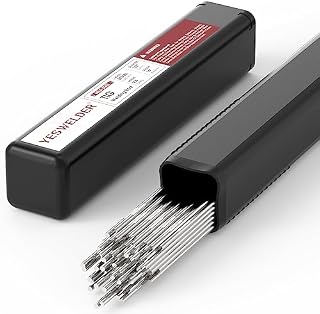 YESWELDER Stainless Steel TIG Welding Rod ER308L 1/8"x16" 5LBCheck price on Amazon
 TOOLIOM ER308L 1/16" Stainless Steel TIG Welding Rod 5LBCheck price on Amazon
 NICETECH E308L-16 Arc Welding Rod Stainless Steel ElectrodesCheck price on Amazon
 TOOLIOM E308L-16 Welding Rod Stainless Steel Stick ElectrodeCheck price on Amazon
This guide links to our product roundups, where WeldGearLab gets a commission on purchases made through links on this page, and your price stays the same. Read our affiliate disclosure.
The difference in one paragraph
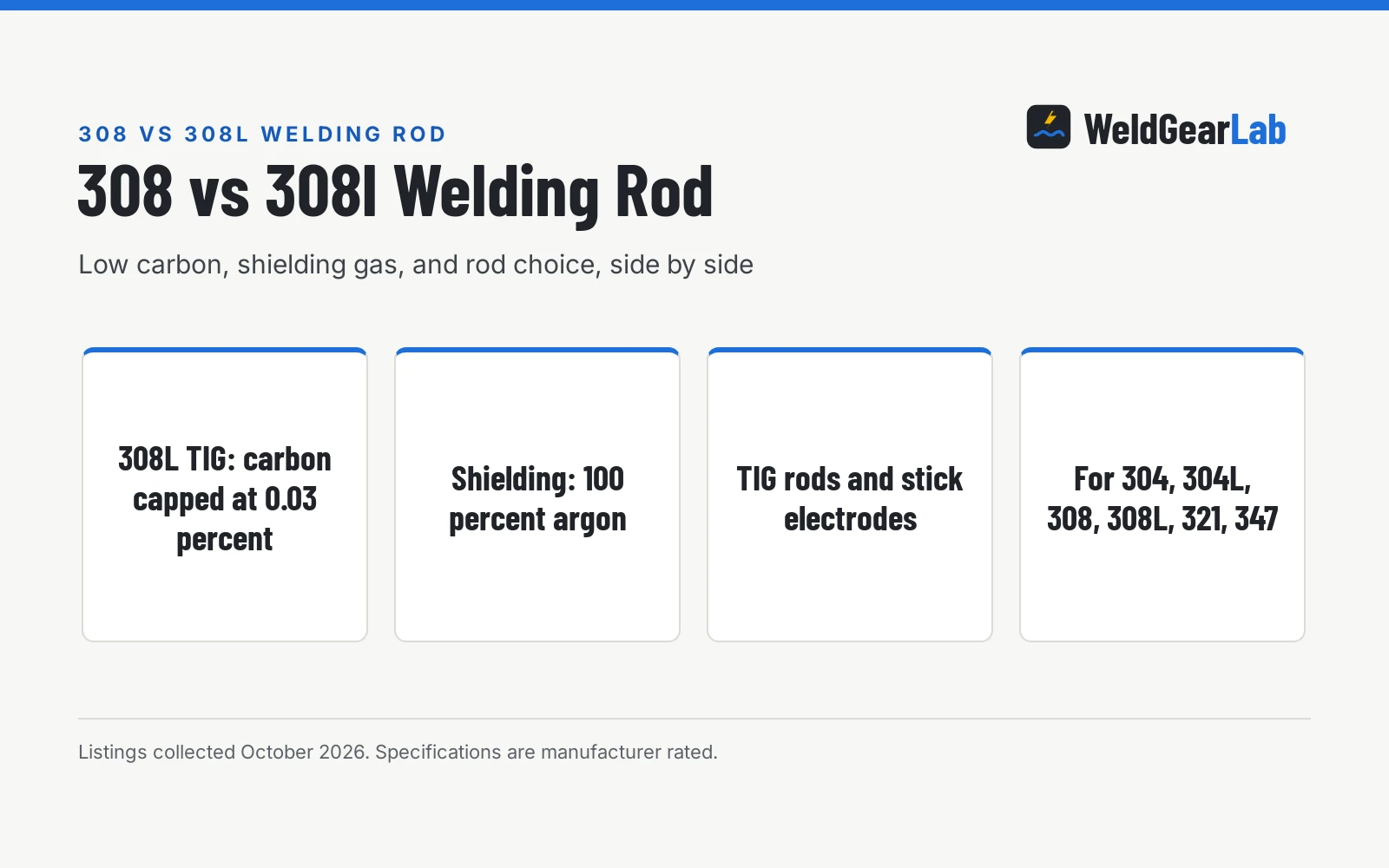
Both grades carry the low-carbon L designation, so low carbon alone does not separate them: the YESWELDER 308L listing puts its carbon content at 0.03 percent maximum, which increases weld metal resistance to intergranular corrosion. 308L is the general-purpose filler for the 304 family, and the YESWELDER listing calls it the most popular stainless rod for general-purpose applications where corrosion is moderate. 316L is the filler for the 316 family, a molybdenum-bearing grade suited to heavier chloride service. The grades are not interchangeable by habit: pick by base metal first, then by service conditions.
308l vs 316l welding rod side by side
| 308L rod | 316L rod | Featured listings | |
|---|---|---|---|
| Base metal match | 304, 304L, 308, 308L, 321 and 347, per the YESWELDER listing | 316 and 316L base metals | All featured listings are 308L |
| Shielding gas | 100% Argon or Argon and Helium, per the ARCCAPTAIN and YESWELDER listings; TOOLIOM recommends 100% Argon | Not stated in the featured listings | TIG rods in the featured listings state argon shielding |
| Form | TIG rod, plus a stick electrode in the featured listings | Not stated in the featured listings | TIG rods and a stick electrode |
| Diameter | 1/16 inch and 3/32 inch in the featured listings | Not stated in the featured listings | Sizes stated per listing, not shared across listings |
| Corrosion resistance | Low carbon content, 0.03 percent maximum, per the YESWELDER listing | Suited to heavier chloride service | Low carbon stated on the ARCCAPTAIN, YESWELDER and TOOLIOM listings |
| Pack size | 5LB packs on the TIG rods | Not stated in the featured listings | 5LB on the TIG rods, 0.15 Lb on the stick electrode |
The featured listings cover the 308L side only, so the 316L column describes the grade, not a featured product. That gap is itself useful: it shows how much of the shelf is 308L, and why a 316L job needs a deliberate search rather than a grab from the 308L bin.
When 308L is the better choice
- 304 family base metal. The YESWELDER listing names 304, 304L, 308, 308L, 321 and 347 as its filler applications, which covers the common austenitic shop metals.
- General-purpose stainless work. The YESWELDER listing describes ER308L as the popular rod where corrosion is moderate, including work at cryogenic temperatures.
- Thin plate welding. The ARCCAPTAIN listing describes its rod as commonly used for thin plate welding, with smooth welding and full-location welding performance.
- Food, medical and process work. The ARCCAPTAIN and YESWELDER listings name food processing machinery, medical equipment, petrochemical work and pressure vessels among the uses.
When 316L is the better choice
- 316 family base metal. Match the filler to the base metal rather than reaching for the 308L rod already on the shelf.
- Heavier chloride service. Where chlorides are the main corrosion concern, the 316L grade is the matching choice for 316 base metal.
- When the spec calls for 316L. If a drawing, procedure or customer spec names 316L filler, that call stands, and a 308L rod is not a silent substitute.
- When corrosion resistance is the deciding factor. If the joint will face chlorides day after day, the 316L grade is the conservative pick.
The featured rods, ranked
No featured listing states a warranty term, and every featured listing is a 308L rod, so the ranking below rests on stated coverage, gas options and packaging. YESWELDER ER308L, 1/16 inch by 16 inch, 5LB. The broadest listing of the group: filler for 304, 304L, 308, 308L, 321 and 347, low carbon content at 0.03 percent maximum for intergranular corrosion resistance, and shielding with 100% Argon or Argon and Helium for greater penetration and higher speeds. It is the natural first pick for general-purpose stainless TIG work.
TOOLIOM ER308L, 1/16 inch by 16 inch, 5LB. A close second, with the same diameter and pack size, recommended for use with 100% Argon gas, and a heavy-duty plastic storage tube that protects the rods from bending, moisture and dust. The listing names 304 and 304L structures, automotive exhaust systems, food-grade equipment, chemical piping and general sheet metal work. The tube is a real shop advantage: loose rods bend and pick up shop grime, and this listing solves that.
ARCCAPTAIN ER308L, 3/32 inch by 16 inch, 5LB. The larger diameter rod of the group, listed for thin plate welding with smooth welding, melted depth, no splash and single-sided welding with double-sided forming. Shielding gas is 100% Argon or Argon and Helium, and the listed uses run from welding and petrochemical work to pressure vessels, food processing machinery and medical equipment. It ranks behind the 1/16 inch rods only because its listing names no base-metal range, while the YESWELDER listing names one.
HARFINGTON E308L-16, 1/16 inch by 10 inch, 0.15 Lb. The odd listing out, and worth noting for that reason: a stick electrode, not a TIG rod, sold as 10 rods for stainless steel welding in metal fabrication, maintenance and repair work. The listing states AC and DC power supply, all-position welding, rust and corrosion resistance, and a note to keep the rods as dry as possible with slow heating and cooling. The title also mentions galvanized steel, while the bullets describe stainless steel welding, so read the bullets as the guide to its use. The small pack suits a repair job, not a production run.
How to choose
Start with the base metal, not the rod diameter. If the base metal is in the 304 family, a 308L rod from the featured listings fits the listing applications. If the base metal is in the 316 family, look for a 316L rod instead, since no featured listing here covers that side. Next, check the process: the ARCCAPTAIN, YESWELDER and TOOLIOM listings are TIG rods with argon shielding, while the HARFINGTON listing is a stick electrode for AC and DC. Finally, check the pack: the TIG rods come in 5LB packs, while the HARFINGTON pack is 0.15 Lb, so size the order to the job.
Stainless fumes and shielding gas. Stainless welding makes fumes that call for ventilation or outdoor air with the head out of the plume, and galvanized steel adds its own fume hazard, so ventilation matters even more there. Argon and helium cylinders are compressed gas: keep cylinders upright and chained, keep the arc flash off skin and eyes with a proper helmet, and clear flammable material from the area before striking an arc.
FAQ for welders
Can I use 308L rod on 316 stainless?
It is not the matching filler for 316 base metal, and the matching rule in this guide says to reach for 316L instead. A 308L rod may lay a bead on 316, but the joint may not match the corrosion resistance the base metal was chosen for. When the base metal is 316, buy the 316L rod for that job.
What shielding gas do the featured 308L rods use?
The ARCCAPTAIN and YESWELDER listings state 100% Argon or Argon and Helium. The TOOLIOM listing recommends 100% Argon gas for a bright, rust-resistant finish and to prevent oxidation during high-heat work. The HARFINGTON listing is a stick electrode, so it needs no separate shielding gas cylinder: its flux coating shields the weld, unlike the bare TIG rods.
Are all the featured rods TIG rods?
No. The ARCCAPTAIN, YESWELDER and TOOLIOM listings are TIG rods, while the HARFINGTON listing is an E308L-16 stick electrode. The stick electrode states AC and DC power supply and all-position welding, which makes it a different process from the TIG rods entirely. Check the process before ordering, since a TIG rod cannot run as a stick electrode.
What diameters do the featured rods come in?
The ARCCAPTAIN listing is 3/32 inch in diameter, while the YESWELDER, TOOLIOM and HARFINGTON listings are 1/16 inch in diameter. Length differs too: the TIG rods are 16 inch long, while the HARFINGTON stick electrodes are 10 inch long. Diameter and length come from each listing, so confirm both against the joint before ordering.
Do the featured rods state a warranty?
No featured listing states a warranty term. The listings describe the rods, their sizes, their gas and their uses, but none names a warranty period. Treat the purchase as a consumable buy, and check the seller listing at order time if a warranty matters for the job.
Related: 308 vs 316 stainless welding rod, 308 vs 308L welding rod, 1/16 vs 3/32 welding rod, and argon vs helium for TIG welding.