Welding Helmet vs Welding Goggles: Which One Should You Buy?
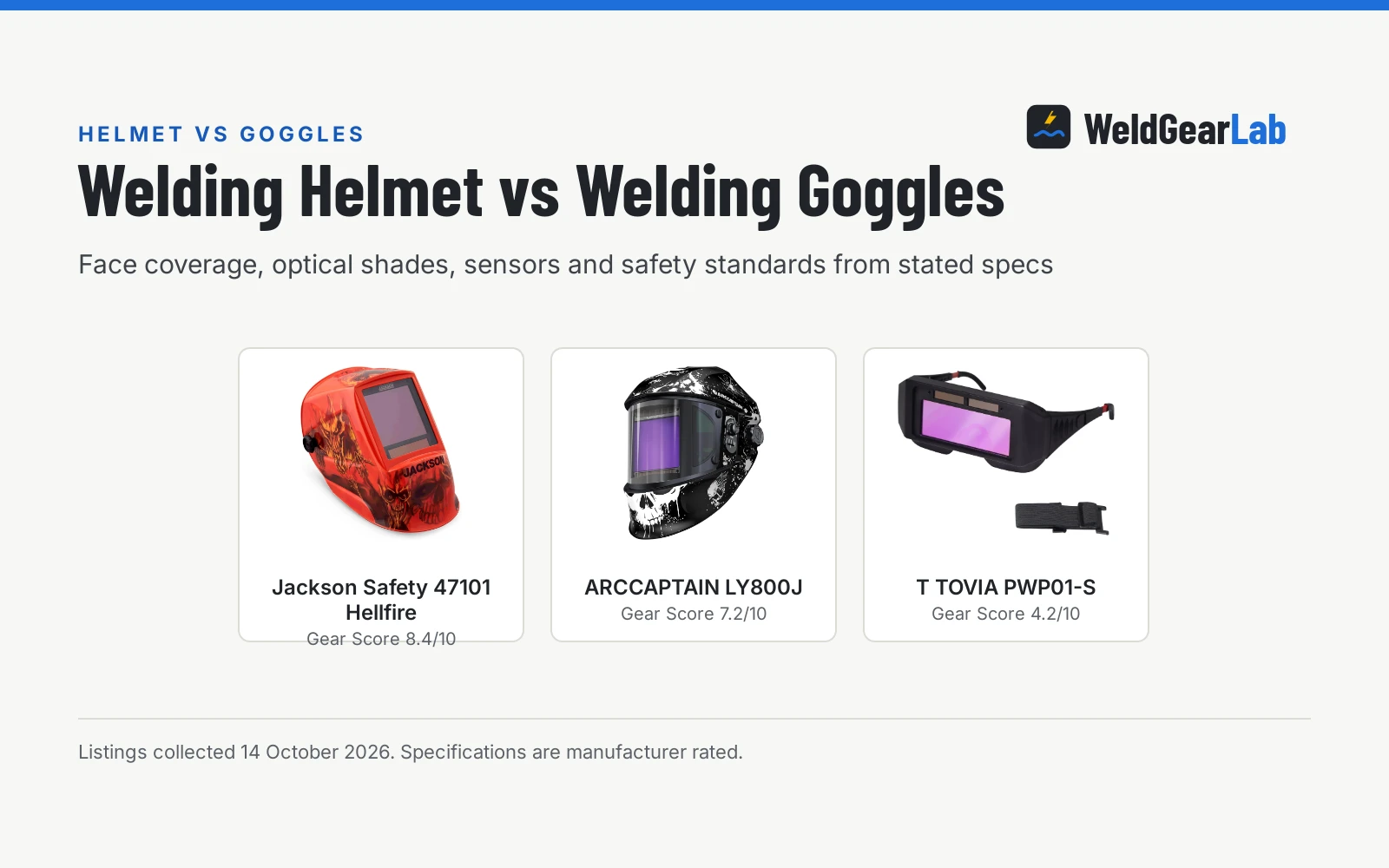
Welding helmets provide full facial shielding against arc radiation and spatter, while welding goggles offer compact eye protection for light cutting and tight clearance work.

On this page
Top picks at a glance
As an Amazon Associate I earn from qualifying purchases.
- 1
 Jackson Safety Premium Graphics Auto Darkening9.7/10View on Amazon
- 2
 ARCCAPTAIN Welding Hood, 180° Panoramic View Auto9.5/10View on Amazon
- 3
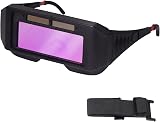 T TOVIA Welding Glasses Auto-Darkening LCD Welding9.2/10View on Amazon
Verdict. In the comparison of welding helmet vs welding goggles, pick a welding helmet for almost every welding job on steel, aluminum, or stainless. A full hood shields your face and eyes from arc flash, radiation, and flying hot spatter, with designs like the Jackson example adding extended throat and neck coverage. Pick welding goggles only for low-spatter jobs in cramped quarters, such as light plasma cutting or torch work, where a full hood will not physically fit.
When you clamp your ground and prepare to strike an arc on the fab bench, choosing between a welding helmet vs welding goggles comes down to the trade-off between total facial coverage and compact clearance. This comparison examines what separates welding helmets from welding goggles using published listings from our bench scoring.
WeldGearLab gets a commission on purchases made through links on this page, and your price stays the same. Read our affiliate disclosure.
The machines

Jackson Safety Premium Graphics Auto Darkening
A lightweight 1.26 lb auto-darkening welding hood with ANSI Z87.1 and CSA Z94.3 certifications, variable 3/5-13 shade, 4 arc sensors and a 2 year warranty.
Pros
- Meets ANSI Z87.1+ and CAN/CSA Z94.3 safety standards, and is CE certified
- Weighs 1.26 lbs in the bullets and includes extended front neck protection
- Variable ADF shade 3/5-13 with 1/1/1/1 optical clarity and 4 arc sensors
- Specification table states a 2 Years warranty term
Cons
- Replaceable CR2032 battery is not included in the box
- Reaction speed is 1/20,000 sec compared to 1/25000 sec on the ARCCAPTAIN

ARCCAPTAIN Welding Hood, 180° Panoramic View Auto
A panoramic auto-darkening welding helmet with a 3.94" x 7.06" viewing field, 4 arc sensors, 1/25000s reaction speed, 1/1/1/1 clarity and spare lenses in the box.
Pros
- 180 degree panoramic viewing screen measuring 3.94" x 7.06" with DIN 5 side views
- Fast 1/25000s switching speed powered by 4 arc sensors
- Shade ranges of DIN 5-9 and 9-13 with DIN 4 light state and 1/1/1/1 clarity
- Ships with 1 storage bag, 2 replacement lithium batteries and 3 replacement lenses
Cons
- Heaviest pick in the group at 2.55 pounds in the specification table
- No ANSI Z87.1, CSA or CE certification standard is stated in the listing
- No warranty term is stated in the listing

T TOVIA Welding Glasses Auto-Darkening LCD Welding
A compact 2.08 oz pair of auto-darkening welding goggles with 2 sensors, adjustable temples and ABS frame for light torch work and tight spaces.
Pros
- Lightest option at 2.08 ounces in the specification table
- Compact goggle profile fits under hoods and inside cramped work spaces
- Equipped with 2 arc sensors for auto-darkening LCD operation
- Adjustable eyewear temples and anti-reflective polycarbonate lenses
Cons
- Protects eyes only, leaving face, ears and neck completely exposed to spatter
- Listing omits switching speed, optical clarity and numeric shade ranges
- No ANSI Z87.1 or CSA impact and radiation standard is stated
- No warranty term is stated in the listing
Other welders and gear to compare
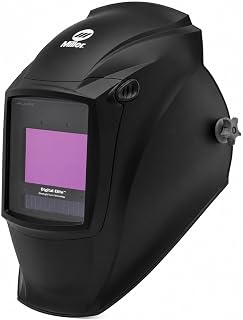 Miller Digital Elite™ Welding HelmetCheck price on Amazon
 ARCCAPTAIN Intelligent Auto-Darkening Welding HelmetCheck price on Amazon
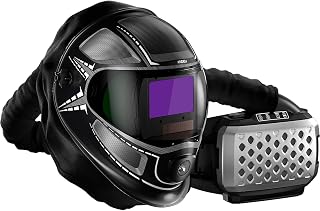 ANDELI Welding Helmet with RespiratorCheck price on Amazon
 Miller Digital Performance™ Welding HelmetCheck price on Amazon
 YESWELDER Auto Darkening Welding Helmet 1/1/1/1 True ColorCheck price on Amazon
 YESWELDER Auto Darkening Welding HelmetCheck price on Amazon
Side by side
| Jackson Safety 47101 Hellfire | ARCCAPTAIN LY800J | T TOVIA PWP01-S | |
|---|---|---|---|
| Gear Score | 83 | 59 | 34 |
| Side | Welding helmet | Welding helmet | Welding goggles |
| Coverage | Full face and extended neck | Full face | Eyes only |
| Viewing area | 3.94″ x 3.64″ (14.34 sq. in bullets, 14.434 sq. in table) | 3.94″ x 7.06″ (center 3.94″ x 3.66″, side views 3.94″ x 1.70″) | Not stated |
| Shade range | Variable 3/5-13 | DIN 4 light, DIN 5-9 / 9-13 dark | Adjustable shade, range not stated |
| Optical clarity | 1/1/1/1 | 1/1/1/1 | Not stated |
| Arc sensors | 4 | 4 | 2 |
| Switching speed | 1/20,000 sec | 1/25000 seconds | Not stated |
| Weight | 1.26 lbs (bullets), 1.3 pounds (table) | 2.55 pounds | 2.08 ounces |
| Power source | Solar and CR2032 battery (not included) | Solar and 2 CR2450 batteries (included) | Not stated |
| Safety standards | ANSI Z87.1+, CAN/CSA Z94.3, CE Certified | Not stated | Not stated |
| Warranty | 2 Years | Not stated | Not stated |
Ratings in this table are the makers’ own claims taken from each product page (14 October 2026). Stated specifications show stark differences in coverage, sensor configurations, and written safety certifications.
Welding helmet vs welding goggles: coverage and protection
The main difference between a welding helmet and welding goggles is physical coverage. An electric arc generates intense ultraviolet and infrared radiation alongside molten spatter. A welding helmet surrounds the forehead, eyes, cheeks, chin, and ears. The Jackson Safety example adds an extended front shell to protect the welder’s throat and neck. The ARCCAPTAIN example encloses the entire face inside a polypropylene shell.
In contrast, welding goggles protect only the ocular cavity. The T TOVIA example covers the eyes with an ABS frame, leaving the welder’s forehead, cheeks, chin, and neck completely bare. During MIG, stick, or flux-cored welding, molten balls of slag and spatter regularly bounce off the workpiece. Without a full helmet shell, that spatter strikes exposed skin. Arc radiation also causes rapid skin burns on unprotected flesh during extended bead work. For any process that produces heavy spatter or sustained radiation, a welding helmet is necessary.
Shade ranges and optical clarity
Darkening capability determines how clearly you see your puddle without blinding your eyes. The Jackson Safety helmet provides a variable shade range of 3/5-13, dropping to shade 3 in its light state for grinding and adjusting from shade 5 to shade 13 for welding, cutting, and carbon arc gouging. The ARCCAPTAIN helmet features a DIN 4 light state with dark ranges of DIN 5-9 and DIN 9-13, paired with 2 non-auto-darkening DIN 5 side windows. Both helmet listings publish a 1/1/1/1 optical clarity rating.
The goggle listing is far less specific. The T TOVIA listing states adjustable shade in its title and highlights, but it publishes no numeric DIN shade range. It lists visible light transmission at 0.5, but it does not state a resting light state or an optical clarity rating. When a listing omits numeric shade data, you cannot verify whether the lens darkens sufficiently for higher-amperage welding arcs.
Sensors and switching speed
Sensor count dictates how reliably an auto-darkening filter darkens when you strike an arc, especially when working out of position or behind pipe. Both the Jackson Safety and ARCCAPTAIN helmets feature 4 arc sensors. The Jackson listing notes 4 sensors reduce possible blockage from hands or the torch during welding. The ARCCAPTAIN listing publishes a reaction time of 1/25000 seconds, while the Jackson Safety listing publishes a switching speed of 1/20,000 sec.
The T TOVIA goggle example includes 2 sensors. An arrangement with 2 sensors functions on straight-line bench work, but out-of-position welds can easily shade sensors and cause the lens to flicker. Furthermore, the T TOVIA listing does not state a switching speed, leaving its reaction rate unstated.
Weight, fit and headgear
Weight and balance influence fatigue during long welding shifts. Here the formats diverge completely. The T TOVIA goggles weigh 2.08 ounces in the specification table. They wear like oversized safety glasses with adjustable temples, slipping easily into tight spaces such as roll cages or underneath vehicle dashboards.
Full helmets carry significantly more bulk. The Jackson Safety hood balances that bulk with a stated weight of 1.26 lbs in its bullets and 1.3 pounds in its specification table, supported by a patented 370 Speed Dial ratcheting headgear. The ARCCAPTAIN helmet is much heavier, weighing 2.55 pounds in its specification table. While the ARCCAPTAIN example includes an upgraded knob section for adjustment with gloves, its extra weight puts greater load on neck muscles during long overhead sessions.
What is in the box
Accessories vary noticeably across the listings. The ARCCAPTAIN package includes 1 welding helmet, 2 replacement lithium batteries, 3 replacement lenses, and 1 storage bag. The Jackson Safety listing includes only the welding helmet; its solar-powered ADF uses a replaceable CR2032 battery that is not included in the box. The T TOVIA goggle listing provides conflicting counts, stating 2 items for number of items and 1 count for unit count, with no extra replacement cover lenses mentioned.
Safety certifications and warranty
Safety certifications confirm whether safety gear satisfies verified impact and optical standards. The Jackson Safety 47101 listing states compliance with ANSI Z87.1+ and CAN/CSA Z94.3 standards, and notes CE certification. It also states a 2 Years warranty in its specification table. That combination of verified standards and written backing gives confidence on the shop floor.
Neither the ARCCAPTAIN helmet nor the T TOVIA goggles state an ANSI Z87.1 or CSA standard. The ARCCAPTAIN listing highlights polypropylene material properties, including an operating range of -5°C to 55°C and 120 MPa tensile strength, but cites no formal safety standard or warranty period. The T TOVIA listing claims ultraviolet light protection, but it names no certification standard and directs buyers to a link without stating a concrete warranty duration.
Choose a welding helmet if
- You run stick, MIG, or flux-cored processes that throw hot spatter and slag.
- You need full facial and eye protection against ultraviolet arc radiation.
- You want multi-sensor auto-darkening to maintain coverage during out-of-position fabrication.
- You want the option of documented industrial safety ratings like ANSI Z87.1.
Choose welding goggles if
- You are performing light plasma cutting or torch heating in confined areas.
- You must fit your head into cramped spaces where a full hood cannot enter.
- You need minimal headgear weight for quick inspection or cutting tasks.
- You are wearing adequate separate heat and radiation protection for your exposed skin.
Before You Strike an Arc
- Inspect the shell or goggles for light leaks, cracked housings, or loose retaining rings before striking an arc.
- For the Jackson Safety hood, obtain a CR2032 lithium battery before use, as the replaceable battery is not included in the box.
- For the ARCCAPTAIN helmet, check that the 2 included CR2450 batteries are seated correctly and keep the 3 spare lenses stored in clean wrap.
- For the T TOVIA goggles, adjust the temples for a secure fit, and note that the unstated shade range means verifying filter darkness before prolonged cutting.
FAQ for welders
Can you use welding goggles for MIG or stick welding?
Welding goggles should not be used alone for MIG or stick welding because they leave your forehead, cheeks, chin, and neck exposed to intense arc spatter and radiation. Hot spatter can cause severe skin burns, and ultraviolet radiation from an open welding arc burns unprotected skin rapidly. A full-coverage welding helmet is necessary to protect the entire head during heavy arc welding.
When are welding goggles appropriate to use in the shop?
Welding goggles are suitable for low-spatter tasks in tight clearances where a rigid hood cannot fit. Typical applications include light plasma cutting, torch heating, brazing, or brief spot tacking on clean metal. Operators must still take precautions to shield any exposed skin from stray heat and light.
What shade range is needed for auto-darkening welding helmets?
A versatile welding helmet typically covers shades from 5 through 13 to support different welding amperages and processes. For instance, the Jackson Safety example offers variable shades 3/5-13, while the ARCCAPTAIN listing provides shade ranges covering DIN 5-9 and DIN 9-13. The T TOVIA goggle listing notes adjustable shade but does not state numeric shade limits.
Why are safety standards like ANSI Z87.1 important for welding eye protection?
Standards such as ANSI Z87.1 and CSA Z94.3 verify that eye protection has met strict requirements for optical radiation filtering and impact resistance against flying debris. In this comparison, only the Jackson Safety listing states compliance with ANSI Z87.1+ and CAN/CSA Z94.3 standards. The ARCCAPTAIN and T TOVIA listings do not publish formal safety certifications.
Do auto-darkening welding helmets need replacement batteries?
Many auto-darkening welding hoods rely on replaceable lithium coin cells alongside solar assist cells to ensure rapid switching. The ARCCAPTAIN helmet includes 2 CR2450 batteries in the box, whereas the Jackson Safety hood requires a CR2032 battery that must be purchased separately. Checking power requirements before starting a project avoids unexpected lens failure at the bench.
Related: best welding helmet for beginners, best lightweight welding helmet, passive vs auto darkening welding helmet, and the welding helmets hub. Also see our welding safety gear checklist for beginners.
Scoring, line by line
The picks are scored out of 10 on performance, build, value, safety listing and warranty, with the weights published on our How We Pick page.
| Product | Gear Score | Perf. /35 | Build /25 | Value /25 | Safety /10 | Warranty /5 |
|---|---|---|---|---|---|---|
| Jackson Safety 47101 Hellfire | 9.7 | 30 | 21 | 20 | 9 | 3 |
| ARCCAPTAIN LY800J | 9.5 | 32 | 19 | 21 | 0 | 0 |
| T TOVIA PWP01-S | 9.2 | 14 | 14 | 14 | 0 | 0 |
The lowest score we show is 9.2 and the highest is 9.8; every point total is spread proportionally across that span, so extra points mean a higher figure.