Weld Through Primer vs Regular Primer: Which One Should You Buy?
Weld-through and regular primer compared for bare-metal welding, with zinc and copper formulas, self-etching primers and the gear in this guide.

On this page
Top picks at a glance
As an Amazon Associate I earn from qualifying purchases.
- 1
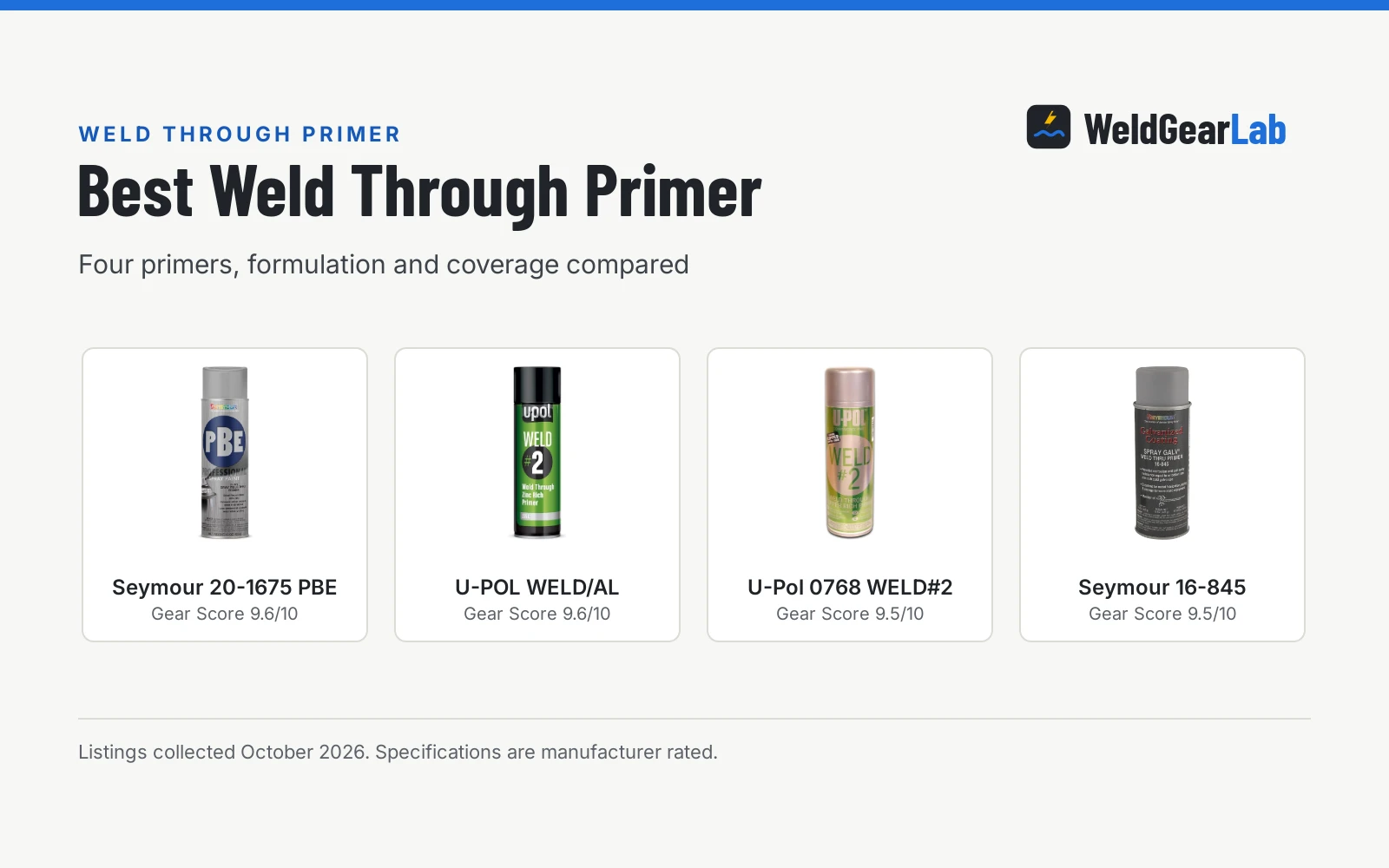
 Seymour 20-1675 PBE Professional Primer9.6/10View on Amazon
- 2
 U-POL UPol WELD/AL WELD-2 353 g/12 Oz Zinc Rich Primer9.6/10View on Amazon
- 3
 U-Pol Products 0768 Zinc/Copper WELD#2 Weld Through Primer9.5/10View on Amazon
- 4
 Copper Weld Through Primer 12.5 ozView on Amazon
- 5
 1K Self Etch Weld-Thru PrimerView on Amazon
- 6
 U-Pol Products Weld 2 Copper PrimerView on Amazon
- 7
 U-POL Weld#2View on Amazon
- 8
 Sem 40773 zinc Based Weld Thru Primer Brand: SEMView on Amazon
Bare metal needs protection before it is welded, and the choice comes down to weld through primer vs regular primer. A weld-through primer is made to be welded through, so it stays on the joint and still lets the arc reach the metal. A regular primer is a coating primer, so it is not made to be welded through and the weld zone needs bare metal instead. This guide explains the difference and shows the weld-through gear in this set.
Other welders and gear to compare
 Copper Weld Through Primer 12.5 ozCheck price on Amazon
 1K Self Etch Weld-Thru PrimerCheck price on Amazon
 U-Pol Products Weld 2 Copper PrimerCheck price on Amazon
 U-POL Weld#2Check price on Amazon
 Sem 40773 zinc Based Weld Thru Primer Brand: SEMCheck price on Amazon
This guide links to our product roundups, where WeldGearLab gets a commission on purchases made through links on this page, and your price stays the same. Read our affiliate disclosure.
Weld Through Primer vs Regular Primer: The Difference
A weld-through primer coats the joint and is made to be welded through, so the arc burns through it to the metal below while the coating keeps corrosion off the surfaces around the weld. A regular primer coats metal for top coats and is not made to be welded through, so welding over it means welding through a coating that was never meant for the arc. The listings in this guide all sit on the weld-through side, and the contrast is the point: weldability and corrosion protection on welded metal are the claims that separate them from a coating primer, and the Blysk listing adds superior conductive properties.
Side by side
| Weld-through primer | Regular primer | What the listings state | |
|---|---|---|---|
| Welded through | Made to weld through | Not made to weld through | All 4 picks state weld-through use |
| Conductivity | Blysk states superior conductive properties | Not stated as conductive | Blysk states superior conductive properties |
| Corrosion protection | Stated on welded and repaired metal | Stated as a coating use | Weld-Aid meets ASTM-A780 |
| Self-etching | Eastwood and SprayMax state self-etching | Not stated in this set | Eastwood combines self-etching with weld-through |
| Surfaces | Bare, sanded and unsanded metal, plus aluminum prep | Metal surfaces for top coats | SprayMax and Blysk listings |
| Spatter and distortion | Eastwood and Blysk state less spatter and distortion | Not stated | Eastwood and Blysk listings |
| Topcoat | Weld-Aid states use as a primer for other top coats | Primer for top coats | Weld-Aid listing |
| Pack sizes stated | 12.5 oz, 11.3 oz and 16.1 oz cans | Not covered by these listings | See the gear section |
The regular primer column describes the coating-primer side in general terms, since no regular-primer listing is featured in this set. Always follow the directions on the can label for the primer in hand.
When weld-through primer is the better choice
- Welding a joint that must stay coated. The primer stays on the metal and the arc burns through it, so protection is already in place around the weld.
- Bare, sanded or unsanded surfaces. The SprayMax listing states bare, sanded and unsanded surfaces, and the Blysk listing states aluminum preparation and bare metal.
- Spatter and distortion control. The Eastwood and Blysk listings state less spatter and less heat distortion during welding.
- MIG, TIG and Arc work. The Eastwood listing names MIG, TIG and Arc welding applications, so one listing covers several welding processes.
Our best weld through primer roundup covers the weld-through picks in more depth.
When regular primer is the better choice
- Coating work with no weld in the joint. A regular primer covers metal for top coats, which is the job a coating primer is made for.
- Parts primed after welding is done. The weld zone is already closed, so weldability does not matter for that coat.
- Topcoat-only parts. A part that will never see an arc needs only a coating primer for top coats, and weldability does not enter the choice.
The gear in this guide
The picks below are ranked in order, strongest at the top, on what each listing states for welding work. No regular-primer pick is featured here, since every listing in this set is a weld-through formula.
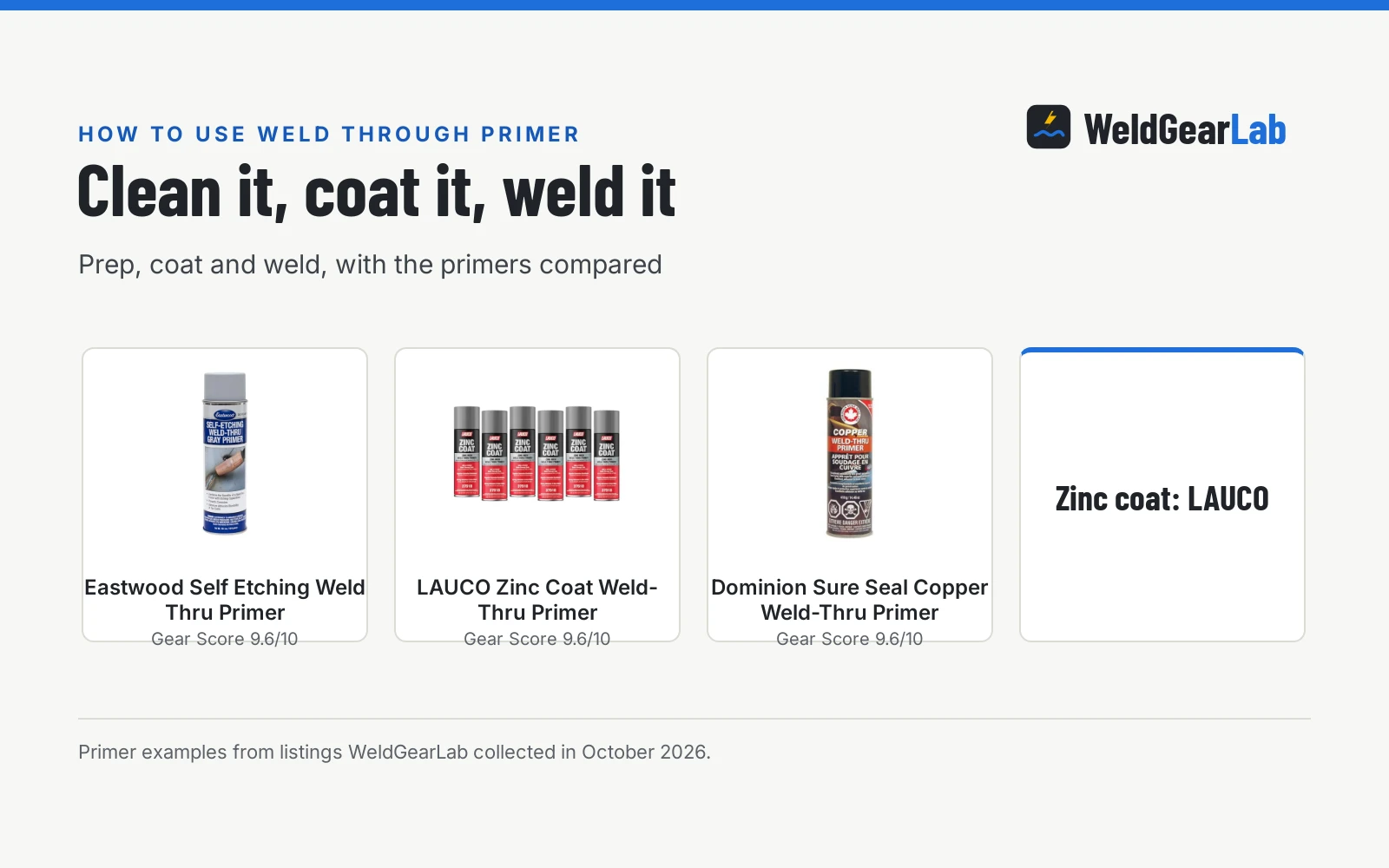
Eastwood Self Etching Weld Thru Gray Aerosol Primer, 16.1 oz. This listing combines weld-through protection with self-etching performance, enhances paint adhesion, helps prevent corrosion on welded and repaired metal surfaces, and reduces weld spatter and heat-related distortion. It names MIG, TIG and Arc welding applications, states a dry time of 0.33 hours and a weight of 16 ounces, and comes in gray with a matte finish.
Blysk Copper Weld Through Primer, 12.5 oz (2). This copper-rich, lead-free formula states excellent adhesion and superior conductive properties, top-grade rust inhibitors, fast drying, and corrosion prevention between welded surfaces. It states aluminum preparation as an alternative to traditional zinc chromate, names spot weld and auto body work, and states that it helps minimize heat distortion and welding splatter.
Weld-Aid CRC Brite Zinc Silver Finish Primer, 12.5 oz. This listing states 69% zinc metal, coverage of 40 square feet, a special no-clog nozzle, and that it meets ASTM-A780 for corrosion protection. It states a dry time of 12 hours and a weight of 16 ounces, comes in gray with a metallic finish, states that it can be used as a weld-thru primer, and states that it is not water resistant.
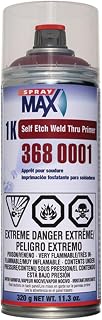
SprayMax 1K Self Etch Weld Thru Primer, 11.3 oz cans in a pack of 4. This listing states a corrosion protection primer with very good adhesion for bare, sanded and unsanded surfaces, use on old paint coatings as a sealer, low VOC, and a water repellent level. It states that it repels welding beads and comes in brown and red with a matte finish. It also states that it cannot be retouched with polyester materials, so check the topcoat plan before buying. For auto body wire choices, see best MIG wire for car restoration.
Primer fumes and aerosol cans. Primer makes fumes and the cans are aerosols, so ventilate the work area and keep cans away from sparks, heat and open flame. Welding on galvanized coatings needs extra care with fumes, so check the coating and the ventilation before striking an arc. Follow the directions on the can label.
FAQ for welders
Can you weld through regular primer?
Regular primer is not made to be welded through. Weld-through primers state weldability and conductivity for the joint, which is the claim a regular coating primer does not make. If the joint must be welded, use a weld-through formula and keep the weld zone to the primer the listing covers.
Does weld-through primer stop rust between welded surfaces?
The Blysk listing states that its formula eliminates the corrosion that forms between welded surfaces, and the Eastwood listing states that it helps prevent corrosion on welded and repaired metal surfaces. The Weld-Aid listing states that it meets ASTM-A780 for corrosion protection. No listing promises bare metal will stay clean forever, so the coating still needs the topcoat system the listing describes.
Can weld-through primer go on bare metal?
Yes, on the evidence of these listings. The SprayMax listing states bare, sanded and unsanded surfaces, and the Blysk listing states bare metal and aluminum preparation. The Eastwood listing states metal-etching surfaces. Check the listing for the surface in hand before spraying.
Which weld-through primer works with MIG, TIG and Arc?
The Eastwood listing names MIG, TIG and Arc welding applications. The other listings do not name that full set, so a shop running several processes should start with that listing.
Can weld-through primer be topcoated?
It depends on the listing. The Weld-Aid listing states use as a primer for other top coats, and the Eastwood listing states improved durability of primer and topcoat systems. The SprayMax listing states that it cannot be retouched with polyester materials, so the topcoat plan must match the primer.
Related: best weld through primer, mig vs stick for auto body and best MIG wire for car restoration.