Variable Shade vs Fixed Shade Welding Lens: Which One Should You Buy?
Variable shade lenses let the welder set the shade across a stated range for changing processes and amps, while fixed shade lenses hold a single shade for repeated work, and this guide compares both types with 4 lenses as gear examples.

On this page
Top picks at a glance
As an Amazon Associate I earn from qualifying purchases.
- 1
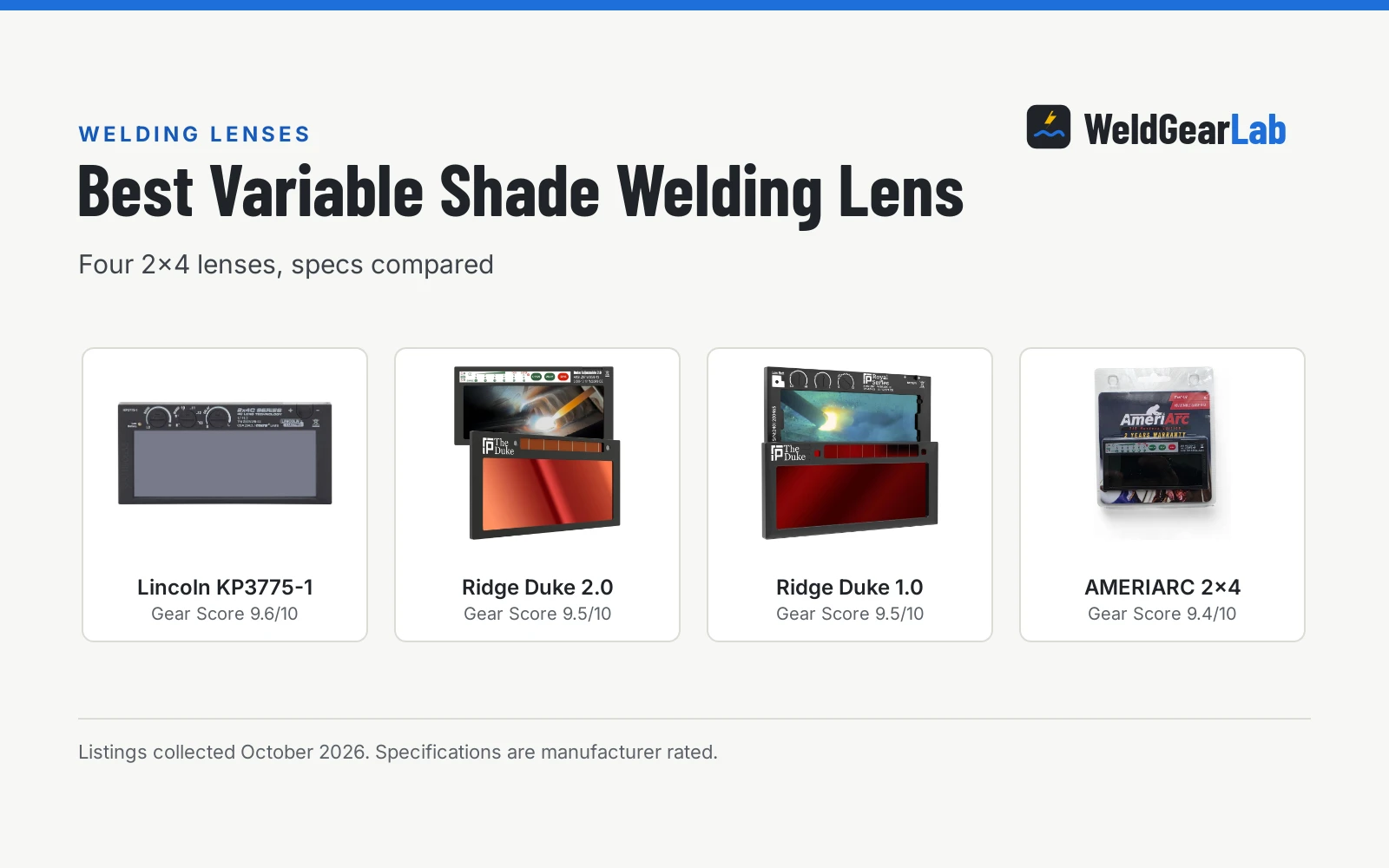
 LINCOLN ELECTRIC 2x4 C-Series Auto-Darkening Welding Lens9.6/10View on Amazon
- 2
 Auto Darkening Welding Lens 2x4 High-Definition Clarity9.4/10View on Amazon
- 3
 Duke 1.09.5/10View on Amazon
- 4
 High Visibility HD Glass Welding LensView on Amazon
- 5
 ClearView HD Auto-Darkening Welding LensView on Amazon
- 6
 Auto Darkening Welding Lens 2x4 1/4View on Amazon
- 7
 SHINE 2x4 1/4 Gold Auto Darkening Welding LensView on Amazon
- 8
 Tefuawe 2x4 1/4 Gold Automatic Welding LensView on Amazon
A variable shade lens lets the welder set the darkness for the job, while a fixed shade lens holds a single darkness for every weld, and variable shade vs fixed shade welding lens comes down to how much the work changes from bead to bead. Choose variable shade when the process or the amps change during the day, since the welder can set the shade for each job. Choose fixed shade when the work stays at a single shade, since the shade does not need changing between welds. All 4 lenses in this guide list a 2 x 4 1/4 in opening, and the choice turns mainly on range and control.
Other welders and gear to compare
 High Visibility HD Glass Welding LensCheck price on Amazon
 ClearView HD Auto-Darkening Welding LensCheck price on Amazon
 Auto Darkening Welding Lens 2x4 1/4Check price on Amazon
 SHINE 2x4 1/4 Gold Auto Darkening Welding LensCheck price on Amazon
 LINCOLN ELECTRIC 2x4 C-Series Auto-Darkening Welding LensCheck price on Amazon
 Tefuawe 2x4 1/4 Gold Automatic Welding LensCheck price on Amazon
This guide links to product roundups, where WeldGearLab gets a commission on purchases made through links on this page, and your price stays the same. Read the affiliate disclosure.
The difference, briefly
An auto-darkening lens darkens when the arc strikes and lightens when the arc stops. A variable shade lens adds a shade control, so the welder can set the darkness across a stated range for different processes and amps; the Flex lens here also lists sensitivity and delay control. A fixed shade auto-darkening lens darkens to its stated shade, and a passive glass lens is a single fixed filter with no electronics at all. The practical difference is control: the welder sets a variable shade by hand, while a fixed shade stays at its stated shade.
Variable shade vs fixed shade welding lens, side by side
| Variable shade | Fixed shade | Gear example | |
|---|---|---|---|
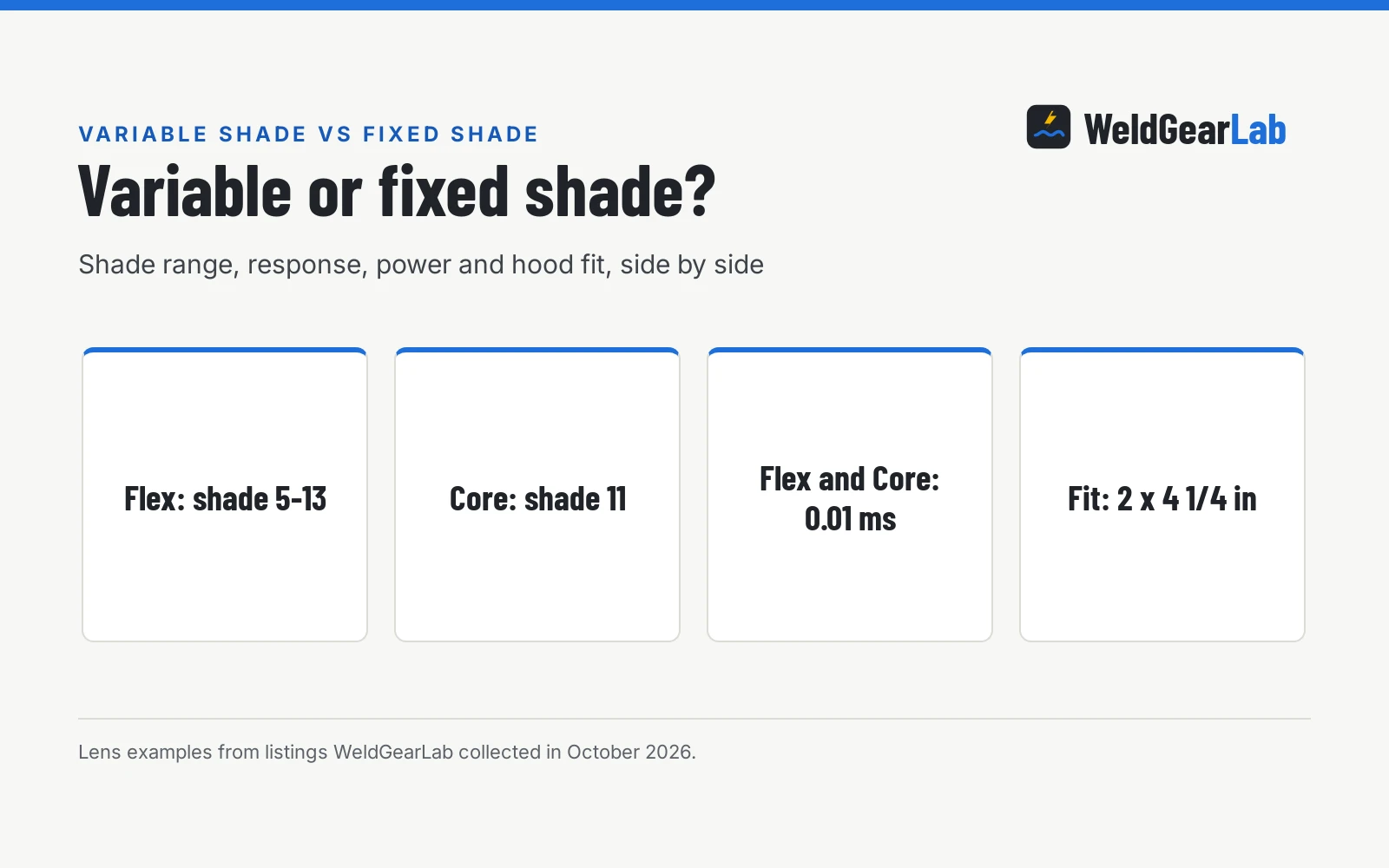
| Shade | 5-13 adjustable on the Flex lens | 11, or 9, 10, 11 or 12 at purchase | Flex 5-13, Core 11, TrueArc 9 to 12 |
| Response | 0.01 ms on the Flex lens | 0.01 ms on the Core lens; no response stated for passive glass | Flex and Core list 0.01 ms |
| Controls | Sensitivity and delay control on the Flex lens | No controls stated on the Core or TrueArc listings | Flex lists sensitivity and delay |
| Power | Replaceable batteries with solar assist on the Flex lens | Solar powered on Core; no power for passive glass | Flex solar assist; TrueArc needs no power |
| Hood fit | 2 x 4 1/4 in opening | 2 x 4 1/4 in opening; Core fits pancake and sugar scoop hoods | All 4 lenses list 2 x 4 1/4 in |
| TIG note | No TIG warning stated for the Flex lens | Core lists MIG, Stick and general welding | Ridge warns against TIG below 90A; shade type unclear |
Shade figures in the table are the figures each listing states. Where a listing gives a range, the table shows the range; where a listing gives a single shade, the table shows that shade. Passive glass has no auto-darkening response, so no response figure is stated for it.
The gear in this guide
Preruner Flex Series Gold, shade 5-13
The Flex lens is the clear variable shade example here. The listing states shade 5-13 adjustable control, with sensitivity and delay control for different welding environments and applications. Dual arc sensors give auto-darkening in 0.01 ms, the gold coating gives a cool blue puddle view, and power comes from replaceable batteries with solar assist. The lens size is 2 x 4 1/4 in, and the listing frames it for welders who move between environments, materials and lighting conditions during the day.
Preruner Core Series Red, shade 11
The Core lens is a fixed shade auto-darkening example at shade 11. The listing states auto-darkening in 0.01 ms with dual arc sensors, a red coating for a teal clarity view, and a slim 0.2 in profile. The slim profile suits pancake hoods, sugar scoop hoods and standard 2 x 4 1/4 in helmets, and the listing names MIG, Stick and general welding applications. Power is solar powered in the spec table, with no shade control stated.
TrueArc hardened glass gold, shades 9, 10, 11 and 12
The TrueArc lens is a passive fixed shade example, with no auto-darkening and no controls. The listing offers shade 9, 10, 11 and 12 options, so the shade is chosen at purchase and then stays put. The listing states that the glass reflects 99.9% of harmful UV and IR rays, that it fits helmets with a 2 x 4 1/4 in opening, and the listing states that it is precision ground and edged for a proper fit. A passive lens suits a welder who wants a single shade with no battery and no electronics in the hood.
Ridge Heir 1.0 Blue, shade figures that need care
The Ridge lens needs care because the title and the bullets do not agree. The title presents a shade 5-13 adjustable blue lens, sized 2 x 4 1/4 x 0.3 in, for Stick, MIG and FCAW, and states that it is not recommended for TIG. The bullets describe single shade lenses in shade 9-13 and describe adjustable lenses at shade 5-13 as an upgrade, which conflicts with the title presentation. The title also says the lens is not recommended for TIG, while the bullets allow TIG work except exclusively low amp work, which is a further conflict inside the listing. The bullets also warn against TIG below 90A, state that solar panels recharge the lens from the weld arc, and mention a free replacement for up to a year. Treat the shade type of this lens as unclear from the listing alone, and treat the below-90A warning as a reason to avoid low amp TIG work with this lens.
When variable shade is the better choice
- Changing processes. A day that mixes processes can call for different darkness, and a 5-13 range lets the welder set the shade for each one without swapping lenses.
- Changing amps. A lens whose shade the welder can set for each amp level suits a shop where a light tack and a heavy bead happen in the same session.
- Shared hoods. Sensitivity and delay controls let each welder set the response for the work in front of them.
- Changing light and surroundings. Sensitivity and delay controls on the Flex lens let the welder tune triggering for different environments, as the listing states.
When fixed shade is the better choice
- A repeated job. A single shade, such as shade 11, suits a welder who runs the same process at similar amps all day.
- No shade dial to bump. The Core and TrueArc listings state no shade control, so the shade cannot be knocked off its setting between welds.
- Simple hoods. A passive glass lens has no battery and no electronics, which suits a spare hood or a backup helmet.
- Pancake and sugar scoop hoods. A slim 0.2 in fixed lens is stated to fit pancake hoods and sugar scoop hoods more comfortably than bulky traditional lenses.
How to pick between them
Start with the shade the work needs, then check the hood. All 4 lenses in this guide list a 2 x 4 1/4 in opening, so opening size alone does not decide the choice, except for pancake and sugar scoop hoods, where the Core slim 0.2 in profile matters. Next, check the process list: the Ridge lens names Stick, MIG and FCAW and warns against TIG below 90A, while the Core lens names MIG, Stick and general welding. Finally, check power: the Flex lens uses replaceable batteries with solar assist, the Core lens is solar powered, and the TrueArc glass needs no power at all. A lens whose stated shade range and process list do not cover the work in front of it is the wrong lens, whatever its range claims.
FAQ for welders
What does shade 5-13 mean on a welding lens?
Shade 5-13 is an adjustable range, from a light shade 5 to a dark shade 13, set with the controls on the lens. The Preruner Flex lens lists shade 5-13 with sensitivity and delay control. A fixed shade lens has no such range and stays at a single shade.
Is a fixed shade lens worse than a variable shade lens?
No, fixed shade is simpler rather than worse. A fixed lens suits repeated work at a single shade, such as shade 11 on the Preruner Core lens. Variable shade suits work that changes process or amps during the day.
Can a fixed shade lens weld TIG?
That depends on the lens, not on the fixed shade idea alone. The Ridge lens warns against TIG below 90A, so low amp TIG work needs a lens that states support for it. Check the process list and the amp warning in the listing before choosing a lens for TIG.
Do passive glass lenses need batteries?
No, passive glass has no electronics and no battery. The TrueArc hardened glass lens is a passive filter in shade 9, 10, 11 or 12, chosen at purchase. Auto-darkening lenses, by contrast, use batteries, solar assist or both, as stated in their listings.
Will a variable shade lens fit a standard hood?
The lenses in this guide use a 2 x 4 1/4 in opening, which suits standard helmets with that opening. The Core lens also states a fit for pancake hoods and sugar scoop hoods at a slim 0.2 in profile. Check the opening size and the profile in the listing before ordering a lens for a close-fitting hood.
Related: welding helmets, auto-darkening welding lens 2×4, variable shade welding lens, wide view vs standard welding lens and flip up vs fixed lens welding helmet.