Toggle Clamp Uses in Metal Fabrication
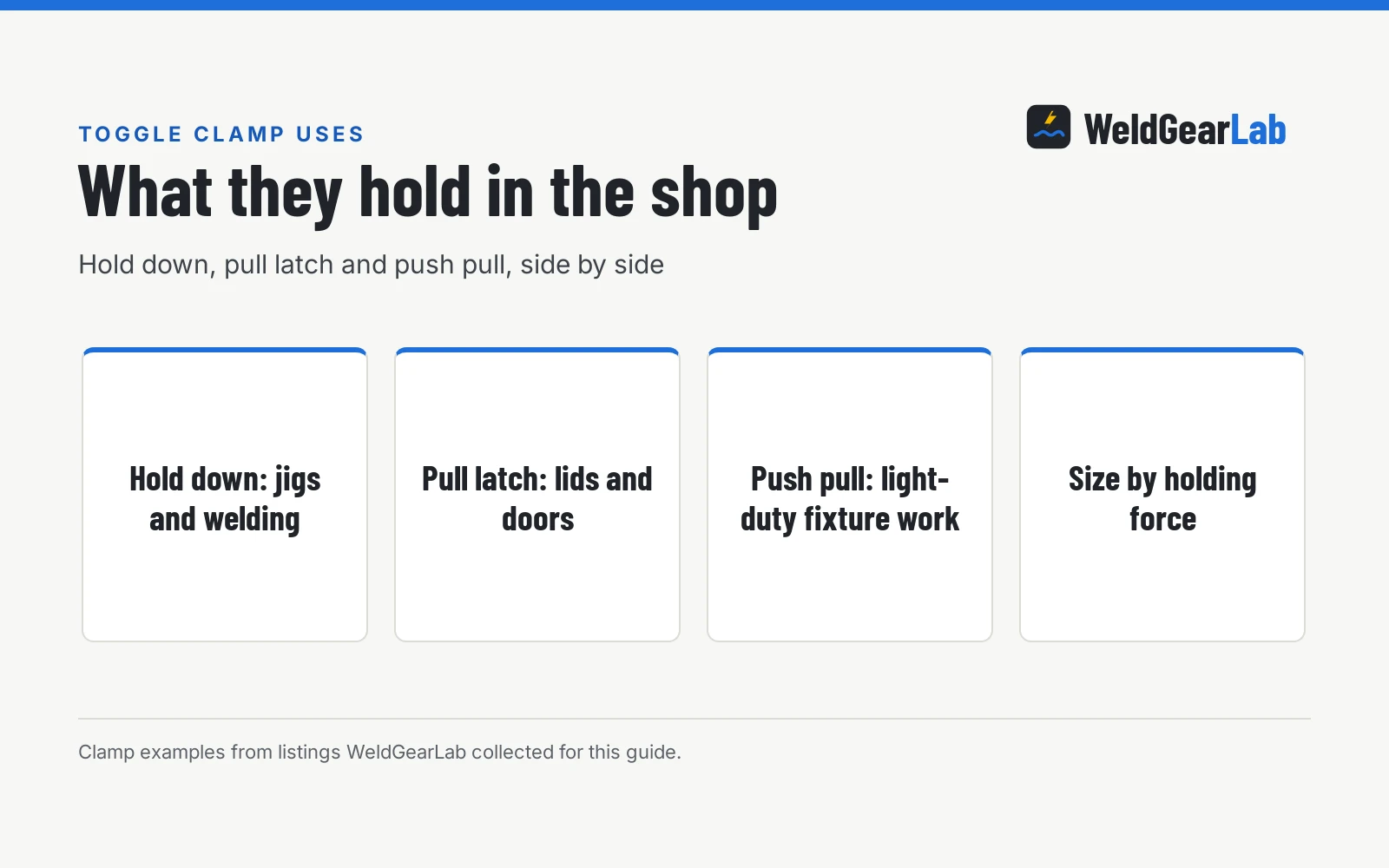
A toggle clamp holds work still with a pull of the handle, and the right type depends on the job: hold down clamps for jigs and welding, pull latches for lids and doors, and push pull clamps for light-duty fixture work.

On this page
A plate shifts a hair while you tack it, and the joint opens up. A jig that held fine yesterday walks across the bench today. A toggle clamp fixes these problems with a pull of the handle: the linkage goes over center, and the clamp holds until you release it. This guide covers toggle clamp uses in a fab shop, from holding plates for tack welding to latching lids and doors, and how to match the clamp to the job.
As an Amazon Associate I earn from qualifying purchases. This guide links to our product roundups, where WeldGearLab gets a commission on purchases made through links on this page, and your price stays the same. Read our affiliate disclosure.
Toggle clamp uses in the shop
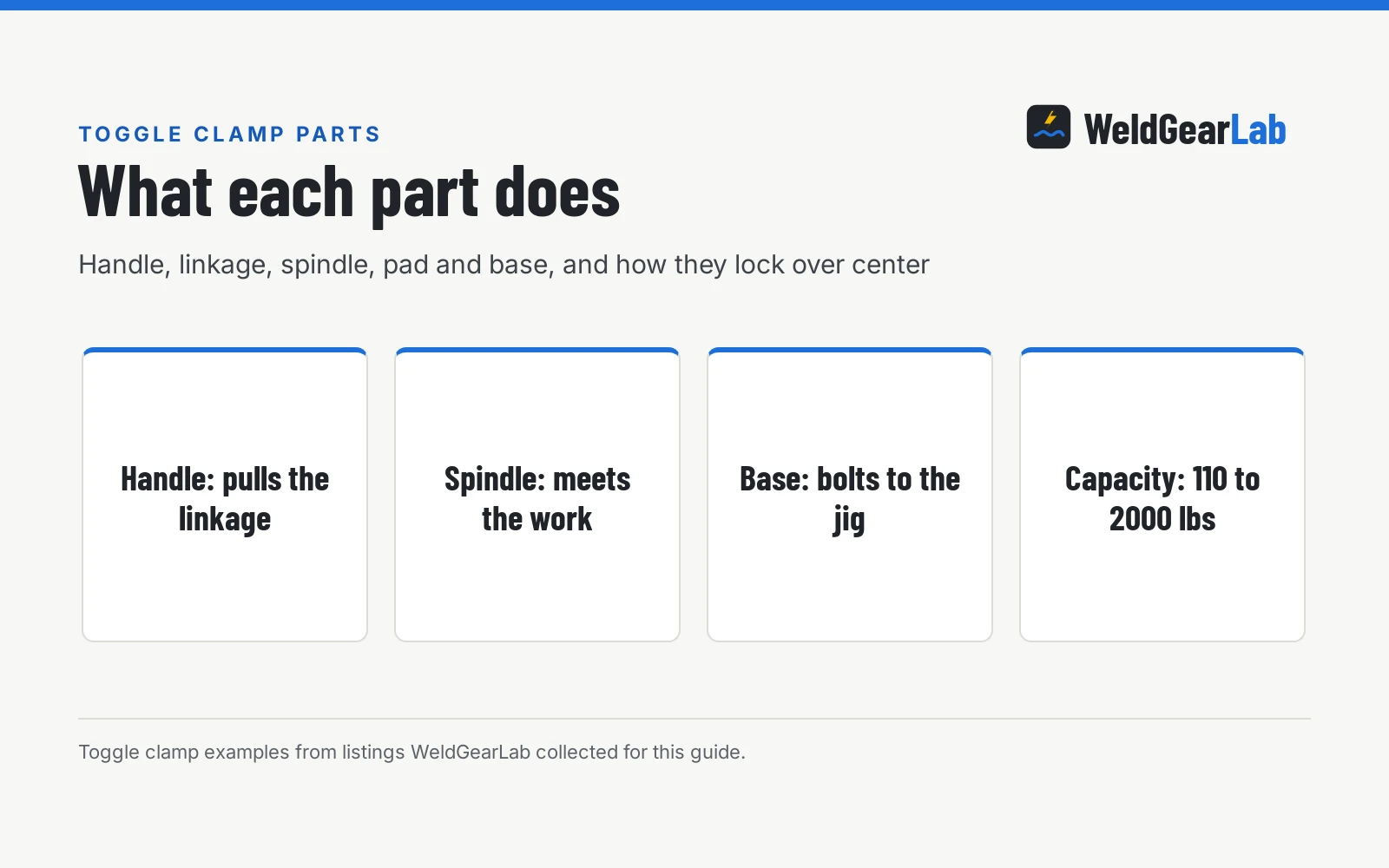
A toggle clamp is a hand operated clamp that locks with an over center linkage. Push the handle and the clamping bar swings down and locks; pull it back and the bar releases, so you can load and unload work fast with one hand. In a fab shop the common uses are holding plates and parts on a welding table, locking jigs and fixtures in place, holding work on a drill press, and clamping parts for cutting, sanding and routing.
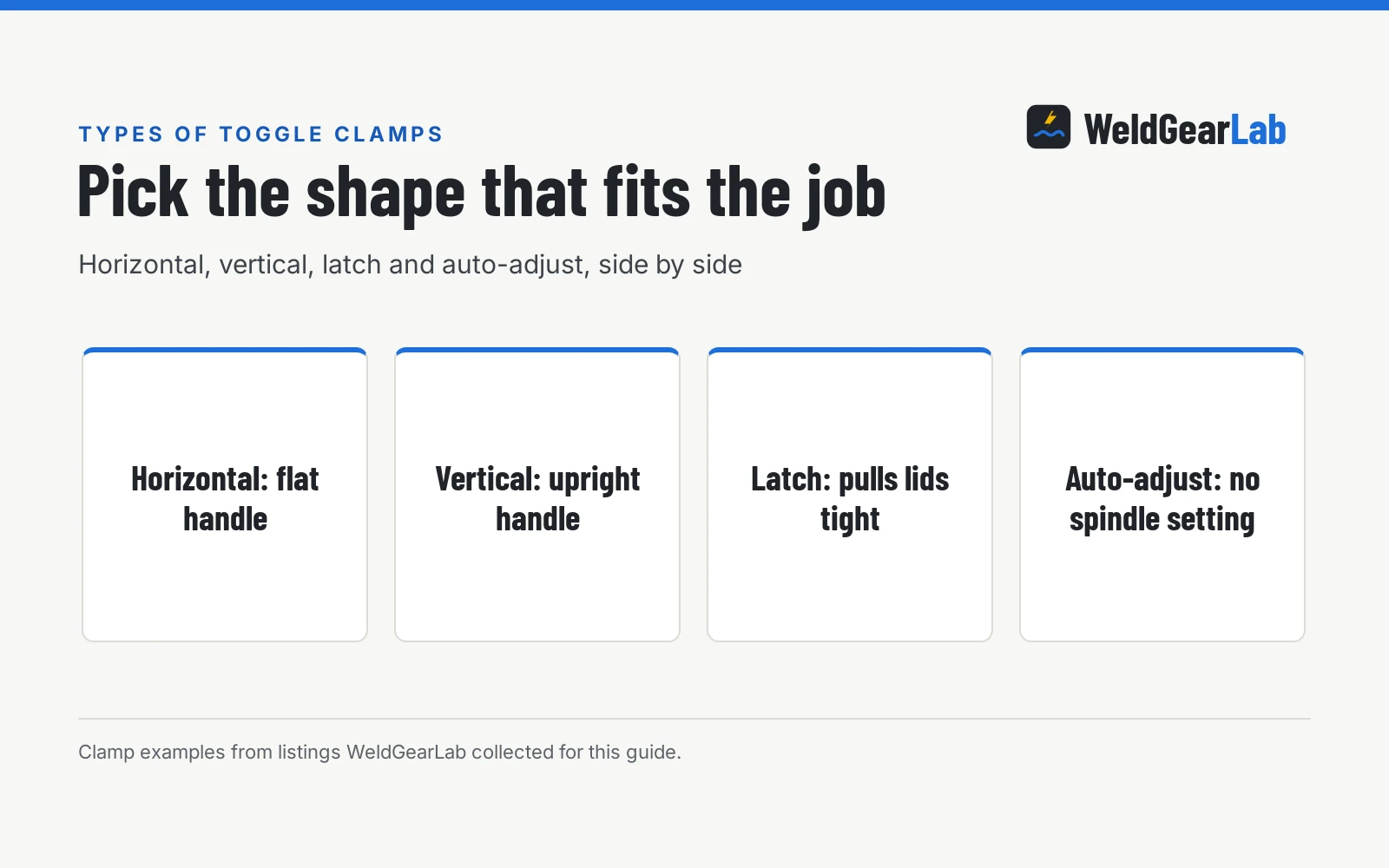
The main families cover most shop work. A horizontal hold down clamp presses work down onto a bench or fixture. A pull latch, sometimes called a draw latch, pulls a lid or a door shut and keeps it shut. A push pull clamp pushes a pad straight out against the work, which suits cabinets, tool boxes and light-duty fixture work. The types of toggle clamps guide walks through each family in more detail.
Side by side
| Horizontal hold down | Pull latch | Push pull | |
|---|---|---|---|
| Holding force | 198, 360 or 500 lbs | Up to 2000 lbs | 110 lbs |
| Typical shop use | Jigs, fixtures, welding | Lids, doors, smoker latches | Cabinets, tool boxes, fixtures |
| Mounting | Screws through the base | Screws or weld | Mounted on fixtures |
| Pressure tip | Adjustable rubber tip | Adjustable U-bolt | Black rubber indenter |
| Pack sizes | 2, 4 or 12 pieces | 6 pack | Part of an 8 piece set |
A hold down clamp is sized by its holding force, a pull latch by the load its latch must hold shut.
Holding a part for tack welding
Tack welding is where a toggle clamp earns its place on a welding table. The clamp holds the plate flat and still while you place the first tacks, so the joint stays square and your hands stay clear of the arc. A U-shaped clamping bar reaches over the plate, and an adjustable pressure tip sets the pad on plates of different thickness. The CUKAYO 225D (on Amazon) hold down lists a holding capacity of 500 lbs, the JMIATRY 201-B (on Amazon) lists 360 lbs, and the E-TING 201B (on Amazon) lists 198 lbs. Mount the clamp on a jig, a fixture or a movable base, check that the pad sits flat on the work, and lock it before you strike an arc. Keep the clamp clear of the weld bead, and wear eye and face protection when you weld.
Jigs and fixtures: where clamps earn their keep
A jig repeats a cut or a weld the same way every time, and it only works if the part sits in the same place each time. Toggle clamps bolt to the jig and press the part into its stops, so you load, clamp, work and release without re-measuring. On a crosscut sled or a drill press fixture the same idea applies, and a low height clamp with a retracted bar leaves room to lift the part straight out. The BESSEY STC-HH70 auto-adjust clamp adjusts itself to the part thickness while it holds a constant clamping force, which saves resetting the spindle height when parts vary a little. Keep the work clamped until the cut or the weld is done.
Latches, lids and doors
A pull latch does a different job from a hold down clamp: it pulls a lid, a door or a cover shut and keeps it shut. The SKYCY pull latch (on Amazon) lists a capacity of up to 2000 lbs, a 4 mm thick cold rolled carbon steel body and an adjustable U-bolt, for tire carriers, sliding doors, barn doors, tool boxes and smoker lids. The U-bolt adjusts the mounting distance and the clipping force, so you can set the latch tight enough to hold and loose enough to open by hand. Fix the latch base with screws or weld it, adjust the U-bolt to suit, and tighten the nuts to set the tension.
How to size a toggle clamp
Size the clamp by the holding force the job needs, not by the size of the clamp. Push pull clamps list 110 lbs of holding force, which suits light-duty fixture work, cabinets and tool boxes. The horizontal hold down clamps list 198 lbs, 360 lbs and 500 lbs, which covers jig work, welding fixtures and heavier plate. The BESSEY STC-HH70 (on Amazon) lists an adjustable clamping force from 25 to 550 lbs, with a max holding capacity of 700 lbs, so one clamp covers a range of part sizes. The SKYCY pull latch lists up to 2000 lbs, which is a latch load, not a hold down force. Pick the smallest clamp that holds the work without moving, and keep the clamp within the force the maker lists. The best locking C clamp pliers with swivel pads roundup covers another clamp style for the shop.
Mounting a toggle clamp
Most toggle clamps mount with screws through holes in the base. The JMIATRY and AConnet 201-B clamps list a hole size of 6 mm and take M4 or M5 screws, and the package does not include screws. The BESSEY STC-HH70 lists a flanged base 2 1/4 inch by 2 1/2 inch, made for 1/4 inch or M6 fasteners. The arm opens 85 degrees while the handle moves 80 degrees on the 201-B models, so leave room behind the clamp for the handle swing. Set the clamp square to the work and check the base sits flat before you set the pressure tip. A steel workbench or welding table gives a flat surface to mount jigs and clamps on.
FAQ for welders
What is a toggle clamp used for?
A toggle clamp holds work still with a quick over center lock. In a fab shop the main uses are holding plates for tack welding, locking jigs and fixtures, and holding work on a drill press.
How much holding force do I need?
Match the force to the job. Light-duty fixture work suits the 110 lbs push pull clamps, while jig and welding work uses the 198 lbs, 360 lbs and 500 lbs hold down clamps.
What is the difference between a hold down clamp and a pull latch?
A hold down clamp presses work down onto a bench or fixture, while a pull latch pulls a lid or a door shut and keeps it shut. Hold down clamps are sized by holding force, and the SKYCY pull latch lists a capacity of up to 2000 lbs for the load it must hold shut.
Can I weld a toggle clamp to a fixture?
Some clamps can be welded on. The SKYCY pull latch maker says to fix the latch bottom with screws or weld it, then adjust the U-bolt and tighten the nuts.
Do toggle clamps come in packs?
Yes. They sell in sets of 2, 4, 6, 8 and 12 pieces. A 12 piece set of 201-B hold down clamps suits a shop with several jigs, while a 2 piece set suits one fixture.
Can a toggle clamp hold a circuit board?
Yes, and the makers name circuit boards among the uses for their hold down clamps. The BESSEY STC-HH70 includes a removable non-marring plastic cap on its steel pressure pads.
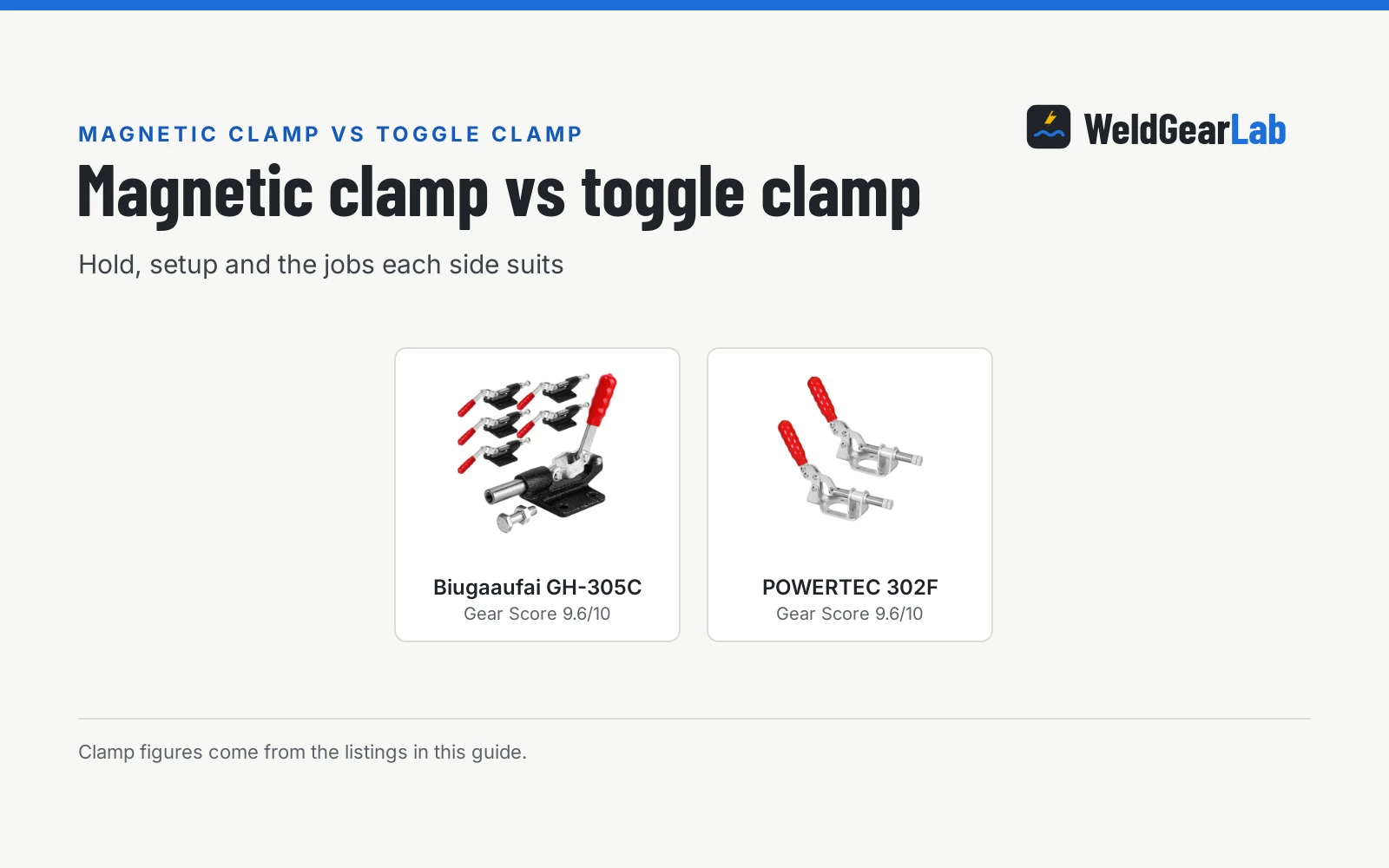
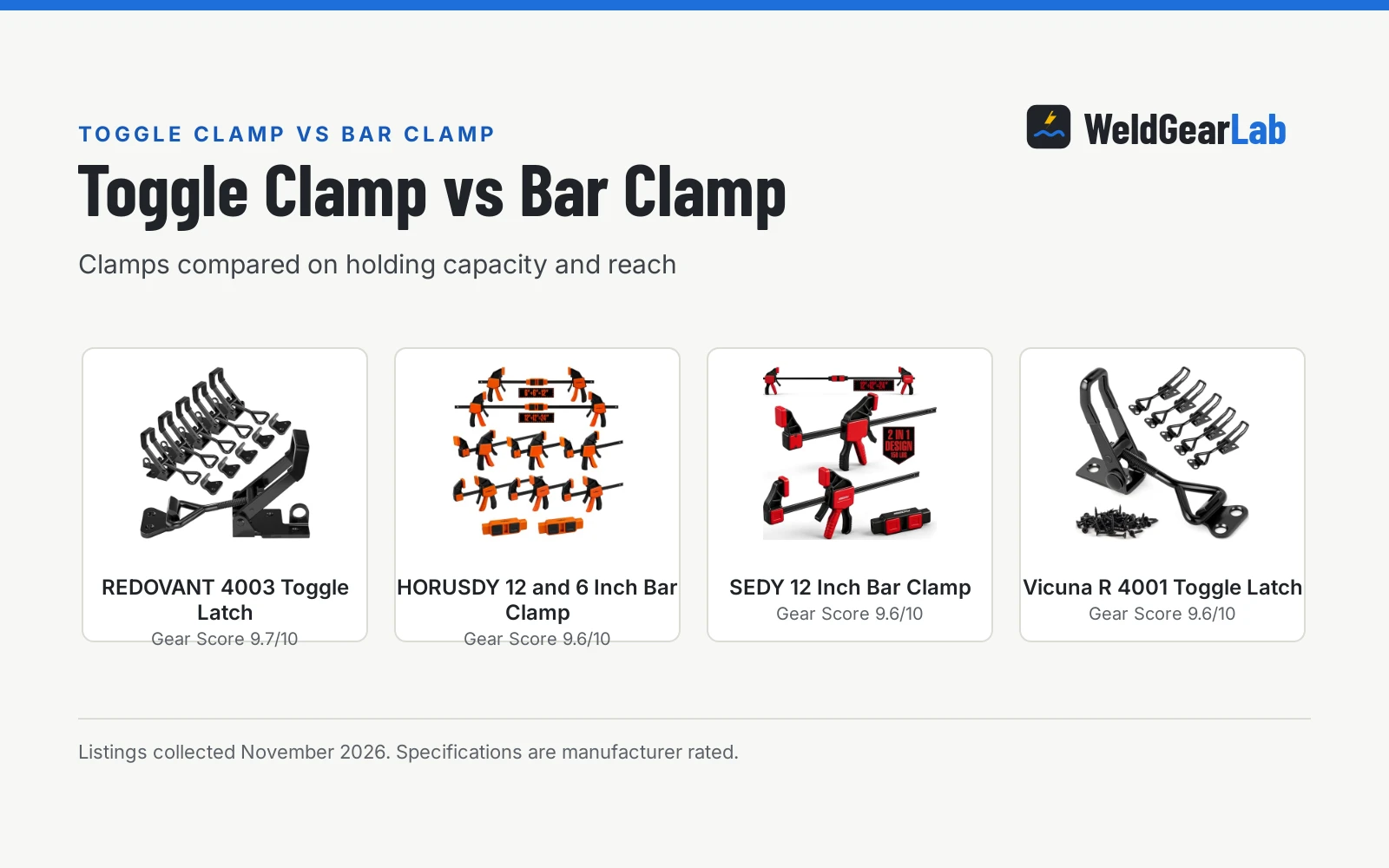
Related: types of toggle clamps, magnetic clamp vs toggle clamp, toggle clamp vs bar clamp, best locking C clamp pliers with swivel pads, and the metal fab tools hub.