Sanding Belt vs Sanding Disc: Which One Should You Buy?
Belts run on belt sanders and file sanders for long, flat passes, while discs suit disc sanders and spot work; the four belt picks below show the belt format.

On this page
Top picks at a glance
As an Amazon Associate I earn from qualifying purchases.
- 1
 2 X 72 Inch Coarse Grit Premium Knife Makers EdgeCore Ceramic9.7/10View on Amazon
- 2
 50 Pack Flap Discs 4 1/2" x 7/8" for Angle Grinder9.7/10View on Amazon
- 3
 POWERTEC 10PK 4x36 Sanding Belts9.6/10View on Amazon
- 4
 1/2x18 1/2 x 18 Inch Sanding Belt Pack 1/2-Inch x 18-InchView on Amazon
- 5
 3x18 3 x 18 Inch Sanding Belt Pack 3-Inch x 18-InchView on Amazon
- 6
 1 x 42 Inch Sanding Belt Pack 1-Inch x 42-InchView on Amazon
- 7
 4x24 4 x 24 Sanding Belt Pack 4-Inch x 24-InchView on Amazon
- 8
 S SATC 3x18 Sanding Belts 20PCS Belt Sander Paper AluminumView on Amazon
- 9
 POWERTEC 10PK 4x36 Sanding BeltsView on Amazon
For most shop work, the answer to sanding belt vs sanding disc comes down to the shape of the job: a belt suits long, flat passes and heavy stripping, while a disc suits flat faces and spot work. Belts run as a loop on a belt sander or a file sander, and discs spin as a round sheet on a disc sander. This guide compares the two formats, the grits they come in, and four belt picks that show what the belt format does.
Other welders and gear to compare
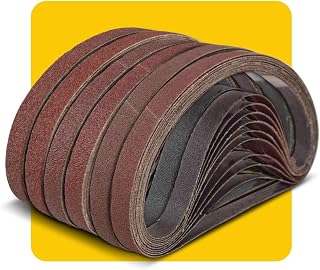 1/2x18 1/2 x 18 Inch Sanding Belt Pack 1/2-Inch x 18-InchCheck price on Amazon
 3x18 3 x 18 Inch Sanding Belt Pack 3-Inch x 18-InchCheck price on Amazon
 1 x 42 Inch Sanding Belt Pack 1-Inch x 42-InchCheck price on Amazon
 4x24 4 x 24 Sanding Belt Pack 4-Inch x 24-InchCheck price on Amazon
 S SATC 3x18 Sanding Belts 20PCS Belt Sander Paper AluminumCheck price on Amazon
 POWERTEC 10PK 4x36 Sanding BeltsCheck price on Amazon
This guide links to our product roundups, where WeldGearLab gets a commission on purchases made through links on this page, and your price stays the same. Read our affiliate disclosure.
The difference in one paragraph
A sanding belt is a closed loop of abrasive cloth that runs over rollers, so the loop keeps cutting along its length for long passes without stopping. A sanding disc is a round sheet fixed to a backing pad, and the work meets part of the spinning face. Belts keep cutting along edges, rails, and flat lengths; discs shine on flat faces, small parts, and spot work where you want to stay in one place. The grit number works the same on both: a low number cuts fast and rough, and a high number finishes smooth.
Sanding belt vs sanding disc side by side
| Sanding belt | Sanding disc | Shop note | |
|---|---|---|---|
| Form | Closed loop | Round sheet | Loops suit long, straight passes |
| Tool | Belt sander or file sander | Disc sander | POWERTEC belts fit named belt and disc sanders |
| Grit range here | 40 to 400 | Format compared only, no disc pick here | SATC spans 40 to 400 |
| Pack sizes here | 10, 20 or 60 belts | Format compared only, no disc pick here | TPmax ships 60 belts |
The four examples covered below are all belts: the listings in this guide cover belt sizes from 1/2 inch to 4 inch wide, and no disc product is featured as a pick in this guide. The disc column compares the disc format only.
When a belt is the better choice
- Long flat work. Rails, table tops, and long edges where a loop keeps cutting without repositioning.
- Heavy stripping. Paint, rust, and mill scale come off faster with coarse grits on a belt.
- Shaping and beveling. A belt sander holds a steady line along an edge or a bevel.
- Spot welds and rivets. A narrow file belt reaches welds and rivets a wide belt cannot.
When a disc is the better choice
- Flat faces. Part of the spinning face meets the work, which suits panels and plate.
- Spot work. Small areas and touch-ups where you work in one place.
- Quick grit changes. Swapping a disc is faster than changing a belt when you move from coarse to fine.
- Small parts. Parts you hold by hand are easier to present to a disc than to a running loop.
Four belt picks
Ranked by grit range, pack value, and how clearly each listing states its fit, the four picks are:
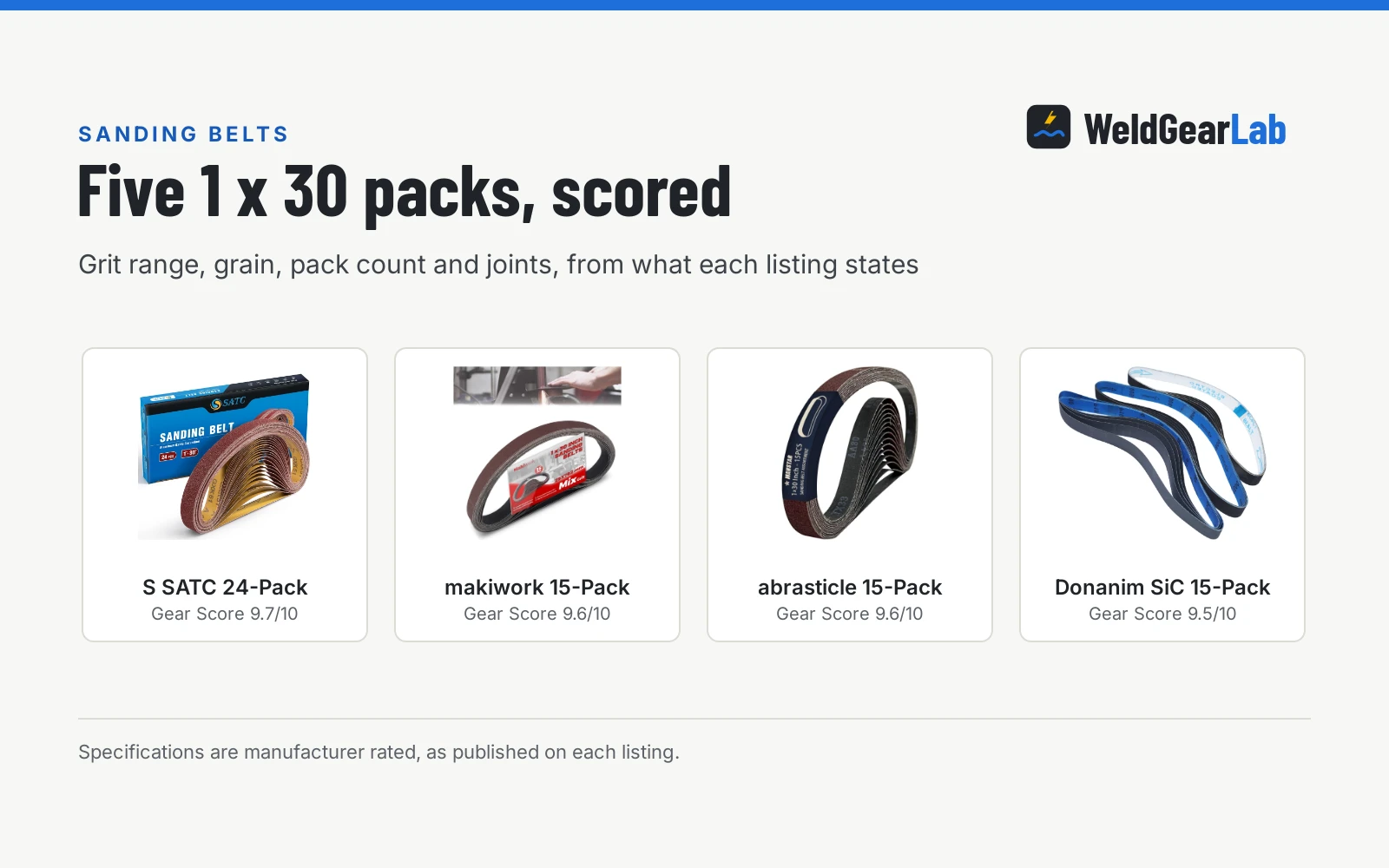
First, the S SATC 3 x 18 belts. This 20 piece set covers 40 to 400 grit, with 3 each of 60, 80, 120, 150, 240, and 400 grits plus 2 of 40 grit, and the grit is indicated on the cloth backing. The belts use an open coat aluminum oxide grain with anti-static and anti-clogging properties, and a diagonal lap splice keeps the seam from bulging. It suits wood, metal, and paint sanding across the full range from stripping to a fine finish.
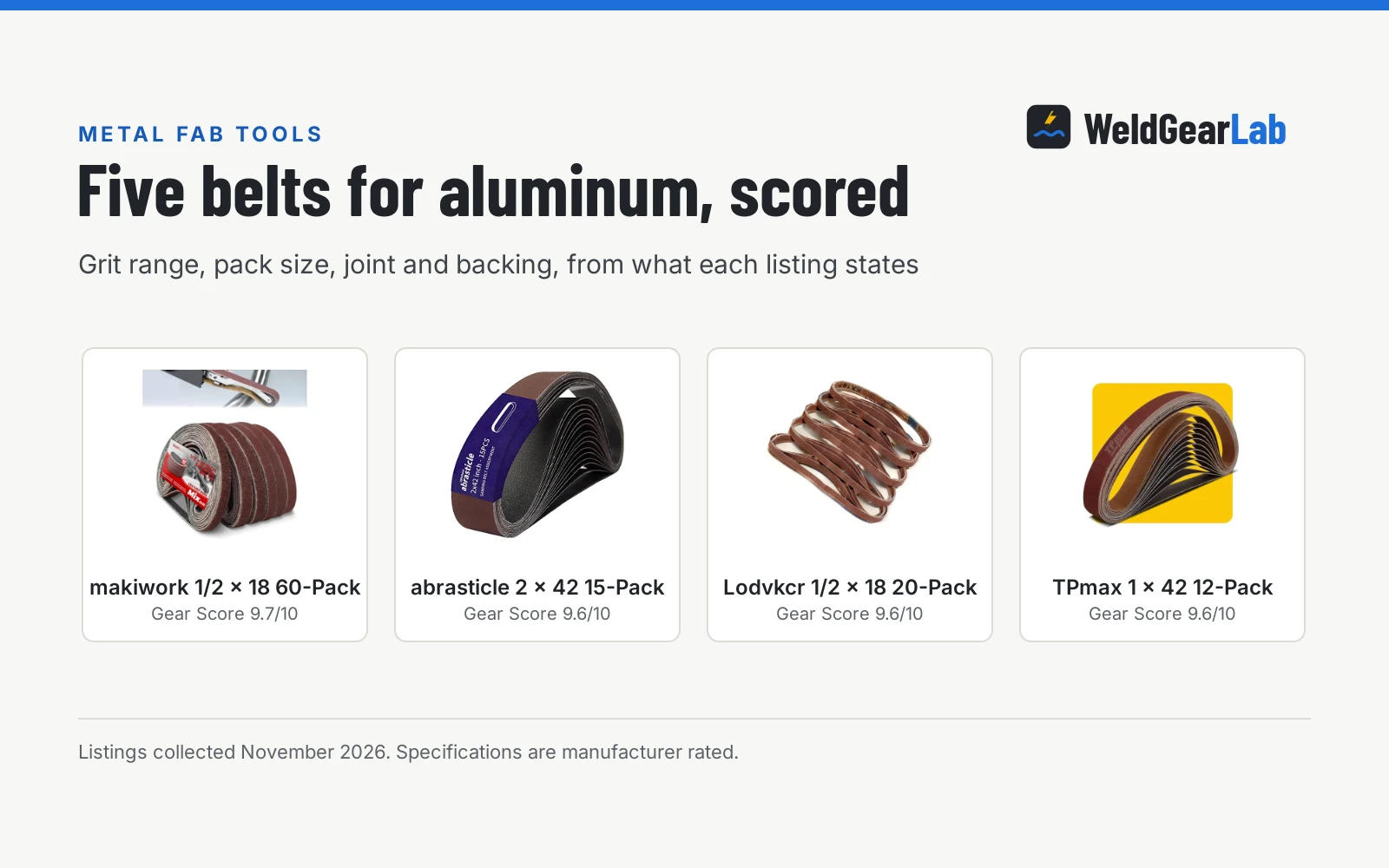
Second, the TPmax 1/2 x 18 belts. This 60 piece assortment holds 10 each of 40, 60, 80, 120, 150, and 240 grits in aluminum oxide, with a diagonal lap splice and an antistatic, washable cloth that resists loading. The narrow 1/2 inch width suits file sanders and tight spots, and the listing names wood, aluminum, non-ferrous metal, glass, plastic, and stone as uses. It is the largest pack here, so it suits a shop that burns through belts.
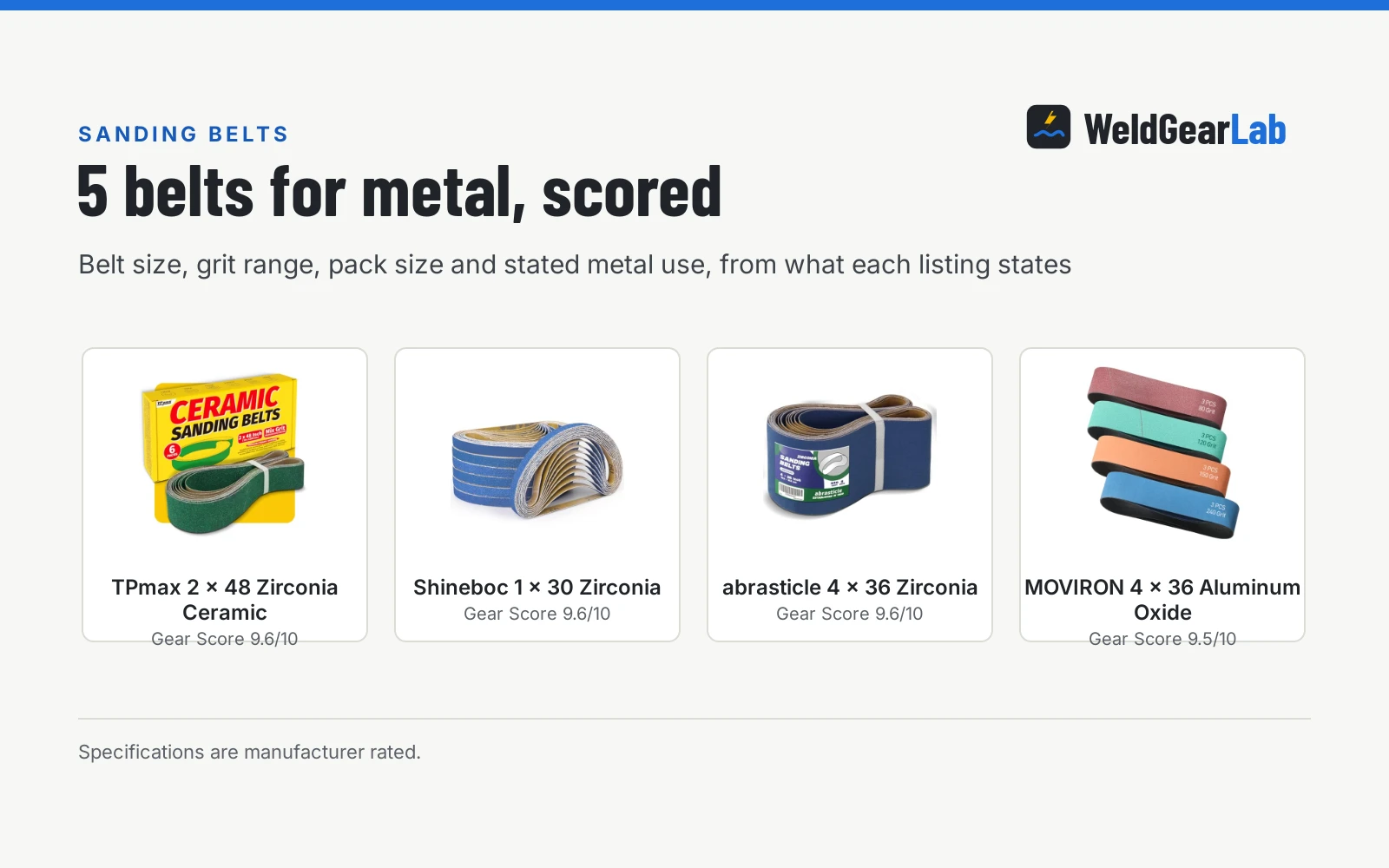
Third, the POWERTEC 4 x 36 belts. This 10 pack of 80 grit belts uses an open coat aluminum oxide grain on an X-weight cloth backing with a resin on resin bond, and the listing describes the material as heat and moisture resistant, with seams crafted to hold under pressure. The listing names POWERTEC BD4600, WEN 6502T, Woodskil, and BUCKTOOL BD4802, BD4603, and BD4801 belt and disc sanders as fits. It suits a benchtop belt and disc sander used for woodworking, metalworking, paint, and rust removal. See our best sanding belt 1 x 30 roundup for more belt packs.
Fourth, the 3M Cubitron II file belt. This 1/2 x 18 inch, 36+ grade, resin bonded belt comes as a 10 pack for spot weld removal, and the maker claims 30 percent faster cut and double the life of other premium abrasives. It grinds out rivets and spot welds when used with a 3M file belt sander. Note the listing states this belt is for industrial and occupational use only, not for consumer sale or use, so it suits a working shop rather than a home bench.
Sparks, dust, and eyes. Belt and disc sanding throw sparks on steel and dust on every material. Wear safety glasses, keep the work area clear of flammable material, and work with ventilation or outdoors when the dust is heavy. Check the belt size on the listing before ordering: 1/2 x 18, 3 x 18, and 4 x 36 inch belts do not interchange.
How to match grit to the job
Start coarse and step up. The SATC grit guide calls 60 grit fairly coarse for heavy sanding and stripping, 80 to 150 grit fairly medium for removing tiny imperfections, and 240 to 400 grit the range for a super fine smooth finish. For rust removal and paint stripping, start at 40 or 60 grit, then move to 80 and 120 grit before finishing. For a fine finish on wood or metal, work up to 240 grit or finer. Changing grit too soon leaves deep scratches that the finer grit must then remove, so let each grit do its pass before moving on.
FAQ for welders
Can I use a sanding belt on a disc sander?
No. A belt needs a belt sander or a file sander that runs a loop, and a disc needs a disc sander with a backing pad. The POWERTEC belts are listed as fitting belt and disc sanders, which means combo machines that carry both a belt station and a disc station, not a disc-only machine. Check the machine type on the listing before ordering.
What grit should I start with on rusty steel?
Start at 40 or 60 grit. The SATC guide calls 60 grit fairly coarse for heavy sanding and stripping, and both the TPmax and SATC assortments include 40 grit for the roughest work. Move to 80 and 120 grit once the rust and scale are gone, then finish at 240 grit or finer if the surface needs to look smooth.
Do I need a file belt for spot welds?
A narrow file belt is the right shape for the job. The 3M Cubitron II file belt at 1/2 x 18 inch and 36+ grade is made for spot weld removal and grinding out rivets with a 3M file belt sander. The listing states it is for industrial and occupational use only, so a home shop should weigh that before buying.
How do I pick the right belt size?
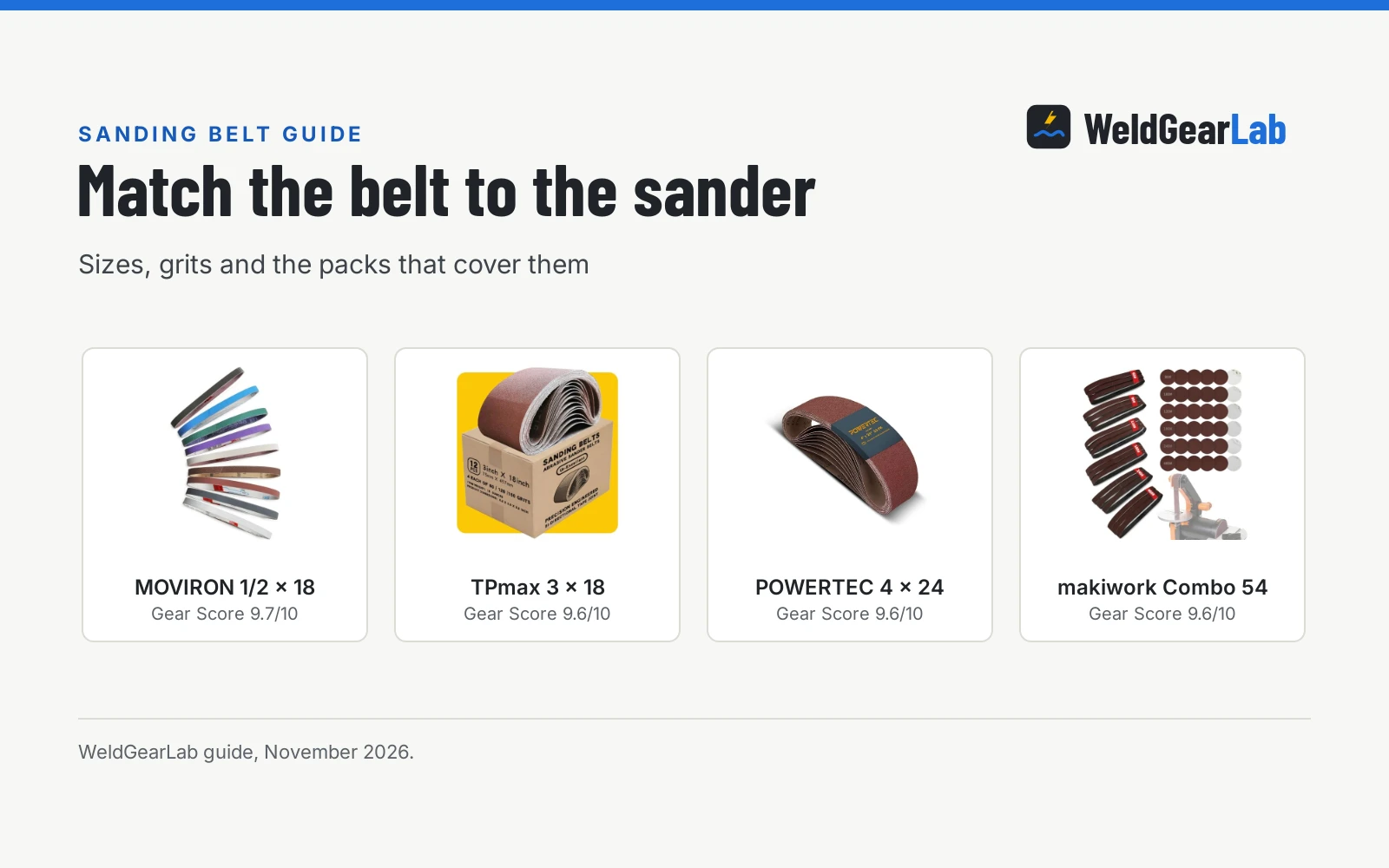
Match the belt to the sander, not to the job. The file sander belts here are 1/2 x 18 inch, and the bench belts here are 3 x 18 or 4 x 36 inch, and the POWERTEC listing names the exact sander models its 4 x 36 inch belts fit. Read the size on the listing and compare it with the size printed on your sander before ordering.
Related: best sanding belt 1 x 30, best surface conditioning discs 2 inch, bead roller vs slip roll, and air hammer vs chipping hammer.