Portable vs Stationary Welder: Which One Should You Buy?
A portable vs stationary welder guide: how handheld 110V stick units compare with shop-class machines on power, amperage, weight and processes.

On this page
Top picks at a glance
As an Amazon Associate I earn from qualifying purchases.
- 1
 ARCCAPTAIN 180A MIG Welder 110V 220V 6 in 1 Multiprocess9.7/10View on Amazon
- 2
 TRQWH Portable Welding Machine 110V Handheld Welder IGBTView on Amazon
- 3
 Portable Welding Machine 110V Handheld Arc Welder forView on Amazon
- 4
 Portable Handheld Welding MachineView on Amazon
- 5
 Saker Portable 110V ARC WelderView on Amazon
- 6
 HGNVGZ 250A MMA Stick Welder 110VView on Amazon
- 7
 250A Stick WelderView on Amazon
The fence bracket broke off the trailer and the repair is out in the yard, not on the bench. That is the portable vs stationary welder question in real life: carry the welder to the work, or bring the work to the welder. Portable means a handheld 110V stick unit you hold in one hand; stationary means a shop machine that lives on a cart or bench, like the 46.5-pound YESWELDER MCT-520, which runs 110 or 220V. Pick portable when the work moves. Pick stationary when the work comes to you.
Other welders and gear to compare
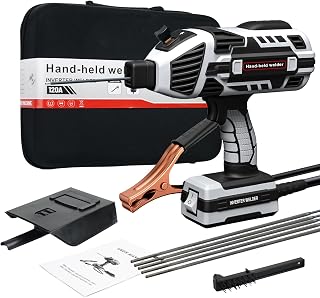 TRQWH Portable Welding Machine 110V Handheld Welder IGBTCheck price on Amazon
 Portable Welding Machine 110V Handheld Arc Welder forCheck price on Amazon
 Portable Handheld Welding MachineCheck price on Amazon
 Saker Portable 110V ARC WelderCheck price on Amazon
 HGNVGZ 250A MMA Stick Welder 110VCheck price on Amazon
 250A Stick WelderCheck price on Amazon
This guide links to our product roundups, where WeldGearLab gets a commission on purchases made through links on this page, and your price stays the same. Read our affiliate disclosure.
portable vs stationary welder: the difference in one paragraph
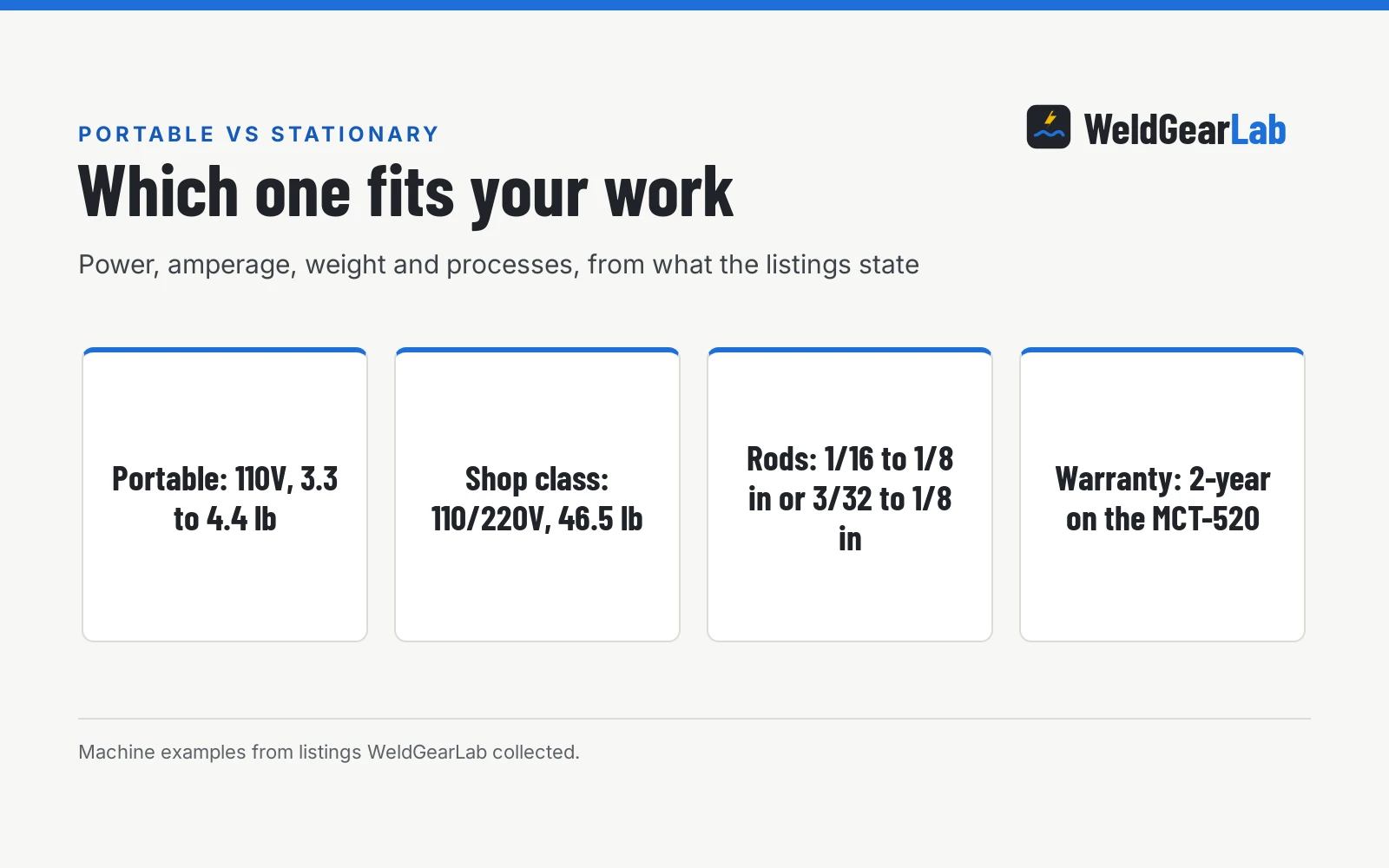
A portable welder is a stick machine you carry: handheld units weigh 3.3 to 4.4 pounds, run on 110V, and weld with 1/16 to 1/8 inch rods on some listings and 3/32 to 1/8 inch rods on others. A stationary welder stays put and trades portability for more processes. The shop-class example is the 46.5-pound YESWELDER MCT-520, a 6-in-1 machine with MIG, flux core, plasma cut, TIG, stick and spool gun modes, running 110 or 220V with 20 to 200A for welding.
Side by side
| Factor | Portable | Stationary | Stated by |
|---|---|---|---|
| Example | Handheld 110V units, 3.3 to 4.4 lb | YESWELDER MCT-520 6-in-1, 46.5 lb | Listing |
| Power | 110V household outlet | 110 or 220V | Listing |
| Amperage | 20-120A typical; 250A Siasky highest | 20-200A welding; 20-50A plasma | Listing |
| Processes | Stick; some add lift TIG | MIG, flux core, TIG, stick, plasma, spool gun | Listing |
| Rod size | 1/16 to 1/8 in; 3/32 to 1/8 in on others | Not stated | Listing |
| Cutting | Not on handheld units | 20-50A plasma on the MCT-520 | Listing |
| Warranty | Not stated on handheld units | 2-year on the MCT-520 | Listing |
Treat the specs as maker ratings pulled straight from the listings.
When portable is the better choice
Farm repairs, trailer fixes, fence brackets, anything at height or across the yard. The handheld units are built for exactly this: the YesRight and TRQWH units weigh 3.9 pounds and measure about 9.8 by 10 inches, the Protmex weighs 3.3 pounds, and the SakerPlus weighs 3.75 pounds with five current settings at 20, 45, 70, 95 and 120A. They run on a standard 110V outlet, and the Protmex listing notes automatic current compensation for long extension cords. Hot start and anti-stick show up across the listings, which matters when you are striking an arc in an awkward position.
The trade is capability. Most handheld listings top out at 120A, which covers sheet metal and light repair. Above that, the ZOJAN is listed at 140A, the HONE at 205A with a 20 to 205A range and lift TIG mode for cleaner work on thin metal, and the Siasky as a 250A unit. None of the handheld listings states a duty cycle, so plan short beads and rest the machine.
When stationary is the better choice
Bench work, production runs, thick material, and anything where you want to set the machine once and weld all day. A stationary machine stays on its cart and brings processes a handheld cannot: the MCT-520 covers MIG, flux core, plasma cut, TIG, stick and spool gun, with 20 to 200A for welding and 20 to 50A for plasma cutting. If the metal is thick, the beads are long, or the welder never leaves the shop, stationary wins.
The middle ground exists. The YESWELDER MCT-520 weighs 46.5 pounds, runs 110 or 220V, and packs six modes: MIG, flux core, plasma cut, TIG, stick and spool gun. Its plasma side cuts a 5/16 inch clean cut with a 5/8 inch maximum sever, and it carries a 2-year warranty. That is a shop machine you can still load into a truck, not a handheld you slip into a toolbox.
How to tell what a listing supports
Read four figures. Voltage tells you where it plugs in: every handheld listing here states 110V. Amperage range tells you the thickness window: 20 to 120A is the common handheld range, with the ZOJAN at 140A, the HONE at 20 to 205A, and the Siasky listed as a 250A unit. Rod size tells you the consumables: 1/16 to 1/8 inch on the YesRight, HONE and TRQWH listings, and 3/32 to 1/8 inch on the Tvgoo, SakerPlus and Protmex listings. Weight tells you the class: handheld units weigh 3.3 to 4.4 pounds, and the MCT-520 weighs 46.5 pounds. If a listing omits any of these, treat it as a gap, not a feature.
What the kits include
Handheld listings sell the kit, not just the machine, and the box contents differ. Rod counts run 5 to 30: the SakerPlus includes 30 3/32-inch rods, the HONE 25, the Protmex 20, and the YesRight and TRQWH 5 each. The YesRight, HONE and TRQWH listings cover 1/16 to 1/8 inch rods, while the Tvgoo, SakerPlus and Protmex listings state 3/32 to 1/8 inch rods. Accessories vary just as much: the SakerPlus packs a carry case, helmet, gloves, goggles, brush and chipping hammer; the Protmex adds a carry bag with mask, safety glasses, gloves and slag hammer; the HONE includes a wire brush, chipping hammer, leather gloves and face shield with 6.5-foot leads. The ZOJAN lists 24-hour customer service. Check the box on arrival against the listing, because a missing ground clamp ends the first session early.
Also note what no listing states: duty cycle. None of the ten listings gives a duty cycle figure, so do not assume one machine outlasts another on long beads. The listings do state protection features instead: overheat, overcurrent and overload protection on the TRQWH, 360-degree cooling on the YesRight, Tvgoo and Protmex, and VRD on the HONE. Treat a missing figure as a gap, weld in short passes, and let the fan do its work between beads.
FAQ for welders
Can a portable welder run on a household outlet?
Yes. Every handheld listing states 110V, and the YESWELDER MCT-520 runs 110 or 220V. Check the circuit amperage on your panel before long beads.
What thickness can a portable stick welder handle?
The HONE listing states 0.05 to 0.22 inch workpiece thickness with 1/16 to 1/8 inch rods. The other handheld listings state rod size but no thickness figure, so do not assume more than the listing says.
Can one machine do both portable and shop work?
Close. The 46.5-pound MCT-520 is the bridge: dual voltage, six processes, plasma cutting, and a 2-year warranty. It is portable the way a toolbox is portable, not the way a 3.3-pound handheld is.
Which is better for a beginner?
A handheld 110V stick unit is the simple start: hot start and anti-stick are standard across the listings, and the SakerPlus 20 to 120A dial keeps settings obvious. Move to a shop machine when the work outgrows the rods.
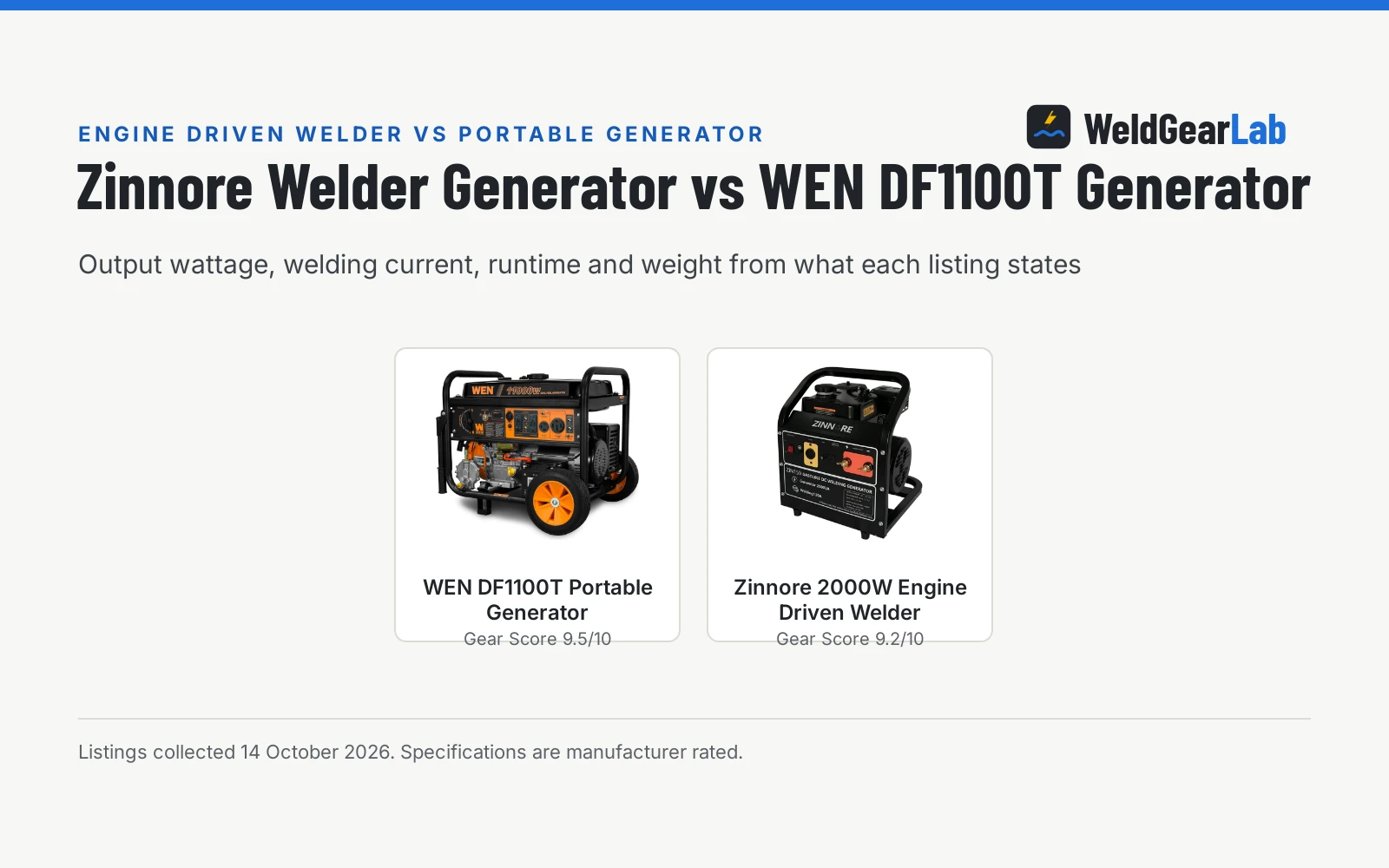
Related: stick welder vs multi-process welder, engine driven welder vs portable generator and how to choose a MIG welder.