Paddle Switch vs Slide Switch Angle Grinder: Which One Should You Buy?
Paddle switch vs slide switch angle grinder: how each switch works, when the deadman paddle wins, when the slide earns its place, and what real listings state.

On this page
Top picks at a glance
As an Amazon Associate I earn from qualifying purchases.
- 1
 Accusize Magnetic Base9.7/10View on Amazon
- 2
 Makita 9565PCV SJS High Power Paddle Switch Angle GrinderView on Amazon
- 3
 Makita GA5052 4-1/2" / 5" Paddle Switch Angle GrinderView on Amazon
- 4
 Makita 9564PC 4-1/2" SJS™ High-Power Paddle Switch AngleView on Amazon
- 5
 Makita 9557PBX1 4-1/2" Paddle Switch Cut-Off/Angle GrinderView on Amazon
- 6
 Makita 9557PB 4-1/2" Paddle Switch Angle GrinderView on Amazon
- 7
 Makita GA7021 7" Angle GrinderView on Amazon
The bead is down and needs dressing, or a bracket needs trimming to fit. You grab the 4-1/2 in grinder. The paddle switch vs slide switch angle grinder question is about what happens when you let go: a paddle stops when your hand leaves it, and a slide switch stays on until you slide it back. For most shop and field work, the paddle’s release-to-stop action is the behavior to shop for. The slide stays on for long, steady cuts in one position.
Other welders and gear to compare
 Makita 9565PCV SJS High Power Paddle Switch Angle GrinderCheck price on Amazon
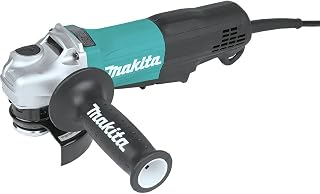 Makita GA5052 4-1/2" / 5" Paddle Switch Angle GrinderCheck price on Amazon
 Makita 9564PC 4-1/2" SJS™ High-Power Paddle Switch AngleCheck price on Amazon
 Makita 9557PBX1 4-1/2" Paddle Switch Cut-Off/Angle GrinderCheck price on Amazon
 Makita 9557PB 4-1/2" Paddle Switch Angle GrinderCheck price on Amazon
 Makita GA7021 7" Angle GrinderCheck price on Amazon
This guide links to our product roundups, where WeldGearLab gets a commission on purchases made through links on this page, and your price stays the same. Read our affiliate disclosure.
Paddle switch vs slide switch angle grinder: the short answer
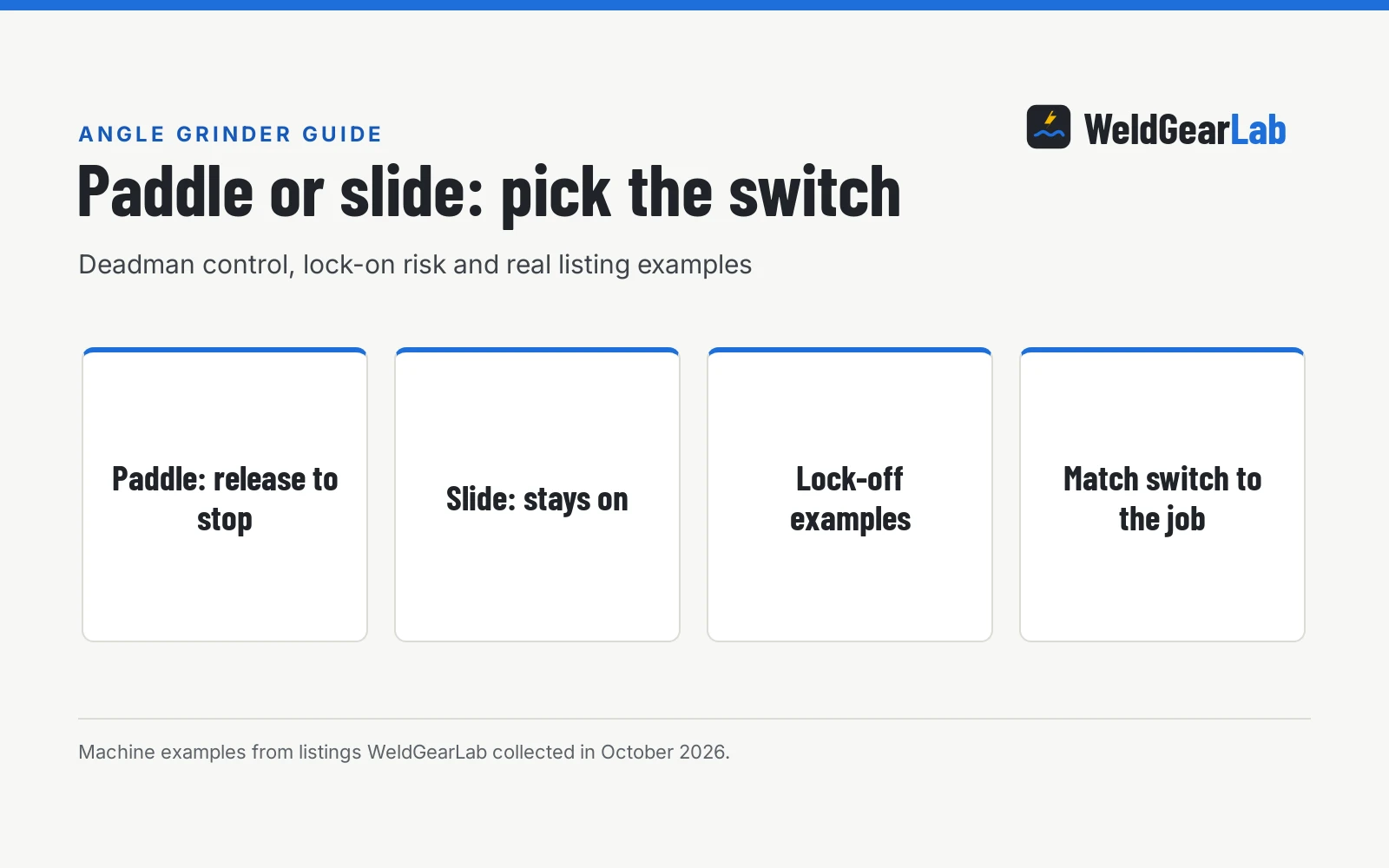
Buy the paddle for general grinding, weld dressing and work where you move around the part. Buy the slide for long cuts in one position where holding a paddle gets old. The difference is control: the paddle is deadman-style and stops when released, while the slide stays on until you move it back. Every listing cited in this guide uses a paddle switch, across 4-1/2 in, 4-1/2/5 in and 5 in sizes.
How a paddle switch works
The paddle is a lever under the grinder body. Squeeze it and the wheel spins. Let go and it stops. The listings show the variations that matter. The DEWALT DWE4012 lists a paddle switch on a 4-1/2 in grinder at 12,000 rpm. The DEWALT DWE4120N lists a paddle switch with no-lock on. The Skil listing describes a paddle switch safety lock that prevents accidental start-up. The Makita GA5052 listing notes press points at multiple grip positions with no lock-on power switch, plus a two-stage power lock-off switch to start the grinder, which helps when you shift your grip mid-cut. When you shop, read the switch line first: no-lock on and lock-off wording tells you the maker thought about accidental starts, and its absence tells you to assume the paddle runs whenever squeezed. One note on reading listings: the DWE4012 title says 7-amp while its bullets say 7.5 amp, so take small spec conflicts like that as a reminder to read the whole listing.
How a slide switch works
The slide is a thumb switch on top of the body. Push it forward and the grinder runs. It stays running until you slide it back. That is the whole appeal and the whole risk. On a long cut you are not squeezing anything, so your hand stays relaxed. But if the grinder kicks or leaves your hand, the wheel keeps spinning until you or someone else shuts it off. That is why the paddle dominates the listings for general shop grinders: the deadman action is the safety feature.
Side by side
| Feature | Paddle switch | Slide switch | Why it matters |
|---|---|---|---|
| Operation | Squeeze the paddle under the body; release to stop | Push the slider on top; stays on until slid back | Paddle stops deadman-style; slide keeps running hands-free |
| Lock-on | DEWALT DWE4120N and Makita GA5052 state no lock-on | Stays on by design | A wheel that keeps spinning after you let go is the main hazard |
| Start safety | Two-stage lock-off (Makita GA5052); safety lock prevents accidental start (Skil) | Not stated the same way in these listings | Lock-off features stop accidental starts |
| Grip | Press points at multiple grip positions (Makita GA5052) | Thumb works from one spot | Paddle suits shifting hand positions |
| Best for | Grinding and weld dressing on the move | Long steady cuts in one stance | Match the switch to the job, not the brand |
The table above covers the control difference. Power and wheel size are a separate question: the paddle listings cited here span 4-1/2 in, 4-1/2/5 in and 5 in sizes, with motors from 11,000 to 12,000 rpm across the DEWALT, Skil and Makita listings, so the switch changes how you control the tool, not what it can cut.
When the paddle switch is the better choice
- Weld dressing and beveling. You reposition constantly, and the wheel stops every time you relax your grip.
- Awkward positions. Overhead or inside a tight fit-up, a deadman switch is the backup your other hand cannot be.
- Shared shop tools. Anyone who picks up the grinder gets the safer behavior by default, with no instruction needed.
- Knock risk. If the work can snag the wheel or the grinder can get knocked from your hand, release-to-stop wins.
When the slide switch is the better choice
- Long straight cuts. Cutting stock to length in one stance, where squeezing a paddle for minutes gets old.
- Production repetition. Same cut, same position, many pieces: the slide saves hand fatigue across a run.
- Steady stance work. When the grinder stays put and your body does not move, the deadman advantage shrinks.
- Respect the tradeoff. If you choose the slide for comfort, keep the guard on and the work clamped, because the wheel will not stop itself.
FAQ for welders
Which switch is safer on an angle grinder?
The paddle, in most cases. It stops when you release it, so a dropped or kicked grinder shuts itself down. The DEWALT DWE4120N states no-lock on, and the Makita GA5052 states no lock-on power switch. The slide stays on until you move it back, which is a real hazard if the tool leaves your hand.
Can you lock a paddle switch on?
Not on the ones cited here. The DWE4120N title states no-lock on, and the Makita GA5052 listing states no lock-on power switch. Some paddles add a two-stage lock-off that takes two actions to start, which prevents accidental starts without letting the grinder run unattended.
What does a two-stage lock-off do?
It makes starting a deliberate act. The Makita GA5052 listing describes a two-stage power lock-off switch to start the grinder, so a bump against the paddle alone does not spin the wheel. Think of it as a safety on the switch itself.
Why do slide switches still exist?
Because some work is long and steady. On extended cuts in one position, the slide stays on without holding a paddle down. The slide trades the release-to-stop behavior for staying on during that specific job.
Does the switch change what the grinder can cut?
No, on the listings cited here. The listings cited here are paddle grinders in 4-1/2 in, 4-1/2/5 in and 5 in sizes, running 11,000 to 12,000 rpm. The switch changes control and safety behavior, not power, wheel size or accessory fit.
Related: best angle grinder, best angle grinder for welding prep, flap disc vs grinding wheel and best cut off wheels for metal.