Multi-Process Welder vs TIG Welder: Which One Should You Buy?
Multi-process welders offer wire-feed versatility for general shop repairs, while dedicated TIG welders deliver the precise heat and arc control needed for clean welds and aluminum.


On this page
Top picks at a glance
As an Amazon Associate I earn from qualifying purchases.
- 1
 ARCCAPTAIN DC 5 In 1 TIG Welder With Pulse9.6/10View on Amazon
- 2
 GNI Multiprocess Portable MINI WelderView on Amazon
- 3
 VEVOR MIG WelderView on Amazon
- 4
 Lincoln Electric Square Wave® 205 TIG Welder K5613-1View on Amazon
- 5
 Forney 271 Easy Weld 140 MP Multi-Process WelderView on Amazon
- 6
 FEMEROL Plasma Cutter Welder Combo 200A Gas MIG/GaslessView on Amazon
- 7
 GZ GUOZHI 145A MIG WelderView on Amazon
When a cracked trailer tongue, an exhaust pipe, and an aluminum intake sit on the same shop floor, deciding between a multi-process welder vs tig welder comes down to the kind of work you tackle every week. A multi-process welder gives you wire-fed speed and stick welding in one cabinet for general fabrication and repair, while a dedicated TIG welder provides the high-frequency arc start and fine foot pedal heat control required for clean, aesthetic welds and aluminum. If you build gates, repair farm equipment, and need MIG convenience, buy a multi-process unit. If your work centers on thin tubing, sanitary stainless, or precision aluminum, buy a dedicated TIG machine.
Other welders and gear to compare
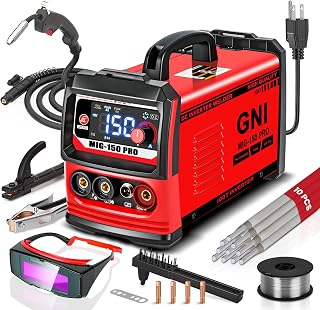 GNI Multiprocess Portable MINI WelderCheck price on Amazon
 VEVOR MIG WelderCheck price on Amazon
 Lincoln Electric Square Wave® 205 TIG Welder K5613-1Check price on Amazon
 Forney 271 Easy Weld 140 MP Multi-Process WelderCheck price on Amazon
 FEMEROL Plasma Cutter Welder Combo 200A Gas MIG/GaslessCheck price on Amazon
 GZ GUOZHI 145A MIG WelderCheck price on Amazon
This guide links to our product roundups, where WeldGearLab gets a commission on purchases made through links on this page, and your price stays the same. Read our affiliate disclosure.
The difference in one paragraph
Multi-process machines are constant-voltage power sources designed to feed wire smoothly for MIG and flux-core, with internal circuitry added for stick and basic DC TIG. That makes them versatile shop workhorses, but their TIG mode is almost always scratch start or lift TIG without high-frequency arc initiation or AC balance control. Dedicated TIG machines are purpose-built constant-current power sources designed for precision arc stability, remote foot pedal amperage regulation, high-frequency non-contact arc starts, and alternating current for cleaning and welding aluminum.
Side by side
| Multi-process welder | Dedicated TIG welder | Ideal application | |
|---|---|---|---|
| Primary processes | MIG, flux-core, stick, and DC TIG | Dedicated TIG and stick | Multi-process for all-around versatility |
| Arc start method | Lift TIG or scratch start on basic models | High-frequency non-touch arc initiation | Dedicated TIG for contamination-free starts |
| Heat control | Preset voltage and wire feed rate | Foot pedal amperage modulation while welding | Dedicated TIG for delicate heat management |
| Aluminum welding | MIG spool gun with DC | AC TIG for oxide cleaning | Dedicated TIG for precision aluminum work |
| Thin metal and tubing | Faster wire welding, prone to burn-through | Fine puddle control on thin stock | Dedicated TIG for sheet metal and exhausts |
| Deposition speed | Fast wire feeding for structural fab | Manual rod dipping, slower bead progress | Multi-process for heavy plate and repairs |
| Consumables and setup | Drive rolls, contact tips, wire spools, nozzles | Tungsten electrodes, collets, gas lenses, cups | Multi-process for wire convenience |
| Shielding gas | Mixed gas or carbon dioxide for MIG, argon for TIG | Pure argon gas | Dedicated TIG for single-gas simplicity |
| Shop footprint | Single cabinet saves bench and floor space | Requires dedicated floor space alongside other machines | Multi-process for compact home garages |
Machine specifications vary by brand and model tier. Always consult your machine manual and door chart for exact voltage settings, polarity, and gas flow rates before striking an arc. Multi-process units require swapping torch leads and drive rolls between processes, while dedicated TIG machines stay wired for torch and foot pedal control.
When a multi-process welder is the better choice
- General fabrication and farm repair. Fast wire-fed MIG and flux-core beads make quick work of structural tubing, brackets, and heavy steel plate where deposition speed matters more than surgical appearance.
- Shop floor space. Housing MIG, stick, and basic TIG capability in a single cabinet clears bench room and reduces clutter compared to parking separate power sources side by side.
- Outdoor maintenance. Switching to flux-core wire or stick mode lets you weld outdoors in breezy conditions without shielding gas blowing away from the molten puddle.
- Fast joint completion. Squeeze-and-trigger wire welding lays down sound fillets rapidly on thicker stock without stopping to feed filler rods by hand.
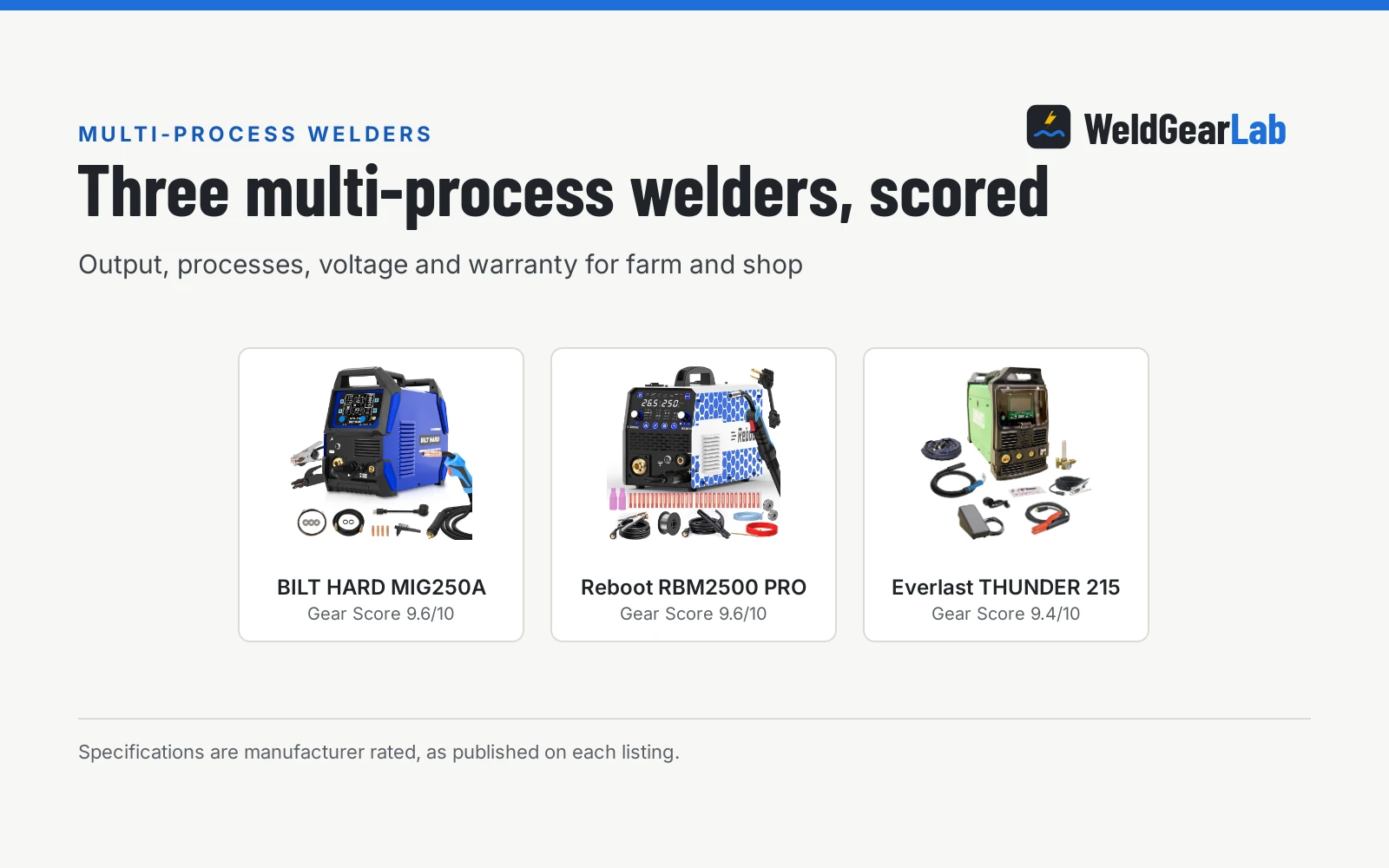
Our best multi-process welder guide details machines configured for versatile shop fabrication and field maintenance. For example, BILT HARD lists a multi-process machine delivering up to 250A with a 60% duty cycle at 250A that welds up to 3/8″ plate, while VEVOR lists a 200A unit with an 11 lbs wire capacity on 110V/220V dual voltage.
When a dedicated TIG welder is the better choice
- Precision heat control. A remote foot pedal lets you taper amperage up or down while watching the puddle, preventing burn-through on thin sheet and delicate tubing joints.
- Non-contact arc starts. High-frequency arc initiation starts the puddle without touching the tungsten to the workpiece, eliminating tungsten contamination and inclusions.
- Sanitary and aesthetic welds. TIG produces clean beads without spatter, slag, or smoke, making it the standard choice for roll cages, motorcycle frames, and visible stainless fab.
- AC aluminum welding. Alternating current breaks through tough aluminum oxide layers during the positive half of the cycle while penetrating the base metal during the negative half.
Our best TIG welder for aluminum roundup explores machines equipped with high-frequency ignition and adjustable AC parameters. For shops focusing on entry-level precision steel and stainless fabrications, our best entry level TIG welder guide covers capable constant-current units. Dedicated machines like the HZXVOGEN listing feature an 80% duty cycle at 200A and adjustable post gas delay from 1-10 seconds to shield the cooling crater.
How to tell what a machine supports
Not every machine sold as a multi-process unit provides full TIG capability. Look for these specific features in published equipment specifications:
- Lift TIG versus High Frequency. Most multi-process machines state lift TIG or scratch start, which requires touching the tungsten to the steel to initiate the arc. Dedicated TIG listings highlight high-frequency non-touch starting, which jumps the arc across the gap with a pedal or torch switch.
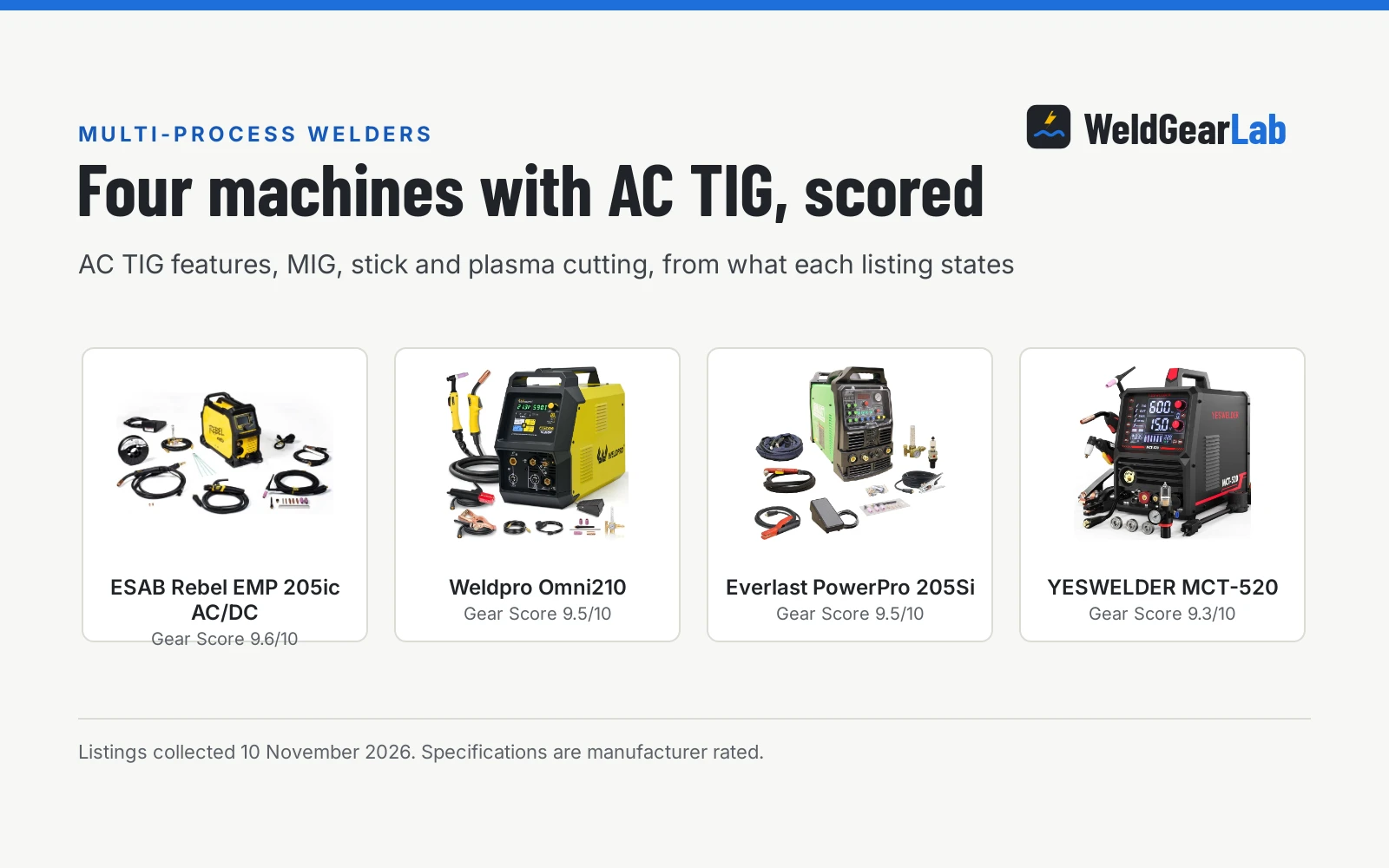
- DC TIG versus AC/DC TIG. Multi-process machines in this tier operate on direct current. DC TIG welds mild steel and stainless steel cleanly but cannot properly weld aluminum. Dedicated aluminum TIG welders explicitly specify AC/DC output. Lincoln Electric lists its Square Wave 205 as an AC/DC TIG platform.
- Included torches and pedals. Listings often advertise multi-process functions while noting that the TIG torch, foot pedal, or spool gun must be purchased separately. HITBOX lists a 15-200A TIG mode compatible with 1/16″ and 3/32″ tungsten electrodes, while YESWELDER lists a foot-pedal-ready 20-200A machine backed by a 2-Year warranty.
- Machine weight and portability. Compact multi-process units vary widely in heft. GNI lists a 110V model weighing 7.5lb, whereas fully featured dual-voltage multi-process cabinets like HITBOX list at 41.2 pounds and YESWELDER lists at 46.5 pounds.
Welding aluminum: spool gun vs AC TIG
Welding aluminum highlights the fundamental divide between these machines. A multi-process machine can weld aluminum only on DC, typically by connecting an optional spool gun or using specialized wire liners to prevent soft aluminum wire from binding. MIG aluminum welding lays down fast beads, but it operates hot, produces soot, and struggles on thin sheet. Dedicated TIG machines use alternating current to clean oxide film on the reverse polarity half-cycle while providing deep penetration on the straight polarity half-cycle. For a detailed comparison of arc initiation methods on thin joints, check our guide on HF start vs lift arc TIG.
Multi-process welder vs tig welder: which one fits your shop?
Choosing between them comes down to your primary projects and available shop space. If you want an all-in-one workhorse for automotive sheet metal, trailer repairs, and general shop fixtures, a multi-process welder delivers maximum utility for your investment. If your focus is building custom exhausts, roll cages, bicycle frames, or aluminum tanks where visual weld perfection and delicate heat management are mandatory, invest in a dedicated TIG welder.
Always operate in a well-ventilated area with appropriate extraction to avoid inhaling metal fumes, particularly when running flux-core wire or welding galvanized steel. Secure shielding gas cylinders upright to a sturdy wall rack or cart, wear flame-resistant leather gear, and choose the proper auto-darkening shade to protect against intense arc radiation.
FAQ for welders
Can a multi-process welder weld aluminum?
Yes, but with limitations. Most multi-process machines weld aluminum using MIG mode paired with a spool gun and pure argon shielding gas. Because they operate on direct current, they cannot TIG weld aluminum, which requires an alternating current arc to scour off aluminum oxide.
Why do most multi-process welders use lift TIG instead of high frequency?
Multi-process machines are designed primarily around constant-voltage wire feeding, and adding high-frequency start circuitry alongside AC balance controls increases cabinet size and electronic complexity. Lift TIG allows manufacturers to offer basic DC TIG capability for mild steel using simpler internal contactor circuitry.
Do I need a foot pedal for TIG welding?
A foot pedal is essential for bench fabrication, precision pipe joints, and thin sheet metal where you must adjust heat as the base metal saturates with heat. While you can weld steel using a fixed amperage torch trigger or lift arc, a pedal gives you the fine control that makes TIG welding shine.
Is a multi-process welder harder to set up than a dedicated machine?
Switching processes on a multi-process unit requires reconfiguring the machine. You must swap drive rolls, change shielding gas cylinders, adjust polarity leads, and switch torches when moving between MIG, stick, and TIG. A dedicated machine stays tuned for its single process, saving changeover time on repetitive tasks.
Can I use the same shielding gas for MIG and TIG welding?
No. MIG welding on carbon steel typically uses an argon and carbon dioxide mixture to stabilize the arc and control penetration. TIG welding requires pure argon shielding gas because carbon dioxide in the gas stream will rapidly burn and erode the tungsten electrode.
Related: is a multi-process welder worth it, best multi-process welder, best entry level TIG welder, and the multi-process welders hub. Also see our HF start vs lift arc TIG.