Is a Multi-process Welder Worth It?
A multi-process welder combines wire feed, stick, and TIG welding into a single compact chassis to save shop space and equipment expense for home fabricators.
 By WeldGearLab Editorial
Updated October 10, 2026
By WeldGearLab Editorial
Updated October 10, 2026
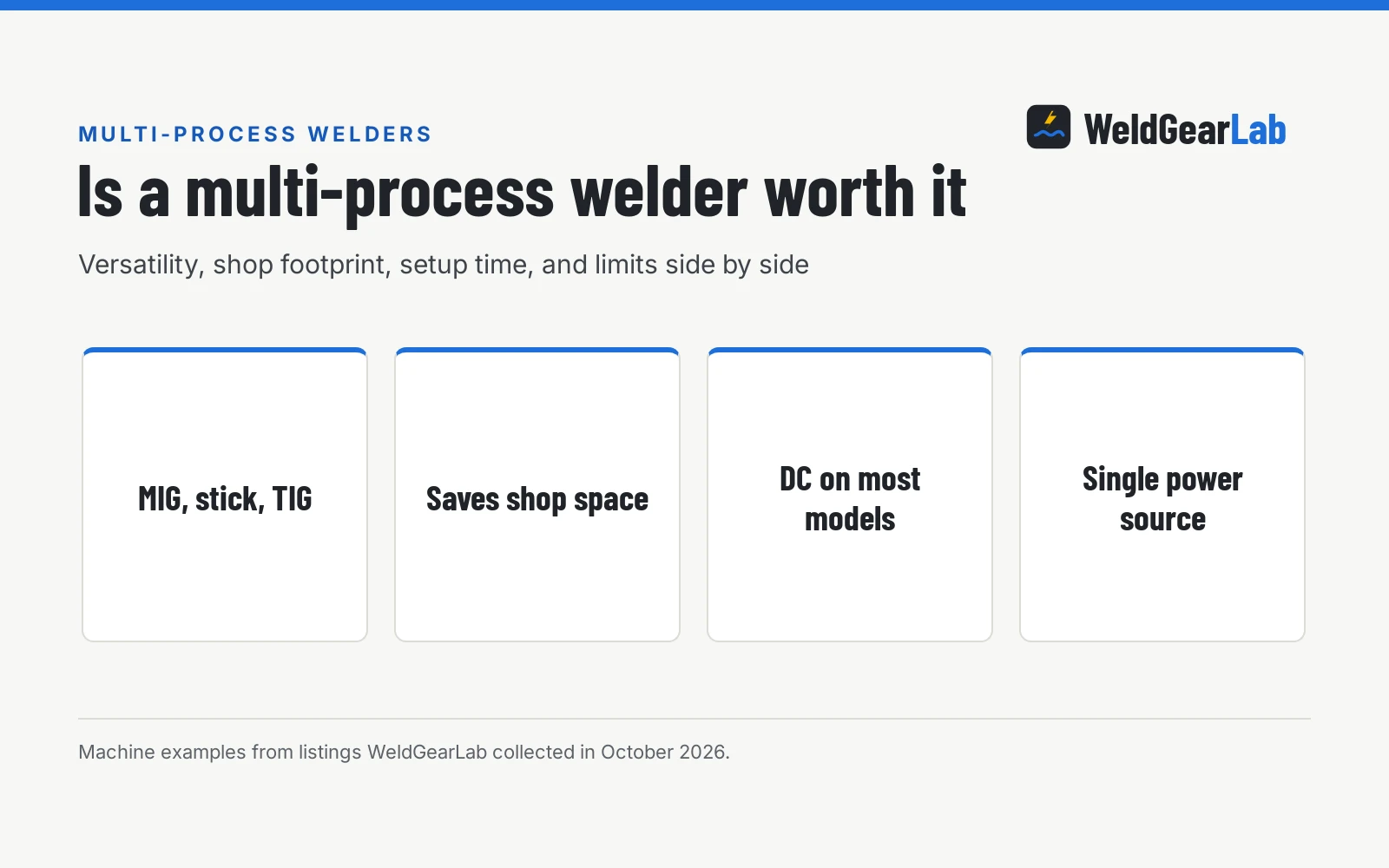
If you are asking is a multi-process welder worth it, the answer for most home fabricators, farm shops, and hobbyists is yes. A multi-process welder is worth it because combining MIG, stick, and TIG welding in a single power source saves valuable shop space and initial investment compared to purchasing separate dedicated machines. You get the speed of wire feed welding for clean sheet fabrication, the outdoor wind tolerance of stick welding for heavy equipment, and the fine control of TIG welding for precise joints. While multi-process machines require compromises on setup changeover time and advanced TIG features, their versatility fits the reality of garage fabrication where projects change from week to week.
As an Amazon Associate I earn from qualifying purchases. This guide links to our product roundups, where WeldGearLab earns a commission when you buy through links, at no extra cost to you. Read our affiliate disclosure.
The difference in one paragraph
A dedicated welder is engineered for a single task, while a multi-process machine uses modern inverter electronics to provide constant voltage for wire feed welding and constant current for stick and TIG arcs. That electronic flexibility allows a single compact cabinet to run a MIG spool, clamp a stick rod, or power a TIG torch. The trade-off is changeover time. Switching between processes means swapping torch leads on the front panel, changing wire feed drive rolls, switching polarity, and connecting the correct shielding gas bottle for the task.
Side by side
| Multi-process welder | Dedicated MIG welder | Dedicated TIG or Stick welder | |
|---|---|---|---|
| Supported processes | MIG, stick, and TIG in a single chassis | MIG and flux core wire feed only | TIG and stick arc welding only |
| Shop floor footprint | Single compact cabinet on one cart | Separate dedicated cabinet and cart | Separate dedicated cabinet and cart |
| Electrical connection | Single power receptacle (110V/220V or 120V/240V) | Dedicated power outlet connection | Dedicated power outlet connection |
| Process changeover | Swapping torch leads, drive rolls, and gas | Always connected and ready to weld | Always connected and ready to weld |
| TIG arc starting | Lift TIG on basic units; HF start on select models | Not applicable | High frequency start or Lift arc |
| Aluminum capability | Spool gun MIG, or AC TIG on select AC/DC units | Spool gun MIG with argon shielding gas | AC TIG with adjustable cleaning balance |
| Equipment investment | Single power source purchase | Dedicated machine purchase | Dedicated machine purchase |
| Machine downtime risk | Chassis fault halts all welding modes | Other machines stay running if one faults | Other machines stay running if one faults |
| Job site portability | Transport a single power source for all jobs | Transporting wire feed unit only | Transporting stick or TIG unit only |
Changeover steps depend on machine layout, so always follow the connection diagram printed inside the wire drive door and in the operator manual. While switching between processes takes a few minutes of changeover, housing your welding gear on a single rolling cart avoids cluttering the shop floor with multiple power sources and duplicate gas cylinders.
When a multi-process welder is the better choice
- Limited garage or shop space. Housing a single power source on a cart frees up floor area that would otherwise be occupied by separate MIG, stick, and TIG cabinets.
- Varied fabrication and maintenance projects. A typical weekend might require self-shielded flux core on a rusty farm gate outdoors, solid wire MIG on clean automotive sheet metal, and stick on heavy steel brackets.
- Mobile repairs and field work. Transporting a single compact inverter machine to a job site, driveway, or barn handles whatever joint condition you encounter without hauling a trailer of equipment.
- Expanding welding skills over time. Beginners can start on forgiving wire feed welding and gradually learn stick and TIG techniques without buying additional power sources.
Our best multi-process welder guide covers versatile machines ranging from compact home units to high-output shop models.
When dedicated machines are the better choice
- Continuous production and repetitive welding. If your workshop runs solid wire MIG all day, you gain nothing from unused stick and TIG circuitry, and dedicated wire feeders offer simpler controls with fewer menus.
- Multiple simultaneous operators. In a busy shop, separate dedicated machines allow multiple fabricators to weld at the same time, whereas a multi-process machine can only support one welder at a time.
- Dedicated equipment backup and redundancy. Having independent power sources ensures that if one machine requires servicing, your shop can continue working with the remaining units rather than halting all welding processes.
- Zero changeover between jobs. Dedicated stations keep torches, drive rolls, shielding gas cylinders, and polarities permanently configured, eliminating the setup time required to switch a multi-process machine between wire, stick, and TIG.
How to tell what a machine supports
Not every machine labeled multi-process offers the same capabilities or includes the necessary hardware. Review the maker specifications for these key features before choosing a machine:
- Wire feed modes and spool capacity. Check whether the machine handles both solid wire with shielding gas or gasless flux core only. VEVOR lists its 200A 4-in-1 model with compatibility for 0.03″ and 0.04″ flux core and solid wire up to an 11 lbs spool capacity, while GNI lists a 110V model running .030″, .035″, and .039″ flux core wire without gas.
- TIG arc starting method and torch inclusion. Most multi-process units offer Lift TIG, which requires touching the tungsten to the workpiece and lifting it to draw an arc. Listings frequently state that the lift TIG torch is not included, as on the VEVOR and GNI units, though HITBOX lists DC HF TIG with non-touch high-frequency starting.
- Built-in plasma cutting functions. Certain multi-process units combine welding circuits with a plasma cutter. HITBOX lists a 40A plasma cutter that cleanly cuts 1/4″ at 40A and max cuts up to 1/2″, while S SIMDER lists a 16.98 lbs 6 in 1 unit that cuts up to 10 mm steel on 220V.
- Rated plate thickness and duty cycle. Review the published material thickness and duty cycle ratings. BILT HARD lists its 250A machine welding up to a 3/8″ plate with a 60% duty cycle at 250A, while Miller lists its Multimatic 220 welding mild steel up to 3/8 in.
Accessories vary widely across listings. Some units include torches, ground clamps, and gas hoses, while others require purchasing a TIG torch, foot pedal, spool gun, or gas regulator separately.
Aluminum capabilities and process limits
Aluminum welding is where multi-process machines show the biggest differences between entry-level and advanced models. Steel and stainless steel weld cleanly on DC TIG, but aluminum forms a tough surface oxide layer that requires alternating current (AC) to clean the puddle during the positive half of the cycle. Most budget multi-process machines deliver DC output only. For example, S SIMDER explicitly notes its machine does not weld aluminum on TIG and has no HF TIG, and GNI states its unit does not weld aluminum. On DC-only multi-process welders, aluminum is welded in MIG mode using an optional spool gun or specialized wire liner, as HITBOX notes with its dedicated AL MIG mode and graphite liner. Truly versatile AC/DC multi-process machines, like the Miller Multimatic 220, include full AC TIG capability for aluminum alongside MIG and stick. For fabricators who prefer a machine built specifically for AC TIG torch work, see our best TIG welder for aluminum guide.
Is a multi-process welder worth it?
For home hobbyists, farm maintenance, and small fabrication shops, a multi-process welder is worth it. Paying for a single power source instead of multiple dedicated cabinets saves floor space and initial budget. The trade-off in changeover time is manageable when you tackle individual projects rather than running high-speed production. If you plan to expand your skills across wire, stick, and TIG welding without crowding your garage, a multi-process inverter delivers practical capability in one cabinet.
Welding safety and ventilation. Every welding process produces electric arc radiation, hot spatter, and airborne fumes. Stick and flux core welding generate heavy smoke that requires outdoor airflow or local exhaust ventilation, while gas MIG and TIG require calm indoor conditions to avoid blowing away shielding gas. Always weld with proper shade protection, wear flame-resistant clothing, and ensure your workshop wiring matches machine input requirements. Check our 120V vs 240V welder guide before choosing your electrical circuit.
Frequently Asked Questions
Is a multi-process welder as good as a dedicated machine?
For general fabrication and repair on mild steel, a multi-process inverter produces welds equal in strength and appearance to dedicated machines. The primary difference is workflow convenience rather than arc quality. Dedicated machines eliminate changeover time between jobs and let multiple operators weld simultaneously, while a multi-process unit delivers matching arc stability from a single chassis.
Can a multi-process welder weld aluminum?
Yes, but the available process depends on the machine’s electrical design. Most entry-level multi-process machines weld aluminum in MIG mode using an optional spool gun or dedicated wire liner with pure argon gas. Advanced multi-process machines that feature AC/DC power sources can also perform AC TIG welding on aluminum, though many fabricators still choose dedicated AC TIG welders for specialized bench work.
What is the difference between Lift TIG and High-Frequency TIG?
Lift TIG requires touching the tungsten electrode to the metal and lifting it upward to establish the arc, preventing electrical high-frequency interference with nearby electronics. High-frequency TIG uses a high-voltage spark to jump the air gap without touching the tungsten to the workpiece. High-frequency starting eliminates tungsten contamination, while Lift TIG is simpler and avoids electrical interference.
Do multi-process welders include all torches in the box?
Accessory packages differ by maker and model. Most multi-process packages include a MIG gun, an electrode holder for stick welding, and a ground clamp. Many entry-level machines do not include a Lift TIG torch, foot pedal, or gas regulator, meaning you must purchase those accessories separately before using every available process.
Is a multi-process welder good for beginners?
A multi-process machine is an outstanding option for beginners because synergic controls automatically align voltage and wire feed speed. New welders can master wire feed welding first, then practice stick and TIG techniques on the same machine without buying new power sources. For starter recommendations, see our best welder for beginners guide.
Related: are multi process welders good, best 4 in 1 welder, best 6 in 1 welder, and our multi-process welders hub. Also see our welding machine types guide.
About the author
WeldGearLab Editorial is the editorial team behind WeldGearLab. We research product listings, specifications, safety listings and warranty terms, score every pick with the published Gear Score method, and correct errors when readers report them. We do not run our own shop trials; see How We Pick for exactly how picks are made.