Millermatic 141 vs 142: What Changed and Is It Worth It?
How the Millermatic 141 and Millermatic 142 differ across inverter power, torch hardware, wire feeding, and portability, and whether upgrading makes sense for your shop.
 By WeldGearLab Editorial
Updated October 9, 2026
By WeldGearLab Editorial
Updated October 9, 2026
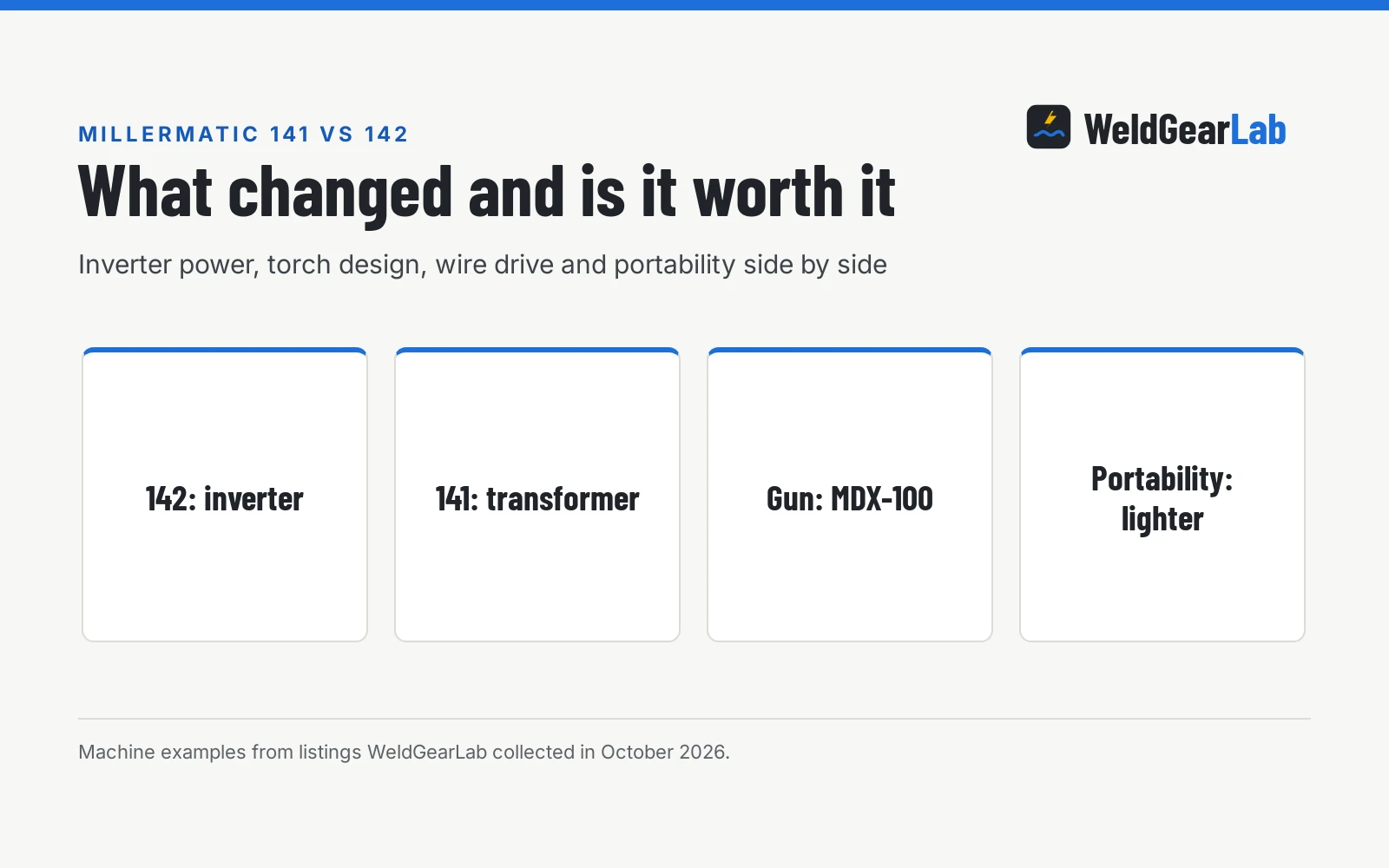
When comparing the Millermatic 141 vs 142, the key difference is that the Millermatic 142 replaces the older transformer platform of the Millermatic 141 with a modern inverter power source and an upgraded gun system. This change makes the Millermatic 142 much lighter to carry, improves arc stability on standard household outlets, and pairs the machine with Miller’s newer MDX-100 torch and AccuLock consumables. If you weld on job sites or move your welder frequently, the Millermatic 142 is worth the upgrade; if your Millermatic 141 sits permanently on a shop cart, its proven transformer still delivers dependable welds for light fabrication.
As an Amazon Associate I earn from qualifying purchases. This guide links to our product roundups, where WeldGearLab earns a commission when you buy through links, at no extra cost to you. Read our affiliate disclosure.
Millermatic 141 vs 142: the difference in one paragraph
The Millermatic 141 was built around a traditional transformer core with manual voltage controls and Miller’s Auto-Set feature, which automatically dials in voltage and wire feed speed based on material thickness. The Millermatic 142 shifts that design to an inverter topology. Inverters convert incoming alternating current to high frequencies before transforming it, resulting in a cabinet that sheds significant bulk while improving arc response across fluctuating utility lines. Beyond internal electronics, the front end changes as well: the Millermatic 141 relied on the older M-10 and M-100 gun design, whereas the Millermatic 142 comes equipped with the MDX-100 torch. Both run on 110V or 115V household power and handle solid or flux-cored wire from .023 to .035 diameter, but the newer machine is built for easier transport and quicker consumable changes.
Side by side
| Millermatic 141 | Millermatic 142 | Takeaway | |
|---|---|---|---|
| Power source topology | Traditional transformer platform | Modern inverter platform | Inverter reduces weight and maintains steady arc |
| Portability and mobility | Heavy cabinet suited for stationary cart use | Lightweight cabinet suited for field transport | Millermatic 142 is significantly easier to transport |
| Factory MIG gun system | Miller M-10 or M-100 series torch | Miller MDX-100 torch | MDX-100 features updated ergonomic grip |
| Consumable platform | Traditional slip-on nozzle and diffuser (169-715, 169-716) | AccuLock MDX series (ns-m1200c, d-m100) | AccuLock seats tip directly against liner lock |
| Supported wire diameters | .023, .024, .025, .030, and .035 inch | .023, .024, .025, .030, and .035 inch | Both models handle identical wire sizes |
| Spool size compatibility | Accommodates compact mobile and shop spools | Accommodates compact mobile and shop spools | Standard spool hub support across both units |
| Input power supply | 110V or 115V household branch circuits | 110V or 115V household branch circuits | Both operate on standard utility power |
| Aftermarket gun cable options | 10ft, 12ft, or 15ft replacement guns | 10ft or 15ft replacement guns (1770028, 1770030) | Available in multiple replacement lengths |
| Replacement torch packaging | M-series kits include 169-715 nozzle and 169-716 diffuser | MDX-100 kits include ns-m1200c nozzle and d-m100 diffuser | Kits provide matching nozzles, diffusers, and tips |
| Primary application | Dedicated garage work and fixed welding benches | Mobile maintenance, autobody, and field fabrication | Select 142 for transport or 141 for stationary shop |
Ratings, cable lengths, and consumable part numbers reflect manufacturer specifications and replacement parts published in October 2026. Both machines run on common 110V or 115V branch circuits, but always check the data chart inside the wire drive door for recommended wire speed and voltage settings before starting a project.
When the Millermatic 141 is the better choice
- Stationary shop use. If your welder sits on a rolling cart in a dedicated home garage, the extra weight of a transformer is not a drawback.
- Straightforward transformer simplicity. Classic transformer welders have fewer sensitive electronic control boards, which some operators prefer for basic maintenance and long-term durability.
- Abundant legacy consumables. Replacement parts for Miller M-10 and M-100 torches are ubiquitous. Common items like the 169-715 nozzle, 169-716 diffuser, and 000-068 contact tips are stocked almost everywhere.
- Budget-friendly secondhand availability. Because owners upgrade to portable inverters, well-maintained Millermatic 141 units frequently appear on the used market at attractive entry points.
If you already own a Millermatic 141 and your welding takes place exclusively at a fixed workbench, there is little practical reason to retire a functioning unit.
When the Millermatic 142 is the better choice
- Portability between jobs. The inverter cabinet is substantially lighter than the Millermatic 141, allowing you to load it into a vehicle or carry it across a workspace without strain.
- Improved arc stability on standard power. Inverter circuitry regulates incoming current efficiently across standard 110V or 115V household circuits, producing a stable arc puddle without voltage sag.
- AccuLock MDX torch technology. The factory MDX-100 gun locks the wire liner directly to the contact tip without requiring set screws, helping prevent wire alignment gaps that can contribute to burnback.
- Refined control interface. The updated control panel offers clear parameter readouts, making it simpler to verify settings whether running in Auto-Set mode or adjusting voltage manually.
For mobile welding, automotive body panels, or off-site repairs, the weight savings and modern arc controls of the Millermatic 142 justify selecting the updated model. Read our guide comparing an inverter welder vs transformer welder for a deeper look at how these internal platforms perform.
MIG gun and consumable differences
A critical hardware distinction between both models lies at the end of the torch cable. The Millermatic 141 was supplied with Miller M-10 or M-100 series torches. These guns use traditional slip-on gas nozzles and threaded brass diffusers, such as the 169-715 nozzle and 169-716 diffuser. Consumable packages from suppliers like Allyearauto provide 2pcs of the 169-715 nozzle, 2pcs of the 169-716 diffuser, and 12pcs of the 000-068 contact tips for .035 wire. While proven over decades of shop service, traditional diffusers require routine inspection to ensure contact tips remain firmly threaded.
In contrast, the Millermatic 142 features the MDX-100 torch, which uses Miller’s AccuLock MDX consumable system. The MDX-100 setup pairs with the ns-m1200c nozzle and d-m100 diffuser, seating the contact tip directly against the brass liner lock. This design creates a smooth path for wire travel and helps prevent alignment gaps. Replacement guns from makers like Hasweld provide complete MDX-100 assemblies with 5 tips for .035 wire, offering factory-compatible options in 10ft (part 1770028) and 15ft (part 1770030) lengths weighing 6.39 pounds. For M-series welders like the Millermatic 141, Hasweld offers 150A replacement torches specifying a 40% duty cycle on carbon dioxide gas in 10ft (weighing 3.89 pounds) and 15ft (weighing 4.95 pounds) lengths handling wire from 0.6 to 0.9 mm, while USWELDWIRE models offer 180A capacity across 10ft (weighing 3.91 pounds), 12ft (weighing 4.16 pounds), and 15ft (weighing 5.37 pounds) cables.
Wire sizes and spool capacity
Both machines are engineered to feed solid steel wire with shielding gas or gasless flux-cored wire. Supported wire sizes range across .023, .024, .025, .030, and .035 diameter. Solid wire in .023 or .024 diameter performs exceptionally well on thin automotive sheet, while .030 and .035 wire deliver solid penetration on heavier bracketry. Replacement guns from YESWELDER rated at 150A on a 10ft cable (weighing 4.1 pounds) support all of these stated diameters, coming standard with a .030 tip.
Inside the wire compartment, both welders feature drive mechanisms designed for reliable wire feeding across various spool sizes. Compact portable spools suit mobile repairs, while larger spools reduce wire replacement frequency during extended shop fabrication. Matching drive roll tension and contact tip size to your chosen wire diameter ensures consistent feeding without birdnesting or erratic arc starts. Reviewing wire drive capacity ensures your machine matches your project scale.
Is the Millermatic 142 worth the upgrade?
If you are choosing between purchasing a new Millermatic 142 or locating a used Millermatic 141, the decision hinges on how often you move equipment. The Millermatic 142 provides modern inverter arc performance, noticeable weight reduction, and superior torch ergonomics with AccuLock MDX consumables. For contractors, field repairs, or home shops with limited bench space, those benefits make the Millermatic 142 well worth the investment.
However, if you already own a reliable Millermatic 141 that remains anchored to a shop workstation, upgrading offers diminishing returns. The older transformer produces sound welds on mild steel and runs standard .023 to .035 wire through widely accessible M-series consumables. Unless you require job site portability or want the simplified consumable changes of the MDX-100 gun, the Millermatic 141 continues to be a dependable workhorse.
Welding safety and workshop precautions. Electric arc welding creates intense ultraviolet radiation, spatter, and hazardous fumes. Always wear a shaded welding helmet and flame-resistant leather gloves during operation, and keep workspaces clear of sawdust and solvents. Anchor gas cylinders upright with a chain to prevent falls. When chipping slag or grinding weld joints, keep protective safety glasses on beneath your hood.
Frequently Asked Questions
Can the Millermatic 141 use MDX-100 consumables?
The standard M-10 and M-100 guns on the Millermatic 141 cannot use AccuLock MDX consumables directly because the nozzles and diffusers have different thread geometries. However, you can install a complete MDX-100 replacement gun on the Millermatic 141 power pin. Once the MDX torch is installed, you can use ns-m1200c nozzles and d-m100 diffusers without issue.
Can the Millermatic 142 run on a standard 110V household outlet?
Yes, the Millermatic 142 is designed specifically for standard household power, plugging into common 110V or 115V circuits. Its inverter power supply manages input current smoothly, maintaining arc stability and reducing breaker trips during arc starts.
What wire diameters can both machines run?
Both the Millermatic 141 and 142 handle solid and flux-cored wire in .023, .024, .025, .030, and .035 diameter. Thinner .023 and .024 wire is ideal for light sheet metal, whereas .030 and .035 wire provides adequate penetration for structural brackets. Match your contact tip and drive roll groove to your chosen wire diameter.
Is the Millermatic 142 lighter than the Millermatic 141?
Yes, the shift from a heavy transformer power source to an inverter circuit allows the Millermatic 142 cabinet to shed considerable weight. This reduction makes the newer unit significantly easier to carry to field repairs or transport between job sites. The older 141 is better suited to a rolling shop cart.
Can both welders weld without shielding gas?
Both units can operate without external shielding gas by running self-shielded flux-cored wire. To weld flux core, swap your internal polarity connections so the torch lead connects to negative DCEN polarity. When welding with solid wire and shielding gas, switch the polarity back to positive DCEP.
Related: how to choose a MIG welder, best 120V MIG welder, inverter welder vs transformer welder, and the MIG welders hub. Also see our troubleshooting guide on why a MIG welder spatters.
About the author
WeldGearLab Editorial is the editorial team behind WeldGearLab. We research product listings, specifications, safety listings and warranty terms, score every pick with the published Gear Score method, and correct errors when readers report them. We do not run our own shop trials; see How We Pick for exactly how picks are made.