Lined vs Unlined Welding Gloves: Which One Should You Buy?
Both lined examples in this comparison add an insulation layer for MIG and stick work, while an unlined glove skips that layer, so the choice comes down to warmth against a closer feel.

On this page
Top picks at a glance
As an Amazon Associate I earn from qualifying purchases.
- 1
 Hobart Premium Goatskin MIG Welding Gloves, Large9.6/10View on Amazon
- 2
 Caiman Premium Split Deerskin MIG/Stick Welding9.5/10View on Amazon
Verdict. Lined vs unlined welding gloves comes down to the layer inside the glove. A lined glove adds insulation between hand and leather, while an unlined glove leaves that layer out. Pick a lined glove for warmth on longer MIG and stick sessions, and pick an unlined glove when a closer feel matters more than insulation.
A MIG bead on a farm gate and a stick repair on a trailer frame ask different things from a glove, and the lining inside decides part of the answer. This comparison puts lined vs unlined welding gloves side by side, using the lined gloves featured here as concrete examples of what lining adds, and setting out what changes when that layer is left out.
WeldGearLab gets a commission on purchases made through links on this page, and your price stays the same.
The two gloves
Hobart Premium Goatskin MIG Welding Gloves, Large
A fleece-lined goatskin and cow split leather glove for MIG and stick welding, with Kevlar stitching and stated ANSI/ISEA 105-2024 abrasion and puncture levels.
Pros
- Fleece lined interior for extra comfort and heat protection
- Goatskin palm with a seamless index finger for precise control
- ANSI/ISEA 105-2024 Level 3 abrasion and Level 4 puncture resistance
- Kevlar stitching with a reinforced thumb for extended use
Cons
- Warranty description states No Warranty Applicable
- No glove length is stated
- No temperature figure is stated
- Material mix is 45% goatskin, 20% cow split, 15% cotton, and 20% polyester
Caiman Premium Split Deerskin MIG/Stick Welding
A sock-lined foam and fleece deerskin glove for MIG and stick work, with a split cowhide heat shield patch, a 21 inch length, and Kevlar thread.
Pros
- 21 inch glove length with heavy-duty padding on the forearm and elbow
- Split cowhide heat shield patch with a reinforced palm, cuff, and lean-on patch
- Sewn with Kevlar thread
- Sock-lined foam and fleece insulation for warmth and comfort
Cons
- Warranty description states 30 Day Limited
- No ANSI/ISEA level is stated
Other welders and gear to compare
 Caiman Premium Goat Grain TIG Welding GlovesCheck price on Amazon
 Caiman Premium Cow Grain MIG/Stick Welding GlovesCheck price on Amazon
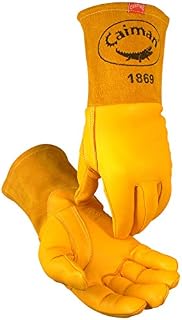 Caiman Premium Top Grain Goatskin MIG Welding GlovesCheck price on Amazon
 Giorgino Premium TIG Welding Gloves Top Grain GoatskinCheck price on Amazon
 Caiman Elk Skin MIG/Stick Welding GlovesCheck price on Amazon
 Miller Electric Welding GlovesCheck price on Amazon
Side by side
| Hobart Goatskin MIG Welding Gloves | Caiman Split Deerskin MIG/Stick Welding Gloves | Unlined side | |
|---|---|---|---|
| Gear Score | 70 | 62 | Not scored |
| Lining | Fleece lined | Sock-lined foam/fleece | No lining layer |
| Leather | Goatskin and cow split leather | Split deerskin with split cowhide heat shield patch | Varies by glove |
| Processes | MIG and stick | MIG, stick and plasma cutting | Varies by glove |
| Stated standard | ANSI/ISEA 105-2024 Level 3 abrasion, Level 4 puncture, Level 2 conductive heat | Not stated | Varies by glove |
| Length and coverage | Not stated | 21 inch glove length | Varies by glove |
| Stitching | Kevlar stitching | Kevlar thread | Varies by glove |
| Weight | 0.5 pounds | 0.75 pounds | Varies by glove |
| Warranty | No Warranty Applicable | 30 Day Limited | Varies by glove |
| Size in spec table | Large | X-Large | Varies by glove |
Treat the specs as maker ratings pulled straight from the listings; we gathered them on 3 November 2026. Both gloves featured here are lined examples, so the unlined column describes that side in general terms, not a featured glove.
Lined vs unlined welding gloves: what the lining changes
Lining is an inner layer added to the leather shell. The Hobart example uses a fleece lined interior, and the Caiman example uses sock-lined foam and fleece insulation. The Caiman listing ties its lining to warmth and comfort, and the Hobart listing ties its lining to comfort and heat protection. An unlined glove has no such inner layer, so the hand sits closer to the leather shell.
That difference cuts both ways. The featured fleece and foam linings add material inside the glove. Leaving the lining out leaves less material between hand and work, while giving up the lining layer the featured gloves provide.
Lining and warmth
The Hobart glove pairs its fleece lined interior with goatskin and cow split leather, and its listing states extra comfort and heat protection from that lining. The Caiman glove pairs sock-lined foam and fleece insulation with split deerskin and a split cowhide heat shield patch, and its listing states warmth and comfort from that insulation. No temperature figure is stated for either featured glove.
Fit, coverage and dexterity
Fit starts with the size each listing gives. The Hobart spec table gives Large, while its bullets name medium, large, and extra large sizes. The Caiman spec table gives X-Large. A glove that is too loose dulls control, and a glove that is too tight strains the hand, so the listed size deserves a check before buying.
Dexterity is where the lining trade shows up most. The Hobart listing names a goatskin palm, a seamless index finger, and precise control. The Caiman listing names pre-curved fingers and a form-fitting design. Both are lined gloves making a dexterity claim. An unlined glove of the same cut has less material inside, but fit and leather thickness also affect feel, so lining alone does not decide dexterity.
Coverage differs between the featured gloves. The Caiman listing states a 21 inch glove length, with heavy-duty padding on the forearm and elbow. The Hobart listing states no glove length. An unlined glove gives no automatic coverage advantage, since coverage depends on the cut and length of that glove, not on lining.
Materials, stitching and durability
The Hobart glove uses goatskin and cow split leather, with a material mix of 45% goatskin, 20% cow split, 15% cotton, and 20% polyester. The Caiman glove uses split deerskin, with a gold split cowhide leather heat shield patch, a reinforced palm, cuff, and lean-on patch. Both featured gloves use Kevlar stitching: the Hobart listing states heavy duty Kevlar stitching, and the Caiman listing states that it is sewn with Kevlar thread. The Hobart listing names a reinforced thumb for extended use.
Stated standards and warranty
Only the Hobart listing states a safety standard with levels. It meets ANSI/ISEA 105-2024 Level 3 abrasion resistance, Level 4 puncture resistance, and Level 2 conductive heat resistance. The Caiman listing states protection against heat, sparks, and abrasions in general words, with no ANSI/ISEA level stated. That difference is a listing difference, not a side difference.
Warranty follows the same pattern. The Hobart warranty description states No Warranty Applicable. The Caiman warranty description states 30 Day Limited, the only stated term with a concrete length.
Choose a lined glove if
- You weld longer MIG or stick sessions and want the warmth a lining adds.
- You want the added heat protection the Hobart listing ties to its fleece lining.
- You work in a cold shop and want insulation inside the glove.
- You accept extra material inside the glove in exchange for warmth.
Choose an unlined glove if
- You want the closest feel to the leather shell, with no inner layer.
- Your sessions are short, and warmth from lining is not a priority.
- You prize a thinner inside feel for fine control work.
- You already have a lined pair and want a pair with less material inside for warm shop days.
Before You Strike an Arc
- Check the size against the listing before ordering: the Hobart spec table gives Large, and the Caiman spec table gives X-Large.
- Check the cuff and forearm coverage on arrival, and note the Caiman 21 inch length with forearm and elbow padding.
- Check the stitching and reinforced areas on arrival, including the Hobart reinforced thumb and the Caiman reinforced palm, cuff, and lean-on patch.
- Check the lining feel with the glove on, and confirm the Hobart fleece lining and the Caiman sock-lined foam and fleece insulation suit the session length.
- Wear a helmet with the right shade for the process, safety glasses underneath, and flame resistant clothing, weld with good ventilation, clear anything flammable from the area, and keep an extinguisher close.
FAQ for welders
Should a MIG welder pick lined or unlined gloves?
For MIG work, pick the lined side when warmth matters, since both featured gloves are lined MIG gloves with warmth claims. Pick the unlined side when a closer feel matters more than insulation, and the session is short.
Do lined welding gloves feel bulkier than unlined gloves?
A lining adds a layer inside the leather shell, so a lined glove has more material inside than an unlined glove of the same cut. The featured lined gloves both claim precise handling despite that layer. The Hobart listing names a seamless index finger for precise control. The Caiman listing names pre-curved fingers and a form-fitting design.
What does ANSI/ISEA 105-2024 mean on the Hobart glove?
The Hobart listing states that it meets ANSI/ISEA 105-2024 Level 3 abrasion resistance, Level 4 puncture resistance, and Level 2 conductive heat resistance. The Caiman listing states no ANSI/ISEA level, so no level comparison is possible between the featured gloves.
Do these gloves cover the forearm?
The Caiman glove states a 21 inch glove length, with heavy-duty padding on the forearm and elbow. The Hobart listing states no glove length, so forearm coverage for that glove cannot be stated from its listing.
Which featured glove has a stated warranty term?
The Caiman glove has a stated warranty term, given as 30 Day Limited. The Hobart warranty description states No Warranty Applicable. The Caiman term is short, and the Hobart listing gives no term to compare it with beyond that statement.
Related: goatskin vs sheepskin welding gloves, MIG gloves vs TIG gloves, and best welding gloves for a snug fit.
Scoring, line by line
Both gloves are scored on performance, build, value, safety listing and warranty, with the weights published on the How We Pick page. How we pick explains the weights.
| Product | Gear Score | Perf. /35 | Build /25 | Value /25 | Safety /10 | Warranty /5 |
|---|---|---|---|---|---|---|
| Hobart Goatskin MIG Welding Gloves | 9.6 | 29 | 21 | 20 | 8 | 0 |
| Caiman Split Deerskin MIG/Stick Welding Gloves | 9.5 | 28 | 21 | 20 | 0 | 2 |
Think of 9.2 as the bottom and 9.8 as the top. Totals are placed between them in proportion, which keeps the order intact: more points, higher score.