Lightweight vs Standard Welding Jacket: Which One Should You Buy?
Lightweight (9oz) vs standard (11oz+) welding jackets compared on weight, protection and comfort, with four examples from the listings.

On this page
Top picks at a glance
As an Amazon Associate I earn from qualifying purchases.
- 1
 MAGID SparkGuard Flame Resistant Green Welding Jacket9.6/10View on Amazon
- 2
 Welding JacketView on Amazon
- 3
 ARCCAPTAIN FR Welding JacketsView on Amazon
- 4
 FR Welding Jacket for MenView on Amazon
- 5
 LeaSeek Welding Jacket Leather Sleeves Flame Resistant HybridView on Amazon
- 6
 QeeLink Leather Welding JacketView on Amazon
- 7
 Lincoln Electric Black Flame-Resistant Cloth Welding JacketView on Amazon
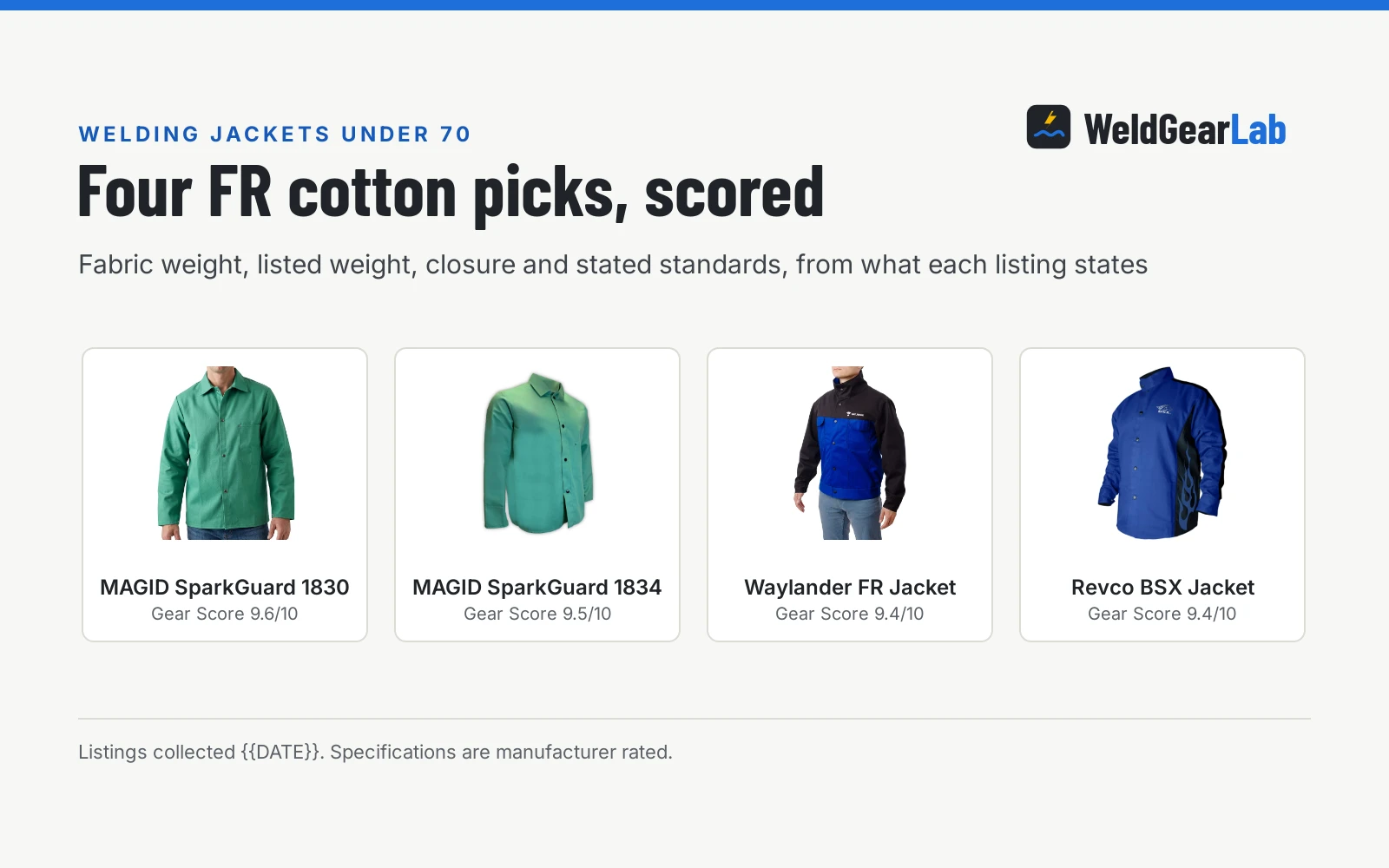
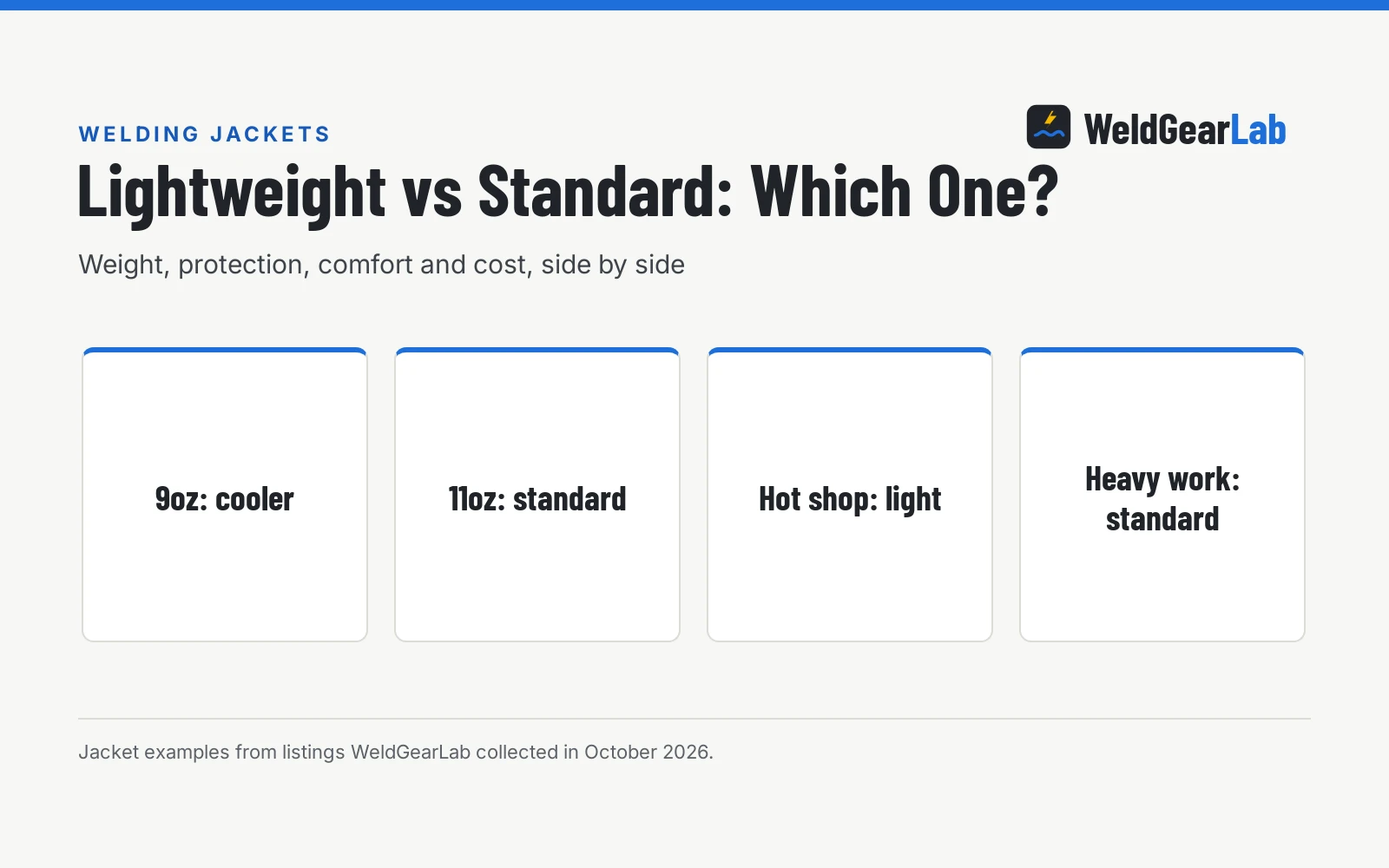
Lightweight vs standard welding jacket comes down to ounces: a 9 oz jacket like the MAGID SparkGuard keeps you cooler on long shifts, while the 11 oz ARCCAPTAIN is the medium-weight example with NFPA2112 certification. Pick lightweight for long shifts and all-day comfort; pick standard for the familiar balance of protection and durability. The two Miller jackets show the range within each side, from lightweight 88% cotton, 12% nylon blend to heavyweight cotton/nylon.
Other welders and gear to compare
 Welding JacketCheck price on Amazon
 ARCCAPTAIN FR Welding JacketsCheck price on Amazon
 FR Welding Jacket for MenCheck price on Amazon
 LeaSeek Welding Jacket Leather Sleeves Flame Resistant HybridCheck price on Amazon
 QeeLink Leather Welding JacketCheck price on Amazon
 Lincoln Electric Black Flame-Resistant Cloth Welding JacketCheck price on Amazon
This guide links to our product roundups, where WeldGearLab gets a commission on purchases made through links on this page, and your price stays the same. Read our affiliate disclosure.
Lightweight vs Standard Welding Jacket: The Difference in One Paragraph
Fabric weight is the whole debate. The MAGID SparkGuard at 9 oz is the lightweight example here: 100% cotton sateen, 1.09 pounds, ASTM D6413, built to stay cooler. The ARCCAPTAIN at 11 oz is the standard example: flame-resistant cotton, NFPA2112 certified, with high-visibility reflective strips. The MAGID listing claims reduced fatigue on long shifts and a breathable build. Both protect against sparks and heat; the choice is comfort versus the traditional feel.
Side by side
| Jacket | Weight class | Fabric | Certification | Best for |
|---|---|---|---|---|
| MAGID SparkGuard | 9 oz lightweight | 100% cotton sateen | ASTM D6413 | Hot shops, long shifts |
| ARCCAPTAIN | 11 oz medium | FR cotton | NFPA2112 | Shops requiring certification |
| Miller M | Lightweight | 88% cotton, 12% nylon | Not stated | Light duty |
| Miller 2XL | Heavyweight | Cotton, nylon | Not stated | Heaviest coverage |
The gear, from light to heavy
1. MAGID SparkGuard (9 oz). The lightweight champion. The listing states 9 oz 100% cotton sateen at 1.09 pounds, ASTM D6413, with FR protection stated to last through 50+ industrial washes. The 30-inch length, leather-reinforced snap closures and light green color round it out. The listing pitches it as cooler than leather at a fraction of the weight, which suits long shifts.
2. Miller M (lightweight class). The listing states 88% cotton and 12% nylon at 1.3 pounds, in the lightweight fabric class, fitting a 42-inch chest. Snap-button cuffs and a utility pocket keep it simple. At 1.3 pounds it is the heavier garment of the two, while its stated fabric class stays ‘Lightweight’.
3. ARCCAPTAIN (11 oz). The standard-weight pick. The listing states 11 oz flame-resistant cotton, NFPA2112 certified, with high-visibility reflective strips, durable snaps, 2-level cuffs and 4 pockets plus a pen holder. Dark blue, unisex, long sleeve. The certification and visibility features make it the choice for shops that require documented FR performance.
4. Miller 2XL (heavyweight class). The heavyweight of the four. The listing places it in the heavyweight fabric class, cotton and nylon, with 5 pockets and a 2XL fit. No weight is stated beyond the class. It suits welders who want the heaviest fabric class of the four and do not mind a heavier fabric.
When lightweight is the better choice
Pick the 9 oz MAGID when heat is the enemy. The listing emphasizes staying cooler all shift and reducing fatigue on long shifts. The 1.09-pound weight is the lowest stated garment weight here. The trade-off is less substantial fabric between you and the sparks, which matches its stated ‘Everyday / Light-Med Welding’ use. The MAGID spec table rates shift comfort high and thermal protection standard, which suits light to medium welding rather than heavy fabrication.
When standard is the better choice
Pick the 11 oz ARCCAPTAIN when you want the industry-standard feel with paperwork to back it. NFPA2112 certification is the documented FR standard many shops require, and the high-visibility strips add jobsite safety. The 4 pockets and pen holder suit welders who carry markers and tools. Standard weight is also the neutral default if you are buying for a crew with mixed preferences. The ARCCAPTAIN spec table lists mild weather under climate suitability.
Pockets, cuffs and closures
Small hardware decides daily comfort. The MAGID lists a 30-inch length with leather-reinforced snap closures on the placket and wrists, a lay-down collar and a riveted inside left breast pocket. The Miller M has snap-button cuffs and a utility pocket. The ARCCAPTAIN lists durable snaps, 2-level cuffs, 4 pockets plus a pen holder and a point collar. The Miller 2XL lists a button closure, 5 pockets and a band collar. If you carry markers and tools, the ARCCAPTAIN’s pen holder and 4 pockets are the most storage here; for the simplest front, the Miller M lists just a utility pocket.
How to tell what a jacket weighs
Listings state weight two ways: fabric ounces (9 oz, 11 oz) and garment pounds (1.09 lb, 1.3 lb). The MAGID gives both (9 oz fabric, 1.09 lb garment). The ARCCAPTAIN gives fabric ounces only. The Millers give fabric class (lightweight, heavyweight) with the M also stating 1.3 lb. The 2XL’s spec table lists a 0.27 g item weight that is not credible for a jacket, so treat the fabric class as the guide.
What about certifications?
Two listings state FR certifications: the MAGID meets ASTM D6413 and the ARCCAPTAIN is NFPA2112 certified. These are standards for checking flame resistance, not guarantees of a specific protection level. No certification is stated for the Miller jackets. If your shop or site requires certified FR, filter for the stated standard first, then pick weight.
Cotton, blends and leather: where jackets fit
Welding jackets sit between shirts and leathers. The 9 oz MAGID is 100% cotton sateen, breathable and light, positioned by its listing as a cooler alternative to leather. The 11 oz ARCCAPTAIN is flame-resistant cotton at the standard weight. The Millers blend cotton with nylon (88% cotton, 12% nylon stated on the M). None of the four here is leather; the MAGID listing positions itself against traditional leather welding jackets.
FAQ for welders
Is a 9 oz welding jacket safe?
The MAGID listing states ASTM D6413 compliance and FR protection lasting through 50+ washes. Lighter fabric is still flame-resistant per its listing; it is cooler, and it meets the ASTM D6413 method the listing states. Match the jacket to the work intensity, and check which standard your shop requires.
What does NFPA2112 mean?
It is a standard for flame-resistant garments, stated by the ARCCAPTAIN listing. It indicates the garment passed the specified FR evaluations. Check whether your workplace requires it.
Should I size up for a welding jacket?
The Miller M fits a 42-inch chest per the listing. Welding jackets are worn over work clothes, so check the chest fit against what you wear underneath. The ARCCAPTAIN lists sizes up to XXXL, with 51.2 for XL, 53.1 for XXL and 55.1 for XXXL in its spec table. The MAGID is cut for men; the ARCCAPTAIN is unisex.
Can I wash a FR welding jacket?
The MAGID states its FR treatment lasts through 50+ industrial washes. Three of the four list hand wash only for product care; the MAGID instead states its FR treatment lasts through 50+ industrial washes. Follow the listing’s care instructions to preserve the FR treatment.