FR Shirts vs Cotton Shirts for Welding: Which One Should You Buy?
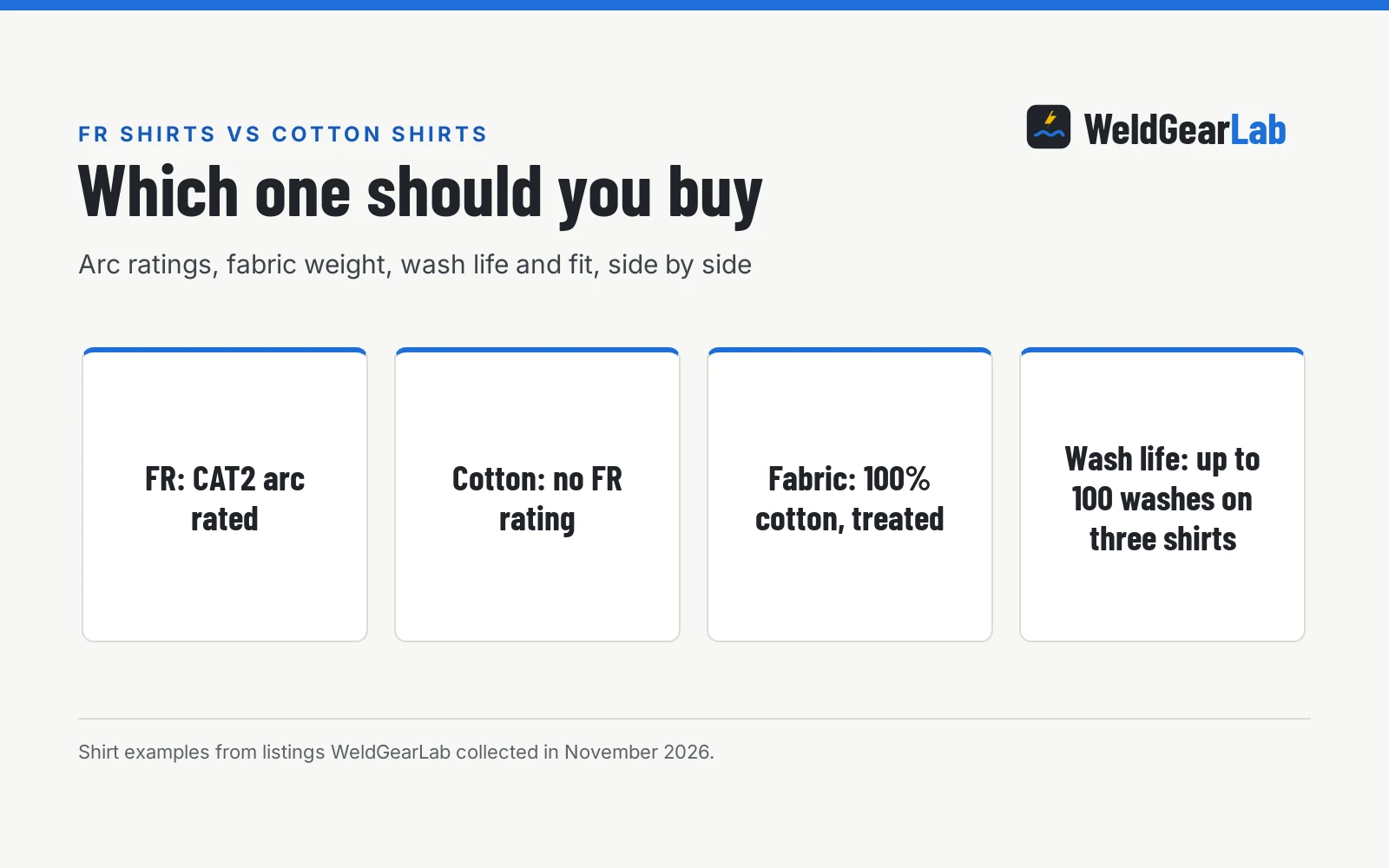
FR shirts in this guide carry CAT2 arc ratings, and three state NFPA 2112 and FR protection up to 100 washes, while plain cotton states no arc rating.

On this page
A bead pops, a spark lands on a sleeve, and the shirt you are wearing matters more than the shirt you grabbed that morning. This guide answers fr shirts vs cotton shirts for welding with a straight verdict: wear flame resistant, and keep plain cotton away from the arc. Every shirt in the gear section below is a flame resistant shirt, and no plain cotton shirt appears there, so the cotton side rests on the ratings the flame resistant shirts carry and the absence of those ratings on plain cotton.
As an Amazon Associate I earn from qualifying purchases. This guide links to our product roundups, where WeldGearLab gets a commission on purchases made through links on this page, and your price stays the same. Read our affiliate disclosure.
The difference in one paragraph
Flame resistant shirts start as cotton, then the maker treats the fabric so the shirt slows burning instead of feeding it. The shirts in this guide are 100% cotton with that treatment, and they carry CAT2, with three of the four also stating NFPA 2112 and arc ratings stated in calories per square centimeter where the maker gives one. A plain cotton shirt has the same fiber and no treatment, no arc rating and no FR standard. That is the whole difference: the fabric is familiar, and the treatment and the ratings are what make one shirt welding gear and the other ordinary clothing.
FR shirts vs cotton shirts for welding, side by side
| FR shirts | Cotton shirts | What it means at the bench | |
|---|---|---|---|
| Fabric | 100% cotton with FR treatment | 100% cotton with no FR treatment | The treatment is the difference, not the fiber |
| Arc rating | CAT2, ATPV 8.2 cal/cm² or 9.3 cal/cm² | Not stated | A stated arc rating is what makes a shirt welding gear |
| Standards | NFPA 2112, NFPA 70E, ASTM F1506 on three shirts; UL certified on all four | Not stated | Standards are the check, not the label |
| Fabric weight | 5.5 oz, 6.25 oz, 6.5 oz or 7 oz | Not stated | Weight varies; check the rating on each shirt |
| Burning behavior | Slows the burn rate and keeps flames from continuing to burn | No flame resistance stated | FR slows burning; it is not fireproof |
| Wash life | FR protection up to 100 washes on three of the shirts | Not stated | Wash life decides how long the rating lasts |
| Buttons and thread | FR buttons and FR sewing threads on three shirts | Not stated | Every part of the shirt needs the same treatment |
| Fit and care | Prewashed and preshrunk, wrinkle-free, on three shirts | Not stated | A shirt that shrinks still has to fit under a jacket |
The table reads top to bottom as a checklist. If a shirt cannot show a standard and an arc rating, it is not welding gear, whatever the fabric feels like. Three of the four shirts state NFPA 2112, and all four state CAT2, and the DPSAFETY shirt carries the highest stated arc rating at 9.3 cal/cm².
When an FR shirt is the better choice
- Any welding, cutting or grinding. Sparks and spatter land on sleeves and chests, and the treatment is there for that exact moment.
- Work that must meet a site rule. Shops and sites that ask for NFPA 2112 and CAT2 need a shirt that states both, and the BOCOMAL and Uno Mejor shirts put the UL details on the neck tag.
- Arc flash risk. Three of the shirts in this guide state arc ratings: 8.2 cal/cm² on the BOCOMAL shirts and 9.3 cal/cm² on the DPSAFETY shirt, and the rating is the number that decides the choice.
- Long days in the shop. Three of the listed shirts are prewashed and preshrunk, and the FR protection on those three lasts up to 100 washes.
See our best flame resistant shirt for welding guide for more FR shirts.
When a cotton shirt is the better choice
- A day with no hot work. A cotton shirt is ordinary clothing, and ordinary clothing is fine when no sparks, spatter or arc flash is in play.
- Laundry days. A cotton shirt takes any wash without using up FR wash life, so the FR shirts stay in rotation longer.
- Work with no ignition risk. Fitting, measuring, sweeping the shop, and other cold work need no FR treatment.
Our best fr shirts for summer guide covers FR shirts for hot shop days.
The flame resistant shirts in this guide
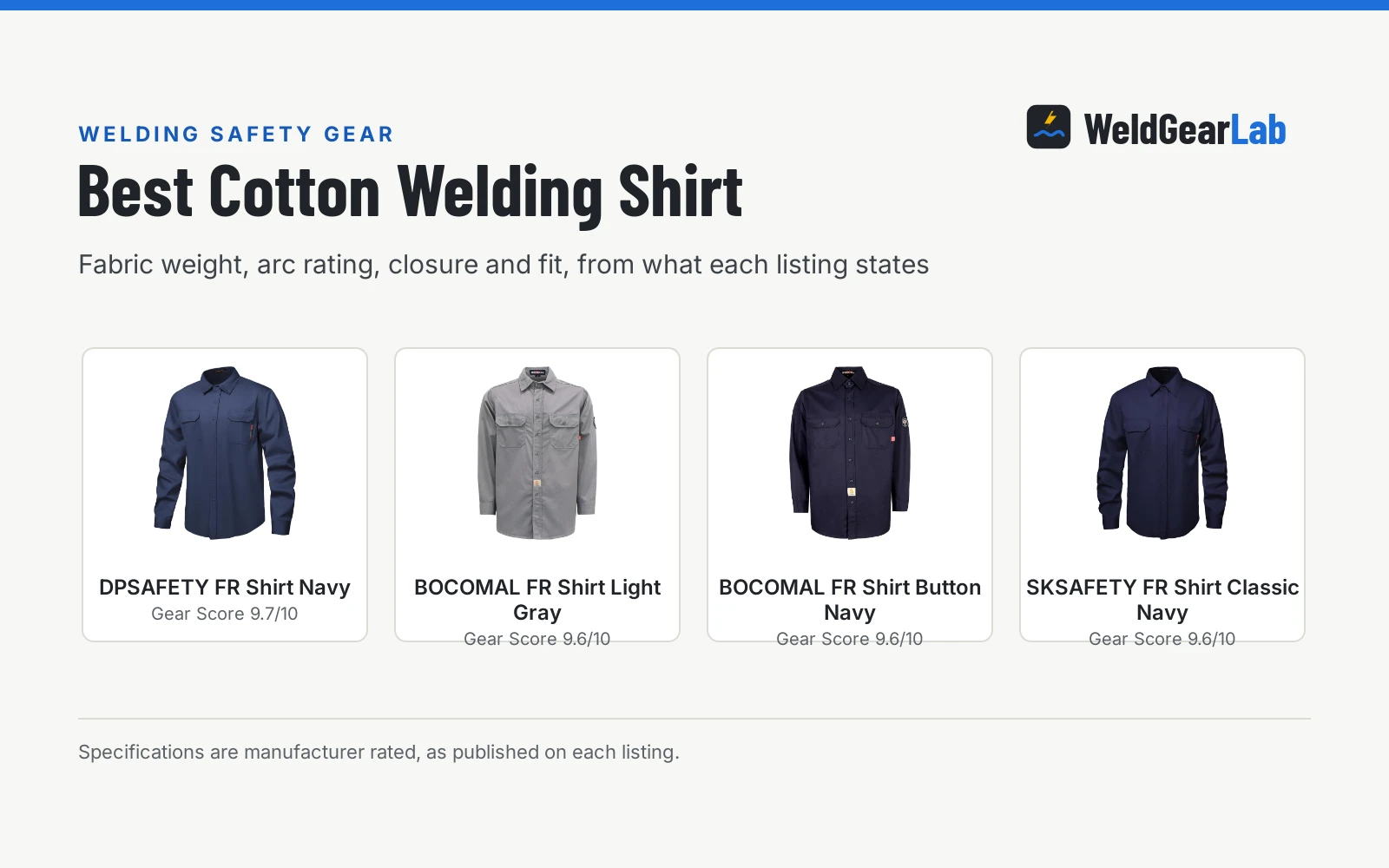
DPSAFETY FR shirt, 7 oz. The heaviest fabric here, and the highest stated arc rating: 9.3 cal/cm², CAT2, with UL certification. The maker builds it from 7 oz 100% cotton knit FR fabric, and lists breathability and durability alongside the rating. The listing is clear that flame retardant is not fireproof: the shirt suits places with ignition risk and no direct contact with open flames, and it slows the burn rate, cuts the time flames keep burning, and stands up to radiant heat and molten droplets.
BOCOMAL FR shirt, 6.5 oz. A 6.5 oz cotton twill shirt with FR treatment, FR buttons and FR sewing threads, plus a water and oil repellent finish. It states an arc rating of 8.2 cal/cm², HRC2, and NFPA 2112, NFPA 70E, ASTM F1506 and CAT II, classified by UL. The shirt is prewashed and preshrunk, wrinkle-free, and the maker states FR protection up to 100 washes. A clear FR tag sits on the front, and a small sample comes inside the package for a simple FR try.
BOCOMAL FR shirt, 6.25 oz. The lighter of the two BOCOMAL shirts at 6.25 oz, in cotton twill with FR treatment, FR buttons and FR sewing threads. It states the same arc rating of 8.2 cal/cm² and the same HRC2, NFPA 2112, NFPA 70E, ASTM F1506 and CAT II set, classified by UL. It has YKK pearl snaps, a button-down front, and a water stain resistant finish. It is prewashed and preshrunk, wrinkle-free, and the maker states FR protection up to 100 washes.
Uno Mejor FR shirt, 5.5 oz. The lightest fabric in this guide at 5.5 oz, in cotton twill with FR treatment, FR buttons and threads. It meets HRC2 and complies with NFPA 2112, NFPA 70E, ASTM F1506 and CAT II, with UL certification details on the neck tag. No arc rating in calories is stated for this shirt, so judge it on the standards it does state. It is prewashed and preshrunk, wrinkle-free, and effective up to 100 washes.
How to read the ratings on an FR shirt
Start with the standard, then the arc rating, then the fabric weight. NFPA 2112 is the standard for flame resistant garments against flash fire, and three of the shirts in this guide state it. CAT2 is the arc rating category, and three of the shirts pair it with an arc rating in calories per square centimeter: 8.2 cal/cm² on the two BOCOMAL shirts and 9.3 cal/cm² on the DPSAFETY shirt. UL classification is the mark behind the claim, and the BOCOMAL and Uno Mejor shirts carry the details on the neck tag. Fabric weight runs 5.5 oz to 7 oz across the four shirts; the Uno Mejor is the lightest at 5.5 oz and the DPSAFETY the heaviest at 7 oz. Wash life is the last number to check: three of the shirts hold FR protection up to 100 washes.
What to check when the shirt arrives
Check the FR tag and the neck tag before the shirt goes into rotation. The BOCOMAL shirts carry a clear FR tag on the front or on the arms and bottom front, and the Uno Mejor shirt carries a clear FR tag on the arms with UL certification details on the neck tag. Try the small fabric sample the BOCOMAL shirts include in the package, and check the fit: the BOCOMAL and Uno Mejor shirts are prewashed and preshrunk, so the size you order is the size you keep. Check the snaps and buttons, and look over the pockets.
Sparks, spatter and arc flash. A spark that lands on plain cotton meets no FR treatment, and an FR shirt only slows burning; it is not fireproof, and the DPSAFETY listing states it suits places with ignition risk and no direct contact with open flames. Keep the work area clear of flammables, wear a welding jacket over the shirt for heavy spatter, and check the shirt for burn damage after a long day. See our welding safety gear hub for the rest of the kit.
FAQ for welders
Can I weld in a plain cotton shirt?
Nothing in this guide recommends it. A plain cotton shirt carries no NFPA 2112 rating, no CAT2 arc rating and no UL mark, while the FR shirts in this guide state CAT2 and UL certification, and three of the four state NFPA 2112. If the job throws sparks or spatter, wear the FR shirt. Save the cotton shirt for days with no hot work.
What does CAT2 mean on an FR shirt?
CAT2 is the arc rating category the shirt is rated to, and three of the shirts in this guide pair it with an arc rating in calories per square centimeter. The DPSAFETY shirt states 9.3 cal/cm², and the two BOCOMAL shirts state 8.2 cal/cm². The Uno Mejor shirt states CAT II with no arc rating in calories, so its rating rests on the standards it does state.
How long does the FR treatment last?
The BOCOMAL shirts and the Uno Mejor shirt state FR protection up to 100 washes. The DPSAFETY shirt states no wash count, so its wash life is not stated here. Count washes against the 100 wash figure the other shirts state.
Are FR shirts heavier than cotton shirts?
Weight depends on the shirt, not the treatment. The FR shirts in this guide run 5.5 oz to 7 oz: the Uno Mejor at 5.5 oz, the BOCOMAL shirts at 6.25 oz and 6.5 oz, and the DPSAFETY at 7 oz. A plain cotton shirt states no weight here, so compare the stated fabric weights and pick the lightest shirt that still carries the ratings you need.
What should I check on an FR shirt when it arrives?
Look for the clear FR tag and the UL details on the neck tag, which the BOCOMAL and Uno Mejor listings describe. Try the small fabric sample the BOCOMAL shirts include in the package. Check the fit and the snaps; the BOCOMAL and Uno Mejor shirts are prewashed and preshrunk, so the size holds.
Related: flame resistant shirt vs cotton shirt, best welding jacket, flame resistant vs cotton welding pants, and the welding safety gear hub.