Deburring Tool vs Metal File: Which One Should You Buy?
A RIDGID pipe reamer, an AFA deburring set, a TARIST flat file and a Nicholson file set compared for finishing: how each cuts, what each suits, and where the listings leave gaps.

On this page
Top picks at a glance
As an Amazon Associate I earn from qualifying purchases.
- 1
 RIDGID 29983 Model 223S Inner/Outer Tubing9.7/10View on Amazon
- 2
 Nicholson Crescent 5 Piece 69.7/10View on Amazon
- 3
 AFA Tooling Deburring Tool Set & 2 Countersink9.6/10View on Amazon
- 4
 TARIST 8 inch Flat Metal File9.6/10View on Amazon
Verdict. Choose a deburring tool if the job is burrs, chamfers or holes after a cut, as the AFA set shows with its swivel head and countersink reamers, or tubing ends, as the RIDGID reamer shows. Choose a metal file if the job is shaping a flat edge or working a surface down, as the TARIST flat file and the Nicholson set show.
A freshly cut edge often needs finishing before fit-up, and the bench usually holds two answers to that job. The deburring tool vs metal file question is about which answer fits the edge in front of you: a blade that shaves a burr, or a toothed file that shapes the surface. This comparison puts the two sides against each other with 4 listings as examples, on how each cuts, what each suits and where the listings leave gaps.
WeldGearLab gets a commission on purchases made through links on this page, and your price stays the same. Read our affiliate disclosure.
The four tools
RIDGID 29983 Model 223S Inner/Outer Tubing
An inner/outer tubing and pipe reamer for 1/4 to 1-1/4 in stainless steel and copper tubing, with 45 cutting edges.
Pros
- 45 heavy-duty cutting edges on the interior cone
- Inner reaming, outer deburring and beveling in one tool
- Dual imperial inch and metric measurement bar
- Ergonomic knurled edges for a firm grip
Cons
- Sized for tubing only, not flat stock
- No certification stated
- Outside diameter capacity tops out at 1-1/4 in
Nicholson Crescent 5 Piece 6
A 5-piece anniversary file set with 6, 8 and 10 in files, co-molded handles and a vinyl pouch.
Pros
- 5 files: slim taper, round, mill, half-round and flat
- Ergonomic co-molded handles with anniversary design
- Tempered steel construction
- Vinyl pouch for storage
Cons
- No certification stated
- Handle material listed as alloy steel and wood, against co-molded handles in the bullets
- Sold as a set only; no single file option in this listing

AFA Tooling Deburring Tool Set & 2 Countersink
A deburring tool set with 11 HSS blades, a swivel head and 2 countersink hand reamers in a protective case.
Pros
- 11 HSS blades: 1 pre-installed and 10 extra
- Swivel head for burrs on uneven surfaces
- 2 countersink reamers at 90 degrees, HRC62-64
- Knurled aluminum handle with a protective case
Cons
- No warranty term is stated
- No certification stated
- Blades are one pattern, BS1010, across the set
- No handle length is stated

TARIST 8 inch Flat Metal File
An 8 inch flat metal file in T12 carbon steel, for filing, deburring and shaping metal and more.
Pros
- T12 carbon steel with body hardness 62~66HRC
- 8 inch flat profile for edges and surfaces
- Suits metal, wood, jewelry, plastics, ceramics and glass
- Hand powered, no setup beyond the file itself
Cons
- No warranty term is stated
- No certification stated
- Teeth coating means the file cannot accept being dropped
- A light touch of machine oil is needed to preserve the surface finish
Other welders and gear to compare
 Reed Tool DEBO Pencil Shape Deburring Tool for Copper Brand:Check price on Amazon
 4pcs Countersink Chamfer Tool HSSCheck price on Amazon
 Noga DB1000 Sheet Metal Deburring Tool Double BurrCheck price on Amazon
 5 pcs Metal Needle File SetCheck price on Amazon
 Air Pneumatic Chamfer Tool for MetalCheck price on Amazon
Deburring tool vs metal file: side by side
| RIDGID 223S Reamer | Nicholson File Set | AFA Deburring Set | TARIST Flat File | |
|---|---|---|---|---|
| Gear Score | 71 | 68 | 60 | 56 |
| Type | Inner/outer pipe reamer | 5-piece file set | Swivel deburring set | Flat metal file |
| Work | Tubing 1/4 to 1-1/4 in | Taper, round, mill, half-round, flat | Burrs, chamfers, holes | Flat filing and shaping |
| Edges / teeth | 45 cutting edges | Tempered steel | 11 HSS blades, 2 reamers | T12 carbon steel |
| Size | 1.42 in long | 6, 8 and 10 in files | 8.27 x 7.48 x 1.57 in | 8 inch |
| Weight | 0.2 kg | 0.78 kg | 10.2 ounces | 8.4 ounces |
| Warranty | Lifetime | Standard Limited Lifetime | Not stated | Not stated |
Treat the specs as maker ratings pulled straight from the listings; we gathered them on 29 October 2026. None of the listings states a CSA, UL or ETL listing.
How each side cuts
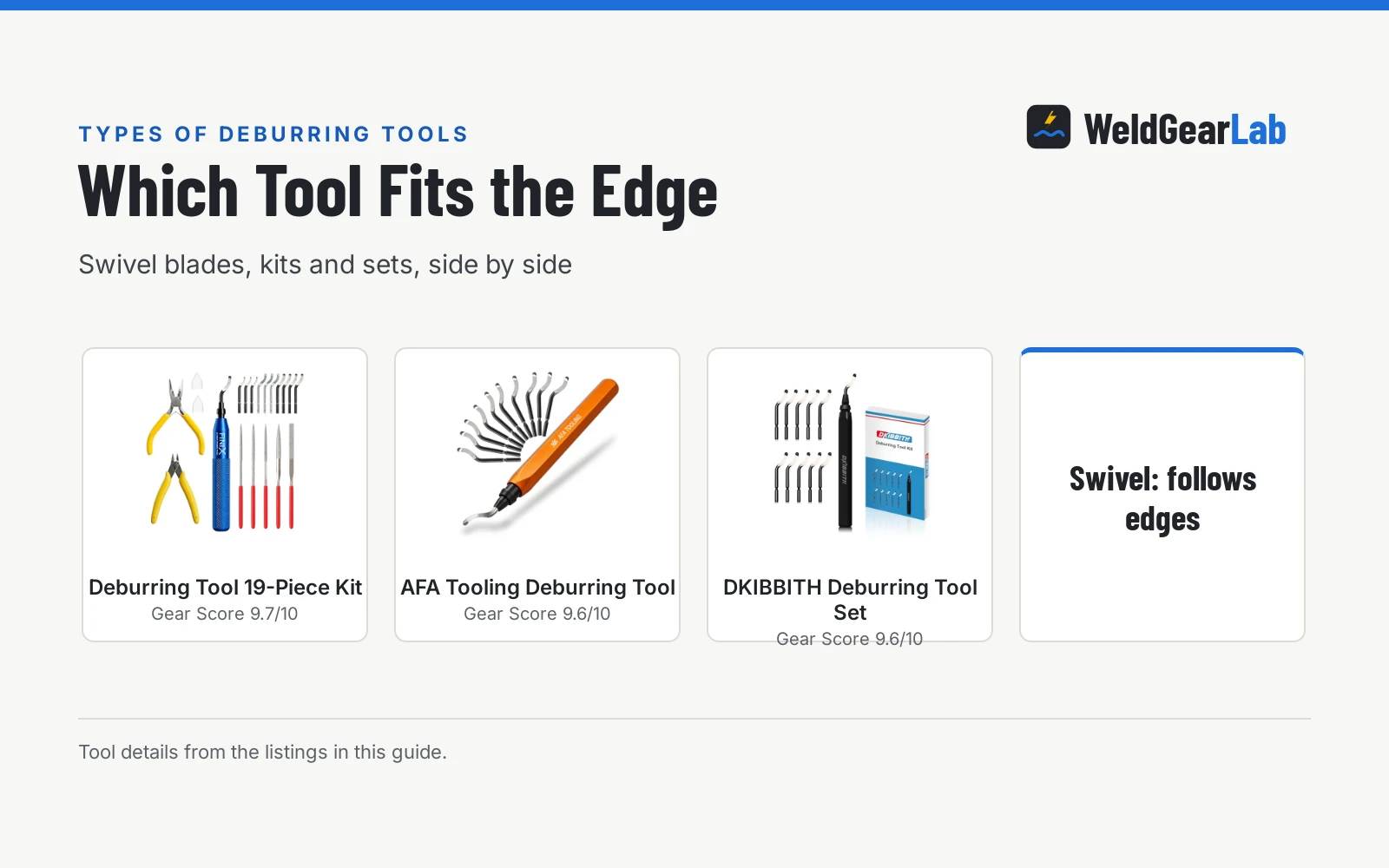
A deburring tool cuts with a small blade or cone that follows the edge. The RIDGID reamer carries 45 cutting edges on an interior cone and does inner reaming, outer deburring and beveling of tubing in one tool. The AFA set uses a swivel head that removes burrs from uneven surfaces, plus 2 countersink reamers that enlarge circular openings and cut chamfers.
A metal file cuts with teeth across a flat, round or shaped face, pushed or drawn along the work. The TARIST file is an 8 inch flat file for filing, deburring and shaping metal, wood, jewelry, plastics, ceramics and glass. The Nicholson set covers the same kind of work with 5 shapes: slim taper, round, single-cut mill, half-round and double-cut flat. Where the deburring side follows an edge, the file side works a surface.
Teeth, edges and hardness
The listings state their cutting parts in different terms, so compare them as stated, not as equivalents. The RIDGID reamer states 45 cutting edges. The AFA set states 11 HSS blades and 2 reamers at 90 degrees and HRC62-64. The TARIST file states T12 carbon steel with a body hardness of 62~66HRC. The Nicholson set states tempered steel without a hardness figure. For more file shapes, see our best narrow metal file picks.
Size, weight and the box
The RIDGID reamer lists 1.42 inches long and 0.2 kg, sized for tubing from 1/4 to 1-1/4 in. The AFA set gives product dimensions of 8.27 x 7.48 x 1.57 inches and a weight of 10.2 ounces, with a protective case for the spare blades. The TARIST file is 8 inch long and weighs 8.4 ounces, sold as a single file. The Nicholson set weighs 0.78 kg for 5 files in a vinyl pouch. The AFA set stores its spare blades in a case; the Nicholson set comes in a vinyl pouch.
Warranty and listing gaps
Only two listings state a warranty term. The RIDGID listing covers its products with a lifetime warranty against defects in material or workmanship for the life of the tool. The Nicholson listing states a Standard Limited Lifetime warranty. The AFA and TARIST listings state no warranty term, so neither earns warranty points. The gaps go further: the RIDGID spec table lists a nominal wall thickness of 1.3 month, which cannot describe thickness, and the Nicholson spec table lists dimensions of 1 by 1 in, which cannot describe a set of 6, 8 and 10 in files. Trust the titles and bullets on both points.
Choose the deburring tool if
- You clean burrs, chamfers and holes after cutting, drilling or sawing.
- You ream tubing ends, inside and outside, as the RIDGID example shows.
- You want spare blades and a case, as the AFA set shows.
- You work metal, plastic and resin edges that need burrs and chamfers removed.
Choose the metal file if
- You shape a flat edge or work a surface down by hand.
- You want several file shapes in one pouch, as the Nicholson set shows.
- You want one flat file for many materials, as the TARIST example shows.
- You accept the care the TARIST listing asks: oil for the finish, and no drops.
Before You Strike an Arc
- Check the reamer against the tube size before cutting: the RIDGID covers 1/4 to 1-1/4 in tubing.
- Seat the AFA blade in the swivel head and check the spare blades in the case before starting.
- Check the file teeth on arrival: the TARIST teeth are quenched and coated, and the listing warns against dropping it.
- Match the Nicholson file shape to the edge: taper, round, mill, half-round or flat, all in the pouch.
FAQ for welders
Should a deburring tool or a metal file come first on the bench?
It depends on the edge. A deburring tool suits burrs, chamfers and holes after a cut, as the AFA set shows, and tubing ends, as the RIDGID reamer shows. A metal file suits shaping a flat edge or working a surface down, as the TARIST file and the Nicholson set show.
Can a deburring tool replace a metal file?
Not for shaping work. The AFA set removes burrs and cuts chamfers with a swivel head and countersink reamers, while the TARIST and Nicholson files remove material across a surface with teeth. Keep both sides on the bench if the work mixes edges and surfaces.
What size tubing does the RIDGID reamer cover?
The RIDGID 223S covers stainless steel and copper tubing from 1/4 to 1-1/4 in, with inner reaming, outer deburring and beveling from its 45 cutting edges.
What hardness does the TARIST file state?
The TARIST file states T12 carbon steel with a body hardness of 62~66HRC, in an 8 inch flat profile.
Do any of these state a certification?
No. None of the 4 listings states a CSA, UL or ETL listing or a similar standard, so none earns safety points in our score.
Related: best metal files for metalworking, best metal file with wood handle, our hacksaw vs angle grinder for metal comparison, and the metal fab tools hub.
Scoring, line by line
Each tool is scored on performance, build, value, safety listing and warranty, with the weights published on our How We Pick page. None of these 4 listings states a certification, so none earns safety points, and only the RIDGID and Nicholson listings state a warranty term. The RIDGID leads on its tubing range and lifetime warranty, the Nicholson follows on its 5-file assortment, and the AFA and TARIST trail on the missing warranty term.
| Product | Gear Score | Perf. /35 | Build /25 | Value /25 | Safety /10 | Warranty /5 |
|---|---|---|---|---|---|---|
| RIDGID 223S Reamer | 9.7 | 30 | 21 | 20 | n/a | 4 |
| Nicholson File Set | 9.7 | 29 | 20 | 21 | n/a | 3 |
| AFA Deburring Set | 9.6 | 30 | 21 | 21 | n/a | 0 |
| TARIST Flat File | 9.6 | 28 | 20 | 20 | n/a | 0 |
Think of 9.2 as the bottom and 9.8 as the top. Totals are placed between them in proportion, which keeps the order intact: more points, higher score. Where safety does not apply (unpowered gear with no listed safety features), it is left out and the remaining 90 points make up the score.