Copper vs Aluminum Welding Cable: Which One Should You Buy?
Copper vs aluminum welding cable compared on conductivity, gauge and termination, with four pure copper cables (1/0 to 2/0 AWG) from the listings.

On this page
Top picks at a glance
As an Amazon Associate I earn from qualifying purchases.
- 1
 1/0 Gauge 1/0 AWG 25 Feet Black + 25 Feet Red Welding Battery9.6/10View on Amazon
- 2
 Hicarer 20 Pcs Aluminum Copper Brazing RodsView on Amazon
- 3
 20pcs Copper Brazing Rods BCuP-2View on Amazon
- 4
 TOOLIOM ER70S-6 Copper-Coated Mild Steel TIG Welding RodView on Amazon
- 5
 40 Sticks Copper Brazing Rods BCuP-2View on Amazon
- 6
 Welding Spoon Copper Welding Spoon Welders Helper 3mm ThickView on Amazon
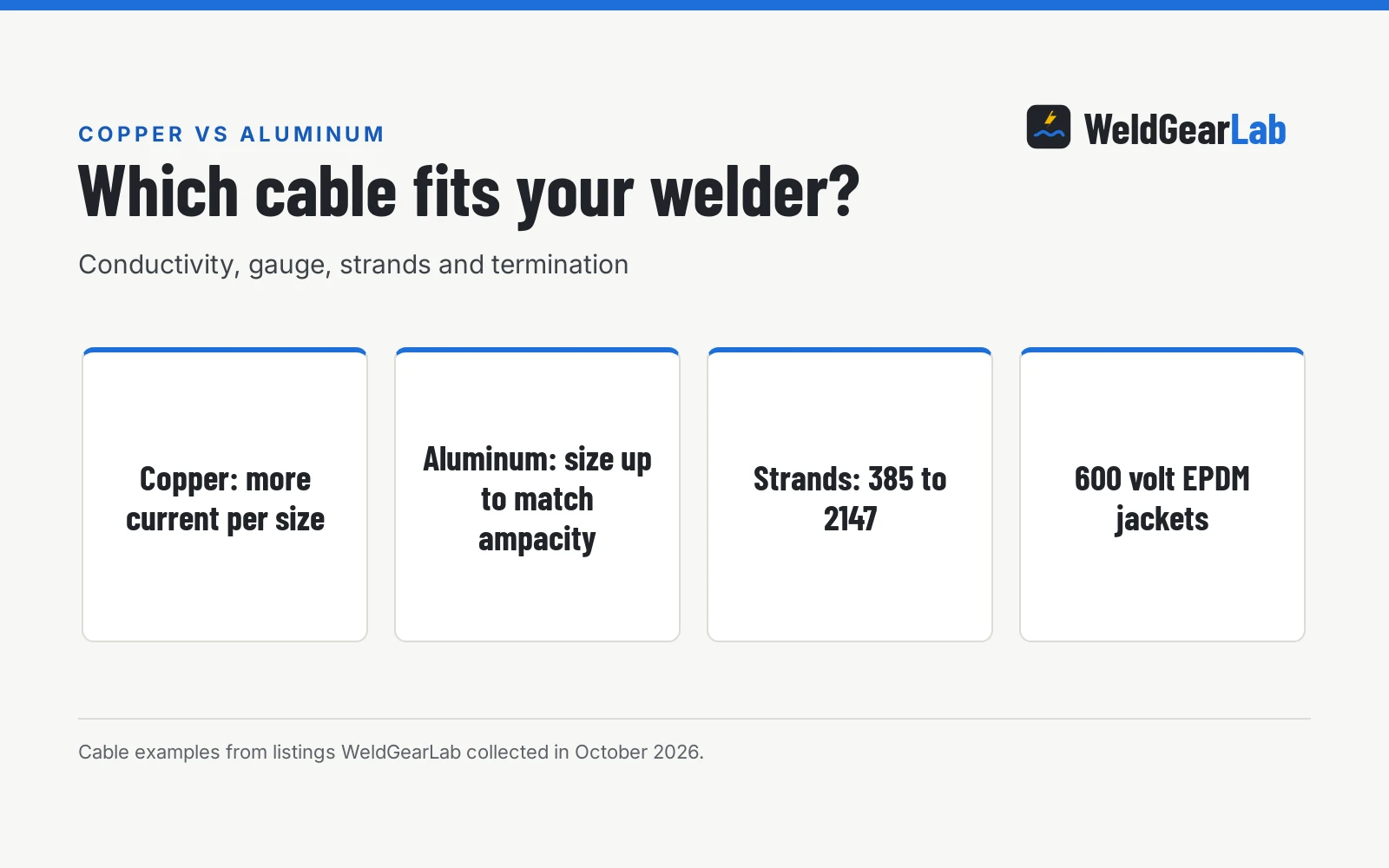
For copper vs aluminum welding cable, the short answer is copper: every one of the four listings here is pure copper, and the listings recommend pure copper for welding leads and DC battery applications. Copper carries more current per size, bends without breaking and resists corrosion at the connections; aluminum needs a larger gauge for the same current and is harder to terminate. If a listing offers aluminum welding cable, size it up and use terminals rated for aluminum.
Other welders and gear to compare
 Hicarer 20 Pcs Aluminum Copper Brazing RodsCheck price on Amazon
 20pcs Copper Brazing Rods BCuP-2Check price on Amazon
 TOOLIOM ER70S-6 Copper-Coated Mild Steel TIG Welding RodCheck price on Amazon
 40 Sticks Copper Brazing Rods BCuP-2Check price on Amazon
 Welding Spoon Copper Welding Spoon Welders Helper 3mm ThickCheck price on Amazon
WeldGearLab gets a commission on purchases made through links on this page, and your price stays the same.
The difference in one paragraph
Copper and aluminum both conduct, but copper conducts better per cross-section, so a 1/0 AWG copper cable carries what takes a larger aluminum cable to match. The four listings here are all pure copper: the Spartan Power 1/0 AWG with 1026 strands, the Spartan Power 4 AWG with 385 strands, the Shirbly 1/0 AWG with 1703 strands of 0.2mm wire, and the Shirbly 2/0 AWG with 2147 strands. All four are rated for up to 600 volts with EPDM jackets, and all four state -58°F to +221°F temperature ranges.
Side by side
| Factor | Copper cable | Aluminum cable | Notes |
|---|---|---|---|
| Current per size | More current per cross-section | Needs larger gauge to match | Copper first for welding leads |
| Listings here | Four pure copper cables | Not stated | Four copper cables |
| Strand counts | 385 to 2147 strands | Not stated | 385 to 2147 strands |
| Voltage rating | 600 volts on all four | Not stated | 600 volts on all four |
| Jacket | EPDM on all four | Not stated | EPDM on all four |
| Termination | Standard lugs; tin-coated on Shirbly | Needs aluminum-rated terminals | Tin-coated on Shirbly |
Treat the specs as maker ratings pulled straight from the listings; we gathered them on 21 October 2026.
Copper vs aluminum welding cable: when copper is the better choice
Welding leads, battery cables and any run you coil and uncoil often. The listings recommend pure copper for welding leads and DC battery applications. More strands mean more flexibility: the Shirbly 2/0 AWG lists 2147 strands, the Shirbly 1/0 lists 1703, the Spartan 1/0 lists 1026 and the Spartan 4 AWG 385. The Spartan listings note paper separators for ease of stripping when making your own cables.
When aluminum could work
Long fixed runs where weight and cost matter more than flexibility. For welding leads specifically, the copper listings here are the stated recommendation. If you do run aluminum, size the aluminum conductor up until its stated ampacity matches the copper one, and use terminals rated for aluminum to control corrosion at the connection.
Gauge, strands and length
Gauge sets the current: 2/0 AWG is the largest here (Shirbly, 2 ft pair with crimped 5/16 in terminals), then 1/0 AWG (Spartan 20 ft bulk, Shirbly 10 ft red plus 10 ft black), then 4 AWG (Spartan 50 ft bulk). Strand count sets flexibility: 2147 strands on the Shirbly 2/0 AWG, 1703 on the Shirbly 1/0 AWG, 1026 on the Spartan 1/0 AWG and 385 on the Spartan 4 AWG. Buy bulk cable when you make your own leads; buy the terminated pair when you want to bolt on and go.
The gear: four copper cables from the listings
Shirbly 2/0 AWG 2 ft pair (ranked first). 2147 strands of 0.2mm pure copper OFC wire with 5/16 in terminals crimped on both ends, 3:1 dual wall adhesive heat shrink, tin-coated lugs and a 600 volt rating. The most strands and the only terminated pair here.
Shirbly 1/0 AWG 10 ft red plus 10 ft black (ranked second). 1703 strands of 0.2mm pure copper OFC wire with solvent resistant EPDM insulation, rated 600 volts and -58°F to +221°F, fire resistant. Twenty feet total for a pair of leads.
Spartan Power 1/0 AWG 20 ft red (ranked third). 1026 strands of pure copper with an ultra-flexible EPDM jacket resistant to heat, abrasion, tear, moisture and oil, rated 600 volts. Made in the USA with paper separators for easy stripping.
Spartan Power 4 AWG 50 ft black (ranked fourth). 385 strands of pure copper, 50 ft bulk, EPDM jacket, 600 volt rating. The smallest gauge here, suited to lighter leads and battery runs.
Strand fineness and flexibility
Strand count is only half the story; strand fineness is the other half. The Shirbly listings state 0.2mm strands: 1703 of them in the 1/0 AWG and 2147 in the 2/0 AWG. Fine strands bend tighter and survive repeated coiling better than coarse ones. The Spartan listings do not state strand diameter but note paper separators for ease of stripping when making your own cables. If you coil and uncoil leads daily, fine-stranded cable is the easier coil: the Shirbly listings describe the EPDM sheath as very soft and bendable into any shape; if you strip your own leads, the Spartan’s paper separators save time.
Temperature and jacket ratings
All four listings state the same working range: -58°F to +221°F, with 600 volt ratings and EPDM jackets resistant to heat, abrasion, tear, moisture and oil. The Shirbly listings add solvent resistance and a fire resistant polyolefin material. The Spartan listings describe the EPDM jacket as ultra-flexible, and the Shirbly listings describe the EPDM sheath as very soft and bendable into any shape.
Terminated pairs vs bulk cable
Buy the format that matches your plan. The Shirbly 2/0 AWG comes as a 2 ft red and black pair with 5/16 in terminals crimped on both ends, 3:1 dual wall adhesive heat shrink and tin-coated closed-end lugs for corrosion protection: bolt on and go. The Spartan cables are bulk: 20 ft of 1/0 AWG red and 50 ft of 4 AWG black for making your own leads, with paper separators for easy stripping. The Shirbly 1/0 AWG splits the difference: 10 ft red plus 10 ft black, unterminated, for a pair of leads you finish yourself.
FAQ for welders
Is copper or aluminum better for welding cable?
Copper, per the listings: all four recommend pure copper for welding leads and DC battery applications. Copper carries more current per size and terminates more reliably.
What gauge welding cable do I need?
Match the gauge to the welder’s output and lead length. Here, 2/0 AWG is the largest, then 1/0 AWG, then 4 AWG. Longer runs need larger gauge for the same current.
Why does strand count matter?
The listings link strand count to flexibility: the counts here run from 385 to 2147 strands, and the Shirbly listings state 0.2mm strands.
Can I use battery cable as welding cable?
The listings position these cables for both welding leads and DC battery applications, with 600 volt ratings and -58°F to +221°F temperature ranges stated. Check those stated ratings against your use.
Do any of these come with terminals?
The Shirbly 2/0 AWG pair has 5/16 in terminals crimped on both ends with heat shrink. The other three are bulk cable for making your own leads.
Related: our best welding cable picks and the best TIG welder for aluminum guide.