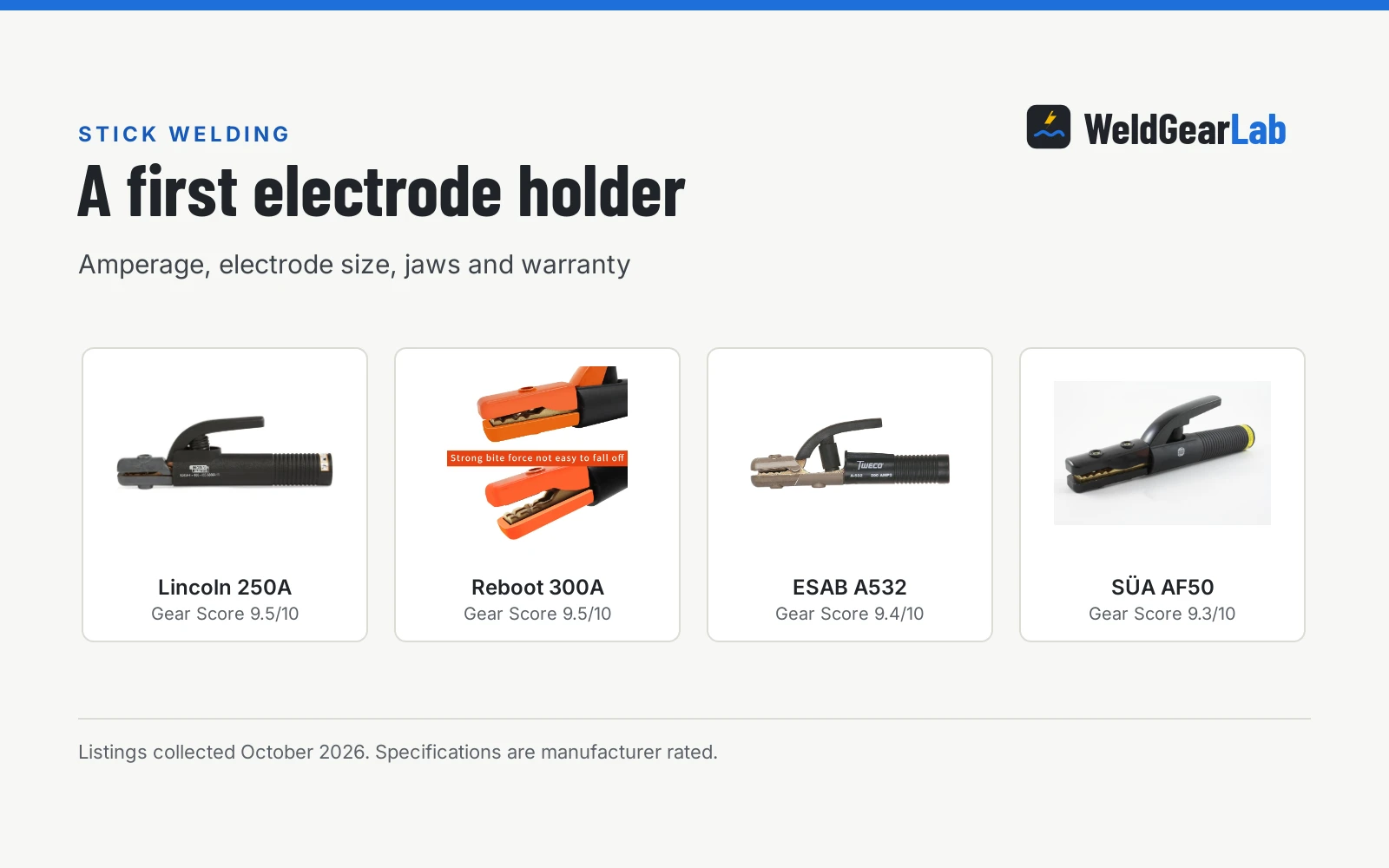
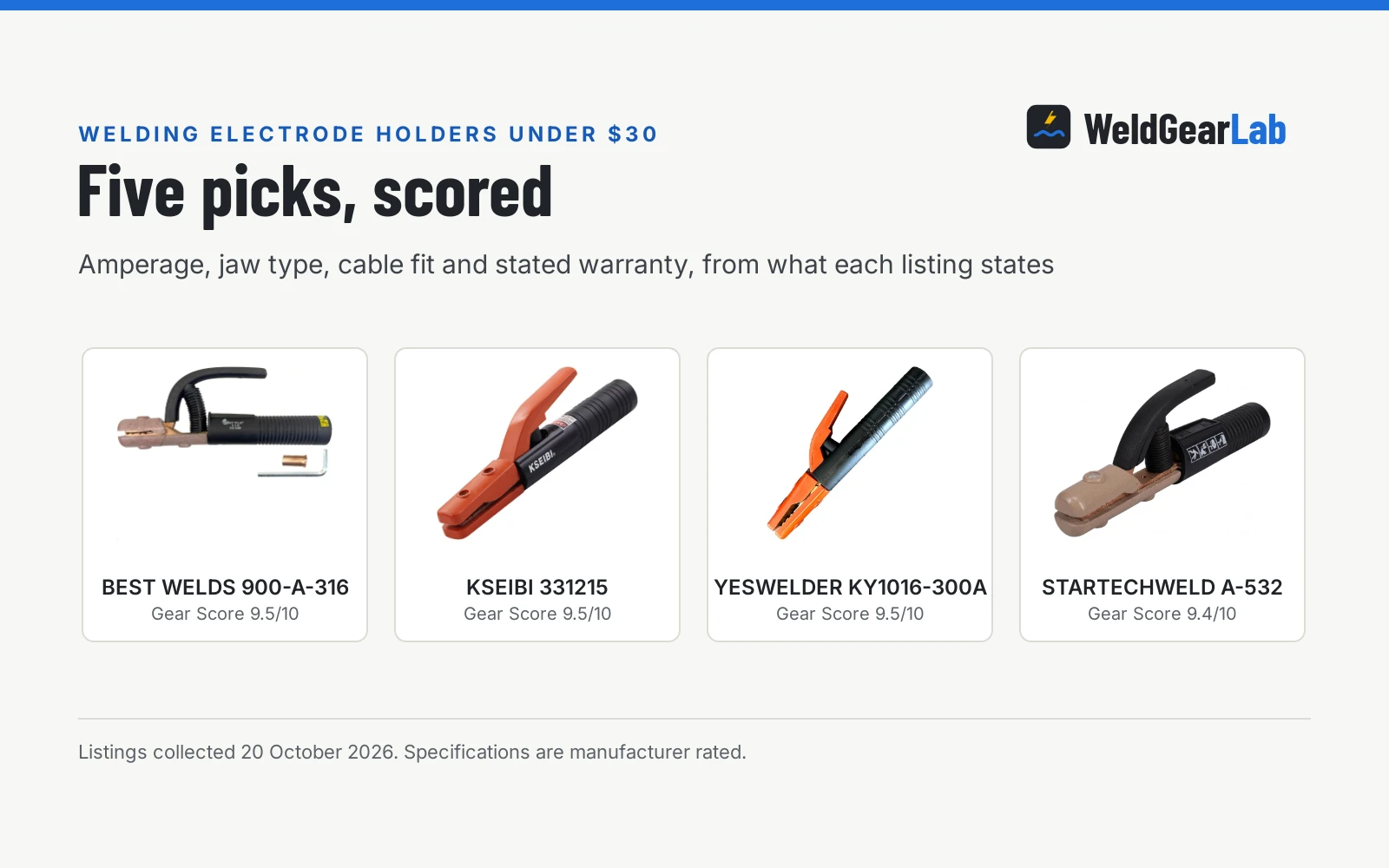
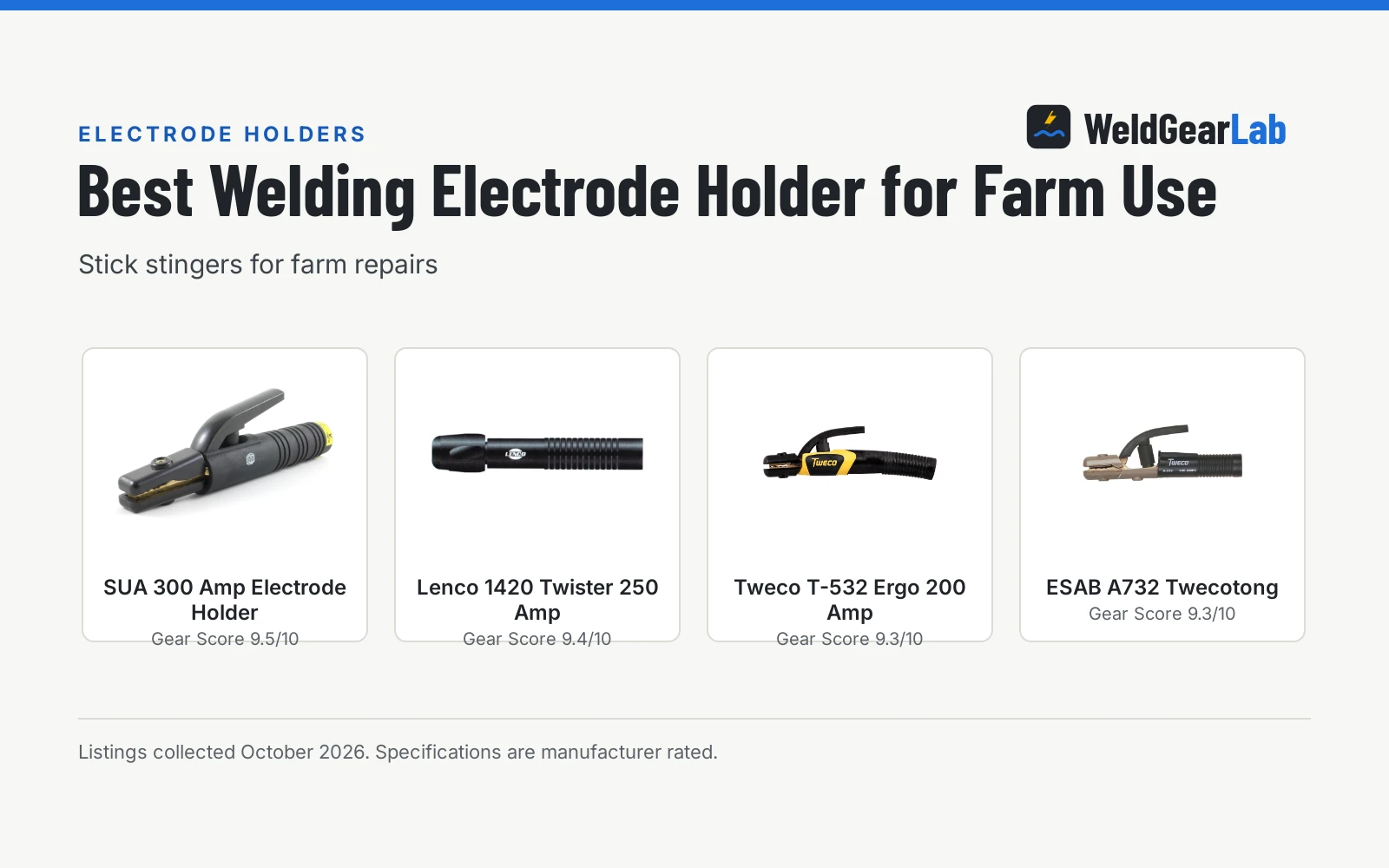
Best Welding Electrode Holder (2026): 5 Picks Compared
Five welding electrode holders compared: 200 to 500 amp holders with jaw patterns, duty cycles and warranties, with Gear Scores.

On this page
Top picks at a glance
As an Amazon Associate I earn from qualifying purchases.
- 1
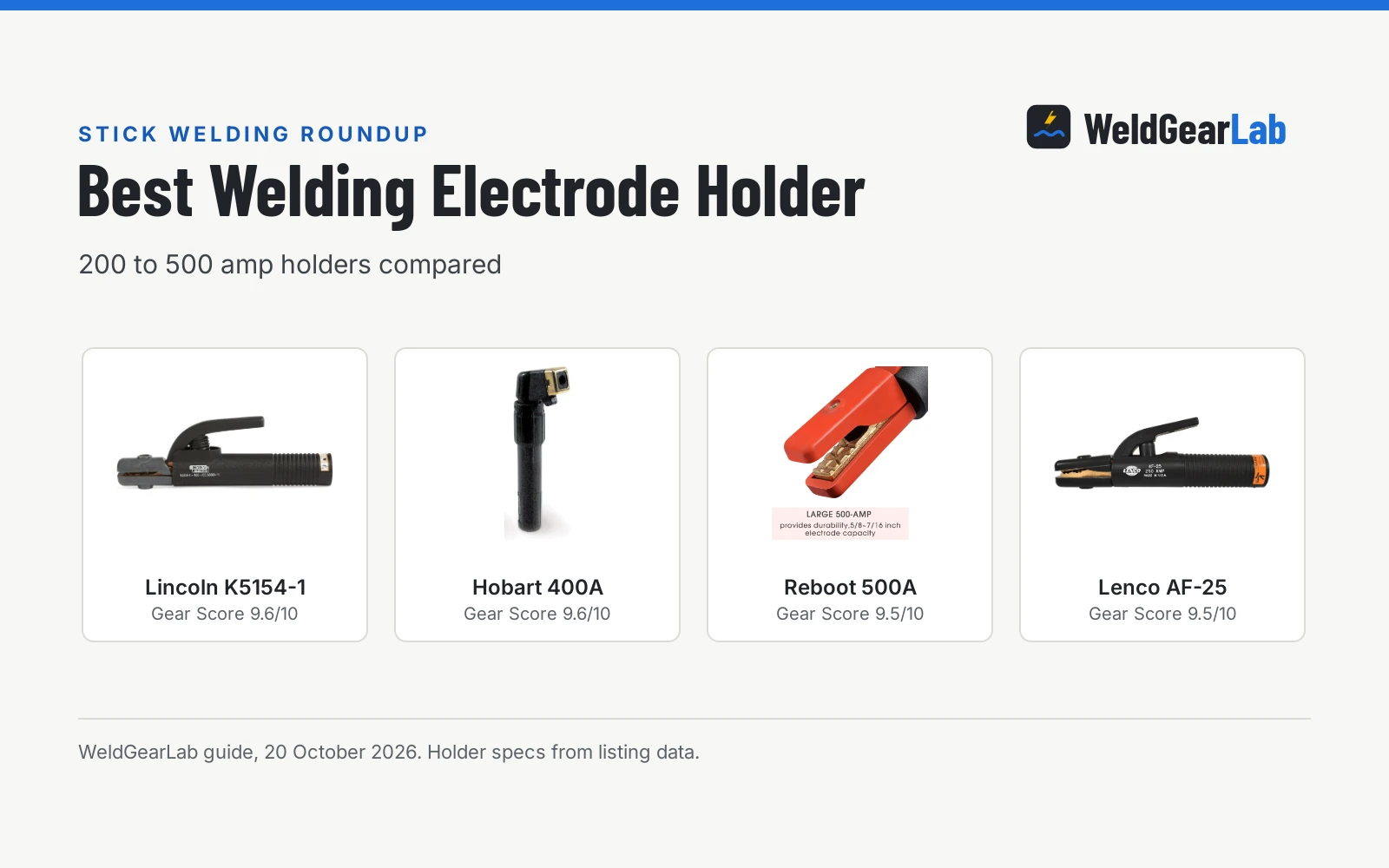
 Lincoln K5154-1Lincoln K5154-19.6/10View on Amazon
- 2
 Reboot 500AReboot 500A9.5/10View on Amazon
- 3
 Hobart 400AHobart 400A9.6/10View on Amazon
- 4
 Lenco AF-25Lenco AF-259.5/10View on Amazon
The electrode holder is the business end of stick welding: it grips the rod, feeds it current and takes the heat. The best welding electrode holder balances amperage, jaw design and insulation, and these five run from a 200 amp ergonomic stinger to a 500 amp brass jaw. For each one we list what the listing states and say plainly what it does not.
WeldGearLab gets a commission on purchases made through links on this page, and your price stays the same. Read our affiliate disclosure.
Quick picks
- Lincoln K5154-1 Lincoln K5154-1: 200 amp with 35% duty cycle, copper alloy jaw, insulated handle and a stated 1-year warranty Check price on Amazon
- Reboot 500A Reboot 500A: 500 amp brass jaw with grooved 45, 90 and 180 degree rod positions Check price on Amazon
- Hobart 400A Hobart 400A: 400A screw-type holder, rods up to 5/16 in, bends electrodes to any angle Check price on Amazon
- Lenco AF-25 Lenco AF-25: 250 amp Lenco made in USA, 2/0 cable capacity, 8-1/2 in length Check price on Amazon
The machines
Lincoln Electric Industrial 200 Amp Electrode
A 200 amp ergonomic electrode holder with a copper alloy jaw, 35% duty cycle and a stated 1-year warranty.
Pros
- 200A with 35% duty cycle stated
- Copper alloy jaw for conductivity
- Insulated nylon and fiberglass handle
- 1-year warranty stated
Cons
- 200 amp is the lowest rating here
- 5/32 in max electrode, smaller than the Hobart
- 1.5 lb is heavier than the Tweco
- No safety certification stated
Hobart 400A Screw-Type Electrode Holder 400A
A 400A screw-type electrode holder accepting rods up to 5/16 in, with electrodes burning to within 1 in of the head.
Pros
- 400A rating, the second highest here
- Accepts rods up to 5/16 in
- Bends electrodes to any angle
- Electrodes burn within 1 in of the head
Cons
- No warranty term stated
- No duty cycle stated
- No safety certification stated
- 1.4 lb package weight, heavier than the Tweco

Reboot Welding Electrode Holder 500AMP Heavy Duty
A 500 amp brass electrode holder with a grooved jaw holding rods in 45, 90 and 180 degree positions.
Pros
- 500 amp, the highest rating here
- Grooved jaw in 3 rod positions
- Brass construction with insulated handle
- Free spanner and spacing sheet included
Cons
- No warranty term stated
- No duty cycle stated
- No holder length stated
- Cable not included, 1 AWG needed
Lenco Model AF-25 Electrode Holder 250 Amp
A made-in-USA 250 amp electrode holder with 2/0 cable capacity and 8-1/2 in length.
Pros
- Made in USA
- 2/0 cable capacity
- 250 amp with 8-1/2 in length
- 1.01 lb, lighter than the Hobart
Cons
- Up to 3/16 in electrodes only
- No warranty term stated
- No duty cycle stated
- No jaw design details stated

A-316 250 Amp Electrode Holder
A 250 amp electrode holder with 6-position jaw patterns, reversible insulators and fully insulated springs.
Pros
- 6-position jaw patterns
- Reversible top and bottom insulators
- Fully insulated springs
- Ball-point cable connection
Cons
- No cable capacity stated
- No warranty term stated
- No duty cycle stated
- No max electrode size stated
Other welders and gear to compare
 Tweco 91101109: A532MC A532 Electrode HolderCheck price on Amazon
 SÜACheck price on Amazon
 SSimder Welding StingerCheck price on Amazon
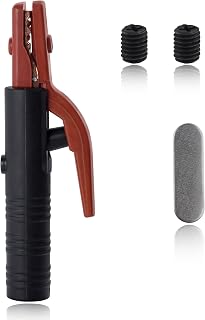 Welding Electrode Holder 500AMP Heavy Duty Jaw Holding PlierCheck price on Amazon
 KSEIBI 331215 300 Amp Welding Electrode Holder American DesignCheck price on Amazon
Spec sheet comparison
| Model | Gear Score | Amperage | Max rod | Jaw | Warranty |
|---|---|---|---|---|---|
| Lincoln K5154-1 | 9.6/10 | 200 amp, 35% duty | 5/32 in | Copper alloy, multi-angle | 1-year |
| Hobart 400A | 9.6/10 | 400A | 5/16 in | Screw-type | Not stated |
| Reboot 500A | 9.5/10 | 500 amp | 5/8 to 7/16 in | Grooved, 3 positions | Not stated |
| Lenco AF-25 | 9.5/10 | 250 amp | 3/16 in | Not stated | Not stated |
| Tweco A-316 | 9.5/10 | 250 amp | Not stated | 6-position | Not stated |
Treat the specs as maker ratings pulled straight from the listings; we gathered them on 19 October 2026. A figure from one listing describes that listing only.
Buying guide: the best welding electrode holder
Amperage and duty cycle
Match the holder to your machine and rods. The Reboot lists 500 amp, the Hobart 400A, the Lenco and Tweco 250 amp, and the Lincoln 200 amp with a 35% duty cycle. Bigger is not better if you weld thin: the Lincoln’s 200 amp rating with a stated duty cycle suits farm and shop work on smaller machines.
Jaw design
The Reboot lists a grooved jaw holding rods in 45, 90 and 180 degree positions. The Tweco lists 6-position jaw patterns. The Hobart is screw-type and lets you bend electrodes to any angle, with rods burning to within 1 in of the head. The Lincoln lists a multi-angle clamp for flat, vertical and overhead welding. More positions mean fewer awkward wrist angles.
Cable connection
The Reboot lists 1 AWG cable capacity with a free spanner and spacing sheet for the connection, though cable is not included. The Lenco lists 2/0 cable capacity, the Lincoln supports up to 1/0 AWG, and the Tweco lists a ball-point cable connection to reduce strand breakage. Check the holder’s cable size against your leads.
Warranty
Only the Lincoln states a warranty with a concrete term: 1 year. The other four state no warranty term at all.
Matching holder amps to your welder
Stated ratings run 200 to 500 amps: Reboot 500A, Hobart 400A, Lenco and Tweco 250A, Lincoln 200A. The holder rating should meet or exceed what your welder puts out; a 200A holder on a 250A machine is the wrong pairing. The Lincoln listing is the only one to state a duty cycle: 200A at 35 percent. Buy the rating for the thickest rod you burn, not the thinnest. The 250A Lenco states made in USA and an 8-1/2 in length; the 250A Tweco states 1.1 lb.
Cable sizes and what is included
The Reboot suits 1 AWG cable in 10 to 20 ft lengths, and the cable is not included. The Lenco takes up to 2/0 cable; the Lincoln up to 1/0 AWG. The Hobart and Tweco listings state no cable size. The Reboot includes a free spanner and spacing sheet for the cable connection; the Tweco uses a ball-point cable connection the listing says minimizes strand breakage.
Handles and insulation
Every listing states an insulated handle. The Lincoln goes further with a nylon and fiberglass cool-grip handle the listing says stays cool during continuous welding, plus fully insulated jaw design. The Tweco states reversible top and bottom insulators and fully insulated springs for safety. The Reboot states a brass body with an insulated handle. If you weld out of position with the handle near hot metal, insulation quality matters.
Weight and length, stated
The Lincoln states 1.5 lb and 8.3 in; the Lenco 1.01 lb and 8-1/2 in; the Tweco 1.1 lb; the Hobart 1.09 lb in the spec table against 1.4 lb package weight. The Reboot spec table states 0.634 ounces. Lighter holders tire the hand less on long beads.
Jaw positions compared
The Reboot jaw holds rods at 45, 90 and 180 degrees with grooved jaws. The Hobart is screw-type and lets you bend electrodes to any angle, burning within 1 in of the head. The Lincoln clamps at angles for flat, vertical or overhead work. The Tweco offers 6-position jaw patterns. More positions help in tight joints; the screw-type Hobart suits welders who reposition rods often.
Before You Strike an Arc
- Match the amps: the Reboot lists 500 amp and the Hobart 400A; the Lincoln lists 200 amp at 35% duty cycle.
- Check the jaw: the Hobart accepts rods up to 5/16 in, the Lenco up to 3/16 in and the Lincoln 5/32 in max.
- Insulation: the Lincoln lists an insulated nylon and fiberglass handle; the Tweco lists fully insulated springs.
- Cable: the Reboot needs 1 AWG cable, not included; the Lenco takes 2/0 and the Lincoln up to 1/0 AWG.
FAQ for welders
What size electrode holder do I need?
Match it to your rods and machine. The Hobart accepts rods up to 5/16 in, the Lenco up to 3/16 in, the Lincoln 5/32 in max and the Reboot 5/8 to 7/16 in capacity. A 200 to 250 amp holder covers most farm and shop stick welding.
What does 35% duty cycle mean?
The Lincoln lists 200A at 35% duty cycle, which is the share of a 10-minute period it can weld at that amperage before cooling. The other listings state no duty cycle.
Do these include the cable?
The Reboot lists cable as not included, with a free spanner for the connection. The other listings do not state cable inclusion, so assume the holder only.
Which one has a warranty?
Only the Lincoln: 1 year, per the spec table. The other four state no warranty term.
Related: our best all around stick welding rod picks and the stick welders hub. Browse all welders.
Can I use a 200A holder on a bigger welder?
Not above its rating. The Lincoln is rated 200A at 35 percent duty cycle; pair it with a welder at or below that output. For hotter machines, the 250A Lenco and Tweco, 400A Hobart or 500A Reboot give headroom.
Do these come with a cable?
The Reboot states the cable is not included and suits 1 AWG in 10 to 20 ft. The others state no cable in the box; the Lenco takes up to 2/0 and the Lincoln up to 1/0 AWG.
Scoring, line by line
Each pick is scored on performance, build, value, safety and warranty, using only what the listing publishes. The weights are on our How We Pick page. Only the Lincoln listing states a warranty with a concrete term, 1 year, so only it scores on warranty. Safety scoring uses stated insulation and duty figures.
| Product | Gear Score | Perf. /35 | Build /25 | Value /25 | Safety /10 | Warranty /5 |
|---|---|---|---|---|---|---|
| Lincoln K5154-1 | 9.6 | 29 | 21 | 20 | 5 | 3 |
| Hobart 400A | 9.6 | 30 | 21 | 20 | 4 | 0 |
| Reboot 500A | 9.5 | 29 | 20 | 20 | 4 | 0 |
| Lenco AF-25 | 9.5 | 28 | 21 | 19 | 4 | 0 |
| Tweco A-316 | 9.5 | 27 | 20 | 19 | 4 | 0 |
Think of 9.2 as the bottom and 9.8 as the top. Totals are placed between them in proportion, which keeps the order intact: more points, higher score.