Best Sanding Belt for Grinding (2026): 4 Picks for Shop Metalwork
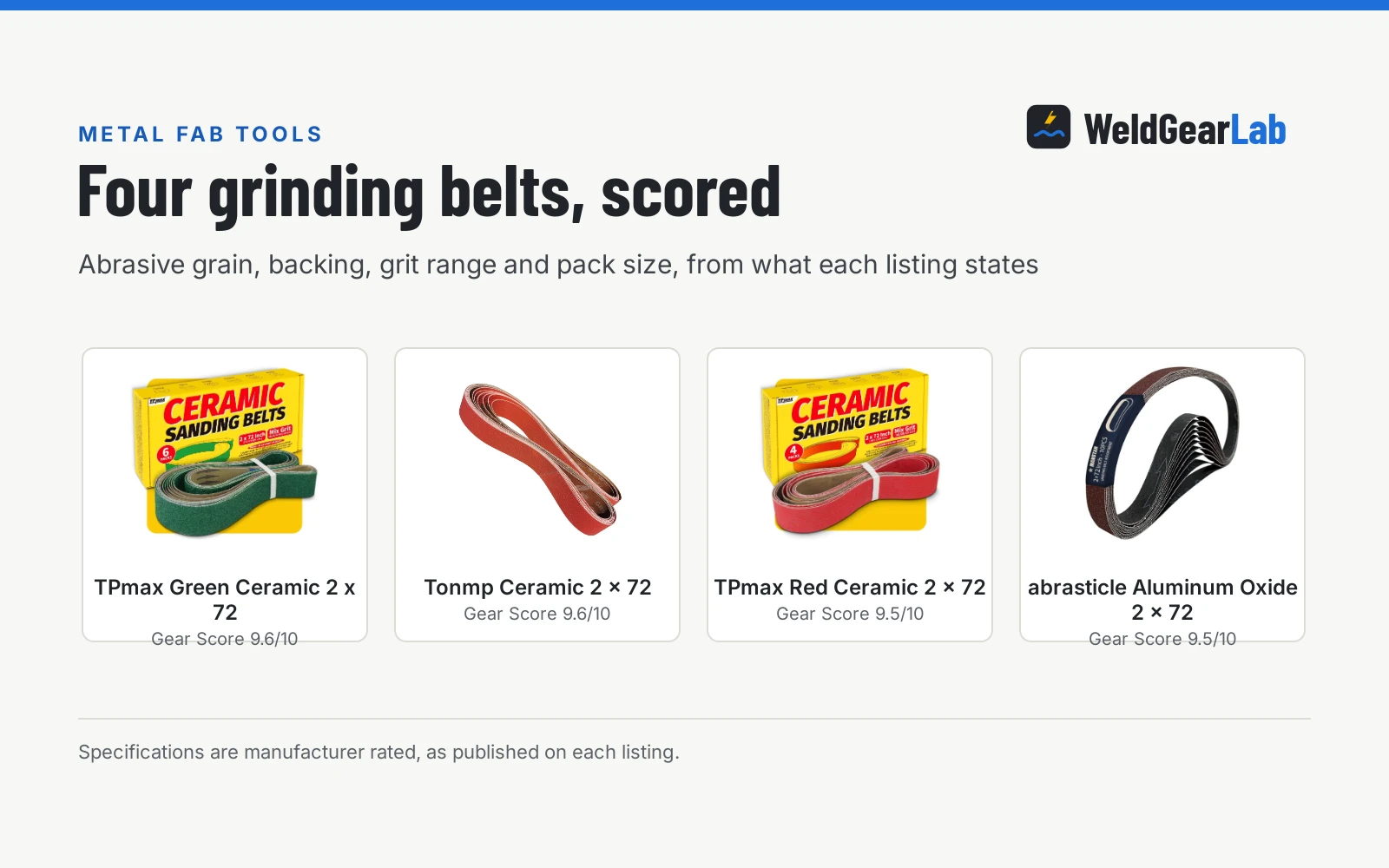
Four 2 x 72 inch sanding belts for grinding metal, compared on abrasive grain, backing, grit range and pack size, from what each listing states.

On this page
Top picks at a glance
As an Amazon Associate I earn from qualifying purchases.
- 1
 Best OverallTPmax Green Ceramic 2 x 729.6/10View on Amazon
- 2
 Coarsest GritTonmp Ceramic 2 x 729.6/10View on Amazon
- 3
 Finest Gritabrasticle Aluminum Oxide 2 x 729.5/10View on Amazon
A dull edge on a bevel or a weld bead that needs blending puts the grinder in your hands before the welder comes back out. The belt on the machine decides how fast stock comes off and how clean the finish looks, and the wrong grit just burns time and belts. This guide compares the best sanding belt for grinding for shop metalwork, using only what each listing states.
WeldGearLab gets a commission on purchases made through links on this page, and your price stays the same. Read our affiliate disclosure.
Quick picks
- Best Overall TPmax Green Ceramic 2 x 72: Zirconia ceramic in 6 grits from 40 to 180, a bi-directional tape joint and wet or dry use. Check price on Amazon
- Coarsest Grit Tonmp Ceramic 2 x 72: A 36 grit ceramic belt in a 6-belt kit, for rapid material removal on tough metals. Check price on Amazon
- Finest Grit abrasticle Aluminum Oxide 2 x 72: A 400 grit belt in a 10-belt aluminum oxide assortment, for polishing and finishing. Check price on Amazon
The machines
6 Pack 2 x 72 Inch Zirconia Ceramic Sanding Belts
A 6-belt zirconia ceramic kit in 2 x 72 inch, with grits from 40 to 180, a bi-directional tape joint and wet or dry use.
Pros
- Zirconia ceramic grain for heavy grinding, weld removal and deburring
- 6 grits from 40 to 180 for stock removal, bevel work and sharpening
- Wet or dry use with a load-reducing stearate top coat
- Bi-directional tape joint runs in both directions
Cons
- No warranty term in the listing
- No grit below 40 for coarse stock removal
- No grit above 180 for fine finishing
Tonmp 6 Pack 2 x 72 Inch Metal Grinding Ceramic
A 6-belt ceramic kit in 2 x 72 inch, with grits from 36 to 120, a bi-directional tape joint and Y-weight polyester backing.
Pros
- Coarsest grit here at 36, for rapid material removal
- Ceramic abrasive stated for stainless steel, titanium alloys and Inconel
- Bi-directional tape joint runs in both directions
- Y-weight polyester cloth backing resists edge fraying and deformation
Cons
- No warranty term in the listing
- No grit above 120 for finer finishing
- No wet or dry use stated

2x72 Inch Ceramic Sanding Belts
A 4-belt ceramic kit in 2 x 72 inch, with grits from 40 to 120, a bi-directional joint and wet or dry use.
Pros
- Ceramic grain for heavy grinding, knife sharpening and hardwoods or metals
- Wet or dry use with a polyester backing and bi-directional joint
- 4 grits from 40 to 120, from aggressive removal to fine finishing
- Lists steel, stainless steel, aluminum, brass and titanium
Cons
- No warranty term in the listing
- Smallest pack here at 4 belts
- No grit above 120 for finer finishing
- No backing weight letter stated
10 Pcs 2 x 72 Inch Assorted Aluminum Oxide Sanding
A 10-belt aluminum oxide assortment in 2 x 72 inch, with 2 each of 80, 120, 150, 240 and 400 grits for grinding, polishing and finishing.
Pros
- 10 belts, the largest pack here, with 2 each of 5 grits
- Finest grit here at 400, for finishing work
- Open coat, antistatic and washable, with an additive to resist loading
- Lists wood, aluminum, non-ferrous metal, glass, plastic and stone
Cons
- No warranty term in the listing
- No grit below 80 for coarse stock removal
- No bi-directional joint or backing weight stated
Other welders and gear to compare
 S SATC Sanding Belts 2×42 Inch Sanding Belt 24 Pcs 3 Each ofCheck price on Amazon
 VEVOR Belt Grinder Sander with VFDCheck price on Amazon
 VEVOR Belt Grinder SanderCheck price on Amazon
 1/2" x 18" Zirconia Sanding Belts for MetalCheck price on Amazon
 4" x 36" Zirconia Sanding Belts for MetalCheck price on Amazon
 2 Pcs Sanding Belts 6 x 80 Inch 120 Grit Aluminum Oxide BeltCheck price on Amazon
Spec sheet comparison
| Model | Gear Score | Abrasive | Grits | Pack | Backing | Wet or dry |
|---|---|---|---|---|---|---|
| TPmax Green Ceramic 2 x 72 | 9.6/10 | Zirconia ceramic | 40, 60, 80, 100, 120, 180 | 6 belts | Heavy-duty polyester | Yes |
| Tonmp Ceramic 2 x 72 | 9.6/10 | Ceramic | 36, 40, 60, 80, 100, 120 | 6 belts | Y-weight polyester | Not stated |
| TPmax Red Ceramic 2 x 72 | 9.5/10 | Ceramic | 40, 60, 80, 120 | 4 belts | Polyester | Yes |
| abrasticle Aluminum Oxide 2 x 72 | 9.5/10 | Aluminum oxide | 80, 120, 150, 240, 400 | 10 belts | Not stated | Not stated |
Treat the specs as maker ratings pulled straight from the listings; we gathered them on 28 October 2026.
How to pick the best sanding belt for grinding
For more picks in this class, see the grinding sanding belt hub. All four belts here measure 2 x 72 inch, so the choice turns on abrasive, grit range, backing and pack size rather than belt size.
Abrasive grain
Ceramic sanding belt options dominate this set: the Tonmp kit and both TPmax kits use ceramic grain, while the TPmax green kit uses zirconia ceramic grain. The abrasticle assortment uses aluminum oxide grain instead. Tonmp claims its ceramic belt gives a 20% boost in grinding efficiency over traditional aluminum oxide belts and up to 200% longer life, and those figures are the maker’s claims, not measurements the listing shows. For weld removal and deburring on ferrous metals, the green kit lists zirconia ceramic grain and names steel, stainless steel, carbon steel and cast iron.
Grit range
Grit decides whether a belt removes stock or refines a surface. The Tonmp kit starts at 36 grit, the coarsest here, and runs to 120 grit. The green TPmax kit runs from 40 to 180 grit, the finest top grit among the ceramic kits, while the red TPmax kit runs from 40 to 120 grit. The abrasticle assortment runs from 80 to 400 grit, with 2 belts at each grit, so it suits polishing and finishing rather than coarse stock removal. Start with the coarsest grit the job needs, then step to finer grits as the surface comes clean.
Backing and joint
Backing and joint decide whether a belt holds its shape under load. The Tonmp kit states Y-weight polyester cloth backing and a bi-directional tape joint, so it can run in both directions. The green and red TPmax kits also state a bi-directional tape joint, with heavy-duty polyester backing on the green kit and durable polyester backing on the red kit. The abrasticle listing states no backing weight and no joint type, so compare it on grain and grit range instead of backing.
Wet or dry use
Only the two TPmax kits state wet or dry use. The green kit adds a load-reducing stearate top coat, which the listing ties to cooler grinding with less heat buildup. The red kit states wet or dry use with less heat buildup and longer belt life. The Tonmp and abrasticle listings do not state wet or dry use, so treat wet grinding as not stated for those two kits.
Pack size
Pack size decides how many grit changes a kit covers before you reorder. The abrasticle assortment holds 10 belts, with 2 each of 80, 120, 150, 240 and 400 grits, so a worn belt has a spare at the same grit. The Tonmp and green kits hold 6 belts each, one at each grit, while the red kit holds 4 belts, one each of 40, 60, 80 and 120 grits. Match the pack to the range of work: a spare at one grit matters more when that grit does most of the work.
Use as directed. Check the belt size against your sander before fitting, and keep hands, clothing and cords clear of the running belt. Replace a belt that shows fraying or damage, and let the belt cut rather than forcing it against the metal.
Before You Strike an Arc
- Check that your sander takes 2 x 72 inch belts before ordering, since every belt here states that size.
- Check the joint direction on the belt you fit: the Tonmp, green TPmax and red TPmax listings state a bi-directional joint.
- Count the belts on arrival and check the grits against the listing, since pack sizes here run from 4 to 10 belts.
- Run wet only on belts whose listing states wet or dry use, which here means the two TPmax kits.
FAQ for welders
What size sanding belt fits a 2 x 72 inch grinder?
Every belt here measures 2 x 72 inch, so each one fits a grinder built for that size. Check your sander manual for the belt size it takes before ordering, since a belt that does not match will not track or fit. The listings state the size in the title, so match the title size to your machine.
Is a ceramic sanding belt better than aluminum oxide for grinding metal?
The listings do not rank the abrasives against each other, so compare them on stated use. The three ceramic kits list metal grinding, with the green kit naming ferrous and non-ferrous metals, while the abrasticle aluminum oxide assortment lists wood, aluminum, non-ferrous metal, glass, plastic and stone. Tonmp claims a 20% efficiency boost over traditional aluminum oxide belts, but that figure is the maker’s claim. For metal grinding, the ceramic kits state the metal uses directly, while the aluminum oxide kit covers a wider mix of materials.
What grit should I start with for stock removal?
Start with the coarsest grit in the kit you buy. That means 36 grit in the Tonmp kit, 40 grit in either TPmax kit, and 80 grit in the abrasticle assortment. Then step to finer grits as the surface comes clean, ending at 120 grit in the Tonmp and red kits, 180 grit in the green kit, or 400 grit in the abrasticle assortment.
Can these sanding belts run wet?
Wet or dry use is stated for the two TPmax kits, green and red. The green kit adds a load-reducing stearate top coat for cooler grinding, while the red kit states wet or dry use with less heat buildup. Wet or dry use is not stated for the Tonmp and abrasticle kits, so do not assume it for those two.
How many belts come in each kit?
The abrasticle assortment holds 10 belts, with 2 each of 80, 120, 150, 240 and 400 grits. The Tonmp and green kits hold 6 belts each, and the red kit holds 4 belts. Count the belts on arrival, since the green kit spec table reads a pack quantity of 1 against the 6-belt title and bullets.
Related: best ceramic sanding belt, best zirconia sanding belts, best sanding belt cleaner, belt grinder vs angle grinder, and the metal fab tools hub.
Scoring, line by line
Each belt is scored on performance, build, value, safety listing and warranty, with the weights published on the How We Pick page. Sanding belts carry no electrical safety listing to state, so every belt here scores zero on that criterion, and no listing states a warranty term, so every belt scores zero on warranty too. The ranking comes from performance, build and value.
| Product | Gear Score | Perf. /35 | Build /25 | Value /25 | Safety /10 | Warranty /5 |
|---|---|---|---|---|---|---|
| TPmax Green Ceramic 2 x 72 | 9.6 | 30 | 21 | 21 | n/a | 0 |
| Tonmp Ceramic 2 x 72 | 9.6 | 29 | 21 | 20 | n/a | 0 |
| TPmax Red Ceramic 2 x 72 | 9.5 | 28 | 20 | 19 | n/a | 0 |
| abrasticle Aluminum Oxide 2 x 72 | 9.5 | 26 | 19 | 21 | n/a | 0 |
Think of 9.2 as the bottom and 9.8 as the top. Totals are placed between them in proportion, which keeps the order intact: more points, higher score. Where safety does not apply (unpowered gear with no listed safety features), it is left out and the remaining 90 points make up the score.