Best Handheld Laser Welder Cost (2026)
Best handheld laser welder cost explained for shop fabricators, covering fiber laser wattage, wire feeders, shielding gas, power supply, and Class 4 safety.

On this page
Top picks at a glance
As an Amazon Associate I earn from qualifying purchases.
- 1
 Battery Spot Welder with 3700W MAX 1.5" LCD Display 1000A9.5/10View on Amazon
- 2
 Hosyond Handheld Battery Spot Welder9.3/10View on Amazon
- 3
 11500W Battery Spot Welder9.4/10View on Amazon
When you have thin sheet metal, stainless tubing, or aluminum assemblies on the bench that warp under standard TIG or MIG torches, checking into the best handheld laser welder cost is usually the next move. A complete handheld fiber laser welding system is an industrial tool built around an optical generator, a handheld laser gun, an automatic wire feeder, and shielding gas controls. Rather than a small hobby accessory, a genuine fiber laser welder requires dedicated electrical supply, high-pressure gas, protective optics, and Class 4 laser safety gear. Understanding what drives the cost helps you decide whether a fiber laser setup pays off for your shop.
This guide links to our product roundups, where WeldGearLab gets a commission on purchases made through links on this page, and your price stays the same. Read our affiliate disclosure.
Handheld laser welding cost in summary
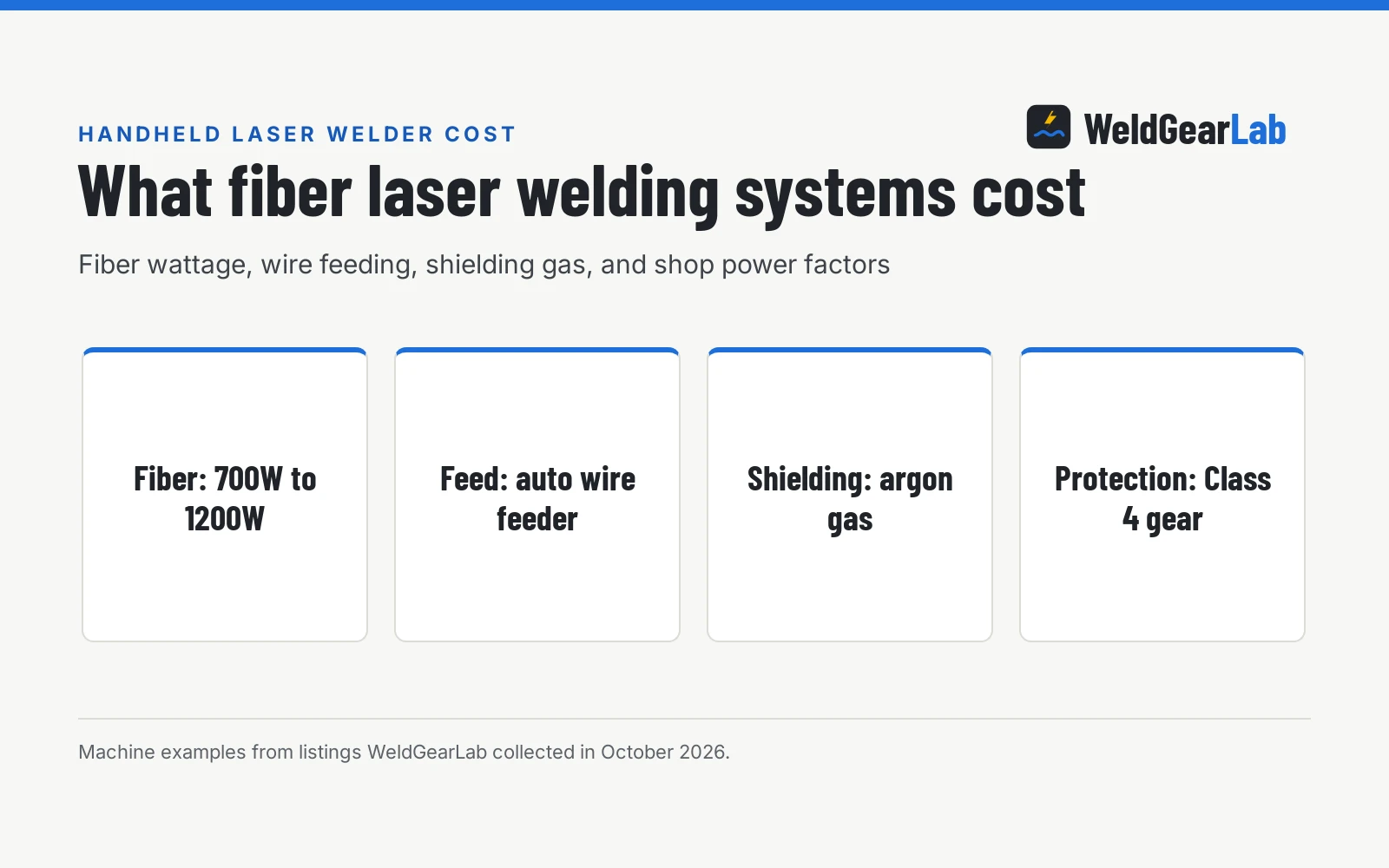
The true cost of a handheld fiber laser welder extends beyond the base machine price tag. A working shop setup includes the fiber laser power source (with reference models featuring 700W, 800W, or 1200W ratings), an optical torch, an automatic wire feeder, a dedicated shielding gas regulator for pure argon, and certified Class 4 protective barriers and safety eyewear. Fabricators must also plan for ongoing consumable expenses, including protective lenses and nozzle tips, alongside dedicated 110V or 220V circuits. Low-cost listings on general marketplaces using laser keywords are often 60-watt soldering irons with nichrome heating elements, or portable stick welders with 20A to 120A output, rather than true optical fiber laser systems.
Side by side
| Handheld Fiber Laser Welder | TIG Welder | MIG Welder | |
|---|---|---|---|
| Energy source | Fiber laser beam | Electric arc (tungsten) | Electric arc (wire) |
| Stated travel speed | xTool listings state 8x faster than TIG | Baseline manual travel speed | Moderate continuous travel speed |
| Heat-affected zone | Minimal heat-affected zone to prevent warping | Wider heat spread with higher distortion risk | Moderate heat spread with distortion risk |
| Thin metal capability | XLASERLAB X1pro listing states 0.5 mm to 3 mm material thickness | Precise control on thin sheet | Risk of burn-through on thin sheet |
| Wire delivery | Automatic wire feeder | Manual hand-fed filler rod | Continuous spool wire drive |
| Shielding gas setup | Pure argon with dedicated regulator | Pure argon cylinder | C25 or pure CO2 cylinder |
| Power supply | 110V or 220V AC input depending on wattage | 110V household or 220V shop power | 110V household or 220V shop power |
| Operator safety gear | Class 4 laser safety glasses and light-tight barrier | Welding helmet with appropriate shade filter | Welding helmet with appropriate shade filter |
| Multi-process capability | Welding, cutting, rust removal, and seam cleaning | TIG and stick welding | MIG and flux core welding |
Handheld fiber laser welders differ from traditional arc welders in heat delivery and filler metal control. Where a TIG torch spreads heat across a broad puddle, a fiber laser concentrates energy into a pinpoint focal point for fast travel speeds and minimal distortion. However, laser welding demands exact joint fit-up without wide gaps, along with specialized Class 4 safety enclosures that standard welding helmets cannot replace.
When a handheld laser welder makes sense
Investing in a handheld fiber laser welder delivers clear shop advantages under specific production conditions:
- Thin sheet metal and sensitive alloys. A focused laser beam prevents heat warping on thin sheet, with the XLASERLAB X1pro listing material from 0.5 mm to 3 mm thick. Fabricators working with stainless steel cabinets, trim, or aluminum sheet avoid the distortion common with arc welding.
- High-volume production speed. Laser welding suits repetitive joints in high-volume production work.
- Minimal post-weld grinding. Because the process creates smooth, narrow seams with virtually no spatter, shops spend far less time grinding and polishing finished parts.
- Multi-function workshop tasks. Multi-process fiber systems, including 3-in-1, 4-in-1, and 6-in-1 machines, combine welding, cutting, and laser rust cleaning in a single power source.
For dedicated aluminum work, review our guide to welding aluminum with TIG welder setups, or explore our overview of the best welding machine for stainless steel.
When traditional TIG or MIG is the better choice
Despite the speed of fiber laser technology, conventional arc welding equipment remains the practical choice for many shop and field tasks:
- Structural steel and heavy plate. Standard stick and MIG welders handle thick steel plate, heavy structural tubing, and farm repairs that exceed the penetration depth of compact fiber lasers.
- Imperfect joint fit-up. Laser welding requires tight, gap-free fit-up because the pinpoint beam cannot easily bridge wide seams. When parts have uneven gaps, a wire-feed MIG welder or stick electrode fills the void with ease.
- Outdoor and field repair. Laser shielding gas easily blows away in outdoor breezes, and optical components are vulnerable to jobsite dust. A portable stick machine or flux core wire welder handles field conditions with far greater durability.
- Accessibility and startup budget. Traditional arc welders operate on household circuits and standard PPE. For small shops, our guides to the best welder for beginners and 120V vs 240V welder outlets outline accessible options.
How to evaluate the best handheld laser welder cost
When comparing handheld fiber laser equipment, fabricators need to evaluate several distinct technical factors to understand the real financial commitment:
Laser source wattage and optical chips. The primary cost factor is the laser generator. Reference models using Coherent chips vary by wattage: 700W units (such as the XLASERLAB X1pro) list material thickness handling from 0.5 mm to 3 mm, while 800W and 1200W models (such as the xTool MetalFab series) list penetration depth up to 5 mm in stainless and carbon steel. Systems rated at 1200W also list cutting capability on carbon steel up to 10 mm thick.
Electrical infrastructure and power supply. While compact stick welders run on a standard 110V circuit, fiber laser welders draw substantial current. Some 700W units feature wide 100-240V AC compatibility, but larger 800W and 1200W models require dedicated 220V shop circuits.
Automatic wire feeder systems. Complete packages include an automatic wire feeder with drive rolls sized for 0.8mm, 1.0mm, 1.2mm, or 1.6mm wire. Some machines support dual-wire feeding to widen seam width up to 7mm for heavier joints.
Avoiding misleading marketplace listings. When searching for handheld laser equipment, buyers encounter low-priced listings using laser terminology. Generic listings titled as laser welding tools often describe 60-watt soldering irons with nichrome heating elements and pencil tips, or 110V stick welders like TORQBEAST rated at 20A to 120A.
Which gas for laser welding
Shielding gas is an essential operational expense that must be factored into laser welding ownership. The gas shields the molten weld pool from atmospheric contamination and protects the internal optical cover lens from spatter.
Pure argon is the primary inert shielding gas for handheld laser welding on stainless steel, carbon steel, and aluminum, preventing porosity in the molten pool. While nitrogen is frequently employed as an assist gas during laser cutting operations to clear the cut kerf, welding processes rely on pure argon shielding to avoid weld metal embrittlement. Because fiber lasers require steady gas flow during operation, fabricators must install a specialized laser welder gas regulator to maintain precise delivery pressure. See our review of the gas regulator for welder setups. To mitigate ongoing gas expenses, certain units feature airflow optimization technology, such as xTool’s SaveGas design, which the maker lists as cutting gas consumption by up to 50%.
Can a laser welder replace traditional shop machines?
A handheld fiber laser welder complements traditional MIG and TIG equipment rather than replacing it entirely. Where a fabricator previously spent hours slowly feeding TIG rod on thin stainless assemblies followed by blending scratches, a fiber laser completes the joint in substantially less time with minimal cleanup.
Many modern units are designed as multi-functional systems. Advanced models combine laser welding, cutting, rust removal, and seam cleaning into a single machine. The xTool MetalFab 1200W 4-in-1 system, for example, integrates an automated 610mm by 610mm CNC cutting bed with smart dual cameras alongside its handheld welding gun. For heavy structural work or dirty agricultural repairs, a conventional multi-process welder remains indispensable. Explore our roundups on the best multi-process welder models and the main welders hub.
Laser safety and operating hazards. Handheld fiber laser welders are Class 4 laser devices operating with invisible laser radiation that presents severe eye and skin hazards. Unlike standard welding arcs, diffuse laser reflections can cause permanent retinal damage. Operators and anyone in the workspace must wear optical safety glasses certified for the specific fiber laser wavelength, and the welding station must be enclosed by light-tight laser barriers with safety interlocks and an emergency stop switch. Metal vaporization also produces airborne particulates that require dedicated extraction. Review our guide to welding safety gear to understand essential shop protection.
FAQ for welders
How much does a laser welder cost?
A complete handheld fiber laser welding system costs significantly more than conventional MIG or TIG units. The full setup includes the laser source, torch, wire feeder, shielding gas equipment, and Class 4 enclosures. Operators must also budget for replacement optics and dedicated electrical circuits.
What is a laser welder?
A handheld laser welder focuses an industrial fiber laser beam through an optical torch to melt base metal and filler wire. The pinpoint beam creates a narrow seam with minimal heat-affected zone and distortion. Unlike electric arc welding, it produces minimal spatter and requires no arc striking.
Can a laser welder weld aluminum?
Handheld fiber lasers weld aluminum alloys when paired with an automatic wire feeder and pure argon shielding gas. Listings for 700W, 800W, and 1200W fiber machines specify capabilities on aluminum, stainless steel, and carbon steel. The concentrated beam helps overcome aluminum’s high thermal conductivity.
Are laser welders any good?
Handheld fiber laser welders produce exceptionally clean, narrow seams with minimal heat distortion, They excel on thin sheet and production runs where post-weld grinding must be avoided. However, they require tight joint fit-up and Class 4 safety controls.
How much is an xTool laser welder?
xTool offers its MetalFab systems in 800W and 1200W configurations, representing an industrial equipment tier rather than a hobby tool. Packages include the power source, handheld gun, wire feeder, and an 8-inch touchscreen with 108 presets. The 4-in-1 model adds a 610mm by 610mm CNC cutting bed.
Related: welders hub, gas regulator for welder, 120V vs 240V welder, welding aluminum with TIG welder, and our guide on the best multi-process welder.