Best Carbon Fiber Welding Helmet (2026): 3 Picks, Auto-Darkening and Passive
Three welding hoods for the shop, compared on lens type, optical clarity, arc sensors, weight and stated standards.

On this page
Top picks at a glance
As an Amazon Associate I earn from qualifying purchases.
- 1
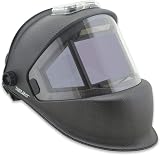 Best OverallTGR Panoramic 1809.6/10View on Amazon
- 2
 Lightest StatedFibre-Metal Tigerhood9.5/10View on Amazon
- 3
 Pipeline ClassicTefuawe Sugar Scoop9.4/10View on Amazon
The arc strikes and the world goes white, then dark, then white again with every tack. A good hood makes that rhythm disappear: it darkens when it should, stays clear when it should, and sits light enough that you forget it by the third joint. A bad hood does the opposite, flashing you at the worst moment or sliding down your nose mid-bead. This guide scores three picks for the best carbon fiber welding helmet on what each listing states about the lens, optics, weight, standards and warranty, so you can pick the hood that matches your work instead of your hopes.
WeldGearLab gets a commission on purchases made through links on this page, and your price stays the same. Read our affiliate disclosure.
Quick picks
- Best Overall TGR Panoramic 180: Stated 180-degree panoramic view, matte carbon fiber finish, 4 sensors and a 1 year warranty. Check price on Amazon
- Lightest Stated Fibre-Metal Tigerhood: 1.2 lb thermoplastic passive hood with ANSI Z87.1, CSA Z94.3 and a hard-hat mount. Check price on Amazon
- Pipeline Classic Tefuawe Sugar Scoop: Chopped fiberglass sugar scoop with CE and CSA stated and a storage bag in the box. Check price on Amazon
The machines
| # | Product | Gear Score | Buy |
|---|---|---|---|
| 1 | TGR Panoramic 180 View Solar Powered Auto | 9.6/10 | Buy on Amazon |
| 2 | Fibre-Metal by Honeywell Tigerhood Classic | 9.5/10 | Buy on Amazon |
| 3 | Flip Up Chopped Fiberglass Sugar Scoop Welding | 9.4/10 | Buy on Amazon |
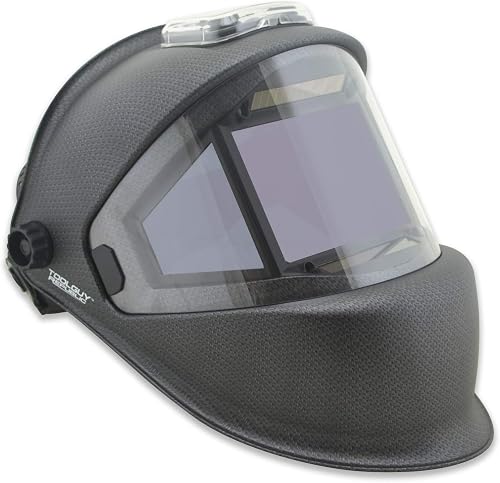
TGR Panoramic 180 View Solar Powered Auto
A panoramic auto-darkening helmet with 4 sensors, a matte carbon fiber finish and a stated 1 year warranty.
Pros
- Panoramic 180-degree view stated, the widest view here
- 4 arc sensors with 1/10,000 sec switching speed
- Matte carbon fiber finish, the only carbon fiber in this guide
- 1 year manufacturer warranty stated in the listing
Cons
- Optical class 1.1.1.2, a step below the top optical class figure
- Nylon shell underneath, not a true carbon fiber shell
- Lists ANSI without a number, which is not ANSI Z87.1
- 1.4 lb, heavier than the Fibre-Metal hood

Fibre-Metal by Honeywell Tigerhood Classic
A thermoplastic passive hood with ANSI Z87.1 and CSA Z94.3, a flip-up shade 10 lens and hard-hat mount, weighing just 1.2 lb.
Pros
- ANSI Z87.1 and CSA Z94.3 stated in the bullets
- 1.2 lb, the lightest hood in this guide
- Flip-up 2 x 4 1⁄4 in lid with a shade 10 lens included
- Speedy Loop hard-hat mount included for site work
Cons
- Passive lens only, with no auto-darkening option
- No warranty term is stated
- Thermoplastic shell, so not a carbon fiber hood
- Fixed shade 10 with no variable shade option
Flip Up Chopped Fiberglass Sugar Scoop Welding
A chopped fiberglass sugar scoop pipeline hood with CE and CSA stated, weighing 2.2 lb and shipping with a storage bag.
Pros
- Chopped fiberglass shell, impact-resistant per the listing
- CE and CSA stated on the listing
- Ratcheting headgear with a wraparound backrest for comfort
- Storage bag included in the box
Cons
- 2.2 lb, the heaviest hood in this guide
- No warranty term is stated
- Passive 2 x 4.25 in lens with no auto-darkening
- Fiberglass shell, so not the carbon fiber pick
Other welders and gear to compare
 Welding Helmet Auto DarkeningCheck price on Amazon
 Black Chopped Fiberglass Sugar Scoop Welding HelmetCheck price on Amazon
 YESWELDER Auto Darkening Welding Helmet 1/1/1/1 True ColorCheck price on Amazon
 YESWELDER Auto Darkening Welding HelmetCheck price on Amazon
 Lincoln Electric VIKING 3350 All American Welding HelmetCheck price on Amazon
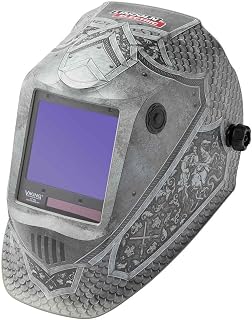 Lincoln Electric VIKING 3350 Medieval Welding HelmetCheck price on Amazon
Spec sheet comparison
| Model | Gear Score | Lens | Weight | Standards | Warranty |
|---|---|---|---|---|---|
| TGR Panoramic 180 | 9.6/10 | Auto-darkening | 1.4 lb | CE, ANSI, AS/NZS, EN175B | 1 year |
| Fibre-Metal Tigerhood | 9.5/10 | Passive shade 10 | 1.2 lb | ANSI Z87.1, CSA Z94.3 | None stated |
| Tefuawe Sugar Scoop | 9.4/10 | Passive 2×4.25 | 2.2 lb | CE, CSA | None stated |
Ratings in this table are the makers’ own claims taken from each product page (22 October 2026).
Buying guide: choosing the best carbon fiber welding helmet
Auto-darkening vs passive
One hood here darkens on its own, the TGR, with 4 arc sensors and a switching speed of 1/10,000 sec, plus true color and a stated 180-degree panoramic view. The Fibre-Metal and Tefuawe are passive: a fixed shade you nod down, shade 10 on the Tigerhood and a 2 x 4.25 inch lens on the sugar scoop. Auto-darkening suits tacking and repositioning, where the hood stays down and your hands stay free; passive suits welders who trust a fixed shade and want fewer parts to fail, and both types have earned their place in real shops. Neither type is automatically better, so match the lens to how you work, not to what the next bench over runs. The passive hoods also suit a welder who already owns the glass and lenses for the 2 x 4 size, since both passive picks use that family of lens size, one as a 2 x 4 1⁄4 inch holder and one as a 2 x 4.25 inch fit.
Optical clarity and sensors
The TGR states optical class 1.1.1.2, the only optical class figure in this guide. Four sensors, on the TGR, reduce the chance of a covered sensor killing the darkening mid-weld, which matters when you weld out of position. The passive hoods state no sensors or switching speed, which is normal; their clarity comes from the glass you put in the 2 x 4 1⁄4 inch holder or the 2 x 4.25 inch lens. If you want the stated view of the puddle through an auto-darkening lens, the TGR is the only pick here that offers it, and its true color claim speaks to how the puddle looks through the lens rather than to a shade range. For passive work, clarity is a property of the lens you fit, so budget for a lens you trust and keep a spare cover lens in the shop.
Weight
Stated weights run from 1.2 lb on the Fibre-Metal to 2.2 lb on the Tefuawe, with the TGR at 1.4 lb. A pound on your head matters by hour six, so the lowest-weight hoods here earn their keep on long days. Balance counts too, and headgear adjustment changes how any stated weight feels once the hood is on. The Fibre-Metal at 1.2 lb suits long overhead sessions where every ounce shows up in the neck, while the Tefuawe at 2.2 lb trades weight for the sugar scoop shape that pipeline welders know. Try the headgear adjustments before you judge the weight; a well-fit heavy hood beats a poorly-fit light one, and the Tefuawe listing stresses a larger wraparound backrest for less head pressure across the day.
Standards
Every hood here states at least one standard: ANSI Z87.1 and CSA Z94.3 on the Fibre-Metal, CE and CSA on the Tefuawe, and CE, ANSI and AS/NZS with EN175B on the TGR. Match the stated standard to your site requirements; a general ANSI statement is not the same as a numbered Z87.1. Note the Fibre-Metal spec table lists Z89.1 while its bullets state Z87.1; the bullets rule, and the review says so. The TGR also states EN175B, which covers grinding protection, so a welder who grinds with the hood down has a stated figure to point to. Check the marking on the shell when the hood arrives, and keep the manual with the stated standards where the site inspector can see it.
Headgear and fit
A hood lives on the headgear. The Tefuawe lists ratcheting headgear with a wraparound backrest and more adjustments for less head pressure, and it adjusts the eyes-to-lens distance for use with more respirators. The TGR uses a strap with an adjustable buckle. The Fibre-Metal fits a hard hat through its Speedy Loop mount, which suits sites where the hard hat stays on, and its listing says the hood accommodates glasses and respirators. Fit the hood before you weld in it: it should sit level, stay put when you nod, and clear your respirator. A hood that slides when you nod will flash you at the worst moment, so spend the time on the headgear before the first arc.
A note on carbon fiber
Only the TGR lists carbon fiber, and it is a matte carbon fiber finish on a nylon shell, not a carbon fiber shell. The Fibre-Metal is thermoplastic and the Tefuawe is chopped fiberglass. If the carbon look matters to you, the TGR is the pick; if the shell material matters more, none of these listings state a true carbon fiber shell, so score them on lens, weight and standards instead. That honesty matters for the focus of this guide: the carbon fiber name draws readers in, but the listings state a finish, not a shell, and this guide scores what the listings state.
Before You Strike an Arc
- Check the stated lens size on arrival: confirm the 2 x 4 1⁄4 inch holder or the 2 x 4.25 inch lens matches the listing.
- Set sensitivity and delay on the 4-sensor hood before the first arc, using the included manual.
- Confirm the stated standard on the shell marking matches the listing, especially where the spec table and bullets disagree.
- For the Tefuawe, check the storage bag and the cover lens, retainer and manual in the box before the first job.
FAQ for welders
Is a carbon fiber welding helmet worth it?
Here, carbon fiber is a finish, not a shell: the TGR lists a matte carbon fiber finish on nylon. The other hoods are thermoplastic and fiberglass. Buy the TGR for the look and the panoramic view; buy on optics, weight and standards if the shell material matters more to you.
How many arc sensors do I need?
The TGR states 4 arc sensors, which guards against a covered sensor when you weld out of position or with the hood tilted. The passive hoods state no sensors, since a fixed shade needs none. For pipe or tight work, the higher stated sensor count is the safer pick, and the two-sensor versus four-sensor guide linked below explains why.
What does the 1.1.1.2 optical class mean?
It is the optical class figure stated here only by the TGR. The passive hoods state no optical class figure, since their view comes from the lens you fit. A clearer stated figure means a clearer stated view of the puddle; all figures here are the makers stated figures.
Can I wear glasses under these hoods?
The Fibre-Metal listing says its hood accommodates glasses and respirators. The Tefuawe listing says its headgear adjusts for more respirators. For the auto-darkening hood, the listing does not state glasses clearance, so check the manual before you buy.
Do these hoods work for grinding?
The TGR states EN175B for grinding protection. The passive hoods do not state a grind mode. If you grind with the hood down, pick one that states it.
Related: best auto darkening welding helmet, two sensor vs four sensor welding helmet, lightweight vs standard welding helmet, and the welding helmets hub.
Scoring, line by line
Each helmet is scored out of 10 on performance, build, value, safety listing and warranty. The one auto-darkening hood carries the performance here with a stated sensor count and switching speed, while the passive hoods lean on stated standards and low weight. One listing states a warranty term and all three state at least one safety standard, so those criteria separate the field. Value follows the stated spec sheet: more stated capability for the class earns more points, and missing specs cost points.
| Product | Gear Score | Perf. /35 | Build /25 | Value /25 | Safety /10 | Warranty /5 |
|---|---|---|---|---|---|---|
| TGR Panoramic 180 | 9.6 | 30 | 20 | 20 | 7 | 3 |
| Fibre-Metal Tigerhood | 9.5 | 26 | 21 | 20 | 8 | 0 |
| Tefuawe Sugar Scoop | 9.4 | 24 | 19 | 19 | 7 | 0 |
The lowest score we show is 9.2 and the highest is 9.8; every point total is spread proportionally across that span, so extra points mean a higher figure.