Best Bevel Gauge Tool (2026): 5 Picks for Layout and Fit-Up
Five bevel gauges for layout and pipe fit-up, compared on angle range, locking, materials and the warranty each listing states.

On this page
Top picks at a glance
As an Amazon Associate I earn from qualifying purchases.
- 1
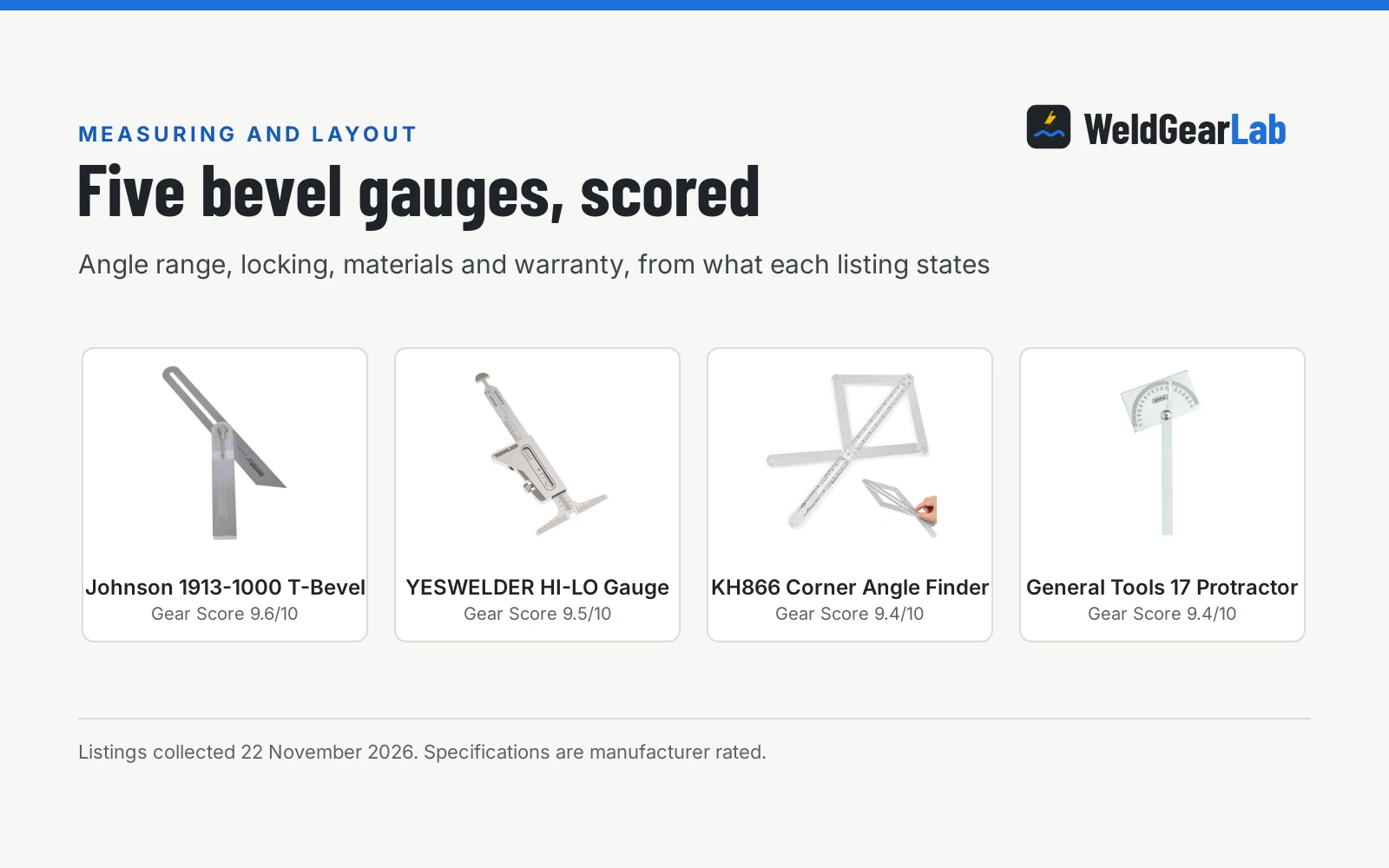
 Best OverallJohnson 1913-1000 T-Bevel9.6/10View on Amazon
- 2
 Best for Pipe Fit-UpYESWELDER HI-LO Gauge9.5/10View on Amazon
- 3
 Widest Angle RangeKH866 Corner Angle Finder9.4/10View on Amazon
- 4
 Best ProtractorGeneral Tools 17 Protractor9.4/10View on Amazon
A mitered corner that will not close, a pipe bevel that needs checking before the root pass, a trim board that has to meet a wall at an odd angle. A bevel gauge carries the angle from the work to the saw, and the best bevel gauge tool is the one that holds that angle steady while you mark it. This guide compares gauges for layout and fit-up, from a sliding T-bevel to a pipe fit-up gauge, on what each listing states: angle range, locking, materials and warranty.
WeldGearLab gets a commission on purchases made through links on this page, and your price stays the same. Read our affiliate disclosure.
Quick picks
- Best Overall Johnson 1913-1000 T-Bevel: A 10-inch T-bevel with a stainless steel blade, a solid aluminum handle, a locking lever and the only stated warranty here, a limited lifetime term. Check price on Amazon
- Best for Pipe Fit-Up YESWELDER HI-LO Gauge: Checks 37-1/2 degree bevels and gaps up to 32mm at a stated plus or minus 0.001 inches, with a dual-sided Standard and Metric scale. Check price on Amazon
- Widest Angle Range KH866 Corner Angle Finder: Measures angles from 10 to 170 degrees and reads the half angle at the same time, with metal knobs that lock the setting. Check price on Amazon
- Best Protractor General Tools 17 Protractor: A stainless steel square head protractor with a 0 to 180-degree scale and a 6-inch adjustable arm. Check price on Amazon
The machines
Johnson Level & Tool 1913-1000 Professional
A 10-inch T-bevel with a stainless steel blade, a solid aluminum handle and a locking lever, and the only stated warranty here.
Pros
- Stainless steel blade and solid aluminum handle
- Locking lever holds the blade in place while you transfer angles
- Holds and transfers inside and outside angles for cabinets, furniture and tile
- Limited lifetime warranty in the listing
Cons
- No angle scale is stated, so it transfers angles instead of reading them
- The 10-inch blade is shorter than the 12.5-inch protractor in this guide
- No storage case is stated in the listing
- Stated uses are cabinets, furniture, picture frames and tile, with no pipe fit-up use named
YESWELDER HI-LO Welding Gauge
A stainless steel pipe fit-up gauge that checks 37-1/2 degree bevels and gaps up to 32mm, with a dual-sided Standard and Metric scale and a storage box.
Pros
- Checks 37-1/2 degree bevel angles and fit-up gaps up to 32mm
- Stated precision of plus or minus 0.001 inches
- Dual-sided design flips between Standard and Metric readings
- Laser-etched scales and a protective storage box in the listing
Cons
- No warranty term is stated
- Built for pipe fit-up, so it does not transfer angles to a saw like a T-bevel
- No item weight is stated in the listing
- Single bevel angle checked: 37-1/2 degrees, with no other bevel angles stated
Corner Angle Finder - Miter Saw Protractor Bevel
An aluminum alloy angle finder that measures 10 to 170 degrees, reads the half angle at the same time, and locks with metal knobs.
Pros
- Measures angles from 10 to 170 degrees
- Reads the included angle and the half angle at the same time
- Metal knobs lock the setting for marking
- Aluminum alloy build for tile, brick, stone, wood and laminate work
Cons
- No warranty term is stated
- No item weight or size is stated in the listing
- Angle range starts at 10 degrees, so it does not read angles below 10 degrees
- No storage case is stated in the listing
General Tools Square Head Protractor & Angle
A stainless steel square head protractor with a 0 to 180-degree scale and a 6-inch adjustable arm that locks with a knurled thumb nut.
Pros
- 0 to 180-degree semi-circle scale in forward and reverse directions
- 6-inch adjustable arm for setting bevels and transferring angles
- 3-3/8 by 2-inch head anchors the protractor against the work
- Knurled thumb nut locks the metal arm in place
Cons
- The 12.5-inch overall length is the longest here and needs more bench space
- No storage case is stated in the listing
- Needs the 3-3/8 by 2-inch head flat against the work to hold its place
- The 6-inch arm is shorter than the 10-inch T-bevel blade

General Tools Contour Gauge 837
A 6-inch contour gauge that copies profiles up to 3 inches deep with 35 leaves per inch, for matching moldings and cut-outs rather than setting bevel angles.
Pros
- Copies profiles up to 3 inches deep at 35 leaves per inch
- Stainless steel pins for greater precision than plastic teeth
- Ruler markings on the body in 1-inch increments
- Presses onto an outline and traces it, with no setup
Cons
- It copies shapes and does not set or transfer bevel angles
- The listing states no warranty
- Profiles deeper than 3 inches exceed the stated range
- Ruler markings are in 1-inch increments only, so fine measurements need another tool
Spec sheet comparison
| Model | Gear Score | Tool type | Angle range | Material | Length | Warranty |
|---|---|---|---|---|---|---|
| Johnson 1913-1000 T-Bevel | 9.6/10 | Sliding T-bevel | Not stated | Stainless steel blade, aluminum handle | 10 in | Limited lifetime |
| YESWELDER HI-LO Gauge | 9.5/10 | Pipe fit-up gauge | 37-1/2 degree bevel check | Stainless steel | Not stated | None stated |
| KH866 Corner Angle Finder | 9.4/10 | Angle finder | 10 to 170 degrees | Aluminium alloy | Not stated | None stated |
| General Tools 17 Protractor | 9.4/10 | Square head protractor | 0 to 180 degrees | Stainless steel | 12.5 in | None stated |
| General Tools 837 Contour Gauge | 9.3/10 | Contour gauge | Not stated | Stainless steel pins | 6 in | No warranty |
Treat the specs as maker ratings pulled straight from the listings; we gathered them on 21 November 2026.
Buying guide: how to pick the best bevel gauge tool
Blade and handle
A T-bevel lives or dies by its blade and handle. The Johnson T-bevel pairs a stainless steel blade with a solid aluminum handle, and the maker says the blade will never rust or corrode. The square head protractor uses a stainless steel arm with a knurled thumb nut, and the HI-LO gauge is stainless steel throughout with laser-etched numerals. The corner angle finder uses an aluminum alloy body, and the contour gauge uses stainless steel pins. Check the blade for play before you mark, and keep the handle clean so the gauge sits flat.
Angle range and locking
Angle range decides which jobs a gauge can take. The protractor reads 0 to 180 degrees in both directions, the corner angle finder measures 10 to 170 degrees and reads the half angle at the same time, and the HI-LO gauge checks a 37-1/2 degree bevel. The T-bevel has no stated scale and transfers whatever angle the work gives it. Locking matters as much as range: the T-bevel uses a locking lever, the protractor a knurled thumb nut, and the corner angle finder metal knobs, so the setting survives the trip from the work to the saw.
Size and weight
These gauges run from 6 inches to 12.5 inches long. The contour gauge is 6 inches, the T-bevel is 10 inches, and the protractor measures 12.5 by 3.88 by 1.63 inches. Weights are light: the contour gauge is 0.15 lb, the protractor is 0.14 lb, and the T-bevel is 0.02 lb. No weight or size is stated for the HI-LO gauge or the corner angle finder, so check the listing before ordering if the tool has to fit a crowded box.
Materials and markings
Stainless steel shows up across this guide: the T-bevel blade, the protractor arm, the HI-LO gauge and the contour gauge pins. The corner angle finder is aluminum alloy, and the T-bevel handle is solid aluminum. Markings matter for repeat work: the HI-LO gauge has laser-etched numerals that the maker says will never rub off, the protractor has a 0 to 180-degree scale, and the contour gauge has ruler markings in 1-inch increments. The T-bevel carries no stated scale, so it copies angles rather than reading them.
Use as directed. Keep the blade or arm closed or covered when the gauge is in a toolbox, so the edge stays true and the pins stay straight. Lock the setting before you lift the gauge off the work, and check the lock again before you mark. Never force a stuck blade or knob; clean the joint and try again.
Before You Strike an Arc
- Check the locking lever on the T-bevel, the thumb nut on the protractor and the metal knobs on the corner angle finder before you mark.
- Confirm the T-bevel blade sits flat against the work with no play in the joint.
- Confirm the HI-LO gauge slides smoothly against the pipe and its storage box is in the listing.
- Press the contour gauge pins onto a scrap outline first, so you know the pins move and hold the shape.
- Check the angle finder against a known square corner before trusting a cut.
FAQ for welders
What is a bevel gauge used for?
A bevel gauge copies an angle from the work and carries it to a saw or a fit-up. The T-bevel in this guide holds and transfers inside and outside angles, and the corner angle finder reads external and internal angles from its scale. Welders use the HI-LO gauge to check 37-1/2 degree pipe bevels before fit-up.
How do I transfer an angle with a T-bevel?
Set the blade against the angle on the work, lock the lever, and carry the gauge to the saw or the workpiece. The Johnson T-bevel uses a locking lever to hold the blade in place, and the blade is stainless steel with a solid aluminum handle. Mark the angle while the lock is set, and check the lock again if the gauge is bumped.
What angle ranges do these gauges cover?
The square head protractor reads 0 to 180 degrees, and the corner angle finder measures 10 to 170 degrees while reading the half angle at the same time. The HI-LO gauge checks a 37-1/2 degree bevel. The T-bevel states no angle range, since it copies whatever angle the work gives it.
Can a contour gauge replace a bevel gauge?
No. The contour gauge copies profiles up to 3 inches deep with 35 leaves per inch, for moldings, spindles and cut-outs around pipes and casings. It sets no angle and transfers none. For bevel work, use the T-bevel, the corner angle finder or the protractor.
Do any of these bevel gauges state a warranty?
Only one does. The Johnson T-bevel states a limited lifetime warranty, and it is the only pick here with a stated warranty term. The General Tools contour gauge states no warranty, and the other listings state no term.
Related: measuring and layout hub, best 6 inch combination square, best center finder tool, best digital angle finder with laser, and the layout tools hub.
Scoring, line by line
Each gauge is scored out of 10 on performance, build, value, safety listing and warranty, with the weights published on the How We Pick page. None of these gauges states an electrical safety listing, so every gauge here scores zero on that criterion; the ranking comes from the other four. The Johnson T-bevel is the only pick with a stated warranty term, a limited lifetime term, so it is the only pick that scores on warranty.
| Product | Gear Score | Perf. /35 | Build /25 | Value /25 | Safety /10 | Warranty /5 |
|---|---|---|---|---|---|---|
| Johnson 1913-1000 T-Bevel | 9.6 | 30 | 22 | 21 | 0 | 4 |
| YESWELDER HI-LO Gauge | 9.5 | 30 | 22 | 20 | 0 | 0 |
| KH866 Corner Angle Finder | 9.4 | 28 | 20 | 21 | 0 | 0 |
| General Tools 17 Protractor | 9.4 | 27 | 20 | 20 | 0 | 0 |
| General Tools 837 Contour Gauge | 9.3 | 23 | 19 | 19 | 0 | 0 |
Think of 9.2 as the bottom and 9.8 as the top. Totals are placed between them in proportion, which keeps the order intact: more points, higher score.