Angle Clamp vs C Clamp: Which One Should You Buy?
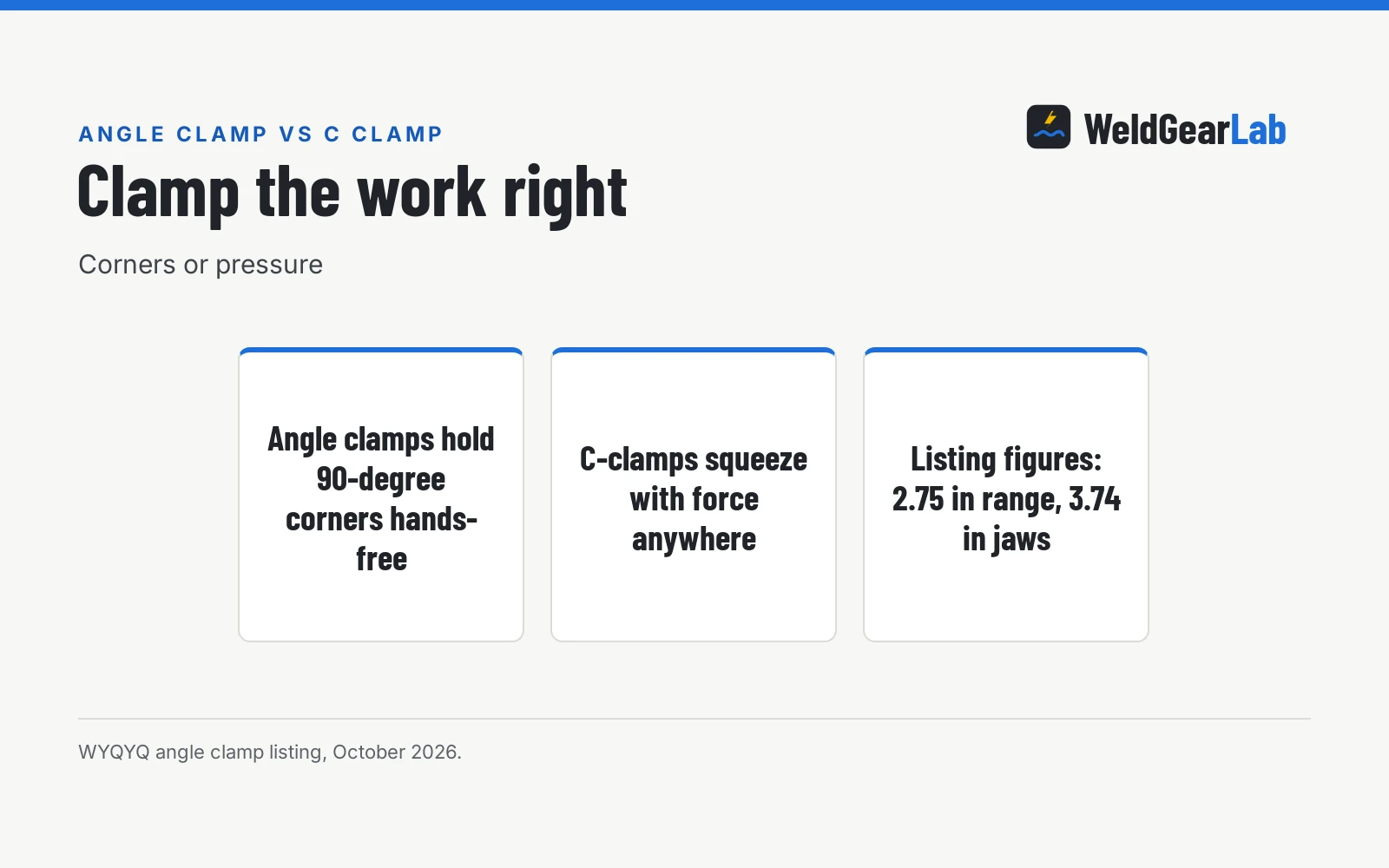
Angle clamp vs c clamp: angle clamps hold 90-degree corners hands-free while C-clamps squeeze with force anywhere. A guide with listing figures for home shops.

On this page
Top picks at a glance
As an Amazon Associate I earn from qualifying purchases.
- 1
 BESSEY WS-3+2K-CB Angle Clamp X 1.125 inView on Amazon
- 2
 BETOOLL Cast Iron Welders Angle Clamp(2PCS)View on Amazon
- 3
 BETOOLL Cast Iron Welders Angle ClampView on Amazon
- 4
 BESSEY WSM-12View on Amazon
- 5
 W045C Ductile Iron 90° Angle ClampView on Amazon
- 6
 DASBET Cast Iron Welders Angle ClampView on Amazon
An angle clamp holds two parts at a fixed 90 degrees hands-free; a C-clamp squeezes parts together wherever its frame can reach. The angle clamp vs c clamp question is really about the joint: corners and frames want the angle clamp; most other clamping wants the C-clamp. This guide explains both, using the WYQYQ 90 degree angle clamp for concrete figures.
Other welders and gear to compare
 BESSEY WS-3+2K-CB Angle Clamp X 1.125 inCheck price on Amazon
 BETOOLL Cast Iron Welders Angle Clamp(2PCS)Check price on Amazon
 BETOOLL Cast Iron Welders Angle ClampCheck price on Amazon
 BESSEY WSM-12Check price on Amazon
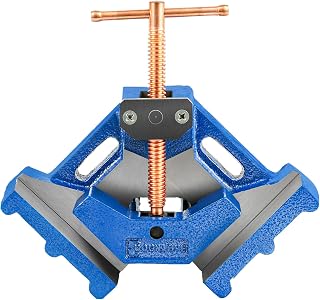 W045C Ductile Iron 90° Angle ClampCheck price on Amazon
 DASBET Cast Iron Welders Angle ClampCheck price on Amazon
WeldGearLab gets a commission on purchases made through links on this page, and your price stays the same. Read our affiliate disclosure.
angle clamp vs c clamp: the difference in one paragraph
An angle clamp is a corner jig with a screw: it holds two workpieces at 90 degrees so you can tack or fasten the joint without a third hand. A C-clamp is a screw press shaped like the letter C: it squeezes two parts together wherever its frame can reach, with the force coming from the screw. One sets angles; the other applies pressure.
What an angle clamp does
The WYQYQ angle clamp is a 90 degree angle clamp sold as a 4-piece set, with a maximum clamping range of approx 2.75 in (70 mm), a jaw width of 3.74 in (95 mm) and a jaw depth of 1.38 in (35 mm). Its body is aluminum alloy die-casting with a non-slip rubber handle, and the single-handle claw rotates in both directions with adjustable jaws and rotating nuts, so two pieces of different thickness can be joined at a right angle. An oblong hole lets you fix the clamp to the workbench. The WYQYQ listing names welding, framing, carpentry, drilling, dowels, cabinets and furniture as uses. That is the angle clamp’s job: hold the corner square while you weld, screw or glue it.
What a C-clamp does
A C-clamp is the general-purpose squeeze. The C-shaped frame reaches over an edge and the screw drives a pad down onto the work, pressing two parts together with force from the screw, limited by the screw and the frame. C-clamps come in many sizes and hold anything the frame can reach: plates to a welding table, parts to a bench, workpieces to each other. They do not set angles by themselves; they hold pressure while you set the angle another way. For fit-up that has to stay exact while you weld, the C-clamp is the workhorse.
When the angle clamp is the better choice
When the joint is a corner. Tacking up a 90-degree frame, a box, a bracket or cabinet corner: the angle clamp holds both pieces square in one move, which is faster than juggling two C-clamps and a square. The WYQYQ clamp’s 2.75 in clamping range suits tube and flat-bar corners up to that size. The rotating claw handles pieces of different thickness, and the bench-mount hole turns the clamp into a fixed jig for repeat corners. If you build a lot of frames, the saved setup time adds up.
When the C-clamp is the better choice
When the job is pressure, not angles. Clamping plate to a welding table, holding parts that are not at 90 degrees, squeezing a joint shut, or reaching where an angle clamp’s fixed geometry cannot go: the C-clamp’s simple screw press does it all. It is the force tool where the angle clamp is the positioning tool: a screw-driven C-clamp is built for pressure. For heavy fit-up, distortion control and tacking thick parts, the C-clamp is the answer. Most shops own several.
Can you use both?
Yes, and most fabrication does. The angle clamp sets the corner square; C-clamps lock the assembly to the table so it cannot move while you weld. The angle clamp is the layout tool that holds the geometry; the C-clamp is the vise that holds the pressure. Buy angle clamps first if you build frames and boxes; buy C-clamps first if you do general fit-up and tacking. Compare clamp types in our F-clamp vs C-clamp for welding.
Setting up a corner with the listing’s clamp
The WYQYQ 90 degree angle clamp shows how the setup works. The single-handle claw rotates in both directions, and the adjustable jaws with rotating nuts take up the slack, so you can join two pieces of different thickness at a right angle: set the thicker piece, wind the jaw down on the thinner one, and the corner holds square. The jaw width of 3.74 in (95 mm) gives the clamp its bite on the work, while the 1.38 in (35 mm) jaw depth sets how far it reaches onto the part. For repeat corners, the oblong hole fixes the clamp to the workbench, turning it into a station you return to instead of a tool you reposition every time. The 4-piece set means four corners at once, which is exactly what a box or frame build wants.
FAQ for welders
Will an angle clamp hold thick steel?
The WYQYQ listing states a maximum clamping range of approx 2.75 in (70 mm), which covers tube and flat-bar corners up to 2.75 in. For thicker stock, use C-clamps.
Can a C-clamp hold a 90-degree corner?
Not by itself. A C-clamp applies pressure, not geometry. Pair it with a square or an angle clamp to hold the corner while the C-clamp locks the parts down.
How many clamps do I need?
The WYQYQ angle clamp sells as a 4-piece set, which suits one frame at a time. For C-clamps, buy more than you think: fit-up has a way of wanting one more.
Aluminum or steel clamps for welding?
The WYQYQ angle clamp is aluminum alloy die-casting, light for layout work. For heavy welding fit-up where heat and force are high, steel C-clamps take the punishment better.
Do angle clamps work on a welding table?
The WYQYQ clamp’s oblong hole lets you fix the angle clamp to the workbench. For table work, that plus C-clamps holding the parts to the table covers most setups.
More welding guides
Also see our locking C-clamp vs screw clamp for welding and the best welding clamps for fabrication.