How to TIG Weld Thin Stainless without Warping
Learn how to TIG weld thin stainless without warping by controlling heat input with copper chill bars, tight fit-up, steady travel, and small filler wire.
 By WeldGearLab Editorial
Updated October 10, 2026
By WeldGearLab Editorial
Updated October 10, 2026
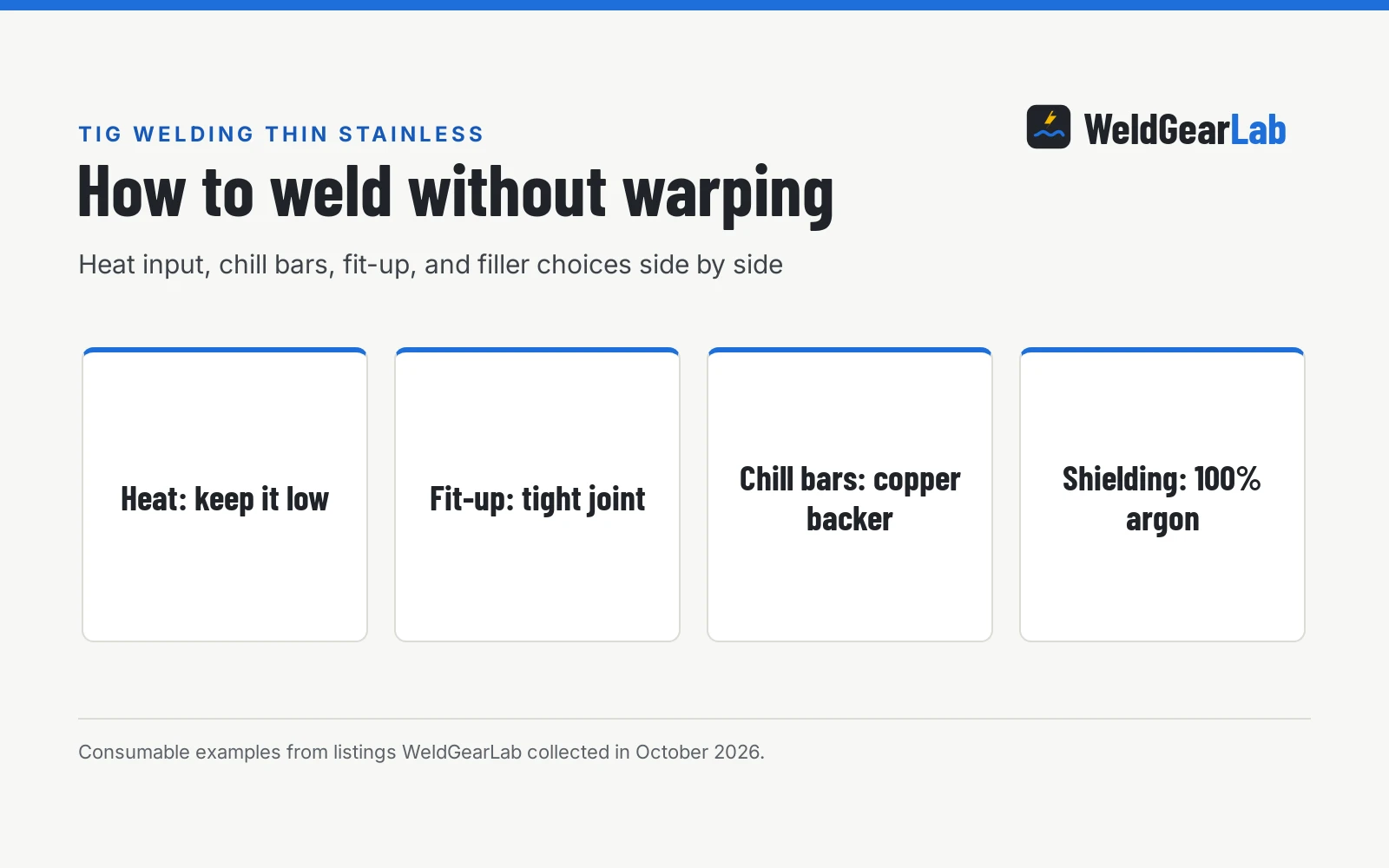
To know how to TIG weld thin stainless without warping, control heat input by maintaining a tight arc, moving with steady travel speed, using copper chill bars behind the joint, and keeping fit-up completely flush. Austenitic stainless steel expands rapidly under heat while conducting heat away slowly, which concentrates thermal stress along the seam and pulls thin sheet metal out of shape. Combining tight clamping with low amperage, small filler wire, and DCEN polarity stops distortion before heat builds up across the panel. This guide explains how to prevent warping on thin stainless sheet metal step by step.
As an Amazon Associate I earn from qualifying purchases. This guide links to our product roundups, where WeldGearLab earns a commission when you buy through links, at no extra cost to you. Read our affiliate disclosure.
The distortion problem in one paragraph
Austenitic stainless alloys like 304 and 316 expand rapidly under arc heat while conducting that heat away sluggishly. In thin sheet metal, thermal energy stays trapped along the weld line rather than dispersing into the base metal, creating sharp temperature differences between the molten puddle and the cold metal beside it. As the puddle cools and shrinks, the surrounding sheet cannot stretch to accommodate the contraction, forcing the panel to buckle and oil-can. Stopping that distortion requires minimizing heat input, clamping with heat-absorbing chill blocks, maintaining flawless fit-up, and traveling fast along the joint.
Side by side
| Pulse TIG | Continuous DC TIG | Autogenous TIG | |
|---|---|---|---|
| Heat input | Lower, background current lets puddle freeze between peaks | Higher, continuous arc continuously heats base metal | Lowest, edge fusion requires no added filler melting |
| Distortion risk | Minimal warping with steady travel speed | Higher warping risk if travel speed slows | Low when edges remain tightly abutted |
| Arc characteristics | Stiff, focused arc cone with pulsed output | Standard conical arc across the joint | Pinpoint arc focused directly along seam |
| Fit-up requirement | Tight fit-up, flush joint contact | Tight fit-up, flush joint contact | Flawless joint contact with no gap |
| Chill bar assistance | Recommended for backing heat dissipation | Essential for backing heat dissipation | Essential to prevent edge melt-through |
| Filler metal addition | Small rod added during pulse cycles | Small rod dipped steadily into puddle | No filler wire added |
| Shielding gas | 100% argon from cylinder | 100% argon from cylinder | 100% argon from cylinder |
| Torch polarity | DCEN (electrode negative) | DCEN (electrode negative) | DCEN (electrode negative) |
| Joint reinforcement | Slight bead crown from filler metal | Slight bead crown from filler metal | Flush bead with no added crown |
Settings and arc characteristics depend on your power source and torch setup; always verify machine capability in the manufacturer manual. Pulse TIG reduces overall heat input by alternating current peaks, while standard continuous TIG demands faster travel speed and manual heat regulation. Autogenous fusion eliminates filler metal entirely on square, tightly clamped joints to keep heat buildup minimal.
How to TIG weld thin stainless without warping
Preventing distortion on thin stainless requires disciplined technique across preparation, clamping, and torch manipulation. Apply these practical workshop practices to keep thin sheet assemblies straight:
- Maintain tight fit-up with no gap. Any gap in thin sheet metal forces the welder to slow down and add filler metal, which increases heat input and promotes warping. Shear edges square, deburr completely, and align joint edges tight against each other before striking an arc.
- Clamp with heavy copper chill bars. Back the weld seam with a thick bar of copper clamped tightly against the underside of the joint. Copper draws heat out of the thin stainless sheet rapidly, acting as a thermal sink that limits the spread of the heat-affected zone.
- Place frequent tack welds. Space small fusion tacks closely along the seam while the parts remain clamped flat. Tack welds hold the joint edges in alignment and prevent the contraction forces from peeling the seam open as the main weld progresses.
- Keep a tight arc length. Holding the tungsten close to the puddle produces a narrow, focused arc column that concentrates heat directly in the seam. A long arc spreads voltage and heat across a wide swath of sheet metal, increasing distortion.
- Increase travel speed. Move steadily along the seam without lingering. Faster travel deposits the necessary fusion energy while minimizing thermal conduction into the adjacent metal.
- Use DCEN polarity. Running direct current electrode negative focuses heat into the joint while preserving tungsten geometry, matching parameter recommendations published by consumable makers like SÜA.
When pulse TIG is the better choice
- Ultra-thin sheet assemblies. Pulsing alternates between a high-amperage peak that penetrates the joint and a low-amperage background that lets the puddle cool. This cycling cuts overall heat input drastically compared to continuous arc welding.
- Narrow heat-affected zones. High pulse rates constrict the arc cone, concentrating thermal energy into a tight bead that reduces visible discoloration and warping.
- Consistent bead appearance. Low pulse rates allow the operator to synchronize rod addition with each peak pulse, producing uniform ripple patterns across long cosmetic seams.
- Corner and edge joints. Thin outside corners melt away easily under continuous current; pulse settings provide the precise freeze-and-thaw cycle needed to maintain corner geometry.
Our what is pulse TIG welding guide explains how background current and pulse frequency interact to control heat dissipation across sheet metal joints.
When copper chill bars and tight fit-up matter most
- Long butt joints in flat sheet. Flat sheet has little structural stiffness, making it prone to oil-canning and wave distortion. Clamping copper bars along the seam absorbs excess heat and holds the sheet rigid.
- Autogenous fusion runs. Welding without filler rod demands total contact between abutting edges. Gaps will cause the edges to melt away and blow through rather than fuse together.
- Enclosed tanks and decorative panels. Stainless kitchen equipment, dairy vessels, and architectural trims require flawless cosmetic surfaces where distortion cannot be hammered flat afterward.
- Thin tubing and exhaust components. Chill blocks or backing rings prevent root oxidation and hold circular parts concentric during circumferential welding passes.
Which gas and filler rod to choose
Selecting the correct consumable match protects weld integrity and keeps heat buildup manageable:
- Shielding gas. Pure 100% argon is the most common shielding gas for TIG welding thin stainless sheet on DCEN, providing arc stability and puddle shielding without adding excess heat. Consumable listings from brands like SÜA, WeldingCity, and SONNLER specify 100% argon for TIG welding, while SÜA, SONNLER, and Convivium also note that argon-helium mixtures can be used where greater penetration or higher travel speeds are needed. Never substitute MIG mixes containing carbon dioxide or oxygen.
- Matching stainless alloy grades. Match filler wire composition to your base metal. SÜA lists ER308L filler rods for welding austenitic stainless grades including 304, 304L, 308, 308L, 321, and 347, noting carbon content under 0.03% to prevent intergranular corrosion. For molybdenum-bearing alloys, WeldingCity lists ER316L rods containing 2% to 3% molybdenum for welding 316 and 316L grades.
- Small wire diameters. Using an oversized filler rod chills a small weld puddle, requiring higher amperage and slower travel speeds that flood the thin sheet with excess heat. SÜA lists ER308L wire in diameters down to 0.030 inch, 0.035 inch, and 0.045 inch, while listings from SÜA and Convivium both provide 1/16 inch (1.6 mm) rods to deposit metal rapidly with minimal heat input.
- Tungsten selection. Grind a sharp point on a small diameter tungsten electrode to maintain a stable, pinpoint arc at low current. Consumable listings from SÜA recommend 2% Ceriated, 2% or 1.5% Lanthanated, or 2% Thoriated tungsten electrodes for DCEN welding.
Our roundup on the best TIG rod for stainless steel reviews popular filler metal options across standard alloy grades.
Can standard DC TIG handle thin stainless sheet?
Yes, standard continuous DC TIG can weld thin stainless steel without distortion if you maintain strict control over joint preparation and travel speed. While pulse controls make heat management more forgiving, skilled welders achieve pristine results on basic inverter machines by using a responsive foot pedal, clamping copper heat sinks, and welding short segments. Welders evaluating versatile shop machines can read our best TIG welder for aluminum guide to compare AC/DC inverters that feature both pulse modes and smooth low-amperage DC arcs.
For dedicated fabrication setups, our best welding machine for stainless steel overview breaks down portable DC units suited for sheet metal work.
Workshop safety precautions. Stainless steel welding generates hazardous hexavalent chromium fumes, especially during extended fabrication runs. Always position an exhaust hood or weld in a well-ventilated space with appropriate respiratory protection. Wear lightweight leather TIG gloves and shade-appropriate eye protection to shield against ultraviolet radiation. Secure high-pressure shielding gas cylinders upright to a stationary wall or rolling cart with a safety chain. Never weld on containers that held combustible materials.
Frequently Asked Questions
Why does thin stainless steel warp so much faster than carbon steel?
Austenitic stainless steel expands significantly more than carbon steel when heated, yet conducts heat away much more slowly. Because thermal energy cannot escape quickly into the surrounding plate, heat remains concentrated right along the weld seam. This localized expansion creates intense compressive stress in the heated metal, causing thin sheet panels to buckle and twist as the weld cools.
Can you TIG weld thin stainless sheet without adding filler rod?
Yes, autogenous welding fuses the base metal edges directly without adding filler rod, which keeps the total heat input lower. This technique requires exceptional joint fit-up with no gap and absolute contact along the entire seam. When fit-up has minor gaps or the joint requires reinforcement, feeding a small diameter wire helps bridge the seam without flooding the puddle with excess heat.
What shielding gas is required for TIG welding thin stainless?
Pure 100% argon is the primary shielding gas for manual TIG welding on thin stainless sheet. Listings from brands like SÜA, WeldingCity, and SONNLER specify 100% argon to maintain a clean, stable arc and shield the tungsten electrode, with makers also noting argon-helium blends for increased travel speed. Shielding gas mixes containing active gases like carbon dioxide or oxygen must be avoided in TIG welding because they erode the tungsten and contaminate the weld pool.
How do copper chill bars prevent distortion on stainless sheet?
Copper conducts heat away from the workpiece far faster than stainless steel can transfer heat through itself. Clamping a thick copper bar directly behind the joint pulls heat out of the heat-affected zone before thermal expansion spreads across the sheet. Clamping also physically restrains the thin metal edges, holding the joint flat while the molten pool solidifies.
What polarity should you use when TIG welding stainless steel?
Direct current electrode negative, or DCEN, is the standard polarity for TIG welding stainless steel alloys. With DCEN, most of the arc energy concentrates directly into the workpiece while keeping the tungsten electrode cool and sharply pointed. Listings from brands like SÜA recommend DCEN to achieve clean penetration with a narrow bead profile on stainless alloys.
Related: how to sharpen tungsten for TIG welding, TIG welding argon flow rate, what color tungsten for steel, and the TIG welders hub.
About the author
WeldGearLab Editorial is the editorial team behind WeldGearLab. We research product listings, specifications, safety listings and warranty terms, score every pick with the published Gear Score method, and correct errors when readers report them. We do not run our own shop trials; see How We Pick for exactly how picks are made.