Can You TIG Weld with a Stick Welder?
A direct current stick welder can run scratch start TIG with an air-cooled torch, a manual gas valve, and pure argon on steel and stainless steel.
 By WeldGearLab Editorial
Updated October 10, 2026
By WeldGearLab Editorial
Updated October 10, 2026
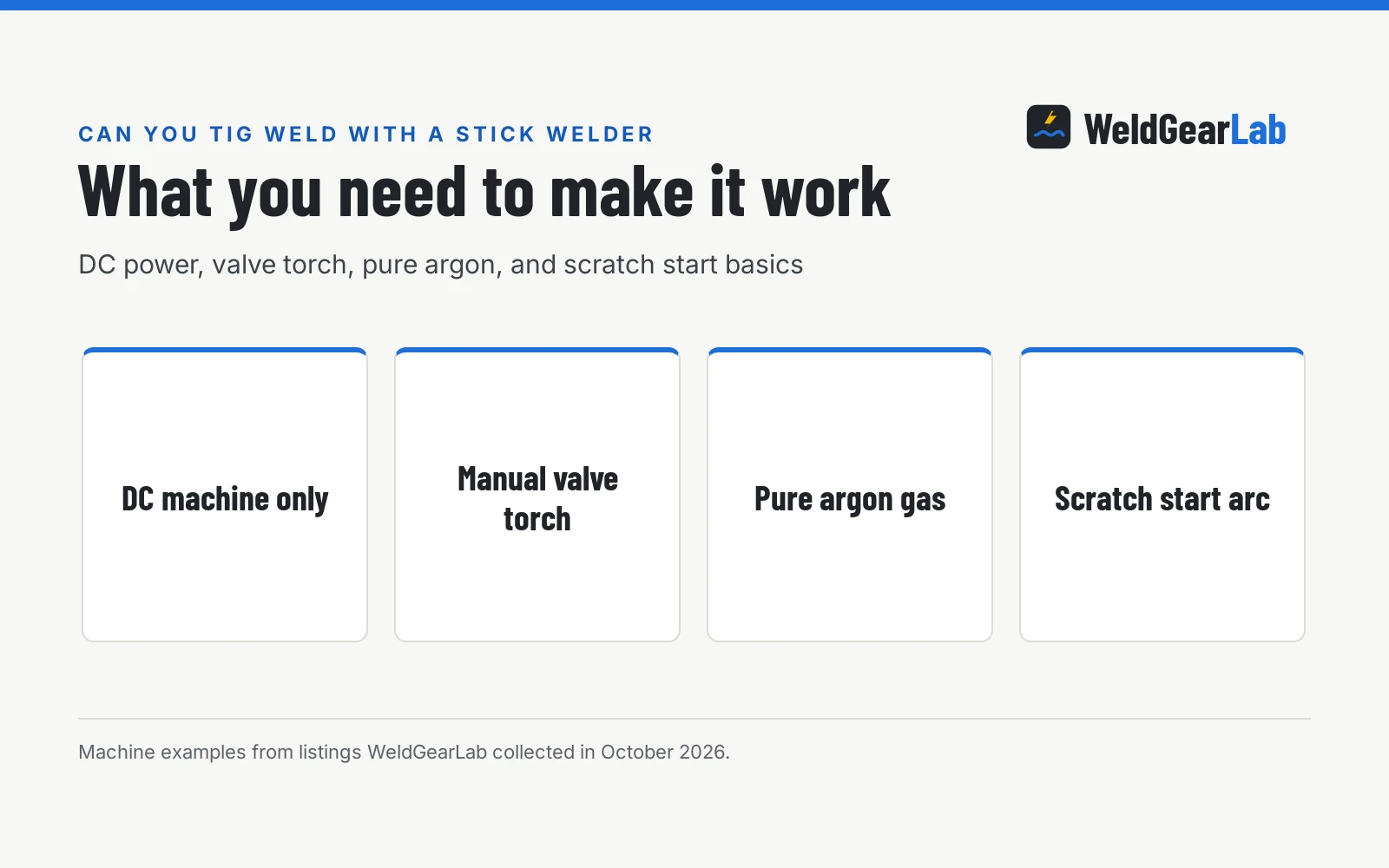
Can you tig weld with a stick welder? Yes, if your machine outputs direct current (DC). Because stick and TIG both run on constant-current power, you can connect an air-cooled TIG torch with a manual gas valve to a DC stick welder. Using scratch start and pure argon shielding, you can weld steel and stainless steel without buying a dedicated TIG machine.
As an Amazon Associate I earn from qualifying purchases. This guide links to our product roundups, where WeldGearLab earns a commission when you buy through links, at no extra cost to you. Read our affiliate disclosure.
The difference in one paragraph
Stick welding uses a consumable, flux-coated electrode that creates its own shielding vapor and protective slag. TIG welding uses a non-consumable tungsten electrode and pure argon shielding from an external cylinder, leaving clean metal without slag. Converted stick welders provide the constant direct current power, while the manual torch handle and argon tank control shielding.
Side by side
| Stick welding (SMAW) | Scratch start TIG (on stick) | Dedicated TIG welder | |
|---|---|---|---|
| Electrode | Consumable flux-coated rod | Non-consumable tungsten | Non-consumable tungsten |
| Shielding gas | Flux coating produces gas and slag | Pure argon via manual valve torch | Pure argon via machine solenoid |
| Arc initiation | Tap or strike rod | Scratch tungsten on workpiece | High-frequency (HF) or Lift TIG |
| Current control | Machine dial setting | Machine dial setting (no pedal) | Foot pedal or torch amp control |
| Gas flow control | None required | Manual valve knob on torch | Automatic pre-flow and post-flow |
| Weld cleanup | Slag chipping and wire brushing | No slag, minimal wire brushing | No slag, minimal wire brushing |
| Thin sheet steel | High risk of burn through | Better puddle and heat control | Precise heat and pulse control |
| Aluminum welding | Requires specialty flux rods | No (aluminum TIG requires AC) | Yes (with AC balance control) |
| Required hardware | Electrode holder and work clamp | Valve torch, argon tank, regulator | TIG torch, argon tank, regulator, pedal |
Polarity is critical. Stick electrodes like 7018 typically run on direct current electrode positive (DCEP). TIG welding steel requires direct current electrode negative (DCEN): torch to negative terminal, ground clamp to positive terminal. Running TIG on DCEP concentrates heat into the tungsten instead of the workpiece, melting the electrode tip.
What you need to TIG weld with a stick welder
Basic stick welder packages lack TIG accessories. To set up scratch start TIG, you need:
- Air-cooled TIG torch with gas valve. Stick welders lack internal gas solenoids, so the torch requires a manual valve on the handle. Connect the power cable to the negative output terminal and the gas line to your regulator. See our best TIG torch guide.
- Pure argon gas and regulator. TIG requires pure argon cylinder gas to shield the puddle. Do not use MIG mixed gases.
- Tungsten electrodes. Use pointed electrodes suited for DC steel welding, such as lanthanated, ceriated, or thoriated rods. See what color tungsten for steel.
- Filler rod. For stainless steel, FUYITE lists ER308L filler rods at 1/16 x 16 inches. WeldingStop lists an aluminum finger feeder pen that handles rod diameters from 1.0mm to 3.2mm (1/32 to 1/8 inch).
- Protective gear. Wear a shade-appropriate welding helmet, leather TIG gloves, and protective clothing.
How scratch start TIG works
Without a foot pedal or high-frequency circuitry, you set output amperage on the welder and initiate the arc manually:
- Open gas valve. Open the torch handle valve to purge air and establish pure argon flow over the joint.
- Lower helmet. Set your auto-darkening shade for the chosen amperage.
- Scratch tungsten. Brush the sharp tungsten tip across the workpiece like striking a match. Avoid tapping straight down, which sticks or snaps the electrode.
- Set arc length. Lift the torch slightly above the plate as the arc strikes. If it sticks, break contact sideways and regrind.
- Puddle and filler. Once the molten puddle forms, travel forward and introduce filler rod into the front edge.
- Break arc and shield crater. Roll the torch or step onto scrap to break the arc. Keep the nozzle over the cooling puddle with argon flowing until the metal solidifies, then shut the valve.
For heat control techniques without remote pedal adjustment, see how to TIG weld without a foot pedal.
How to tell if your stick welder can run TIG
The primary requirement is direct current output. Alternating current (AC) transformer welders cannot sustain a DC scratch TIG arc on steel. Check machine specifications for:
- Direct current (DC) rating. Forney Easy Weld lists its 297 100 ST-i inverter welder with 100-Amp output on 120V power, welding mild steel up to 1/4 inch thick with rods up to 1/8 inch, noting the TIG torch is sold separately.
- Dual-voltage input. Forney Easy Weld lists its 280 160 ST-i machine with 160A output on 120V or 230V, handling rods up to 5/32 inch. HZXVOGEN lists a 145A multi-process welder on 110V/220V dual voltage for Lift TIG across 1–3 mm thickness using 1.6–2.4 mm tungsten.
- Lift TIG mode. Dedicated Lift TIG modes limit contact current so you can touch and lift the tungsten. PUWU lists its ARC-135PRO delivering 20A to 135A on 110V, noting the Lift TIG torch is not included. PUWU also lists its ARC-195PRO on 110/220V with a Lift TIG range from 15A to 195A. Standard stick machines run scratch start on DCEN.
- Terminals. PUWU notes 10-25 quick connectors on its ARC-135PRO. Match your torch power cable adapter to the machine sockets.
Compare compact power sources in our best portable stick welder roundup.
Can you tig weld with a stick welder?
Can you tig weld with a stick welder on every metal? No. Scratch start TIG on a DC stick machine works on carbon steel, alloy steel, and stainless steel, but cannot weld aluminum. Aluminum requires alternating current (AC) with continuous high frequency to clean its tough oxide skin.
Because stick welders lack AC balance controls, attempting to TIG weld aluminum on DC creates heavy black oxide and no puddle fusion. For aluminum, pick a dedicated AC machine from our best TIG welder for aluminum guide. To evaluate starting methods on steel, see HF start vs lift arc TIG.
Safety considerations for scratch start TIG. Converted stick welders keep the torch electrically live whenever the machine is powered on. Rest the torch on an insulated hook when not welding. Pure argon displaces oxygen in confined shops; secure cylinders upright with a chain and ensure ventilation. Wear an auto-darkening helmet and leather TIG gloves. Follow instructions in your equipment manual.
Frequently Asked Questions
Can you TIG weld with an AC-only stick welder?
No. TIG on steel requires direct current electrode negative (DCEN). AC transformer stick welders lack arc stabilization and melt tungsten during the positive half-cycle.
What polarity do you use for TIG on a stick welder?
Set the welder to direct current electrode negative (DCEN). Connect the TIG torch to the negative terminal and the ground clamp to the positive terminal.
Do you need a foot pedal to TIG weld with a stick welder?
No. Basic stick welders lack remote control wiring, so you preset amperage on the machine dial. Puddle heat is regulated by travel speed and torch angle.
Why does the tungsten keep sticking to the steel?
Tungsten sticks when pressed straight down rather than scratched lightly like a match. If it sticks, break contact sideways, clean the joint, and resharpen the tip.
Can you use MIG gas for scratch start TIG?
No. MIG gases with carbon dioxide or oxygen contaminate the tungsten electrode instantly. TIG welding requires pure argon shielding gas.
Related: best TIG torch, how to TIG weld without a foot pedal, best portable stick welder, what color tungsten for steel, and the TIG welders hub. Also see our stick welders hub.
About the author
WeldGearLab Editorial is the editorial team behind WeldGearLab. We research product listings, specifications, safety listings and warranty terms, score every pick with the published Gear Score method, and correct errors when readers report them. We do not run our own shop trials; see How We Pick for exactly how picks are made.