Passive vs Auto Darkening Welding Helmet: Which One Should You Buy?
Here is how passive and auto darkening welding helmets compare on optical clarity, shade control, reaction speed, weight, safety ratings and warranty terms.
 By WeldGearLab Editorial
Updated October 9, 2026
By WeldGearLab Editorial
Updated October 9, 2026
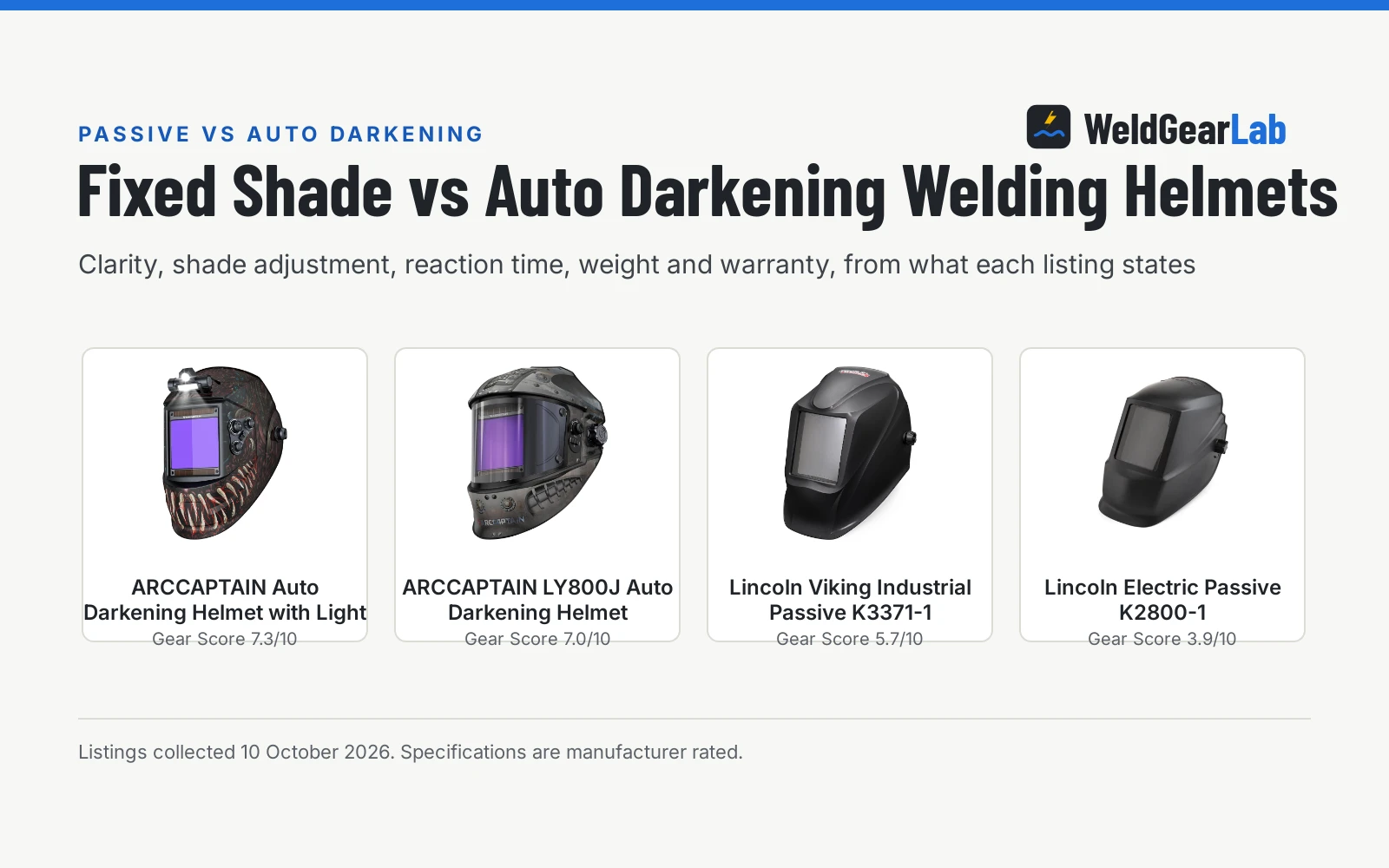
Verdict. When choosing between a passive vs auto darkening welding helmet, pick an auto-darkening hood if you weld frequently, do tack welding or need variable DIN 5 to 13 shades with clear vision before striking an arc. Pick a passive welding helmet if you want a simple, durable shell with no electronics, batteries or sensors to maintain and prefer fixed shade protection.
A passive vs auto darkening welding helmet comparison comes down to lens technology, reaction speed, weight and convenience. This head-to-head comparison examines four real listings from Lincoln Electric and ARCCAPTAIN to show how passive and auto-darkening models compare on stated specifications.
As an Amazon Associate I earn from qualifying purchases. WeldGearLab earns a commission when you buy through links on this page, at no extra cost to you. Read our affiliate disclosure.
Side by side
| ARCCAPTAIN with Light | ARCCAPTAIN LY800J | Lincoln Viking K3371-1 | Lincoln K2800-1 | |
|---|---|---|---|---|
| Gear Score | 64 | 61 | 53 | 32 |
| Type | Auto-darkening | Auto-darkening | Passive | Passive |
| Viewing area | 3.94 x 3.66 in | 3.94 x 3.66 in | Not stated | Not stated |
| Optical clarity | 1/1/1/1 True Color | 1/1/1/1 True Color | Not stated | Not stated |
| Shade range | DIN 4 / 5-8 / 9-13 | DIN 4 / 5-9 / 9-13 | Not stated | Not stated |
| Reaction speed | 1/25000 s | 1/25000 s | Fixed (no switching) | Fixed (no switching) |
| Arc sensors | 4 sensors | 4 sensors | None (passive) | None (passive) |
| Power source | 2 solar panels + CR2450 (table says 1 AAA) | 2 solar panels + 2 CR2450 (table says 1 Lithium Metal) | None required | None required |
| Weight | 1 lb (bullets), 8.1 oz (table) | 2.55 lb (table) | 1.3 lb (package weight) | Not stated |
| Safety standard | Not stated | Not stated | Not stated | Not stated |
| Warranty | 180 Days | 180 Days | 2 Years | Not stated |
Specifications are manufacturer rated, as published on each listing and collected 9 October 2026. None of the four listings state an ANSI, CSA, or EN standard certification.
Passive vs auto darkening welding helmet: core differences
The fundamental dividing line between a passive and an auto-darkening welding helmet is how each protects your eyes before and during an arc. A passive helmet uses a fixed-shade dark filter lens that remains dark at all times. To see your workpiece and line up your electrode or torch, you must lift the helmet or nod it down right as you strike the arc. An auto-darkening helmet uses a liquid crystal display filter paired with light sensors. It stays in a light shade when idle, allowing you to see your joint clearly with the hood down, and then darkens automatically when arc sensors detect the arc.
Lens technology and shade control
On an auto-darkening model, shade flexibility is a major asset. Both ARCCAPTAIN listings feature variable dark shade ranges, offering DIN 5 to 8 or DIN 5 to 9 alongside DIN 9 to 13, with a DIN 4 resting light state and a maker-rated 1/1/1/1 optical clarity score. This variable range allows you to switch between low-amperage TIG welding, MIG welding, and cutting without changing physical lenses. For recommendations on selecting the right shade for wire welding, see our guide on what shade for MIG welding.
Passive helmets rely on physical filter plates. A fixed lens provides a single, uniform shade level across the entire viewing area without electronic controls. However, neither Lincoln passive listing states its installed shade number or plate dimensions. While fixed-shade helmets typically accept standard replacement filter plates, these listings leave the shade rating unconfirmed on paper.
Arc sensors and response speed
Reaction speed defines auto-darkening performance. Both ARCCAPTAIN hoods list four arc sensors and a switching speed of 1/25000 second from light to dark. Four sensors reduce the risk of sensor obstruction when welding out of position or behind pipe. Both listings also report automatic DIN 16 ultraviolet and infrared protection that remains active regardless of filter state.
Passive helmets do not have sensors or reaction times. The optical filter provides constant UV and IR filtering at its fixed shade level without any switching delay. Because there are no electronic sensors, a passive filter requires no sensitivity adjustment for different lighting conditions or obstructed weld joints.
Power source and battery maintenance
Auto-darkening helmets require continuous electrical power to operate their liquid crystal cells and sensor circuits. Both ARCCAPTAIN models feature dual solar panels combined with lithium coin cells. The ARCCAPTAIN with light listing states a CR2450 battery in its bullets, though its specification table lists one AAA battery. The ARCCAPTAIN LY800J listing notes two CR2450 batteries in its bullets but lists one lithium metal cell in its table.
Passive helmets require no batteries, charging cables, or solar cells. With no electronic power system, passive hoods like the Lincoln Viking K3371-1 and Lincoln K2800-1 need no battery replacement or solar charging.
Weight and comfort
Weight directly influences neck fatigue during long shop sessions. The Lincoln Viking passive listing reports a package weight of 1.3 lb with ratchet closure headgear, while the Lincoln K2800-1 listing leaves weight unstated. Published weights for the auto-darkening listings vary. The ARCCAPTAIN with light listing presents conflicting figures, stating 1 lb in its bullets but 8.1 ounces in its specification table. Meanwhile, the ARCCAPTAIN LY800J specification table lists an item weight of 2.55 pounds, which is heavier than the 1.3 lb package weight stated for the Lincoln Viking example.
What is in the box
The ARCCAPTAIN auto-darkening packages include multiple accessories. The model with light ships with three replacement lenses, a replacement battery, stickers, and a top-mounted USB LED light with two brightness levels. The LY800J model includes three replacement lenses, two replacement batteries, and a storage bag.
The Lincoln passive listings are minimal. The Viking K3371-1 lists one passive welding helmet, while the K2800-1 listing leaves included components blank.
Warranty and reliability
Lincoln Electric provides a two-year manufacturer warranty on the Viking Industrial Passive K3371-1, stated consistently in both the bullets and the specification table. In contrast, both ARCCAPTAIN listings state a 180-day warranty. The Lincoln K2800-1 listing does not state a warranty term. The two-year coverage gives the Lincoln Viking model a significant advantage in written warranty protection.
Choose a passive welding helmet if
- You want a simple hood with no batteries, solar cells, or electronic sensors to maintain.
- You prefer the assurance of a two-year manufacturer warranty as published on the Lincoln Viking K3371-1.
- You prefer a fixed filter plate that requires no sensitivity adjustments or battery checks.
- You already have dedicated fixed-shade filter plates suited to your shop’s standard amperage.
Choose an auto darkening welding helmet if
- You do frequent tack welding, fit-up, or fabrication requiring clear visibility before striking an arc.
- You need variable shade adjustment between DIN 5 and 13 for different processes and amperages.
- You want auxiliary features like four arc sensors, a 3.94 by 3.66 inch viewing screen, and True Color optics.
- You work in dark areas where an integrated LED work light improves seam visibility.
The four welding helmets
| Award | Product | Gear Score About the Gear ScoreThe Gear Score runs from 0 to 10 and weighs performance (35%), build (25%), value (25%), safety (10%, where it applies) and warranty (5%), using only what the manufacturer and the listing publish. How we pick › | |
|---|---|---|---|
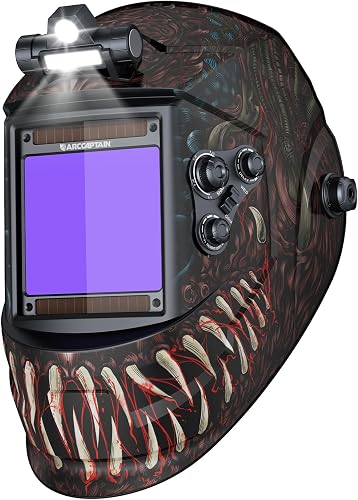 ARCCAPTAIN Auto Darkening Welding Helmet
|
7.3/10 | Check price on Amazon | |
 ARCCAPTAIN Welding Helmet
|
7.0/10 | Check price on Amazon | |
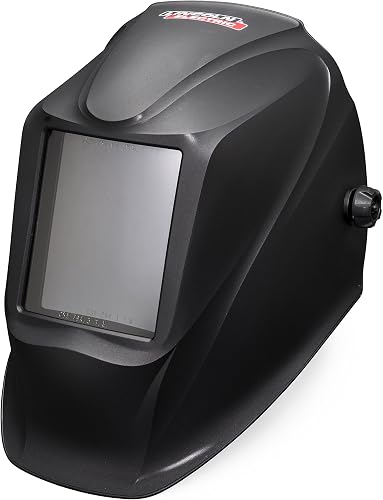 Lincoln Electric Viking™ Industrial Passive™ Black
|
5.7/10 | Check price on Amazon | |
 Lincoln Electric Passive Welding Helmet, K2800-1
|
3.9/10 | Check price on Amazon |
ARCCAPTAIN Auto Darkening Welding Helmet
An auto-darkening welding helmet featuring a 3.94 by 3.66 inch viewing screen, 1/1/1/1 optical clarity, four arc sensors, an attachable USB LED light, and a 180-day warranty.
Pros
- 3.94 by 3.66 inch viewing screen with maker-stated 1/1/1/1 optical clarity
- Four arc sensors with a 1/25000 second switching speed
- Detachable USB-powered LED work light with two brightness levels
- Variable dark shades DIN 5 to 8 and 9 to 13 with DIN 4 light state
Cons
- Contradiction between 1 lb in bullets and 8.1 ounces in the specification table
- Contradiction between CR2450 battery in bullets and 1 AAA battery in the table
- 180-day warranty period
- No ANSI or CSA safety standard stated in the listing
ARCCAPTAIN Welding Helmet
An auto-darkening hood offering a 3.94 by 3.66 inch screen, 1/1/1/1 optical clarity, four sensors, dual solar panels, two CR2450 batteries, and a 180-day warranty.
Pros
- 3.94 by 3.66 inch viewing screen with maker-stated 1/1/1/1 optical clarity
- Four arc sensors with a 1/25000 second response time
- Dual solar panels paired with two CR2450 lithium batteries
- Variable dark shades covering DIN 5 to 9 and 9 to 13
Cons
- Specification table lists weight at 2.55 pounds
- Specification table indicates 1 lithium metal battery required while bullets state two CR2450 cells
- 180-day warranty period
- No ANSI or CSA safety certification stated in the listing
Lincoln Electric Viking™ Industrial Passive™ Black
A fixed-shade passive welding helmet with a plastic shell, ratchet headgear, 1.3 lb package weight, and Lincoln's two-year warranty.
Pros
- Two-year manufacturer warranty stated in bullets and specification table
- Ratchet closure headgear for fit adjustment
- Simple passive design requires no batteries, sensors or electronic controls
- Package weight listed at 1.3 lb
Cons
- Bullets classify product type as Cutting Tools rather than a welding helmet
- Listing does not state the shade rating or lens dimensions
- No replacement cover lenses or accessories listed in the box
- No ANSI or CSA safety standard stated in the listing
Lincoln Electric Passive Welding Helmet, K2800-1
A basic passive welding helmet shell under Lincoln's K2800-1 model number, with no published specifications, warranty term or certifications in the listing.
Pros
- Lincoln Electric brand passive welding helmet design
- Passive configuration has no batteries or charging circuits to maintain
- No electronic sensors or switching filters to fail or delay
- Established Lincoln Electric model number K2800-1
Cons
- Specification table is completely blank with no published technical data
- Bullets provide no details on lens shade, viewing dimensions or shell material
- No warranty term is stated anywhere in the listing
- No ANSI or other safety certification is stated
How we scored them
All four helmets are scored out of 100 on performance, build, value, safety listing and warranty, with the weights published on our How We Pick page.
| Product | Gear Score | Perf. /35 | Build /25 | Value /25 | Safety /10 | Warranty /5 |
|---|---|---|---|---|---|---|
| ARCCAPTAIN Auto Darkening Helmet with Light | 7.3 | 30 | 20 | 21 | 0 | 2 |
| ARCCAPTAIN LY800J Auto Darkening Helmet | 7.0 | 29 | 20 | 20 | 0 | 1 |
| Lincoln Viking Industrial Passive K3371-1 | 5.7 | 21 | 18 | 16 | 0 | 3 |
| Lincoln Electric Passive K2800-1 | 3.9 | 14 | 12 | 12 | 0 | 0 |
Before you strike an arc. Wear a welding helmet with the correct filter shade for your welding process and amperage, safety glasses underneath, leather gloves, and flame-resistant clothing. Maintain good shop ventilation, remove all flammable materials from your workspace, and keep a rated fire extinguisher within reach. Always inspect headgear and lenses before work. Follow OSHA welding safety recommendations for eye and face protection.
Frequently Asked Questions
Is a passive or auto darkening welding helmet better for beginners?
An auto-darkening helmet is generally easier for beginners because the lens remains light until the arc strikes. This allows you to position your electrode or MIG gun precisely without nodding the helmet down and slipping off target. A passive helmet requires practice to nod into place without losing your starting position.
Do auto darkening welding helmets protect your eyes if the battery fails?
Both ARCCAPTAIN auto-darkening listings state automatic DIN 16 ultraviolet and infrared protection, which remains active even when the filter is unpowered. If the battery fails or the sensors are obstructed, the permanent optical filter continues to block harmful UV and IR radiation. However, because the liquid crystal shutter will not switch to its dark state, you will experience bright visible glare that can cause temporary dazzle and eye fatigue.
What shade comes with a passive welding helmet?
Neither Lincoln passive listing in this comparison states the shade rating of its installed lens or whether a filter plate is included in the box. With passive helmets, welders typically install an aftermarket fixed filter plate matched to their welding process and current. Check our guide on what shade to use for MIG welding to select the correct protection level.
How fast do auto darkening welding helmets switch?
Both ARCCAPTAIN auto-darkening listings cite a switching speed of 1/25000 second from light to dark. This rapid response darkens the lens before the intense visible glare of the arc can cause eyestrain or temporary dazzle. Passive helmets have no switching mechanism because their optical filter remains permanently dark.
How do warranty terms compare between these helmet listings?
Warranty terms differ significantly across the four listings. Lincoln Electric provides a two-year manufacturer warranty on the Viking Industrial Passive K3371-1, whereas both ARCCAPTAIN auto-darkening listings provide 180 days of coverage. Meanwhile, the Lincoln K2800-1 passive listing leaves its warranty term unstated, meaning buyers must verify coverage terms directly with the seller.
Related: what shade for MIG welding, how to use auto darkening welding helmet, best auto darkening welding helmet, best fixed welding lens, and the welding helmets hub.
About the author
WeldGearLab Editorial is the editorial team behind WeldGearLab. We research product listings, specifications, safety listings and warranty terms, score every pick with the published Gear Score method, and correct errors when readers report them. We do not run our own shop trials; see How We Pick for exactly how picks are made.