Welding Safety Gear Checklist for Beginners
A complete welding safety gear checklist for beginners covering essential personal protective equipment from auto-darkening helmets and leather to boots and respirators.
 By WeldGearLab Editorial
Updated October 9, 2026
By WeldGearLab Editorial
Updated October 9, 2026
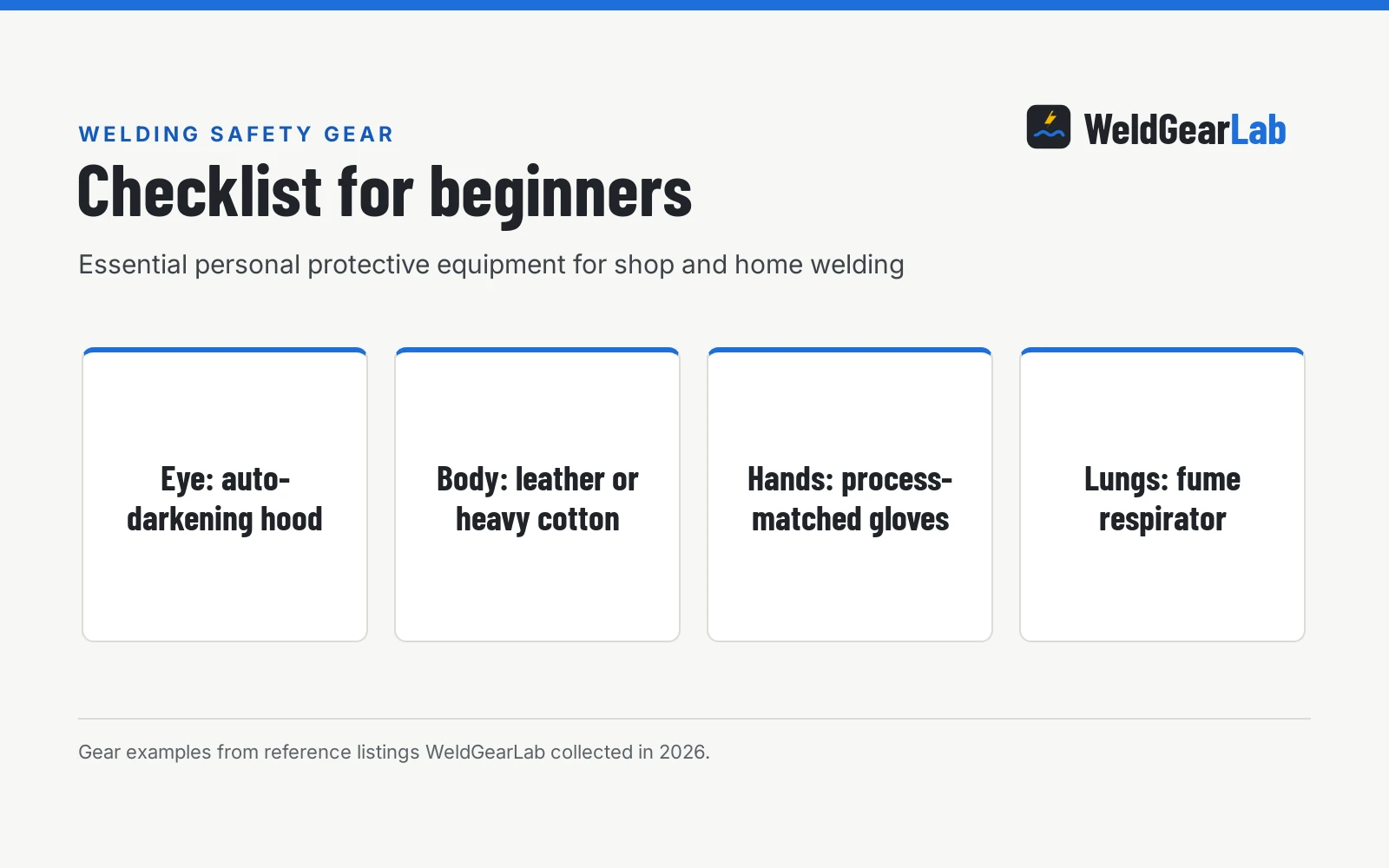
A complete welding safety gear checklist for beginners protects you from arc radiation, molten spatter, toxic fumes, and intense heat before you strike an arc. Every beginner striking an arc needs a properly fitted auto-darkening welding helmet, fire-resistant leather or heavy cotton clothing, process-appropriate leather gloves, clear safety glasses, ankle-high leather boots, and respiratory protection. Welding creates intense light that damages unprotected eyes, while molten metal spatter burns exposed skin and ignites flammable street clothes. Preparing your personal protective equipment in advance keeps you safe in your shop or garage while you learn torch control and puddle manipulation. This guide outlines the essential protective gear step by step, explains how to match materials to your welding process, and shows how to inspect your equipment before every project.
As an Amazon Associate I earn from qualifying purchases. This guide links to our product roundups, where WeldGearLab earns a commission when you buy through links, at no extra cost to you. Read our affiliate disclosure.
Welding safety gear checklist for beginners in one paragraph
Welding safety gear must protect every part of your body from thermal energy, ultraviolet rays, and flying debris. Your eyes and face require an auto-darkening helmet paired with impact-resistant safety glasses underneath. Your hands need gauntlet-cuff leather gloves that block radiant heat and molten slag. Your torso, arms, and legs require flame-resistant cowhide leather or tightly woven, treated cotton that sheds sparks without catching fire. Your feet need sturdy leather work boots with covered tongues to prevent sparks from slipping inside. Finally, your lungs need a particulate respirator designed to clear metal fumes and grinding dust. Missing any piece of this basic kit leaves vulnerable skin exposed to severe burns or flash injuries.
Side by side
| MIG and stick welding | TIG welding | Grinding and metal prep | |
|---|---|---|---|
| Welding helmet | Auto-darkening hood with variable shade | Auto-darkening hood with low-amp sensors | Clear grinding shield or helmet grinding mode |
| Primary gloves | Heavy split cowhide with long gauntlet cuffs | Thin goatskin or deerskin for torch dexterity | Medium leather work gloves for handling sharp plate |
| Body protection | Heavy cowhide leather jacket, sleeves, or apron | Flame-retardant treated cotton jacket or leather | Heavy shop apron or durable treated work shirt |
| Eye protection | Clear safety glasses worn beneath the helmet shell | Clear safety glasses worn under the hood | High-impact safety glasses with side shields |
| Footwear | Leather work boots with heat-resistant soles | Leather work boots with oil-resistant soles | Steel-toe leather work boots with covered laces |
| Respiratory gear | Particulate respirator filtering welding fumes | Particulate respirator filtering prep dust and fumes | Particulate dust mask or fume respirator |
| Primary hazard | Heavy molten spatter, hot slag, and arc rays | Intense arc radiation with minimal spatter | High-speed abrasive wheel fragments and flying burrs |
| Ear protection | Foam earplugs to block sparks and grinder noise | Earplugs for prep grinding and workshop noise | Earmuffs or earplugs against loud angle grinder noise |
Safety gear requirements change depending on your chosen process and shop tasks. MIG welding and stick welding produce heavy spatter, flying slag, and high radiant heat, which demands thicker split cowhide leather to prevent burns. TIG welding creates minimal spatter but generates intense ultraviolet radiation, requiring flexible, thin leather gloves that preserve torch control without exposing your wrists. During grinding and metal preparation, clear safety glasses under a raised hood shield your eyes from high-speed abrasive wheel fragments. You can explore complete starter kits in our best welding kit for beginners guide or browse our comprehensive welding safety gear section for individual gear categories.
When leather is the better choice
- Heavy spatter and flying slag. Stick welding and flux-core wire feed throw molten droplets that instantly burn through thin textiles. Heavy cowhide absorbs this thermal shock without burning or shrinking.
- Out-of-position welding. Overhead and vertical joints cause sparks to rain downward onto your shoulders and arms, where only thick leather provides reliable penetration resistance.
- Abrasion and sharp metal edges. Handling rough plate steel, sheared tubing, and plasma-cut edges tears lighter cloth, whereas durable cowhide resists cuts and gouges.
- Durability over time. Quality leather garments withstand repeated radiant heat exposure without degrading, cracking, or losing their protective structure.
For dedicated hand protection against intense heat, our best welding gloves for MIG roundup reviews durable leather pairs selected for spatter defense. For body coverage, Lyksgir lists a 35-inch cowhide apron in its 3-piece protector set, with a stated shoulder to bottom hem length of 35 inches for front torso and leg protection.
When treated cotton is the better choice
- Warm weather and indoor shops. Heavy leather retains body heat quickly, leading to fatigue and sweating. Flame-retardant treated cotton allows airflow while protecting against light sparks.
- Light-duty MIG and clean TIG welding. When working on small bench projects where spatter is minimal, lightweight cotton jackets offer ample protection against ultraviolet radiation.
- Freedom of movement and comfort. Stiff leather can restrict arm swing and wrist movement, whereas flexible woven cotton sleeves allow natural motion when guiding a torch.
- Lower overall garment weight. Wearing treated cotton reduces strain on your neck and shoulders during long fabrication sessions at your workbench.
Treated cotton jackets and sleeves should carry an explicit flame-retardant rating to shed sparks effectively. Avoid synthetic fabrics and thin or frayed garments, as synthetic blends melt on contact and loose fibers can trap sparks and smolder unnoticed. If you add heavy wire feed or stick welding to your routine, you can slip leather sleeves over your cotton jacket to reinforce your arms against spatter.
How to inspect your safety gear
Safety gear only protects you when it remains in sound condition. Inspect your protective equipment before every welding session to catch damage before heat and ultraviolet rays penetrate your defenses. Look for these warning signs across your gear:
- Check helmet shells and cover lenses. Inspect the front cover lens for pitting, scratches, or spatter buildup that clouds your view. Examine the outer shell for cracks that could leak harmful radiation into your eyes. Ensure the auto-darkening cartridge switches promptly by checking sensor cleanliness.
- Inspect glove stitching and leather softness. Feel the palm and fingers for stiff, heat-hardened leather that restricts grip. Look closely at the seams for broken or burned stitching, particularly around the thumb crotch and index finger.
- Examine clothing for holes and frayed edges. Check jackets, aprons, and pants for thinning fabric, holes, grease stains, or frayed cuffs that can ignite from a stray spark.
- Examine boot soles and laces. Inspect boot leather for deep gouges or separated soles, and confirm that your pant legs drape cleanly over the boot shafts without leaving exposed socks or laces.
For beginners seeking a starter kit, Miller lists an 11.11-pound Student Safety Pack under part number 291662 with product dimensions of 13 by 13 by 22 inches, including clear safety glasses alongside a chipping hammer and wire brush.
Which shade lens for beginner welding
Choosing the correct lens shade is vital for guarding your vision against ultraviolet and infrared radiation while maintaining a crisp view of the weld puddle. Modern auto-darkening helmets provide a variable shade cartridge that automatically transitions from a light resting state to a protective dark filter when an arc is struck. You can learn more about dial settings and helmet operation in our guide on how to use an auto darkening welding helmet, or explore reliable entry-level models in our best welding helmet for MIG welding roundup.
Arc brightness and glare depend directly on your welding amperage. Higher amperage welding on thick steel produces a brighter arc that requires a darker shade setting to prevent eye strain. Lower amperage passes on thin sheet metal produce less visible glare, allowing a slightly lighter shade setting so you can see the joint seam clearly. When setting your helmet, start with a darker shade setting and adjust downward until you can clearly see the puddle edges and joint seam without experiencing eye fatigue. Always ensure your helmet features an integrated grinding mode, which locks the lens into a light shade so you can grind weld prep and chip slag without removing head protection.
Can one gear setup cover every process?
A versatile basic gear setup can cover MIG, stick, and flux-core welding with minimal adjustment, provided your primary gear includes heavy leather gloves, a split cowhide apron or jacket, and a variable shade helmet. However, TIG welding requires thinner, supple leather gloves to manipulate lightweight filler rod accurately, as well as helmet sensors capable of detecting low-amperage arcs. If you plan to practice multiple welding methods, investing in separate pairs of MIG and TIG gloves and verifying your helmet’s low-amperage response provides the best balance of safety and dexterity.
Respiratory and fume safety. Welding creates airborne metal particulates and vaporized shielding gases that irritate airways and present long-term hazards. A standard dust mask is inadequate for welding fumes. Beginners should wear a compact particulate respirator equipped with metal fume filters that fits comfortably beneath the chin of a welding helmet. Our guide to the best welding respirator for under a helmet reviews low-profile models engineered specifically for tight helmet clearances. Always weld in well-ventilated areas, position your head outside the rising smoke plume, and never weld on galvanized or coated metal without dedicated exhaust extraction.
Frequently Asked Questions
What PPE do you need for welding as a beginner?
A beginner needs an auto-darkening welding helmet, impact-rated safety glasses, process-matched leather gloves, and flame-retardant clothing such as a cowhide apron or treated cotton jacket. Sturdy leather work boots protect your feet from hot sparks, while a low-profile particulate respirator protects your lungs from metal fumes and grinding dust. Having every piece in place ensures full protection against heat, radiation, and molten spatter.
Can I wear regular jeans while welding?
You can wear heavy denim jeans provided they are made of pure, heavyweight cotton without synthetic stretch blends. Synthetic fibers like polyester melt when hit by hot sparks, fusing directly to your skin and causing severe burns. Ensure your pants have no frayed cuffs, holes, or deep turn-up cuffs that could catch and hold falling sparks or hot slag.
Why do I need safety glasses under a welding helmet?
A welding helmet shields your face and eyes from direct arc rays, but sparks and grinding chips can bounce beneath the open bottom of the hood. Safety glasses provide essential secondary eye protection when you lift your helmet to inspect a completed joint or chip away slag. Always keep impact-resistant safety glasses on throughout your entire work session in the shop.
What type of gloves should a beginner buy first?
Beginners starting with wire feed or stick welding should choose heavy split cowhide gloves with long gauntlet cuffs that extend over their jacket sleeves. These gloves provide thick heat insulation and withstand heavy molten spatter during arc strikes. If you begin with TIG welding, choose softer goatskin or deerskin gloves that allow precise finger dexterity for feeding filler wire.
How do I protect my breathing when welding in a home garage?
Always weld in an open area with positive cross-ventilation or an active exhaust fan pulling smoke away from your workstation. Keep your head positioned to the side of the rising plume rather than leaning directly over the weld puddle. Wear a low-profile particulate respirator fitted with filters rated for metal fumes under your welding helmet for reliable respiratory defense.
Related: welding safety gear hub, best welding kit for beginners, best welding gloves for MIG, best welding respirator for under a helmet, and our guide on how to use an auto darkening welding helmet.
About the author
WeldGearLab Editorial is the editorial team behind WeldGearLab. We research product listings, specifications, safety listings and warranty terms, score every pick with the published Gear Score method, and correct errors when readers report them. We do not run our own shop trials; see How We Pick for exactly how picks are made.