How to Change the Wire Spool on a MIG Welder
How to change the wire spool on a MIG welder step by step, from trimming the old wire and setting spindle brake tension to matching drive rolls and feeding the gun.
 By WeldGearLab Editorial
Updated October 9, 2026
By WeldGearLab Editorial
Updated October 9, 2026
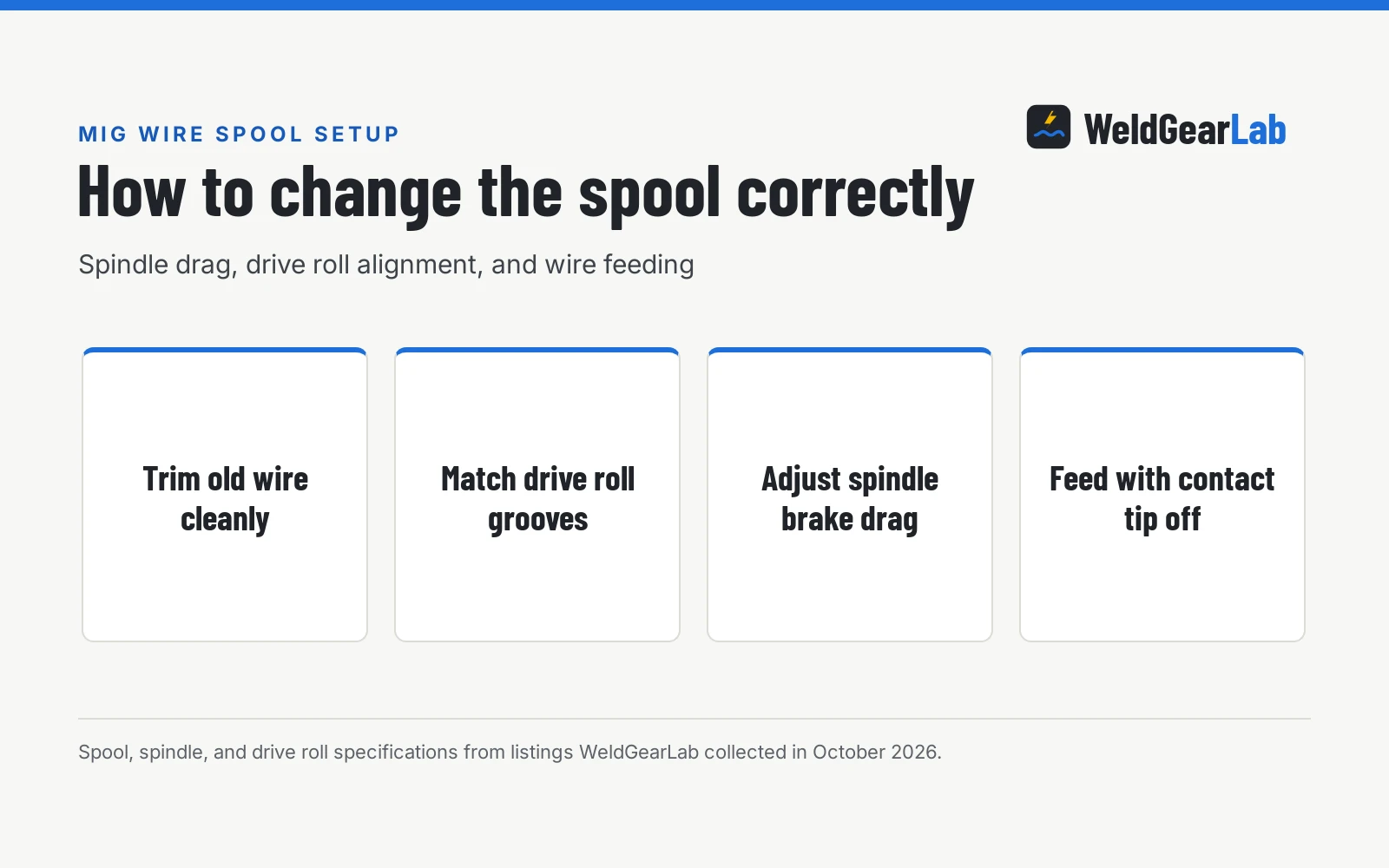
To know how to change the wire spool on a MIG welder, turn off the welder, cut the wire near the spool, and release the drive roll tension arm. Pull the remaining wire through the gun, swap the spool on the spindle, and set the brake nut so the spool turns with light drag. Align the wire with the correct drive roll groove, feed it into the liner, and power the machine on to drive the wire through the torch.
As an Amazon Associate I earn from qualifying purchases. This guide links to our product roundups, where WeldGearLab earns a commission when you buy through links, at no extra cost to you. Read our affiliate disclosure.
Core steps for loading MIG wire
Changing a wire spool is routine maintenance for wire welding. Small mistakes during spool swaps cause feeding jams, birdnesting, and erratic arcs. Keeping tension on the free wire end at all times prevents the coil from unraveling inside the wire compartment.
Side by side
| 1 lb mini spools | 2 lb / 1 kg spools | 10 lb / 5 kg spools | |
|---|---|---|---|
| Spool outer diameter | 100 mm | 100 mm | 200 mm |
| Spindle center hole | 15 mm | 15 mm | 50 mm (or 2 inches with spindle adapter) |
| Mounting hardware | Direct mount on standard 15 mm spindle shaft | Direct mount on standard 15 mm spindle shaft | Requires 2 inch spindle or 50 mm adapter hub |
| Spindle brake drag | Light drag to control low rotating weight | Light drag to control low rotating weight | Firm drag to stop heavier rotating mass |
| Welder compartment fit | Spool guns and compact portable welders | Compact and portable workshop welders | Full-size shop welders with large wire cabinets |
| Typical use case | Spool gun aluminum work and small portable jobs | Hobby fabrication, auto body, and wire swaps | Continuous production and long welding runs |
Verify spool dimensions and spindle requirements before buying reels. Compact welders mount smaller spools directly, while larger reels often require hub adapters.
How to change the wire spool on a mig welder
Follow these procedures to remove an old spool and install a new reel cleanly without wire feed problems.
Cutting and clearing the old wire
Disconnect machine power before opening the drive cabinet. Cut the wire between the spool and inlet guide using wire cutters. Secure the wire end into the spool flange hole to prevent unraveling. Remove the nozzle and contact tip at the torch neck. Release drive roll tension, then pull the cut wire forward out through the torch end. Never pull wire backward toward the drive rolls, which can score the liner or shed metal shavings.
Checking and matching the drive rolls
Inspect the drive rolls before mounting the spool. Remove the retaining cap to confirm the correct groove faces the wire path. Solid steel wire runs in smooth V-grooves. Flux-cored wire requires knurled grooves that grip without crushing the hollow core. Aluminum wire uses smooth U-grooves. Clean metal shavings from the drive housing before securing the roll.
Mounting the new spool and setting spindle brake drag
Remove the spindle retaining collar and slide the old spool off the shaft. Slide the new spool on with the wire feeding cleanly toward the guide as shown on your door chart. Engage the spindle drive pin into the locating hole on the spool. Reinstall the collar and tighten the spindle nut until the spool shows slight resistance by hand. The brake should stop rotation promptly without shedding slack loops when feeding stops.
Threading and feeding wire through the gun
Hold the wire end securely, trimming any kinked tip cleanly with wire cutters. Thread the wire through the inlet guide, across the drive roll groove, and into the liner. Latch the drive roll tension arm. Lay the torch cable straight on the floor. Power the welder on, point the torch away from grounded metal and bystanders, and run the wire feed jog to advance wire through the cable. Once wire exits the neck, power off, install the contact tip and nozzle, and trim excess wire.
Setting spindle brake drag and drive roll tension
Proper tension balance prevents feed errors. If the spindle brake is loose, the spool freewheels after the motor stops, shedding coils inside the cabinet. If too tight, the drive rolls slip or the drive motor strains.
Adjust the spindle nut until light drag is felt by hand. Trigger a short feed burst: the spool should halt cleanly without slack. For drive rolls, start with light pressure. Feed wire against a wooden block: the rolls should feed under normal resistance but slip when the wire meets firm blockage, preventing birdnesting. If rolls slip without blockage, add slight tension; avoid overtightening. See our guide on how to fix MIG wire birdnesting.
Spool sizes, hub adapters, and hardware specifications
MIG welders use spools from compact reels to production coils. HOgardenME lists a spool holder assembly supporting 1KG and 5KG reels, specifying 100mm diameter reels with a 15mm center hole and 200mm diameter reels with a 50mm center hole, secured by four 5mm base holes. Cloudpower lists a stand assembly accommodating 0.5 kg, 1kg, and 5kg reels with 100 mm and 200 mm diameters, 15 mm and 50 mm center holes, and four 5 mm mounting holes.
Spindle adapters bridge hub sizes on shop welders. Lincoln Electric lists a 2 inch wire reel spindle, model M15445-1, with a 2 inches diameter. HAVANSIDY lists a replacement adapter hub weighing 6.4 ounces compatible with Miller Millermatic 211, 140, 135, and 180 welders and Hobart 500559 machines. Lisnhlin lists an adapter hub weighing 7.4 ounces for Miller Millermatic 211, 140, 135, and 180 machines and Hobart 500559 welders. For dependable shop machines, see our guide to the best MIG welder under 500.
Wire weight also determines feeding methods. ARCPEX lists a 2-pound spool of .030 inch ER70S-6 solid wire, while TASKZOOM lists a 10 lb spool of 0.030 inch (0.77 mm) ER70S-6 wire weighing 10.77 pounds. For soft wires, ARCCAPTAIN lists a 1 lb spool of .035 inch ER5356 aluminum wire. To feed 1 lb spools without birdnesting in long cables, VEVOR lists a 150Amp spool gun with a 20FT cable and a 0.030 to 0.035 inch drive roll, plus a 200Amp spool gun with a 20FT cable weighing 7.6 pounds compatible with 1 lb spools.
Drive roll grooves and wire types
Matching the drive roll to the wire type is essential. Solid steel wire, such as the .030 inch wire listed by ARCPEX and TASKZOOM, requires smooth V-grooves. Shielding gas is necessary: ARCPEX specifies either 100% CO2 or an 80% Argon / 20% CO2 mixture for its ER70S-6 wire. For wire sizing on thin stock, see our guide on what size MIG wire for sheet metal.
Flux-cored wire requires knurled drive rolls with teeth that grip the softer outer sheath without crushing the internal flux. Smooth V-grooves slip on flux core, prompting overtightening that damages the wire. Aluminum wire uses smooth U-grooves or spool guns to avoid feeding friction.
Electrical and wire feeding safety
Disconnect input power before opening the drive cabinet. When wire is energized, contact between the wire end and the welder chassis or work clamp creates an electric arc that can cause flash injury or equipment damage.
Coiled wire is springy and presents an eye hazard. Grip the wire end securely when cutting spool ties, and wear safety glasses. Keep hands clear of rotating drive rolls during feeding. If wire feeds erratically, check the contact tip; see our guide on why MIG wire burns back to the tip.
Frequently Asked Questions
How tight should the spindle brake nut be?
The spindle brake nut should provide just enough friction to stop spool rotation promptly when wire feeding ceases. If too loose, the spool freewheels and spills loose loops inside the cabinet. If too tight, the drive rolls slip and shave the wire.
Why does wire birdnest at the drive rolls after changing spools?
Birdnesting occurs when drive rolls continue pushing wire that has jammed downstream. Common causes include mismatched drive roll grooves, excessive clamp tension, or a blocked contact tip. Setting drive rolls to slip under blockage prevents severe tangles.
Do I need to remove the contact tip when loading MIG wire?
Removing the contact tip and nozzle is standard practice before feeding new wire through the torch cable. The wire end can catch on internal shoulders inside the tip, buckling at the drive rolls. Once wire exits the neck, slide the tip over the wire and thread it in.
Can I put a 10 lb spool on a welder made for small spools?
Mounting a 10 lb spool requires sufficient cabinet space and a spindle rated for the mass. Compact welders are often sized strictly for 1 lb or 2-pound spools. Where space permits, spindle assemblies like Lincoln Electric’s 2 inch spindle or adapter hubs like those from HAVANSIDY and Lisnhlin allow larger reels to mount.
How do I know which side of the drive roll to use?
Drive rolls have stamped markings indicating groove sizes on their side faces. Depending on the manufacturer, the stamped size facing outward may indicate the active groove or the alternate groove. Always consult the cabinet door chart to confirm which groove corresponds to the visible stamp.
Related: how to choose a MIG welder, best MIG welder for hobbyist, flux core vs MIG, and the MIG welders hub.
About the author
WeldGearLab Editorial is the editorial team behind WeldGearLab. We research product listings, specifications, safety listings and warranty terms, score every pick with the published Gear Score method, and correct errors when readers report them. We do not run our own shop trials; see How We Pick for exactly how picks are made.