What Polarity for Flux Core Welding?
Self-shielded flux core wire runs on DCEN straight polarity. Why gasless welding requires electrode negative, how it differs from MIG, and how to swap your leads.
 By WeldGearLab Editorial
Updated October 9, 2026
By WeldGearLab Editorial
Updated October 9, 2026
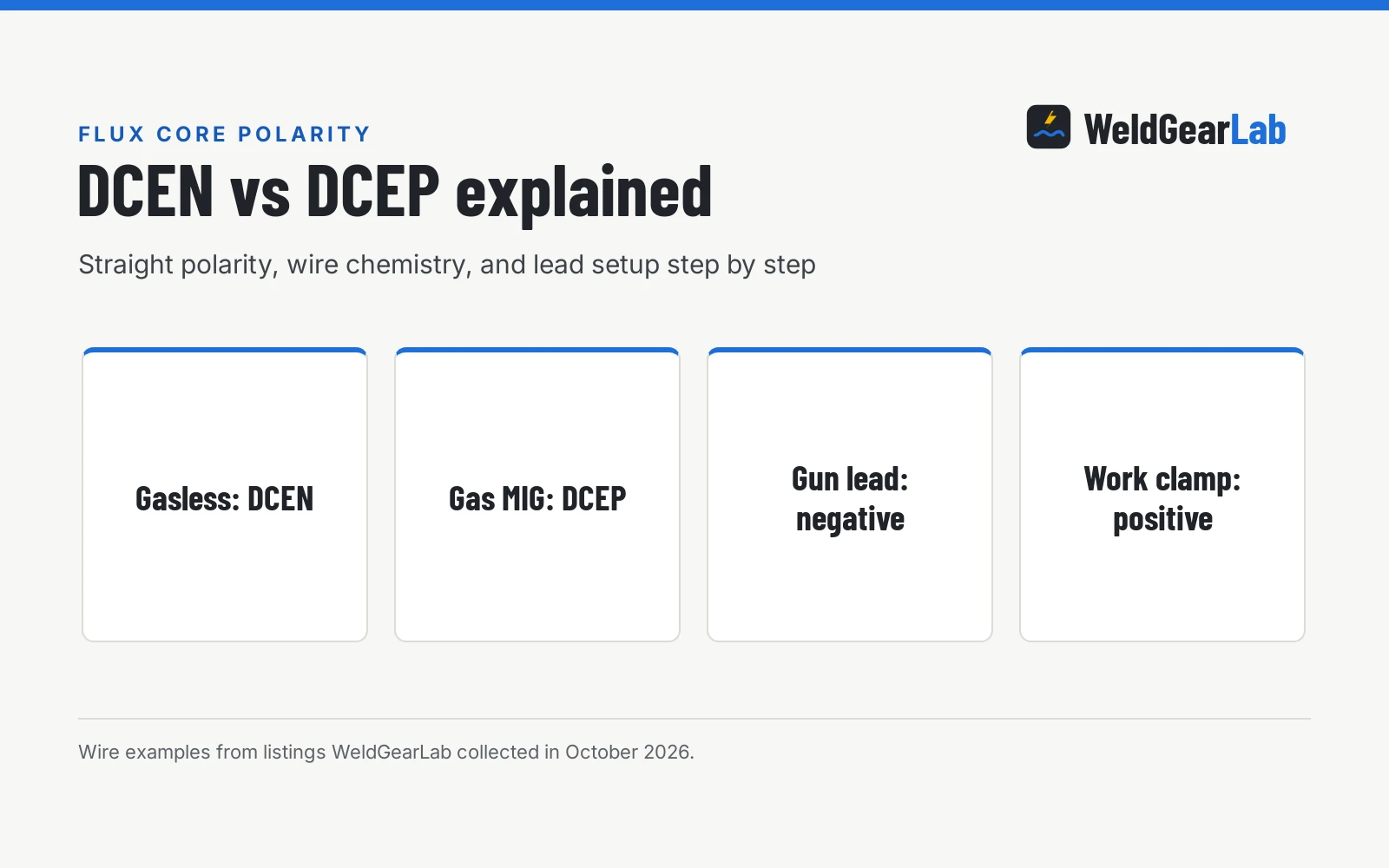
When setting up a wire feed machine for gasless wire, what polarity for flux core welding should you use? The direct answer is DCEN, which stands for Direct Current Electrode Negative and is commonly called straight polarity. In this electrical arrangement, the welding gun connects to the negative terminal and the work clamp connects to the positive terminal. Connecting your machine to DCEN provides rapid wire melt-off, allowing the internal flux compounds to vaporize evenly and create protective shielding gas around the molten weld puddle.
As an Amazon Associate I earn from qualifying purchases. This guide links to our product roundups, where WeldGearLab earns a commission when you buy through links, at no extra cost to you. Read our affiliate disclosure.
What polarity for flux core welding
Direct current welding circuits flow in a continuous loop between the power source, the welding torch, the workpiece, and the ground clamp. Polarity describes the direction of electric current traveling through this circuit. In direct current wire feed welding, setting your machine to DCEN straight polarity attaches the torch gun to the negative terminal and the work clamp to the positive terminal.
Common self-shielded flux-cored arc welding wires operate on DCEN straight polarity because the wire design relies on high resistance heating at the negative electrode. A flux core wire is formed from a thin metal sheath wrapped tightly around a core of powdered minerals, deoxidizers, and gas-generating agents. For the flux compounds to melt, react, and shield the puddle before ambient air contaminates the steel, the tubular wire sheath must burn off rapidly upon entering the arc. Running on straight polarity delivers that high wire burn-off rate while directing moderate heat into the base metal, producing shallower penetration that helps prevent burn-through on thin steel. In contrast, standard gas-shielded MIG welding with solid wire uses DCEP, where the wire connects to the positive terminal, establishing deep penetration into the base metal while shielding gas flows from an external cylinder.
Side by side
| Gasless Flux Core (DCEN) | Solid Wire MIG (DCEP) | Flux Core on DCEP (Incorrect) | |
|---|---|---|---|
| Gun polarity | Negative (-) | Positive (+) | Positive (+) |
| Work clamp polarity | Positive (+) | Negative (-) | Negative (-) |
| Shielding source | Internal flux vapor | External gas cylinder | Internal flux vapor |
| Base metal penetration | Moderate penetration | Deep penetration | Inconsistent penetration |
| Wire melt-off rate | High burn-off rate | Standard burn-off rate | Irregular burn-off |
| Arc stability | Smooth and consistent | Smooth and stable | Erratic and popping |
| Spatter level | Low with proper wire | Minimal spatter | Heavy violent spatter |
| Slag formation | Protective glassy layer | No slag | Uneven trapped slag |
Polarity is established by wire design; always follow the polarity markings printed on your wire spool packaging and in your machine manual. Most multi-process wire welders include movable lead connections that allow you to switch terminals when alternating between flux-cored wire and solid steel wire.
Why flux core requires DCEN straight polarity
Understanding how self-shielded wire functions explains why polarity cannot be treated as optional. Unlike solid MIG wire, which relies on a separate high-pressure cylinder of shielding gas, flux-cored wire must generate its own protective atmosphere right at the arc zone. As current passes through the wire, the internal chemical core burns to produce shielding gas and forms a slag blanket that covers the cooling weld metal.
Manufacturers formulate common gasless wires specifically for DCEN operation. For example, Blue Demon lists its E71T-GS gasless wire in .035 inch diameter on a 10 pound spool and explicitly states that it runs on DCEN (Straight Polarity). Lincoln Electric produces .035 inch NR-211 wire for all-position gasless welding. In addition, ARCCAPTAIN lists .035 inch E71T-GS wire on a 10LB spool with a stated tensile strength of 80496 psi, as well as a 2LB spool. Smaller wire diameters like 0.030 inch appear in listings from WelderElite and YixangDD on 2 lb spools. For these gasless wires, running on straight polarity supports stable droplet transfer, complete slag coverage, and sound weld deposits.
When current flows through the negative electrode, wire melt-off remains rapid and consistent, allowing core flux ingredients to deoxidize the molten puddle. To compare gasless options with gas-shielded setups, see our guide on can you MIG weld without gas.
What happens when flux core is welded on DCEP
Hooking up a flux core welder with reverse polarity is a frequent error for beginners, especially when transitioning from solid MIG wire with shielding gas. Because the machine still strikes an arc and feeds wire on DCEP, you might not realize the polarity is backward until you inspect the weld bead and surrounding work area.
Welding self-shielded wire on DCEP produces noticeable weld defects:
- Excessive spatter: Reversing the current disrupts droplet detachment, expelling violent bursts of molten metal across the workpiece and welding bench.
- Erratic arc and burnback: Because reverse polarity alters arc dynamics, the arc becomes unstable. The wire often stubs into the puddle or burns back into the contact tip.
- Poor bead appearance and heavy slag entrapment: The flux inside the wire fails to burn properly, creating irregular slag deposits and internal porosity.
- Extreme heat buildup in the gun nozzle: DCEP drives chaotic arc dynamics that radiate excessive heat back into the torch neck, deteriorating contact tips and diffusers.
If you encounter erratic feeding or heavy spatter on mild steel, verify your terminal connections before adjusting drive tension or voltage. For additional troubleshooting, explore our guide on why is my MIG welder spattering so much.
How to change polarity on a wire feed welder
Changing polarity on a wire feed welding machine requires swapping the electrical leads that power the welding torch and the work ground clamp. The physical process varies depending on whether your machine is a dedicated gasless unit or a dual-process MIG welder.
Follow these steps to change your machine setup:
- Disconnect main electrical power: Always switch off the power switch and unplug the power cord from the wall receptacle before opening the cabinet.
- Locate the polarity terminals: On most portable wire feed machines, the polarity terminals are situated inside the wire spool compartment, directly adjacent to the wire drive mechanism. On other models, the terminals sit on the front lower faceplate.
- Identify terminal markings: Look for embossed plus (+) and minus (-) symbols stamped into the sheet metal or molded into terminal blocks.
- Attach the torch lead to negative: For gasless flux-cored wire, connect the heavy cable running to the welding gun to the negative (-) terminal stud. Tighten the retaining wing nut or twist connector firmly to prevent resistance heating.
- Attach the work clamp to positive: Connect the ground clamp cable to the positive (+) terminal stud. Fasten the connection firmly to provide a solid ground return path.
- Close the door and inspect the feed path: Fasten the cabinet latch before reconnecting the machine to main electrical power.
In our review of the best MIG welder picks, several budget units feature accessible terminal studs inside the wire cabinet that make switching between flux-cored wire and solid wire straightforward. If you are comparing machines or considering a workshop upgrade, consult our guide on how to choose a MIG welder.
Drive rolls, nozzles, and contact tips for gasless welding
Setting the correct polarity is critical, but gasless flux core welding also requires proper wire drive components and torch consumables. Because flux-cored tubular wire is softer than solid steel wire, standard smooth MIG drive rolls can crush the hollow casing if tension is set too high.
To set up your torch and wire drive for flux-cored welding:
- Use knurled drive rolls: Flux core wire benefits from knurled drive rolls featuring serrated grooves. The tiny teeth grip the wire surface without requiring excessive tension, feeding the wire smoothly through the liner without deforming the tubular profile.
- Match contact tip diameter: Select a contact tip that matches your wire size. In data listings, replacement sets like the TimelyDu kit supply .030 inch contact tips compatible with machines such as the Lincoln Magnum 100L and Lincoln Weld-Pak 100HD.
- Install a gasless flux core nozzle: Unlike gas MIG nozzles that direct shielding gas around the puddle, flux core nozzles feature a heat-resistant cone designed to shield the contact tip holder from spatter while giving you a clear view of the joint. The TimelyDu consumable kits include dedicated flux core nozzles and diffusers to protect the torch neck during operation.
- Keep wire stick-out consistent: Self-shielded flux core requires greater electrical stick-out than solid wire MIG. Maintaining proper distance preheats the wire core before it enters the arc puddle, improving flux vaporization.
For dedicated gasless equipment and portable options suited for farm maintenance and outdoor repairs, check our guide to the best flux core welder picks.
Safety considerations for gasless flux core welding
Gasless flux-cored arc welding produces substantial smoke, hot particulate spatter, and airborne fumes as internal core deoxidizers burn. Protecting yourself, your workspace, and nearby personnel requires attentive safety discipline.
Always prioritize these workshop safety precautions:
- Fume extraction and ventilation: Never inhale welding plume fumes directly. Position your helmet so your face remains outside the rising smoke column. Always work in well-ventilated spaces, outdoors, or alongside dedicated workshop fume extraction equipment.
- Hot slag protection: Self-shielded flux core deposits a glassy slag shell over the completed weld bead. As the puddle cools, brittle slag chips can pop off unpredictably. Always wear safety glasses under your welding helmet when chipping or brushing slag.
- Fire prevention: Hot spatter from gasless flux core travels farther than spatter from gas-shielded MIG. Clear dry grass, sawdust, solvent rags, and flammable liquids from your workspace before striking an arc, and keep an approved fire extinguisher within arm reach.
- Electrical safety: Inspect cables, torch leads, and ground clamps for damaged insulation before powering on your equipment. Never weld while standing on wet ground or handling damp gloves.
Always follow workshop safety guidelines and consult your machine manual for proper ventilation and personal protective equipment recommendations.
Frequently Asked Questions
What polarity is used for gasless flux core welding?
Self-shielded flux core welding wire typically runs on DCEN, which stands for direct current electrode negative. This configuration attaches the welding torch lead to the negative terminal and the work ground clamp to the positive terminal. Running DCEN provides rapid wire melt-off to vaporize the internal flux core and generate protective shielding gas.
What happens if you weld flux core on DCEP?
Welding self-shielded flux core wire on DCEP causes severe spatter, an unstable arc, and uneven wire burn-off. Because electron flow disrupts droplet transfer at the positive wire tip, the internal flux compounds fail to vaporize evenly. This incorrect setup results in irregular beads, porous welds, and heavy slag cleanup.
Do all flux core wires run on DCEN?
Most common gasless mild steel wires, including AWS E71T-GS and NR-211 formulations, run on DCEN straight polarity. However, not every flux-cored wire uses electrode negative; certain specialty wires and gas-shielded flux-cored wires require DCEP. Always verify the recommended polarity printed on your wire spool packaging before beginning a project.
How do I know if my welder is set to DCEN?
Inspect the terminal studs located on the front panel or inside the wire drive cabinet of your machine. The internal cable connected to your welding gun must attach to the negative terminal marked with a minus sign. The cable attached to your work ground clamp must connect to the positive terminal marked with a plus sign.
Can I weld flux core on an AC welder?
Standard self-shielded flux core wire formulated for DCEN cannot operate properly on alternating current. An AC power source continuously cycles polarity back and forth, resulting in violent spatter, poor arc stability, and weak weld beads. Quality flux core welding requires a direct current power supply configured for electrode negative operation.
Related: explore our MIG welders hub for machine comparisons, wire drive guides, and shop equipment overviews.
About the author
WeldGearLab Editorial is the editorial team behind WeldGearLab. We research product listings, specifications, safety listings and warranty terms, score every pick with the published Gear Score method, and correct errors when readers report them. We do not run our own shop trials; see How We Pick for exactly how picks are made.