What Size MIG Wire for Sheet Metal?
For welding thin sheet metal, .023 inch MIG wire provides lower heat input and cleaner puddle control than .030 wire to prevent burn-through on delicate panels.
 By WeldGearLab Editorial
Updated October 9, 2026
By WeldGearLab Editorial
Updated October 9, 2026
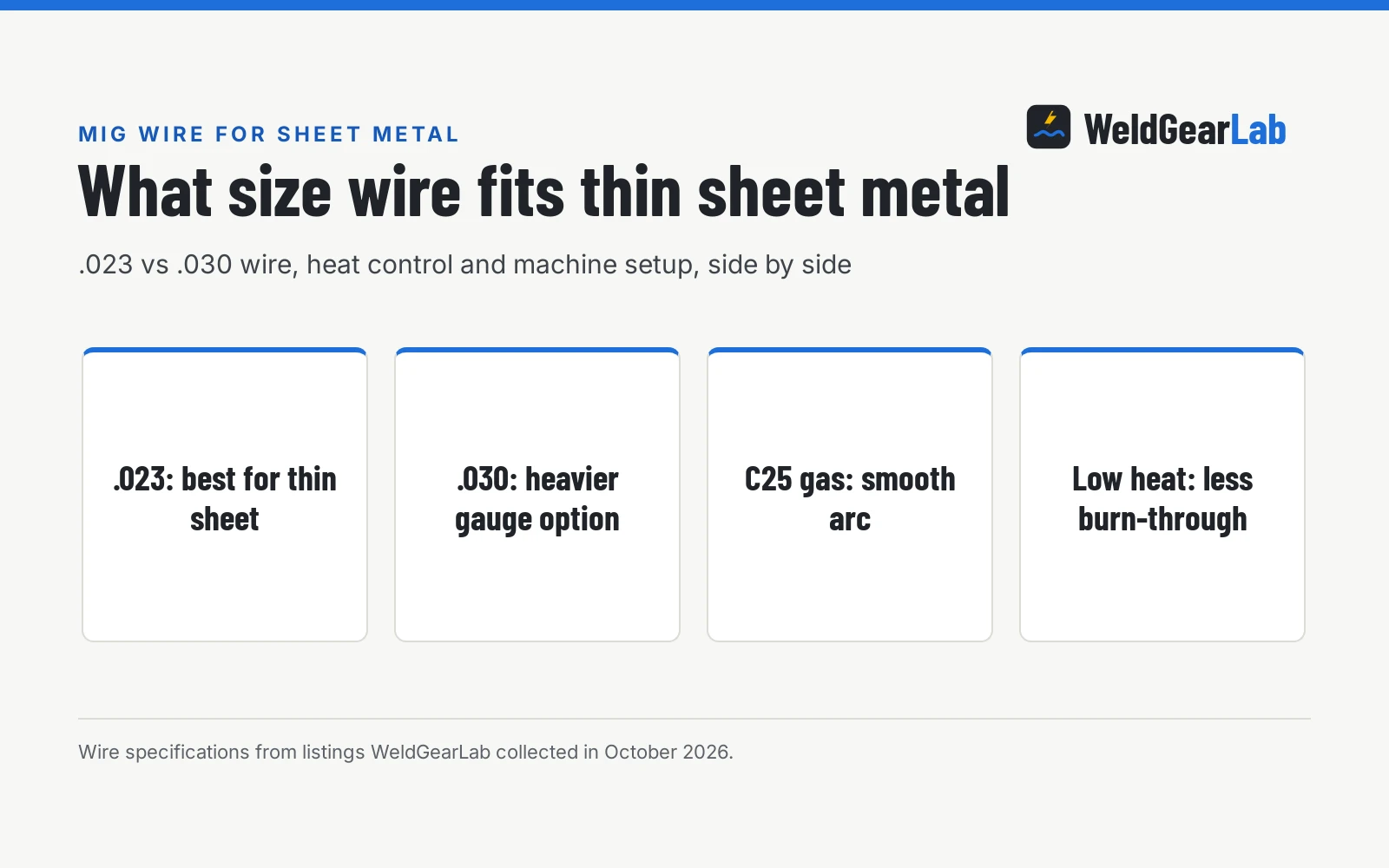
When deciding what size mig wire for sheet metal projects, .023 inch (0.6mm) solid wire is the primary recommendation for thin auto body panels and light sheet steel. It melts at lower amperage, generates a smaller molten puddle, and significantly minimizes the risk of burning through thin metal compared to larger diameters. While .030 wire can weld sheet metal, .023 wire provides superior puddle control and lower heat input on delicate joints.
As an Amazon Associate I earn from qualifying purchases. This guide links to our product roundups, where WeldGearLab earns a commission when you buy through links, at no extra cost to you. Read our affiliate disclosure.
What size MIG wire for sheet metal
Wire diameter directly governs how much electrical current and heat are transferred into your workpiece. Because thin sheet metal heats up rapidly and has little mass to dissipate thermal energy, excessive heat melts away joint edges and burns holes through the base metal. Solid .023 inch wire has a narrow cross section, which allows the welding arc to initiate and stabilize at lower voltage and wire feed speed settings. This fine wire diameter deposits a small bead that solidifies quickly, leaving less material to grind down smooth.
Using larger wire on thin sheet increases the danger of heat distortion and blow-through. Wire sized at .030 inch deposits more filler metal per inch of travel and requires higher current to burn off steadily. For sheet metal fabrications, auto body patch panels, and exhaust tubing, switching down to .023 wire gives you a forgiving puddle and predictable penetration.
Side by side: .023 vs .030 wire
| .023 inch wire (0.6mm) | .030 inch wire | .035 inch wire | |
|---|---|---|---|
| Primary use | Thin auto body panels and light sheet | General fabrication and heavier sheet | Thicker plate and structural fabrication |
| Sheet metal capability | Thin sheet panels (INE lists 20 gauge to 16 gauge / 0.8mm to 1.6mm) | Heavier gauge sheet with stitch technique | Not suited for thin sheet due to high burn-through |
| Burn-through risk on sheet | Lowest heat input, minimal burn-through | Moderate heat input, risks burn-through | High heat input, severe burn-through risk |
| Shielding gas compatibility | C25 (75% Ar / 25% CO2), 80% Ar / 20% CO2, or 100% CO2 | C25 (75% Ar / 25% CO2), 80% Ar / 20% CO2, or 100% CO2 | Pure argon for aluminum ER5356 |
| AWS classification | AWS A5.18 ER70S-6 | AWS A5.18 ER70S-6 | AWS ER5356 |
| Wire drive roll style | Smooth V-groove sized for .023 | Smooth V-groove sized for .030 | Smooth U-groove sized for .035 |
| Contact tip size | Matching .023 inch tip | Matching .030 inch tip | Matching .035 inch tip |
| Listing spool size examples | 2 lb spool (INE, YESWELDER) | 10 lb spool (TOOLIOM) | 1 lb spool (ARCCAPTAIN) |
| Typical polarity | DCEP (electrode positive) | DCEP (electrode positive) | DCEP (electrode positive) |
Wire specifications from manufacturer listings show how these diameters divide practical shop duties. INE lists its .023 inch ER70S-6 wire for 20 gauge to 16 gauge (0.8mm to 1.6mm) sheet steel and auto body repair on a 2 lb spool. YESWELDER lists a .023 inch (0.6mm) ER70S-6 wire on a 2 lb spool for sheet metal without burn through. For heavier fabrication, TOOLIOM lists a 0.030 inch ER70S-6 wire on a 10 lb spool for general shop tasks and truck bodies. For aluminum welding, ARCCAPTAIN lists ER5356 wire in .035 inch on a 1 lb spool. Eastwood offers a dual-sided sheet metal gauge measuring from 36-0 gauge to verify base metal thickness before selecting wire.
When .023 wire is the better choice
- Auto body repair and thin panels. Automotive sheet steel is thin and vulnerable to warping. Wire in .023 diameter minimizes thermal buildup, helping you maintain flat body lines.
- Tack welding and stitch joints. Trigger pulses with .023 wire build tiny, flat tack welds that do not mound up high or melt adjacent sheet edges.
- Light gauge tubing and sheet assemblies. Light sheet assemblies benefit from quick puddle freezing, bridging small fit-up gaps cleanly.
- Reduced grinding time. Because .023 wire leaves smaller, flatter weld crowns, post-weld dressing requires less aggressive abrasive disc work.
For dedicated automotive bodywork and light sheet repairs, our best welder for body panels guide reviews machines optimized for low-amperage sheet metal work.
When .030 wire is an option
- Heavier sheet metal and light plate. When joining heavier gauge steel assemblies that can absorb heat without melting through, .030 wire deposits more filler metal per pass to build adequate throat thickness.
- Mixed-thickness joint designs. Welding thin sheet to a heavy frame bracket or tubing section often benefits from the penetration profile of .030 wire directed into the thicker member.
- General shop fabrication. For heavier assemblies and brackets, spools such as the 10 lb spool listed by TOOLIOM provide ample filler metal for general repair tasks without frequent spool changes.
- Structural attachments and brackets. Mounting tabs, hinges, and suspension brackets welded to sheet structures handle service loads better with the throat thickness provided by .030 wire.
How to set up your machine for thin wire
Switching your MIG machine to feed .023 wire involves matching your gun consumables and drive mechanism to the smaller diameter:
- Drive roll grooves. Solid steel wire feeds properly across smooth V-grooves. Verify that your machine drive roll is flipped to the groove marked for .023 inch wire. Running .023 wire inside a larger .030 or .035 groove causes slipping and erratic feeding.
- Drive tension adjustment. Set drive roll tension just tight enough to advance wire smoothly against light nozzle resistance. Overtightening drive tension crushes fine .023 wire, while loose tension slips; see our troubleshooting guide on how to fix MIG wire birdnesting.
- Contact tip sizing. Always thread a designated .023 contact tip onto your torch diffuser. Using an oversized tip causes micro-arcing inside the bore, erratic wire delivery, and arc wander.
- Gun liner selection. While many standard liners can feed .023 through .035 wire, keeping the gun cable straight minimizes feeding drag and prevents fine wire from flexing inside the liner.
Shielding gas for sheet metal MIG
Solid ER70S-6 wire requires an external shielding gas supply to shield the molten puddle from ambient atmosphere. Listings from INE and YESWELDER specify compatibility with mixed gas such as C25 (75% Ar / 25% CO2) or 80% Ar / 20% CO2, along with 100% CO2.
For sheet metal, C25 (75% argon and 25% carbon dioxide) is the preferred industry standard. Argon creates a smooth, gentle arc with fine droplet detachment and low spatter, while the carbon dioxide portion adds puddle fluidity and bead wetting without digging too deep. Pure 100% CO2 runs hotter, produces stiffer arc action, and generates heavier spatter, which elevates the risk of burning through thin sheet metal. If you weld aluminum sheet, standard steel ER70S-6 wire cannot be used; aluminum welding requires pure argon shielding and aluminum alloy wire, such as the ER5356 aluminum wire listed by ARCCAPTAIN in .035 inch on a 1 lb spool.
Can you weld sheet metal with .030 wire?
You can weld sheet metal with .030 wire if you adapt your welding technique to manage heat buildup. When using .030 wire on sheet metal, avoid continuous bead runs. Instead, use a series of overlapping spot tacks or short stitch welds, allowing the puddle to solidify and cool between trigger cycles. Placing a clean copper backing bar behind the seam absorbs surplus heat and supports the molten puddle, preventing burn-through.
However, for hobbyists and home shop welders, switching to .023 wire remains far easier and more reliable. Most compact and dual-voltage wire feed welders support both wire sizes; see our reviews in our budget MIG welder roundup and explore options across our MIG welders hub.
Sheet metal welding safety and fume control. Sheet steel, especially salvage automotive panels and galvanized sheet, often carries primer, oil, body fillers, or zinc coatings that generate noxious fumes when exposed to an electric arc. Always mechanical grind joint margins clean before welding, keep your head out of the rising fume plume, and ensure proper workshop ventilation. Protect yourself from arc radiation with proper shade helmet lenses and leather welding gloves. Secure compressed gas cylinders upright with a safety chain to prevent tip-over accidents.
Frequently Asked Questions
Can I weld auto body sheet metal with .030 wire?
You can weld auto body sheet metal with .030 wire, but it requires careful heat management. Because .030 wire demands higher current to melt, continuous seams frequently blow through thin sheet. Using brief stitch pulses and backing the joint with copper helps prevent holes, though .023 wire remains significantly easier to control.
Why is .023 wire better for thin sheet metal?
Wire in .023 diameter carries a smaller cross-sectional area, allowing it to melt and establish a stable arc at lower welding voltage and wire feed speed. This lower heat input keeps the molten puddle small and controllable, preventing burn-through and excessive heat warping on thin panels.
Do I need different drive rolls for .023 MIG wire?
Yes, you need a drive roll with a smooth V-groove sized specifically for .023 wire. Running .023 wire in a groove sized for .030 or .035 wire causes slipping and irregular feeding. Many welders include a reversible dual-groove drive roll with one side sized for .023 wire.
What shielding gas should I use with .023 wire on sheet metal?
The standard shielding gas for .023 solid steel wire on sheet metal is C25, which consists of 75% argon and 25% carbon dioxide. This blend delivers a stable, low-spatter arc that wets smoothly without excessive penetration. Straight 100% CO2 can be used, but it increases spatter and penetration.
Can I use flux core wire on thin sheet metal?
Flux core wire can weld sheet metal, but it produces more penetration and heat than gas-shielded .023 solid wire, increasing the risk of burn-through. Most gasless flux core wires come in .030 or .035 inch sizes. For thin sheet metal and bodywork, solid .023 wire with shielding gas yields cleaner results with less slag cleanup.
Related: best welder for body panels, can you MIG weld without gas, how to choose a MIG welder, and the MIG welders hub. Also see our guide on why a MIG welder spatters.
About the author
WeldGearLab Editorial is the editorial team behind WeldGearLab. We research product listings, specifications, safety listings and warranty terms, score every pick with the published Gear Score method, and correct errors when readers report them. We do not run our own shop trials; see How We Pick for exactly how picks are made.