Flux Core vs MIG with Gas: Which One Fits Your Work
Flux core and MIG with gas run on similar wire feed welders but suit different jobs, from outdoor wind and dirty steel to clean indoor sheet metal fabrication.
 By WeldGearLab Editorial
Updated October 9, 2026
By WeldGearLab Editorial
Updated October 9, 2026
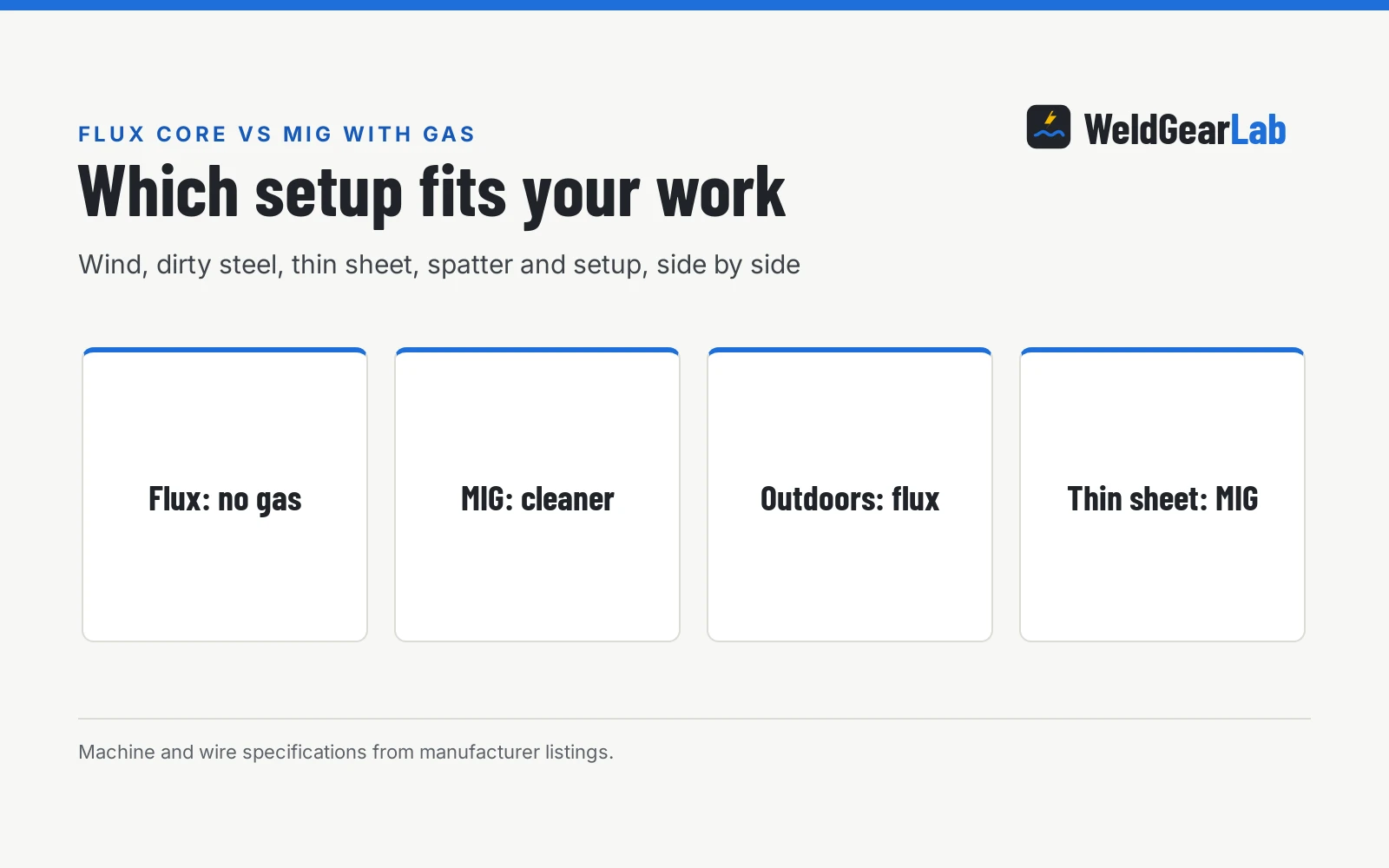
When comparing flux core vs MIG with gas, the main difference is how the molten weld pool is shielded from atmospheric contamination. Flux core wire carries internal flux that burns to shield the arc without an external gas cylinder, making it portable and effective in outdoor wind. MIG with gas feeds solid wire under an external shielding gas supply, producing clean, low-spatter beads with no slag to chip on thin sheet metal. This guide explains how both processes work, when to choose each, and how to verify which wire feed setup a machine supports.
As an Amazon Associate I earn from qualifying purchases. This guide links to our product roundups, where WeldGearLab earns a commission when you buy through links, at no extra cost to you. Read our affiliate disclosure.
The difference in one paragraph
Molten steel reacts quickly with oxygen and nitrogen in surrounding air, creating brittle porosity and weak joints. Gas MIG protects the weld puddle by feeding shielding gas through the torch nozzle around a solid metal wire. Self-shielded flux-cored wire is hollow and packed with mineral flux compounds that vaporize under the arc to form a protective vapor envelope and deposit a protective slag coating over the cooling bead. That means flux core operates without an external gas cylinder, flow regulator, or gas supply hose, whereas gas MIG depends on an active gas cylinder to keep air away from the molten puddle.
Flux core vs MIG with gas: side by side
| Flux core (self shielded) | Gas MIG (solid wire) | Practical verdict | |
|---|---|---|---|
| Shielding | Flux inside the wire | Gas from an external cylinder | Flux core eliminates gas tanks |
| Gear beyond the welder | Flux core wire spool | Solid wire, cylinder, regulator, gas hose | Gas MIG needs gas plumbing |
| Wind and outdoor work | Tolerates breeze and wind | Shielding gas blows away without shelter | Flux core for outdoor field work |
| Dirty or rusty steel | Tolerates light rust and mill scale | Requires clean bare steel | Flux core handles light contamination |
| Thin sheet and auto body | Higher risk of burn through | Precise heat control, smaller beads | Gas MIG for thin panels |
| Spatter and cleanup | Slag crust to chip, heavier spatter | No slag, less spatter with argon mix | Gas MIG for cleaner beads |
| Fumes and smoke | Heavier smoke and fume plume | Lighter smoke | Gas MIG for indoor shops |
| Typical polarity | DCEN (electrode negative) | DCEP (electrode positive) | Follow spool label instructions |
| Aluminum capability | No (cannot weld aluminum) | Supported with spool gun and pure argon | Gas MIG required for aluminum |
Polarity selection reflects standard operating practice for common steel welding wires: self-shielded flux core generally runs on electrode negative (DCEN), whereas solid wire with gas runs on electrode positive (DCEP). Always verify the specific polarity listed on the wire spool packaging and in your machine instruction manual. Most multi-process machines that accommodate both methods provide terminal leads or a quick-change polarity terminal inside the wire drive compartment.
When flux core is the better choice
- Outdoor welding in windy conditions. Wind and outdoor air drafts blow away external shielding gas, causing severe porosity in gas MIG welds. Self-shielded flux core creates its own localized protective shield directly at the molten puddle, allowing you to weld outside on pasture fencing, gates, trailers, and structural frames without erecting wind barriers.
- Steel with light surface contamination. The core of flux-cored wire contains deoxidizers and scavengers that lift impurities out of the molten pool into the surface slag. While thorough grinding is always recommended, flux core manages light rust, scale, and surface residue significantly better than bare solid wire.
- High portability without gas cylinders. Running gasless wire eliminates the physical bulk and transport hazards of high-pressure steel tanks, gas regulators, and supply lines. You only need to transport the power source, ground clamp, torch, and wire spool into the field or across a job site.
- Thicker steel penetration on compact machines. Flux core wire operates at high current density because of its hollow tubular design, helping it penetrate deeper into thicker steel joints at a given machine setting. This allows compact welders to tackle heavier farm equipment and gate repairs where solid wire might lack sufficient fusion.
For dedicated portable setups designed for field maintenance and farm repairs, check our guide to the best flux core welder.
When gas MIG is the better choice
- Thin sheet metal and automotive bodywork. Solid wire can be run in smaller diameters at lower machine voltage settings, creating a smaller, highly controllable puddle in short-circuit transfer. This lower heat input significantly reduces the risk of burning through thin sheet steel during auto body repair and light fabrication.
- Exceptional bead appearance with minimal cleanup. Because shielding gas leaves no glassy slag deposit over the finished weld, there is no slag crust to chip away with a chipping hammer. Spatter is minimal, meaning parts require far less cleanup time before priming, powder coating, or painting.
- Enclosed indoor workshop fabrication. Gas MIG produces noticeably less airborne smoke and particulate plume than flux core. Working in an enclosed garage or fabrication shop remains significantly cleaner and more comfortable, though adequate mechanical ventilation remains essential.
- Welding non-ferrous metals like aluminum. When switched to pure argon shielding gas and an appropriate wire drive arrangement or spool gun, gas MIG machines can weld aluminum alloy materials. Flux core wire cannot weld aluminum.
How to tell what a machine supports
Not every wire feed machine sold under the broad banner of MIG welding includes the components required to run shielding gas. Several budget machines on the market are dedicated flux-core units with fixed internal wiring and no gas solenoid. To determine whether a machine supports true gas MIG, examine the published manufacturer listing for the following indicators:
- Stated gas MIG capability and included gas hardware. Machines that support gas shielding explicitly state gas MIG or solid wire operation in their product literature. Some dual-process machines include basic gas hardware in the box: for example, the ACEWELDER 200A listing explicitly includes a gas hose along with its ground clamp, torch, nozzles, and contact tips, confirming its gas readiness.
- Dedicated solid wire sizes alongside flux core. Dual-process machines specify wire diameter support for both bare solid wire and flux-cored wire. The FEMEROL 250A multi-process welder specifies compatibility with .023”, .030”, and .035” solid wire alongside .030” and .035” flux core wire on 2 lb and 10lb spools. In contrast, dedicated gasless wires like YESWELDER E71T-GS 0.035 in or ATLAS WELDER .030 Inch and .035 Inch spools state self-shielded operation where an external cylinder is not needed.
- Multi-process listings and stated process modes. Look for explicit multi-process labeling in the specification breakdown. For instance, the ARCCAPTAIN 200A lists a 60% rated duty cycle on workpieces up to 5/16″ across its multi-process modes, while the compact BESTMIG 145A explicitly designates both gas and gasless operation for mild steel up to 3mm (2/5″) thick. Dedicated gasless welders omit any mention of gas MIG modes.
- Internal gas solenoid and rear gas inlet fitting. A machine that runs gas MIG must house an internal electric gas solenoid valve to open and close gas flow with the gun trigger. If the rear panel lacks a threaded gas inlet fitting, the machine cannot run shielding gas.
Remember that while a dual-process machine may include a basic gas hose, high-pressure gas regulators and shielding cylinders are rarely bundled in the carton. Plan to source a dedicated gas cylinder and flow meter from your local welding gas distributor.
Which gas for MIG on steel
Choosing the correct shielding gas is critical for sound metallurgy when running solid steel MIG wire. For carbon steel and mild steel, the standard industrial selection is an argon and carbon dioxide blend. The argon component stabilizes the arc and produces smooth metal transfer with minimal spatter, while carbon dioxide improves puddle fluidity and base metal penetration. Running pure carbon dioxide provides deep penetration on structural joints at economical gas cylinder fill expense, but it creates a harsher arc with heavier spatter that requires additional post-weld cleanup. For aluminum welding, pure argon gas is required. Always consult the recommended gas specification printed on your wire packaging and the machine manufacturer guide.
Can one machine do both?
Yes, and investing in a dual-process wire feed machine that runs both flux core and gas MIG gives a home or farm shop the greatest practical versatility. You can install self-shielded flux core for outdoor equipment repairs, fencing, and rusty trailer frames, then switch to solid wire and shielding gas for clean indoor sheet fabrication, decorative projects, and auto body work. Many versatile multi-process welders support both processes; explore our guide to the best welder for beginners and our selection of the best budget MIG welders.
Flux core smoke and workshop safety. Self-shielded flux core wire generates considerably more smoke, particulate fumes, and surface spatter than gas MIG. Hot glassy slag can also pop loose unexpectedly as welds cool or when struck with a chipping hammer. Always position your welding hood so your face remains outside the rising smoke plume, maintain positive cross-ventilation in your workspace, and wear approved safety glasses beneath your helmet. If using shielding gas, always chain compressed cylinders securely in an upright position against a wall rack or dedicated cart to prevent tipping hazards.
Frequently Asked Questions
Is flux core welding as strong as MIG with gas?
When proper joint preparation, wire selection, and machine voltage parameters are applied, flux core and gas MIG yield equally strong, dependable welds on mild steel. Joint strength depends primarily on penetration depth, proper fusion, and operator technique rather than the shielding method alone. For critical structural joints or overhead suspension components, consult qualified welding procedures and professional inspection standards.
Can I run flux core wire in a gas MIG welder?
Most machines capable of gas MIG can run self-shielded flux core wire without issue, provided the machine allows polarity switching. Flux core wire requires DCEN polarity, meaning the welding gun lead connects to the negative terminal and the ground clamp connects to the positive terminal. You may also need a serrated knurled drive roll to feed hollow flux wire without crushing or slipping.
Can a gasless flux core welder be converted to use shielding gas?
Dedicated gasless flux core welders cannot be easily converted to run gas MIG because they lack the internal gas solenoid valve, internal gas routing tubes, and trigger wiring needed to control gas flow. Modifying a gasless cabinet costs more than replacing it. If you anticipate needing clean welds on thin steel or aluminum, choose a machine built from the factory with gas MIG capability.
Why does flux core leave a hard crust over the weld bead?
That hard glassy coating is slag formed by the mineral flux core burning inside the wire during welding. The molten slag floats to the surface of the weld pool, shielding the hot metal from atmospheric oxygen as it solidifies. This slag layer must be thoroughly removed with a chipping hammer and wire brush between passes and prior to painting.
Which process is easier for a beginning welder to learn?
Gas MIG on clean, properly prepared steel is generally easier for beginners to achieve clean, visually pleasing beads because the arc is soft and there is no slag crust to manage. However, flux core is simpler to set up initially because it requires no high-pressure cylinders, flow regulators, or gas leak checks. Many hobbyists start with self-shielded flux core and add a gas cylinder later as their fabrication skills progress.
Related: how to choose a MIG welder, best flux core welder, best 120V MIG welder, and the MIG welders hub. Also see our guides on why a MIG welder spatters and can you MIG weld without gas.
About the author
WeldGearLab Editorial is the editorial team behind WeldGearLab. We research product listings, specifications, safety listings and warranty terms, score every pick with the published Gear Score method, and correct errors when readers report them. We do not run our own shop trials; see How We Pick for exactly how picks are made.