What Causes Porosity in MIG Welds?
Porosity in MIG welds happens when air contaminates the molten puddle, leaving holes caused by shielding gas loss, drafts, dirty base metal, or spatter buildup in the nozzle.
 By WeldGearLab Editorial
Updated October 9, 2026
By WeldGearLab Editorial
Updated October 9, 2026
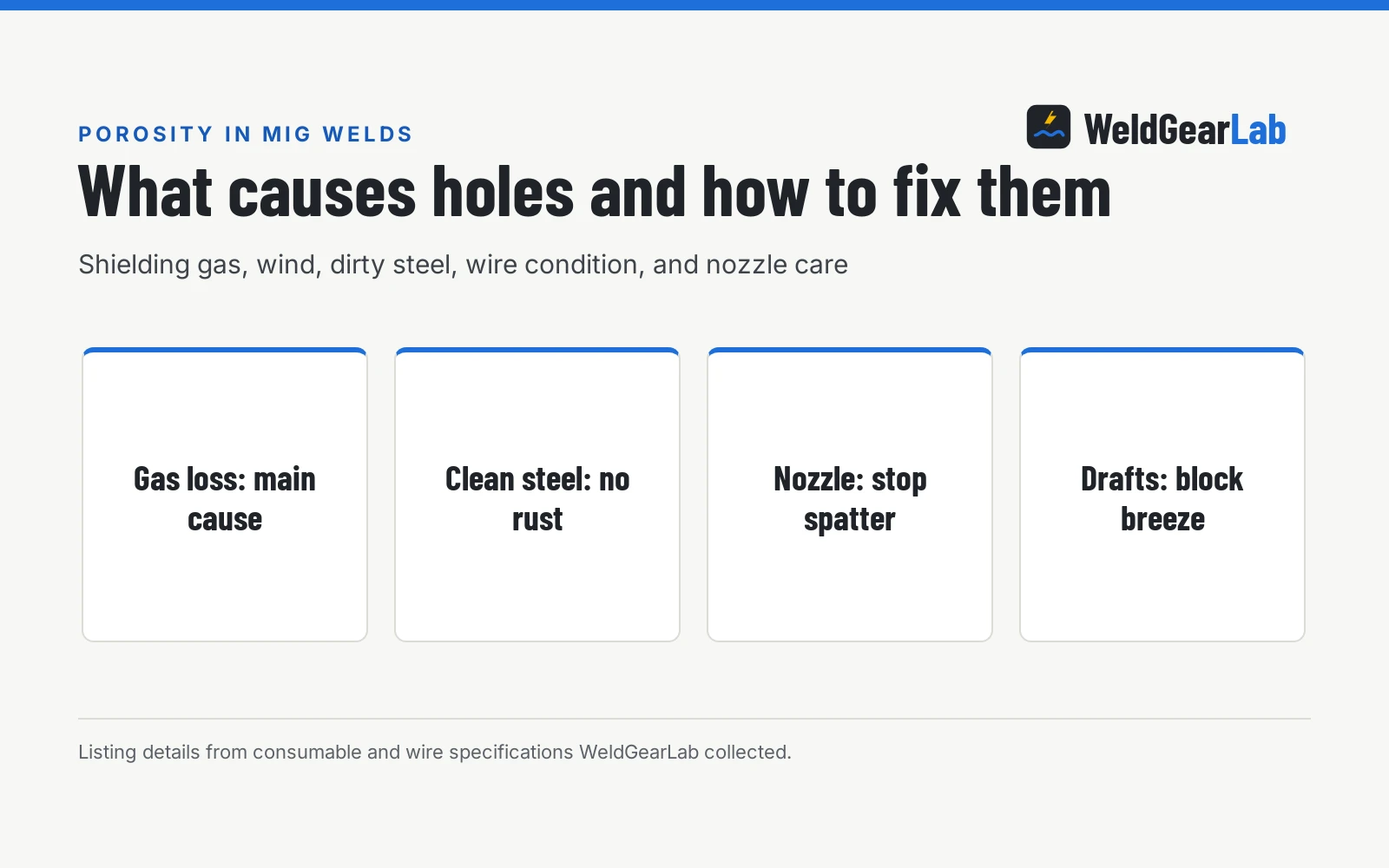
What causes porosity in MIG welds is gas contamination in the molten weld puddle, which creates cavities or pinholes as the metal freezes. This happens when the shielding gas envelope is blown away by drafts, blocked by spatter inside the gun nozzle, starved by incorrect gas delivery, or contaminated by surface rust, oil, mill scale, and wet wire. Preventing porosity requires maintaining continuous gas shielding, preparing base metal down to clean steel, and keeping wire and torch consumables in sound working order.
As an Amazon Associate I earn from qualifying purchases. This guide links to our product roundups, where WeldGearLab earns a commission when you buy through links, at no extra cost to you. Read our affiliate disclosure.
What causes porosity in mig welds
Porosity takes place when atmospheric gases dissolve into liquid steel and fail to escape before the puddle solidifies. Molten weld metal has a high solubility for nitrogen, oxygen, and hydrogen from surrounding air. As the puddle cools and transitions from liquid to solid, the solubility drops sharply, forcing trapped gases out of solution. If the gas cannot reach the surface before the bead skins over, bubbles remain frozen inside the metal. These bubbles form visible surface pits, hidden subsurface pockets, or long wormholes running along the centerline of the joint.
The result is a weakened joint with compromised mechanical strength and poor appearance. In pressure-tight containers or structural assemblies, even minor porosity creates leak paths and stress risers that can cause cracking under load. Understanding the sources of contamination allows operators of MIG welders to troubleshoot their setup systematically and stop weld holes before running production beads.
Side by side
| Cause | Where it happens | Visual sign | Direct fix |
|---|---|---|---|
| Shielding gas loss | Regulator, hose, or cylinder | Visible pinholes across bead surface | Check regulator, cylinder valve, and gas line |
| Draft or shop breeze | Open bay doors and fans | Scattered holes while welding near doors | Shield workspace or set up a wind screen |
| Dirty or oily steel | Base metal joint area | Black soot, bubbling puddle, swiss-cheese holes | Grind mill scale, rust, paint, and oil to bare metal |
| Spatter buildup in nozzle | MIG gun front end | Turbulent gas flow, intermittent porosity | Clean nozzle and apply anti-spatter nozzle gel |
| Rusty or wet wire | Wire spool or drive cabinet | Continuous porosity along the joint | Store wire dry and replace oxidized spools |
| Excessive gun angle | Torch manipulation by operator | Air drawn into puddle by turbulence | Keep torch near vertical with slight travel angle |
Porosity stems from distinct mechanical, environmental, and consumable faults. Identifying whether the holes appear continuously along the bead or intermittently during specific shop conditions helps pinpoint the exact failure point in your equipment or technique.
Shielding gas delivery and draft issues
The primary defense against porosity in gas metal arc welding is the shielding gas blanket. A cylinder containing carbon dioxide or an argon and carbon dioxide mixture supplies gas through the regulator, machine solenoid, gun hose, and gas diffuser. Any interruption along this path starves the puddle of protective gas and exposes molten steel directly to ambient air.
Drafts represent a frequent environmental culprit. Airflow from open shop bay doors, overhead cooling fans, exhaust vents, or outdoor breezes easily blows away the protective shielding blanket. Even a gentle breeze that feels barely noticeable can strip the gas column away from the arc. When welding in drafty environments, erect portable welding screens or close overhead doors to keep the air surrounding the weld joint calm.
Equipment leaks along the gas line also draw outside air into the stream through venturi action. Inspect the regulator fittings, cylinder connections, hose clamps, and internal torch O-rings. A cracked gas hose or a missing rubber O-ring where the gun backend seats into the machine socket allows air to mix into the gas stream before reaching the gun nozzle.
Base metal contamination and dirty steel
Dirty base metal is another widespread cause of porosity. Unlike stick welding or self-shielded flux core welding, solid wire MIG welding lacks thick slag-forming fluxes to float heavy contaminants out of the weld puddle. Surface contaminants vaporize under arc heat, generating large volumes of gas directly inside the molten metal.
Common surface contaminants include mill scale, red rust, cutting oil, grease, primer, and water. Moisture is particularly damaging because the extreme heat of the welding arc dissociates water molecules into hydrogen and oxygen. Hydrogen dissolves rapidly in molten iron and causes severe porosity as well as delayed cold cracking. Always clean your base metal with an angle grinder fitted with a grinding disc or flap disc back to bright, bare steel before pulling the trigger.
Galvanized steel poses a severe challenge because the zinc coating vaporizes at a lower temperature than steel melts. The boiling zinc gas bubbles furiously through the weld pool, leaving large craters and swiss-cheese holes throughout the bead. Grind the zinc plating completely away from both sides of the joint area before welding, and work with proper ventilation to keep fumes away from your breathing zone.
Welding wire condition and consumable setup
The solid welding wire feeding into the arc must remain clean and dry. Wire stored on an open spool in an unheated garage or damp shop absorbs ambient humidity and develops a fine film of oxidation on the surface. When this rusted wire feeds through the torch, the rust carries oxygen and moisture straight into the arc zone.
Solid carbon steel wire such as Blue Demon ER70S-6 contains manganese and silicon deoxidizers that combine with small amounts of oxygen to form tiny surface islands, but heavy rust on the spool easily overwhelms these deoxidizers. Blue Demon packages ER70S-6 wire in .030 inch and .035 inch diameters on spools that require dry storage. If a spool exhibits visible rust or surface corrosion, discard the outer layers or replace the spool completely. In addition, keep the wire drive cabinet closed and use spool covers to shield consumables from airborne shop dust.
Consumables at the front of the MIG gun also dictate gas coverage. MIG nozzles, including the Hot Max 23092 spotweld nozzle with its 5/8-Inch bore, channel shielding gas around the contact tip and wire. If spatter accumulates inside the nozzle bore, the opening narrows and creates turbulent gas flow. Turbulent gas pulls surrounding shop air into the stream like a whirlpool, spoiling the shielding envelope. Clean the nozzle regularly and apply anti-spatter nozzle gel, such as Forney 37031 in a 16-Ounce jar or lopmou gel in a 7-ounce tub, to stop hot spatter from sticking inside the nozzle bore. Also check our guide on why a MIG welder spatters for nozzle maintenance advice.
Welder machine setup and torch technique
Operator technique and machine parameters play a direct role in gas shielding stability. Holding the torch too far from the work piece increases the contact-tip-to-work distance and allows ambient air to dilute the gas column before it covers the puddle. Keep the nozzle close to the joint so the shielding blanket remains concentrated over the arc.
Torch angle also influences gas coverage. Holding the gun at an extreme tilt in either direction pulls ambient air into the shielding stream through venturi aspiration. Keep the torch nearly perpendicular to the workpiece, using only a slight push or drag angle so the nozzle directs the gas column squarely over the molten pool. Travel speed must remain steady as well: moving too fast outruns the gas envelope, exposing the trailing puddle to air before the metal solidifies.
Machine setup and wire feed consistency also influence weld pool stability. On compact wire feed welders, such as the DURATECH 125A designed for 120V power delivering up to 125A for steel up to 3/16 inch plate, irregular wire feeding causes arc stutter and spatter. In gas-shielded MIG setups, erratic wire feeding disrupts arc length and disturbs the gas shield. Review our roundup of the best budget MIG welders to compare dual-voltage machines equipped with reliable gas solenoids and smooth drive systems.
How to fix holes in a porous MIG weld bead
When porosity occurs, never attempt to simply weld over the pinholes with a second pass. Melting additional wire over porous steel traps the existing gas cavities beneath the surface, resulting in internal wormholes and severe structural weakness. The trapped gas will boil back up through the new puddle, creating even larger craters.
Fixing porosity in a completed bead requires mechanical removal. Take an angle grinder equipped with a grinding wheel or a carbide burr and grind away the entire affected weld metal until you reach solid, sound base metal without any dark specks or pockets. Clean the ground groove thoroughly with a stainless steel wire brush to remove grinding dust.
Before restriking the arc, resolve the root cause that initiated the porosity. Confirm that the cylinder valve is open, inspect the gas line for pinches, wipe the joint clean of oils, and clear any spatter bridging the nozzle bore. Run a practice bead on a piece of scrap steel to confirm smooth, quiet arc operation and a dense, hole-free puddle before returning to your project.
Frequently Asked Questions
Can you grind out and reweld over porosity holes?
Yes, but you must grind out all contaminated metal completely down to clean base steel before striking a new arc. Simply running a new bead directly over existing porosity traps the gas bubbles deeper inside the joint and makes the weld structurally unsound. Inspect the ground groove to ensure no remaining voids or dark inclusions remain before depositing fresh wire.
Why do holes appear in my MIG weld when welding outdoors?
Outdoors, natural breezes and shifting air currents strip the shielding gas envelope away from the torch nozzle. Without protective gas covering the molten puddle, oxygen and nitrogen from the air react instantly with the liquid steel to create bubbling and pinholes. Setting up windscreens, working inside a sheltered enclosure, or switching to self-shielded wire prevents wind from ruining the bead.
Does rusty MIG wire cause porosity?
Yes, surface rust on steel wire feeds oxygen and moisture directly into the electrical arc. Water molecules and iron oxide decompose in the intense arc heat, releasing hydrogen and oxygen into the molten puddle where they form gas bubbles as the bead solidifies. Store wire spools in dry containers and replace any spool showing visible oxidation.
How does spatter in the nozzle cause weld holes?
As weld spatter accumulates inside the nozzle bore, it restricts and deflects the smooth laminar flow of shielding gas. This restriction causes turbulence that draws surrounding room air directly into the gas stream. Cleaning spatter regularly and dipping the nozzle in anti-spatter gel maintains an uninterrupted gas column over the weld pool.
What is the difference between surface pinholes and subsurface wormholes?
Surface pinholes are visible cavities that break through the top skin of the weld bead where escaping gas bubbles popped as the metal froze. Subsurface wormholes are elongated voids trapped inside the interior of the weld throat, often caused by severe moisture, thick oil contamination, or excessive travel speed. Both forms compromise joint strength and require grinding out the defective bead.
Related: how to choose a MIG welder, best MIG wire for mild steel, how to fix MIG wire birdnesting, and can you MIG weld without gas.
About the author
WeldGearLab Editorial is the editorial team behind WeldGearLab. We research product listings, specifications, safety listings and warranty terms, score every pick with the published Gear Score method, and correct errors when readers report them. We do not run our own shop trials; see How We Pick for exactly how picks are made.