Can You MIG Weld without Gas? Wire Types, Polarity, and Setup
You can run wire feed without gas by switching to self-shielded flux-core wire, but true MIG welding always requires shielding gas from a cylinder to protect the molten puddle.
 By WeldGearLab Editorial
Updated October 9, 2026
By WeldGearLab Editorial
Updated October 9, 2026
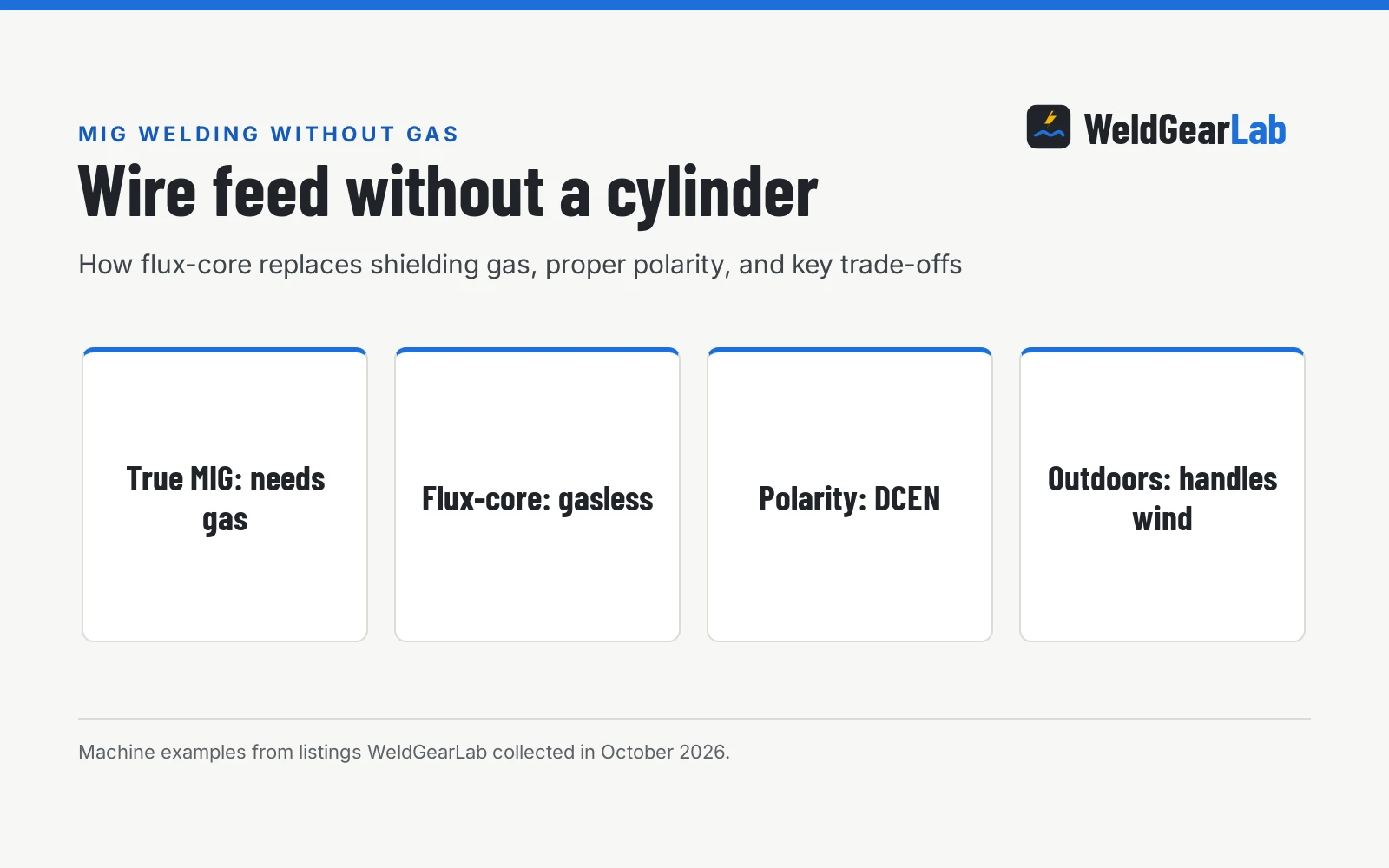
When welders ask, can you mig weld without gas, the answer is no for true MIG, but yes for wire feed welding. True MIG requires external shielding gas to protect the puddle from atmospheric contamination. However, wire feed machines that support flux-core wire run without gas by feeding self-shielded wire on DCEN polarity. The hollow wire contains flux agents that shield the arc as it melts, eliminating the cylinder, regulator, and gas hose. This guide explains machine requirements, polarity setup, and key trade-offs.
As an Amazon Associate I earn from qualifying purchases. This guide links to our product roundups, where WeldGearLab earns a commission when you buy through links, at no extra cost to you. Read our affiliate disclosure.
Can you mig weld without gas: the difference in one paragraph
MIG stands for Metal Inert Gas, or Gas Metal Arc Welding. True MIG requires an external cylinder supplying shielding gas through the torch to protect the puddle from oxygen and nitrogen. When you weld without gas, you are running self-shielded flux-cored arc welding. The gun and wire feed feel similar, but the shielding mechanism differs. Instead of bottled gas, compounds inside the hollow wire vaporize in the arc to shield the molten pool and leave a slag crust over the bead.
Side by side
| Self-shielded flux core | Gas MIG (mild steel) | Gas MIG (aluminum) | |
|---|---|---|---|
| Shielding source | Internal flux core decomposes in arc | External cylinder (argon and carbon dioxide mix or straight CO2) | External cylinder (pure argon) |
| Cylinder and regulator needed | None | Gas cylinder, regulator, and hose | Gas cylinder, regulator, and hose |
| Typical electrical polarity | DCEN (straight polarity) | DCEP (reverse polarity) | DCEP (reverse polarity) |
| Outdoor wind tolerance | High (handles outdoor breeze) | Low (breeze blows shielding away) | Low (drafts create severe porosity) |
| Post-weld slag | Heavy slag coating to chip and brush | No slag coating, light silica islands | No slag coating |
| Thin sheet metal control | Greater penetration, higher burn-through risk | Lower penetration, easier puddle control on thin gauge | Demands high heat dissipation and fast travel |
| Torch and feed gear | Standard MIG gun, knurled drive roll recommended | Standard MIG gun, smooth V-groove roll | Spool gun or Teflon liner, U-groove roll |
Polarity is the key technical difference between the two methods. Self-shielded flux-core wire runs on DCEN (electrode negative, straight polarity), where the torch is negative and the work clamp is positive. This concentrates arc energy to burn the internal flux and melt filler metal smoothly. True MIG with solid wire runs on DCEP (electrode positive, reverse polarity). Running flux core on DCEP produces erratic arc action, heavy spatter, and poor penetration. Most dual-process welders have internal leads you swap when changing wire types.
When gasless flux core is the practical choice
- Outdoor jobs and field repairs. A light breeze blows MIG shielding gas away, causing porous welds. Self-shielded flux core generates shielding directly at the puddle, tolerating windy outdoor conditions on gates and trailers.
- Rusty or oxidized steel. Solid wire requires clean bare metal. Flux-core wires contain deoxidizers that tolerate light mill scale and surface rust better than bare wire.
- Portability without cylinders. Eliminating cylinders removes heavy tanks and refill trips. The PLOWIC 250A handheld welder weighs 3.97 lb on 110V power with .032 and .040 flux wire, while the PONEY 135A welder weighs 9.9 lb and welds mild steel up to 1/8 inch with .030 flux wire.
- Penetration on household power. Flux core penetrates deeper at a given setting on 110V or 120V circuits. The DURATECH 125A welder runs on 120V to handle mild steel up to a 3/16 inch plate with 0.030 and 0.035 flux core wire, while the Acewelder 140A unit welds mild steel plate up to 4.0mm thick with .030 and .035 wire.
See our best flux core welder guide and our tips on how to choose flux core wire.
When gas MIG remains necessary
- Thin sheet and auto body work. Solid wire with gas runs cooler and lays flatter beads. Flux core penetrates aggressively, increasing burn-through risk on thin sheet.
- Clean beads and less cleanup. Solid wire leaves no slag crust and minimal spatter. Flux core leaves heavy slag to chip and brush, adding cleanup on visible projects.
- Indoor shop work. Gas MIG generates far less smoke than burning flux, keeping home garages cleaner.
- Aluminum welding. Self-shielded aluminum flux-core wire does not exist. Aluminum requires pure argon and a spool gun or push-pull feed. The Sunstac 5-in-1 multi-process welder lists 200A MIG output with a 60% duty cycle on 110V and 220V power with .030, .035, and .045 wires, but requires bottled gas.
Our best MIG welder under 500 review covers dual-mode options, and our flux core vs MIG welding comparison details running costs.
How to tell what your wire welder supports
Not every wire welder connects to gas; many budget machines are gasless only. Check these indicators:
- Gas connection hardware. Gas-capable units feature a rear gas inlet fitting and an internal solenoid or torch valve. Dedicated gasless units lack gas fittings entirely.
- Wire diameter listings. Listings naming .023 inch solid wire indicate gas capability. Units listing only .030 or .035 flux wire are typically gasless. Torches like the YESWELDER 100A model include a valve in the handle, handling .023, .030, and .035 wire with or without gas.
- Included accessories. Dual-mode units include gas hoses and feed rollers. The BESTMIG 145A welder includes a gas tube connector with rollers for 0.8mm solid and flux wire on steel up to 3mm thick on 110V and 220V. In contrast, gasless models like the JEGS MIG 100 list a 10% duty cycle at 70A on 110V AC with flux wire, but list no gas accessories.
Review our guide on how to choose a MIG welder for more details.
Gas choices when you add a cylinder
Selecting shielding gas depends on your metal. The listing for the Vniissok 145A welder notes that carbon dioxide or a mixture of carbon dioxide and argon is suitable for solid steel wire. An argon and carbon dioxide mix yields a stable arc and smooth beads on steel, while straight carbon dioxide penetrates deeply but spatters more. Aluminum wire requires pure argon to avoid oxidation. Check your machine door chart for recommendations.
Our best welder for beginners guide explains synergic settings that match voltage and wire speed.
Can one machine run with and without gas?
Yes, dual-mode welders alternate between flux-core and gas MIG. The FEMEROL 250A welder demonstrates this on 110V and 220V power, taking 2 lb and 10 lb spools of .023, .030, and .035 solid wire alongside .030 and .035 flux core wire. Switching involves loading wire, reversing polarity between DCEN and DCEP, swapping drive rolls, and connecting gas.
Safety precautions. Burning flux core produces heavy smoke and fumes. Keep your hood outside the plume, work with ventilation, and wear safety glasses under your helmet when chipping slag. Clear dry grass from outdoor work areas. Secure gas cylinders upright with a safety chain.
Frequently Asked Questions
Is flux core welding without gas as strong as MIG?
Yes, sound welds made with flux core offer strength comparable to solid wire on mild steel. Joint integrity depends on penetration, fit-up, and machine settings rather than the shielding method alone. Critical structural joints should be inspected or welded by a certified professional.
Can I put solid MIG wire in a gasless welder?
No, bare solid wire cannot weld without shielding gas. Atmospheric air dissolves into unprotected molten steel, causing severe porosity and weld failure. If your welder has no gas hookup, you must run self-shielded flux-core wire.
Why does gasless flux core wire require DCEN polarity?
Flux-core wire is formulated for DCEN straight polarity to match its internal flux chemistry. Running on DCEN provides smooth wire burn-off and proper penetration. Operating on DCEP causes an erratic arc, heavy spatter, and poor penetration.
Can you weld aluminum with a MIG welder without gas?
No, aluminum cannot be welded without gas. There is no self-shielded flux-core wire made for aluminum. Welding aluminum requires pure argon shielding gas and a spool gun setup.
Why does flux core produce so much spatter compared to gas MIG?
Flux compounds vaporize violently in the arc, scattering molten droplets around the seam. Gas MIG transfers wire smoothly under shielding gas without burning flux. Using correct DCEN polarity and steady stickout keeps spatter manageable.
Related: explore our complete MIG welders guide, check why a MIG welder spatters, and browse our best flux core welder picks.
About the author
WeldGearLab Editorial is the editorial team behind WeldGearLab. We research product listings, specifications, safety listings and warranty terms, score every pick with the published Gear Score method, and correct errors when readers report them. We do not run our own shop trials; see How We Pick for exactly how picks are made.