Why Does My MIG Wire Keep Burning Back to the Tip?
MIG wire burns back to the contact tip when wire feed stalls, stickout runs too short, or voltage outpaces wire delivery, but simple setup checks keep your gun feeding smoothly.
 By WeldGearLab Editorial
Updated October 9, 2026
By WeldGearLab Editorial
Updated October 9, 2026
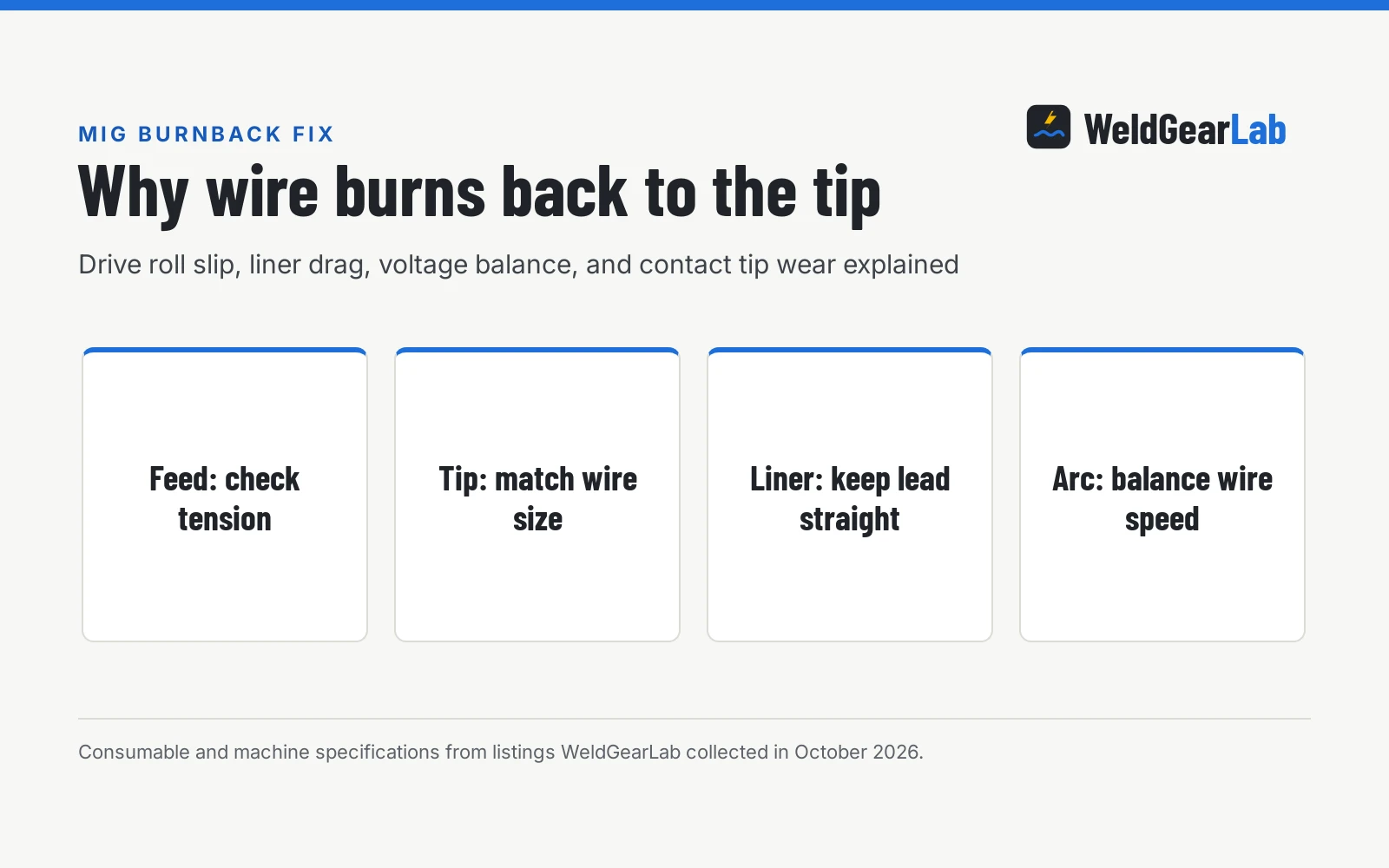
If you are wondering why does my MIG wire keep burning back to the tip, the short answer is that wire feed lagged behind the arc. When drive rolls slip, a contact tip wears or clogs, or wire speed is set too low for your voltage, the arc melts the wire faster than the feeder advances it, fusing the wire into the copper bore. Stopping burnback requires matching tip size to wire diameter, eliminating liner friction, and balancing voltage with wire speed.
As an Amazon Associate I earn from qualifying purchases. This guide links to our product roundups, where WeldGearLab earns a commission when you buy through links, at no extra cost to you. Read our affiliate disclosure.
Why does my MIG wire keep burning back to the tip?
MIG welding depends on balancing wire feed speed against arc voltage melt rate. Current transfers through the copper contact tip into the wire, forming an arc to your grounded workpiece. As long as drive rolls push wire at the rate the arc consumes it, welding proceeds smoothly. When wire feed hesitates while voltage remains energized, the arc climbs backward, fusing wire solid inside the contact tip hole.
Burnback usually stems from mechanical friction in the feed path, a worn or fouled contact tip, improper drive roll pressure, or machine settings feeding wire too slowly for the selected voltage. Isolating feed drag or tip wear resolves the issue quickly.
Side by side: common causes and shop corrections
| Troubleshooting Area | Symptom at the Gun | Root Cause | Shop Fix |
|---|---|---|---|
| Wire feed speed | Arc climbs wire into tip during weld | Wire speed set too low for operating voltage | Increase wire feed speed or lower welding voltage |
| Contact tip | Erratic arc starts or wire binding in the tip | Worn oval bore or tip bore mismatched to wire size | Install a fresh tip that matches wire diameter |
| Drive rolls | Motor turns but wire stops advancing | Roll tension slipping or incorrect groove profile | Adjust tension screw to feed steadily without crushing wire |
| Gun liner | Feeding stutters when cable is moved | Sharp cable coils or debris packed inside liner | Straighten torch cable and blow out debris with air |
| Spool hub | Spool resists turning or motor stalls | Spindle brake nut overtightened at spool hub | Loosen spindle nut until spool turns with light drag |
| Stickout | Wire fuses flush with tip while welding | Nozzle held too close to molten weld puddle | Maintain proper contact-tip-to-work distance |
| Gas nozzle | Arc bridges nozzle or wire snags on spatter | Heavy spatter buildup bridging tip to nozzle | Clean nozzle interior and apply nozzle gel |
| Ground clamp | Arc sputters with sudden voltage drops | Poor electrical contact through paint or mill scale | Attach ground clamp directly to clean bare metal |
Disconnect primary power before adjusting drive tension or swapping consumables. Inspecting feeding components in order isolates friction before changing machine voltage.
Drive roll tension and spool hub friction
Wire feeding begins at the spool spindle. If the spool brake nut is too tight, the drive motor struggles to pull wire, causing drive roll slippage and burnback. The spindle nut should only be tight enough to stop the spool from freewheeling when you release the trigger. When spun by hand, the spool should stop with light drag rather than spinning freely or binding.
Drive roll tension requires equal care. Loose tension allows rolls to slip while the arc melts the stationary wire. Excessive clamping flattens wire, strips copper shavings, and clogs the liner. Match roll grooves to your wire: smooth V-grooves for solid steel wire, and knurled grooves for flux-cored wire.
Contact tip bore size, wear, and spatter accumulation
The contact tip transfers current to the wire through physical contact. Wire friction wears the soft copper bore into an oval keyhole, causing erratic electrical transfer and micro-arcing that triggers burnback.
Matching tip size to wire diameter is essential. Forney lists 0.030 inch contact tips measuring 1 inch in length, while GZTIGWELD lists 0.023 inch (0.6 mm) contact tips and TimelyDu lists 0.035 inch (0.9 mm) contact tips. Furthermore, Allyearauto lists 0.030 inch (0.8 mm) contact tips compatible with common gun styles. Running 0.030 inch wire through a 0.035 inch tip creates loose electrical contact, while forcing 0.035 inch wire into a 0.030 inch tip binds wire.
Spatter buildup inside the nozzle also creates bridges that snag wire. Forney lists a 16-Ounce jar of nozzle gel that coats consumables to minimize spatter adhesion.
Torch cable bends, liner friction, and gun maintenance
Between the drive rolls and torch nozzle lies the cable liner. Sharp loops, kinks, or cable pinches create friction against the wire. When resistance rises, drive rolls slip or birdnest in the drive cabinet, halting wire delivery while the arc burns back.
Keep the torch cable as straight as possible while welding. Copper flakes and shop dust also collect inside the liner over time. When changing wire spools, remove the tip and nozzle and blow compressed air through the liner toward the drive rolls. Replace kinked liners rather than attempting to straighten damaged wire spirals.
Balancing wire feed speed, welding voltage, and stickout distance
Wire feed speed sets wire delivery and amperage, while voltage dictates arc length and bead profile. Setting voltage too high for your wire speed burns wire faster than drive rolls advance it, driving the arc into the tip.
Contact-tip-to-work distance also matters. Holding the nozzle too close exposes the contact tip to molten spatter and radiant heat, welding wire flush at the orifice. Maintain steady stickout and travel speed. Setting baseline parameters is crucial across our MIG welders category, and owners operating machines from our guide to affordable MIG welders should follow door chart recommendations.
If your machine has a burnback control timer, verify its setting. When set too high, voltage stays energized after wire feed stops, fusing wire to the tip when releasing the trigger. Dial down burnback duration if wire melts back upon trigger release.
Ground clamp connection and arc stability
An unstable ground return mimics feeding trouble. Clamping over rust, paint, or mill scale causes resistance and fluctuating voltage drops. The arc stutters, disrupting steady wire consumption and provoking burnback.
Attach the ground clamp directly to clean, bare steel on your workpiece rather than a painted table leg. Grinding a bare contact area stabilizes arc voltage and promotes consistent wire burnoff.
Safety precautions during MIG gun troubleshooting
Troubleshooting wire feed involves moving drive rolls and electrical components. Disconnect machine power before opening the wire compartment, cleaning rolls, or replacing contact tips to avoid accidental feed injuries.
Wear sturdy MIG welding gloves and safety glasses under your welding helmet when handling wire ends or cleaning nozzles. Point the gun away from your body when checking wire feed after clearing jams, and maintain shop ventilation to disperse shielding gas and welding fumes.
Frequently Asked Questions
How do I get melted wire out of a contact tip?
Unscrew the tip using welding pliers and attempt to twist the wire free or snip and tap it out. Replacing the contact tip is usually best because burnback damages the interior copper bore.
Can a dirty torch liner cause MIG wire to burn back?
Yes, debris and copper shavings inside the liner create friction that slows wire delivery. Blowing out the liner with compressed air or installing a replacement restores smooth feeding.
Why does my MIG wire burn back immediately when I strike an arc?
Immediate burnback indicates voltage is set too high for wire speed or drive rolls are slipping. Verify roll tension, check door chart settings, and confirm tip bore matches wire diameter.
Does wire feed speed cause burnback if set too low?
Yes, low wire speed allows the arc to burn up the electrode faster than the motor advances it. Increasing wire feed speed maintains the balance needed to keep the arc away from the tip.
When should I replace a MIG contact tip instead of cleaning it?
Replace the tip when the bore wears into an oval shape or spatter cannot be removed without gouging copper. Worn tips cause poor electrical transfer and repeated burnback.
Related: how to choose a MIG welder, best welder for beginners, best flux core welder, and best welding gloves for MIG. Also see our guide on why a MIG welder spatters.
About the author
WeldGearLab Editorial is the editorial team behind WeldGearLab. We research product listings, specifications, safety listings and warranty terms, score every pick with the published Gear Score method, and correct errors when readers report them. We do not run our own shop trials; see How We Pick for exactly how picks are made.