Flux Core Welding vs Tig: Which One Should You Buy?
Flux core welding and TIG welding serve different metalworking needs, differing across outdoor wind tolerance, metal thickness, bead appearance, shielding gas, and equipment setup.
 By WeldGearLab Editorial
Updated October 9, 2026
By WeldGearLab Editorial
Updated October 9, 2026
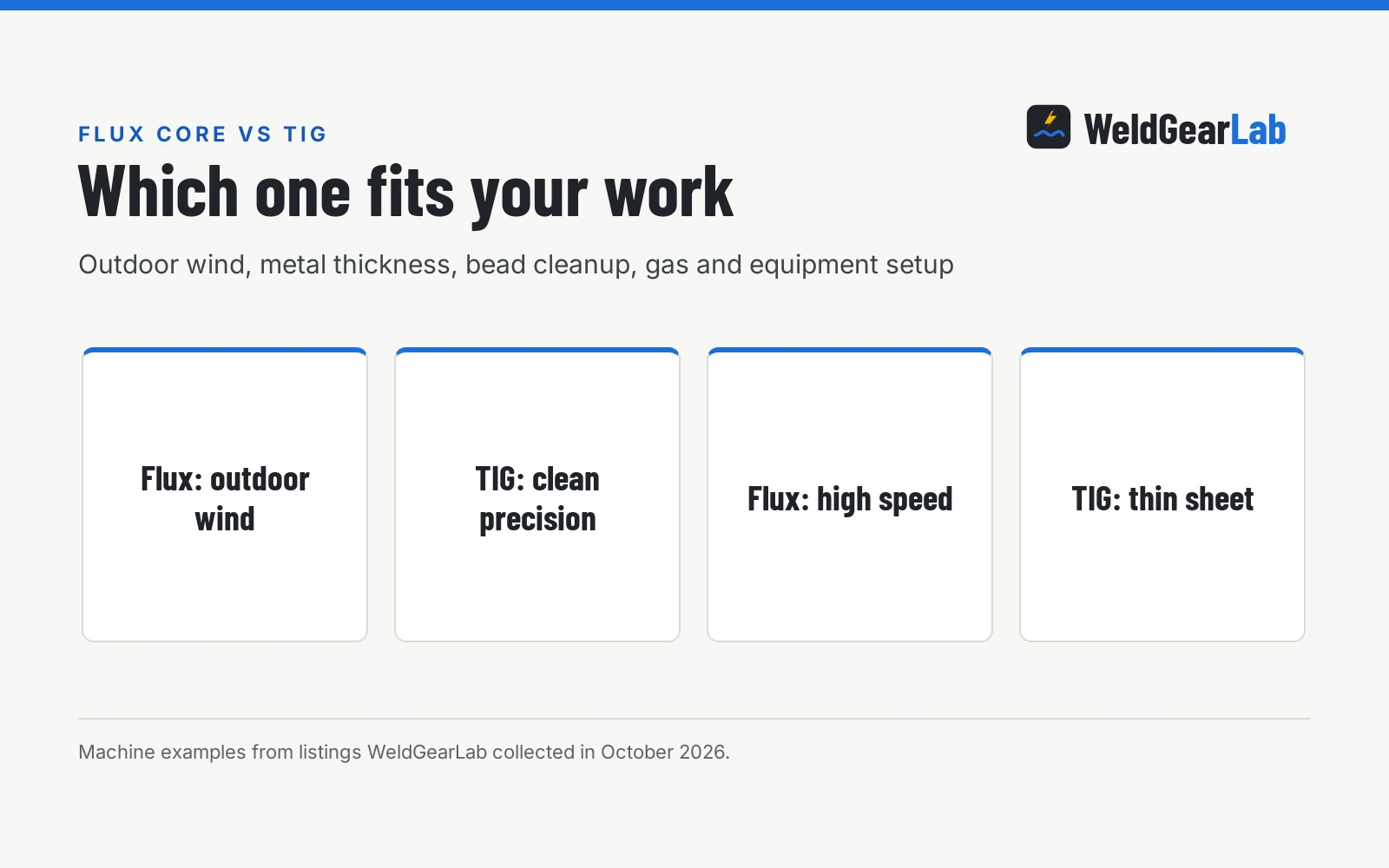
When comparing flux core welding vs TIG, flux core is the practical choice for outdoor repairs, thicker steel, and fast farm or gate fabrication without shielding gas, while TIG is the right choice for thin sheet metal, sanitary stainless steel, aluminum, and clean shop fabrication where bead appearance matters. Flux core feeds wire continuously from a spool through a handheld gun, burning internal flux compounds to shield the weld puddle in drafty conditions. TIG uses a non-consumable tungsten electrode and an external flow of pure argon gas, allowing the welder to add bare filler rod as needed to produce spotless, spatter-free beads. This guide compares flux core welding vs TIG step by step to help you pick the right process for your shop.
As an Amazon Associate I earn from qualifying purchases. This guide links to our product roundups, where WeldGearLab earns a commission when you buy through links, at no extra cost to you. Read our affiliate disclosure.
The difference in one paragraph
Molten steel reacts with oxygen and nitrogen in surrounding air, causing porosity and cracking in unprotected weld puddles. Flux core welding shields the joint using chemical flux packed inside a hollow steel wire, which vaporizes in the electric arc to generate protective gas and a protective slag crust over the solidifying bead. TIG welding protects the puddle using an external stream of pure argon gas delivered through the torch nozzle around a non-consumable tungsten electrode, while the welder dips a bare filler rod into the molten puddle by hand. Flux core operates as a fast, self-contained wire-feed system, whereas TIG operates as a deliberate, high-precision manual process requiring clean metal and zero drafts.
Side by side: flux core welding vs TIG
| Flux core (self-shielded) | TIG (steel & stainless) | TIG (aluminum) | |
|---|---|---|---|
| Shielding method | Internal flux core vaporizes to shield the arc | External pure argon gas from a cylinder | External pure argon gas from a cylinder |
| Equipment and hardware | Wire-feed gun, spool, ground clamp | TIG torch, tungsten electrode, regulator, gas cylinder | TIG torch, tungsten electrode, regulator, gas cylinder |
| Filler metal feeding | Continuous wire fed automatically by machine drive rolls | Bare steel or stainless rod fed by hand | Bare aluminum rod fed by hand |
| Current and polarity | DCEN (direct current electrode negative) | DCEN (direct current electrode negative) | AC (alternating current with cleaning action) |
| Outdoor wind tolerance | Tolerates outdoor wind and drafts well | Drafts blow shielding away, needs indoor shelter | Drafts blow shielding away, needs indoor shelter |
| Base metal prep | Tolerates light surface rust and mill scale | Demands completely clean, ground steel | Demands clean metal free of surface oxides |
| Thin metal and sheet | Higher risk of burn through on light gauge sheet | Exceptional heat control for thin steel sheet | Precise heat control for thin aluminum sheet |
| Bead appearance and cleanup | Produces slag crust and spatter requiring chipping | Spotless, spatter-free bead without slag | Spotless, spatter-free bead without slag |
| Skill and coordination | Single-hand gun trigger control, faster to learn | Two-hand coordination plus foot pedal current control | Two-hand coordination plus high frequency AC control |
While torch hardware and gas requirements differ between these methods, electrical polarity on steel is actually identical. Self-shielded flux core welding runs on direct current electrode negative, commonly called DCEN or straight polarity, where the gun lead connects to the negative terminal and the ground clamp connects to the positive terminal. Gas-shielded TIG on carbon steel and stainless steel runs on direct current electrode negative as well, directing arc heat into the workpiece while keeping the tungsten electrode cooler. Polarity diverges when welding aluminum, where TIG requires alternating current, known as AC, to provide cleaning action that breaks up tough surface oxide layers. Always verify the polarity settings on your machine panel and check the manufacturer’s manual before striking an arc.
When flux core is the better choice
- Outdoor field work and wind. Farm gates, corral fences, utility trailers, and equipment repairs out in the open. Wind and ambient drafts that blow away shielding gas have little impact on flux core wire because the flux burns directly at the arc.
- Light rust and mill scale. The core of AWS E71T-GS flux core wire incorporates deoxidizers that tolerate light surface rust, mill scale, and imperfect metal preparation better than bare wire or clean TIG tungsten.
- High deposition and joint speed. Wire feeds continuously from a spool when you pull the gun trigger, allowing rapid buildup on structural joints, butt welds, and lap joints without stopping to insert fresh rods.
- Portability without gas cylinders. Running gasless wire eliminates heavy high-pressure shielding gas cylinders, gas regulators, and trailing gas hoses, making field jobs much more portable.
Compact wire-feed units running on household power, such as the ARCCAPTAIN 130A Flux Core Welder MIG Welder or YESWELDER 135A MIG Welder on a 110V circuit, handle general shop repairs and outdoor fabrication with spools of 0.030 inch or 0.035 inch wire. For dedicated wire machines, see our guide to the best flux core welder.
When TIG is the better choice
- Thin sheet metal and delicate tubing. TIG generates a focused, controllable arc that lets you weld thin gauge sheet and delicate tubing without burning through or blowing holes in the workpiece.
- Pristine weld appearance and zero cleanup. TIG produces no spatter and leaves no slag coating. Welds appear as clean, uniform ripples that require no post-weld chipping hammers or grinding discs.
- Non-ferrous metals like aluminum. TIG handles non-ferrous metals that common wire setups cannot join cleanly. With alternating current, an AC TIG power source breaks through aluminum surface oxides to cleanly join aluminum plate, sheet, and castings. For carbon steel, alloy steels, and stainless tubing, direct current TIG creates uniform, high-strength welds without the spatter of wire processes.
- Precision control over heat input. Using a foot pedal or torch dial allows real-time amperage adjustment while welding, letting you taper heat off at the end of a weld to prevent crater cracks.
If your work centers on aluminum fabrication, see our guide to the best TIG welder for aluminum. For general torch selection and filler metal, explore our reviews of the best TIG torch, the best TIG rod for mild steel, and the best TIG rod for stainless steel.
How to tell what a machine supports
Many entry-level welders are sold as wire-feed machines, but not every machine supports TIG or both processes. When evaluating equipment, look for these specific indicators in the manufacturer’s listing:
- Dedicated process switches or ports. Look for listings explicitly advertising multi-process capabilities, such as the ANDELI 110V/220V PULSE Flux Core MIG Welder, which lists pulse and wire capabilities alongside lift TIG functionality.
- Gas connections and solenoid valves. Dedicated gasless flux core welders do not include a rear gas inlet or internal solenoid valve. In contrast, TIG capability requires an inert gas path, either routed through an internal machine solenoid or connected via an external gas hose running directly from the regulator to a manual torch valve.
- Torch and accessory compatibility. Wire feed machines use drive rolls sized for wire such as 0.030 inch or 0.035 inch, and gasless guns often use specialized nozzles, such as the Allyearauto nozzle listing specifying a 100A to 130A operating range. Manufacturers package flux core wire in various spool sizes, with listings like ARCCAPTAIN offering a 10LB spool rated at 80496 psi tensile strength, alongside 2 lb spools from YESWELDER and YixangDD. TIG setups require a compatible torch, collets, and a non-consumable tungsten electrode.
TIG torches and gas regulators are rarely bundled with entry-level wire feed welders. If you plan to add TIG later, verify that the power source includes gas valving and accepts standard torch connectors.
Which gas for TIG on steel
For steel and stainless steel, TIG welding requires pure argon shielding gas. Unlike wire processes that use carbon dioxide blends, TIG cannot operate with carbon dioxide or oxygen mixtures because reactive gases instantly oxidize and destroy the tungsten electrode. Pure argon shields the puddle smoothly and maintains arc stability. For aluminum, pure argon is also the standard choice when paired with alternating current. Check our guide on selecting a gas regulator for welder setups before buying equipment.
Can one machine do both?
Yes, multi-process machines can perform both flux core wire feeding and TIG welding. Inverter power sources capable of running on 110V and 220V household lines allow you to run gasless wire for fence posts and heavy brackets, then connect a TIG torch and a shielding gas cylinder for precision TIG joints. Dual-voltage machines like the ANDELI 110V/220V PULSE Flux Core MIG Welder demonstrate how versatile compact shop machines can be. For machine selections, see our guide to the best welder for beginners and our review of the best multi-process welder.
Safety considerations for both processes. Flux core produces heavy smoke, metal fumes, and flying spatter, while hot slag can pop during cooling. Always weld with strong ventilation or work outdoors with your head positioned outside the smoke plume, wear ANSI-rated eye protection under your helmet when chipping slag, and check our review of the best respirator for welding fumes. TIG produces negligible smoke and no slag, but its open arc generates intense ultraviolet radiation that requires full skin coverage and proper shade protection; see our guide to the best welding helmet for flux core and our picks for the best welding gloves for dexterity. Keep compressed gas cylinders chained upright to a wall or cylinder cart at all times. For a broader overview of power sources across all processes, visit our welders hub.
Frequently Asked Questions
Is flux core welding MIG?
Flux core is closely related to MIG because both feed a continuous wire through a handheld gun, but they differ in how they shield the weld. Standard MIG relies on an external shielding gas bottle, whereas self-shielded flux core uses hollow wire filled with flux compounds that generate their own gas as they melt. Many wire-feed machines can run both processes if they have the proper polarity settings and drive rolls.
Is flux core welding easy to learn compared to TIG?
Flux core is generally much easier for beginners to pick up because you can trigger the gun with a single hand while stabilizing the workpiece. TIG welding demands significantly more motor skill and coordination because you hold the torch with a steady grip, feed filler rod with the opposing hand, and modulate current with a foot pedal. Beginners typically learn to lay solid joint passes with flux core relatively quickly, whereas mastering consistent TIG beads requires extensive practice and muscle memory.
What is flux core welding good for?
Flux core welding is ideal for outdoor fabrication, farm repairs, structural steel framing, and heavy repairs where dragging gas bottles is impractical. Its penetrating arc cuts through light rust, mill scale, and dirt on carbon steel better than bare wire processes. It also excels in windy conditions where shielding gas envelopes would blow away.
Can flux core weld stainless steel?
Yes, specialty stainless steel flux core wires exist, but standard carbon steel wire will cause joints to rust. Stainless flux core wire is generally more expensive and harder to find in hardware stores than standard steel wire. For clean, sanitary stainless steel fabrication, TIG welding remains the industry benchmark because it prevents oxidation and produces immaculate beads without spatter.
Which process makes stronger welds on mild steel?
Both flux core and TIG can produce full-strength, sound welds on carbon steel when set up properly. Flux core achieves deeper root penetration on thicker steel joints with less edge preparation, making it a favorite for structural brackets. TIG allows precise puddle control and cleaner metal deposition, but requires impeccable joint cleanliness to avoid internal contamination.
Related: best flux core welder, best TIG welder for aluminum, best welder for beginners, and the TIG welders hub. Also see our comparison of flux core vs MIG welding and our guide on welding aluminum with TIG welder.
About the author
WeldGearLab Editorial is the editorial team behind WeldGearLab. We research product listings, specifications, safety listings and warranty terms, score every pick with the published Gear Score method, and correct errors when readers report them. We do not run our own shop trials; see How We Pick for exactly how picks are made.