Plasma Cutter vs Angle Grinder: Which One Should You Buy?
Plasma cutters and angle grinders tackle different metal cutting and fabrication tasks. How they compare on cutting speed, metal thickness, curves, edge preparation, and shop setup.
 By WeldGearLab Editorial
Updated October 9, 2026
By WeldGearLab Editorial
Updated October 9, 2026
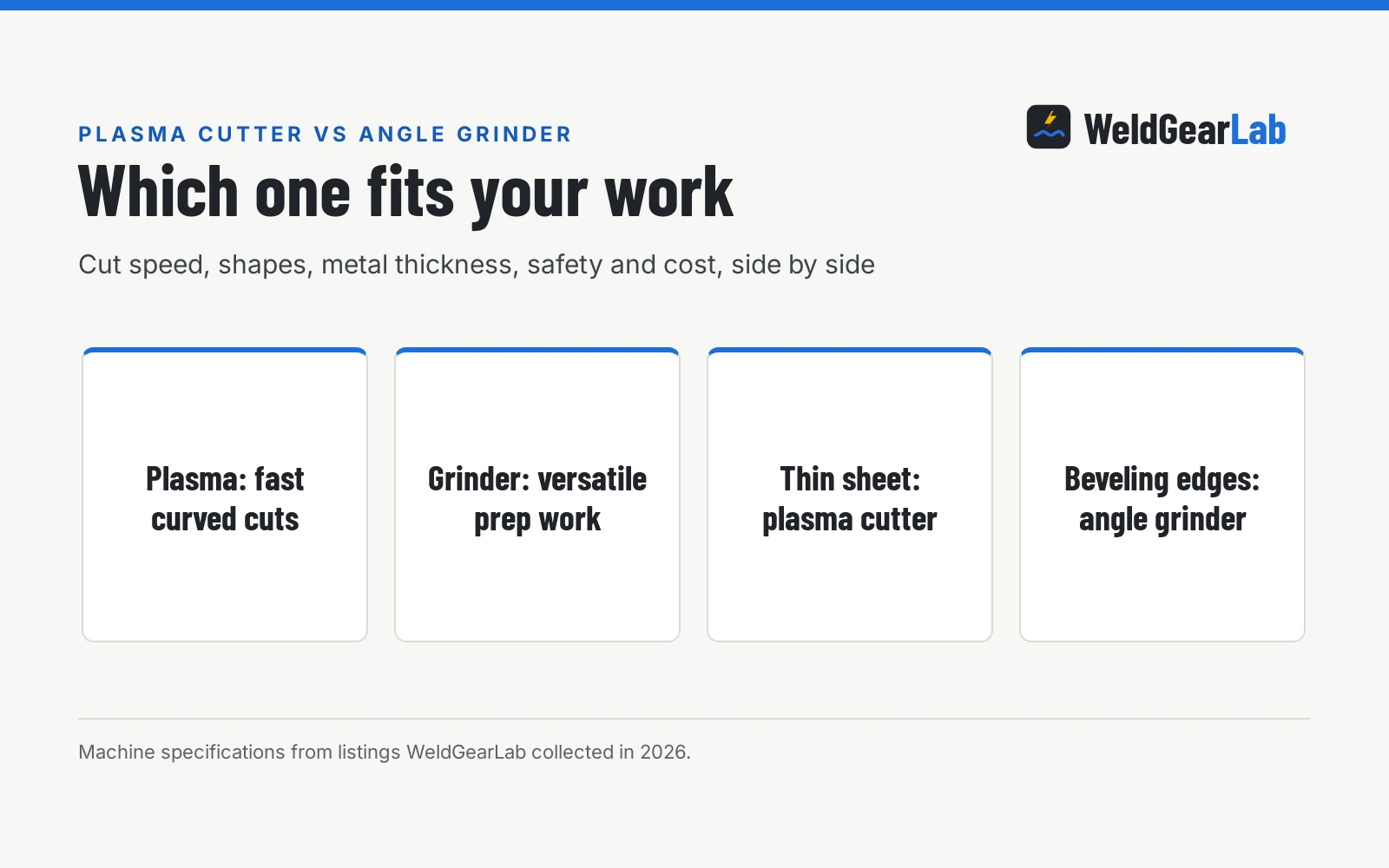
When choosing between a plasma cutter vs angle grinder, the right tool depends on whether you need quick, intricate cuts in metal plate or a versatile tool for edge prep, beveling, and weld cleanup. A plasma cutter uses an electric arc and compressed air to slice through conductive metal with high speed, making it well suited for curved cuts, interior holes, and sheet fabrication. An angle grinder uses abrasive discs to cut, grind, bevel, and clean, making it a dependable workhorse for prep and finishing. This guide compares both tools for home, farm, and fabrication shops to help you decide which one fits your metalwork.
As an Amazon Associate I earn from qualifying purchases. This guide links to our product roundups, where WeldGearLab earns a commission when you buy through links, at no extra cost to you. Read our affiliate disclosure.
Plasma cutter vs angle grinder: the difference in one paragraph
A plasma cutter passes an electric arc through a stream of compressed air, creating an ionized plasma jet that melts conductive metal and blows the molten material out of the kerf. It requires an electrical power source and a continuous supply of clean compressed air. An angle grinder uses a high-speed electric motor to spin an abrasive wheel, mechanically shearing metal using a high-speed bonded abrasive wheel. The grinder requires no compressed air and handles grinding, edge beveling, sanding, and wire brushing in addition to basic straight cutoffs.
Side by side
| Plasma cutter | Angle grinder | Best choice | |
|---|---|---|---|
| Cutting mechanism | Ionized gas arc melts and blows metal away | Bonded abrasive wheel shears metal chips | Different cutting physics |
| Metal compatibility | Electrically conductive metals (steel, aluminum) | Ferrous and non-ferrous metals with matching discs | Plasma avoids wheel loading on aluminum |
| Cutting speed | High speed on sheet and plate metal | Slower on plate, limited by wheel wear | Plasma on flat stock |
| Curves and shapes | Follows curves, patterns, and inside cutouts | Cutoff wheels cut straight lines only | Plasma for shapes |
| Edge preparation | Cuts metal; gouging needs specialized setup | Excels at beveling, weld prep, and blending | Grinder for weld prep |
| Power requirements | Requires electric power and compressed air | Requires electric power only | Grinder for simple setup |
| Consumables | Electrodes, nozzles, swirl rings, and shields | Cutoff wheels, grinding discs, and flap wheels | Both need wear parts |
| Heat affected zone | Narrow band along the cut edge | Broad heat buildup along continuous cuts | Plasma limits distortion |
| Cutting depth | Set by machine amperage and travel speed | Limited by usable wheel radius | Plasma on thicker plate |
Cutting performance depends heavily on proper technique and clean power. Always match your cutting process to the metal thickness and verify that your electrical circuit can supply the necessary current.
When a plasma cutter is the better choice
- Curved and intricate shapes. Plasma torches follow curves, circles, stencils, and internal cutouts that an abrasive wheel cannot navigate.
- Fast cutting on sheet and plate. High travel speed leaves a clean kerf on sheet metal and plate with minimal distortion.
- Rusted or painted metal. Pilot arc torches start without touching the workpiece, cutting through surface rust and paint without stalling.
- Non-ferrous metals. A plasma cutter on aluminum, copper, and stainless steel delivers clean severed edges without loading up an abrasive disc.
Our plasma cutter for metal guide covers scored picks for shop and garage fabrication.
When an angle grinder is the better choice
- Weld prep and beveling. Grinding discs quickly bevel thick plate edges before welding to ensure proper joint penetration.
- Cleaning and weld blending. Flap discs and wire wheels remove mill scale, rust, and spatter, and smooth finished weld seams.
- Simple straight cutoffs. For trimming rebar, angle iron, square tubing, or bolts, an abrasive cutoff wheel is fast and convenient.
- Portability without air lines. Grinders operate anywhere with an electrical outlet or battery pack, requiring no bulky compressor or air hoses.
For mobile repairs away from electrical outlets, see our best cordless angle grinder guide.
Cutting capacity and machine specifications
Cutting capacity on a plasma cutter scales directly with output amperage and input voltage. Dual-voltage machines adapt between household outlets and dedicated workshop circuits. On 110V power, the YESWELDER CUT-50DS specifies a clean cut of 1/4 inch and a maximum severance of 3/8 inch, stepping up to a 1/2 inch clean cut and a 5/8 inch maximum cut on 220V. Higher-output units provide greater severance capability; for example, the ARCCAPTAIN CUT55 Non-HF lists clean cutting up to 3/5 inch and a maximum severance cut of 1 inch on 220V. Duty cycle ratings indicate cutting endurance before thermal pause, with the SILATU STC550P listing a 60% duty cycle across an output range of 15-40A on 110V and 15-55A on 220V.
An angle grinder cut depth is physically restricted by the usable radius of the abrasive wheel. As the cutoff wheel wears away during cutting, the maximum depth of cut steadily decreases, requiring wheel replacement to restore cutting reach. For thicker structural stock, an angle grinder requires making multiple relief passes around the perimeter as wheel reach allows.
Air compressor and electrical requirements
Running an electric plasma cutter requires balancing power supply and pneumatic delivery. While an angle grinder plugs directly into an electrical outlet or runs on a battery platform, a plasma cutter demands a dependable compressed air source to cool the torch and eject molten metal. Air pressure must remain stable during the entire cut. The YESWELDER CUT-50DS listing specifies maintaining air pressure within 45-75 Psi, while the SILATU STC550P calls for 70 PSI with an airflow rate of 250 liters per minute. Moisture in the air line degrades consumables and destabilizes the plasma arc, making an inline air filter essential.
For workshops without dedicated compressed air piping, an integrated machine offers a self-contained alternative. Our plasma cutter with air compressor guide covers compact units that incorporate an internal air pump.
Do you need both tools in a metal shop?
For most metal fabrication, farm repair, and automotive shops, the plasma cutter and angle grinder are complementary tools rather than mutually exclusive choices. The plasma cutter handles the initial breakdown, slicing plate, cutting brackets, blowing bolt holes, and roughing out custom shapes. The angle grinder then takes over for joint preparation, grinding weld bevels, cleaning mill scale, deburring sharp edges, and blending finished welds flat.
Sparks, fumes, and protective gear. Both tools generate intense sparks, hot debris, and airborne particles. A plasma cutter generates brilliant electrical arcs rich in ultraviolet radiation, requiring a dark protective shade, leather welding gloves, and full skin coverage. The process also vaporizes metal, requiring proper ventilation to evacuate metal fumes. An angle grinder generates directional showers of grinding sparks and abrasive dust, calling for a full face shield over safety glasses, heavy leather gloves, and hearing protection against high motor noise. Always maintain a clear perimeter free of dry brush, sawdust, or flammable solvents before cutting or grinding.
Frequently Asked Questions
What is the best plasma cutter?
The best plasma cutter depends on your available electrical service and the metal thickness you routinely cut. Dual-voltage inverter machines that run on standard household outlets and higher-voltage circuits offer broad flexibility for home garages and small shops. Look for a pilot arc torch that cuts through painted or rusted metal without tip contact, along with a built-in air regulator and water separator.
What size compressor for a plasma cutter?
A plasma cutter requires an air compressor that can deliver continuous pressure and volume matching the torch specifications. Air pressure requirements vary across machines. For example, the YESWELDER CUT-50DS listing specifies maintaining air pressure within 45-75 Psi, while the SILATU STC550P listing specifies a flow rate of 250 liters per minute at 70 PSI. Choose a compressor with sufficient tank storage and motor power so air delivery does not drop below operating limits during long cuts.
Do plasma cutters need gas?
Plasma cutters for workshop and farm use do not require specialized bottled shielding gas like MIG or TIG welding machines. They operate on clean, dry compressed air to generate the plasma jet and purge the cut. Industrial systems cutting exotic alloys may use specialized gases such as nitrogen, but standard metal fabrication models run on everyday compressed air.
Do you need a welding helmet for a plasma cutter?
Yes, eye and face protection with an appropriate filter shade is necessary when operating a plasma cutter. The plasma arc produces intense ultraviolet and infrared radiation that can cause painful arc flash burns to unprotected eyes. Use a welding helmet or a cutting face shield with the correct shade rating rather than clear shop glasses.
Why are CNC plasma cutters good?
CNC plasma cutters combine plasma cutting speed with computer-guided torch movement, allowing exact repeatability across intricate parts. Automated motion maintains a consistent standoff height and travel speed, producing clean cut edges on decorative art, brackets, and sheet metal panels. This precision reduces secondary grinding and ensures identical dimensions across production runs.
Related: plasma cutter for metal, plasma cutter with air compressor, best cordless angle grinder, and the plasma cutters hub. Also see our cut 50 plasma cutter tips and metal fab tools.
About the author
WeldGearLab Editorial is the editorial team behind WeldGearLab. We research product listings, specifications, safety listings and warranty terms, score every pick with the published Gear Score method, and correct errors when readers report them. We do not run our own shop trials; see How We Pick for exactly how picks are made.