What Grit Flap Disc for Weld Grinding?
How to choose between 40, 60, 80, and 120 grit flap discs for weld bead knockdown, flush blending, and pre-paint metal finishing.
 By WeldGearLab Editorial
Updated October 10, 2026
By WeldGearLab Editorial
Updated October 10, 2026
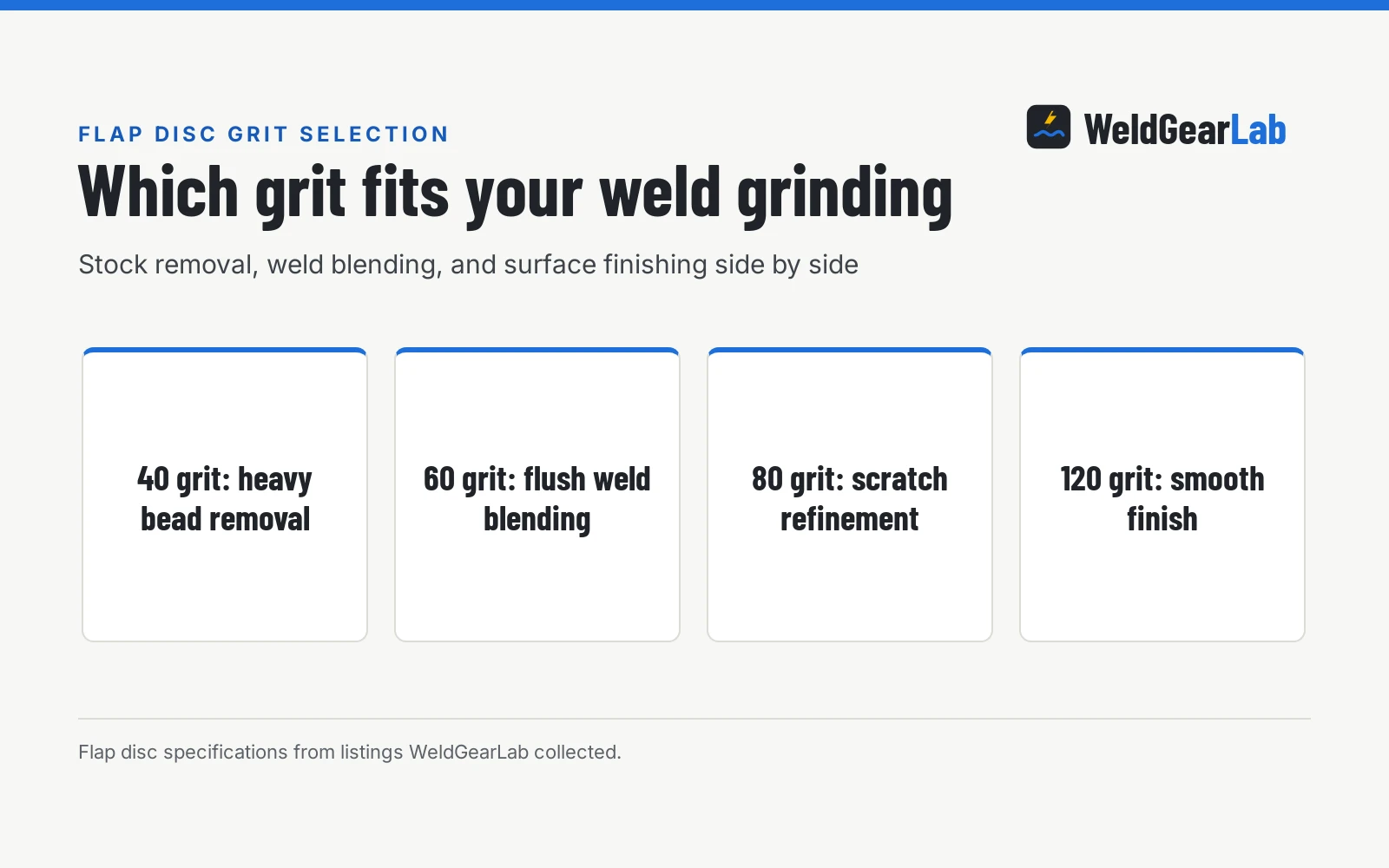
For most projects, the best starting abrasive is a 40 grit or 60 grit disc. When deciding what grit flap disc for weld grinding, use 40 grit for heavy bead knockdown, switch to 60 grit for flush blending, and use 80 grit or 120 grit before paint or powder coat. Starting with the right grit prevents gouging and cuts cleanup time.
As an Amazon Associate I earn from qualifying purchases. This guide links to our product roundups, where WeldGearLab earns a commission when you buy through links, at no extra cost to you. Read our affiliate disclosure.
What grit flap disc for weld grinding
For heavy reinforcement, grinding down a weld is rarely a single-step job. A tall bead stands proud of the plate with ripples and spatter. Attacking it with a fine abrasive glazes the disc and overheats the metal, while an overly coarse disc on thin sheet can gouge furrows into the base steel.
A standard grinding progression moves from coarse stock removal to surface conditioning. Coarser grits cut tall crowns rapidly with large abrasive grains. Finer grits refine the scratch pattern, leaving a uniform finish for primer or inspection without thinning the workpiece unnecessarily.
Side by side
| 40 Grit | 60 Grit | 80 Grit | |
|---|---|---|---|
| Primary shop purpose | Heavy weld bead knockdown and beveling | General weld blending and leveling | Surface smoothing and scratch cleanup |
| Stock removal speed | Fast and aggressive material removal | Moderate, balanced cutting rate | Light, controlled material removal |
| Surface scratch depth | Coarse grind lines requiring follow-up blending | Moderate scratch pattern suited for unpainted parts or heavy primer | Fine uniform scratch pattern ready for standard primer and paint |
| Gouging risk on base metal | Higher risk if tilted or held in place | Moderate risk with normal working pressure | Low risk, forgiving on thin steel |
| Typical abrasive grains | Zirconia alumina or ceramic | Zirconia alumina or ceramic | Zirconia alumina or aluminum oxide |
| Common disc profile | Type 29 conical bevel | Type 29 conical or Type 27 flat | Type 27 flat or Type 29 conical |
| Best working stage | Initial pass on tall weld reinforcement | Follow-up pass to bring bead flush with sheet | Final pass before coating or inspection |
Coarser abrasives remove weld crowns quickly under moderate pressure, while finer grades smooth out surfaces. The right sequence depends on bead height and finish requirements.
When 40 grit is the better choice
Coarse 40 grit flap discs deliver maximum stock removal. This grit is the workhorse for leveling large stick or flux-core reinforcements and removing heavy spatter, cutting rapidly into weld crowns without premature glazing.
- Tall weld reinforcement. Thick beads on structural joints need rapid material removal before blending.
- Beveling and joint prep. Edge preparation requires aggressive cutting; see our guide on how to bevel metal for welding.
- Mill scale and spatter. Coarse grains remove stubborn scale and slag that clog finer discs.
- Heavy fabrication. On thick steel or farm repairs, 40 grit flattens joints in minimum passes.
Makers build 40 grit discs for heavy stock removal. EZARC lists high-density 40 grit discs with 90 flaps, advertising a 25% flap increase over 72-flap models and claiming 50% longer life. FOXBC lists 40 grit zirconia discs meeting ANSI B7.1 standards, citing up to 10X faster removal than bonded wheels. For tall structural beads, pair 40 grit with a capable grinder from our guide to the best angle grinder for welding prep.
When 60 grit is the better choice
For many fabricators, 60 grit is the most versatile shop abrasive, balancing cutting speed with surface refinement. It levels moderate MIG and TIG beads smoothly while leaving a moderate scratch profile that blends cleanly.
- Flush sheet blending. On thinner assemblies, 60 grit removes beads without gouging neighboring steel.
- Single-pass cleanup. On modest frame or bracket welds, 60 grit levels and blends in one step.
- Fillet weld cleanup. Internal corners require controlled contact to avoid notching perpendicular plate.
- General fabrication. For shops stocking a single grit for light stock removal and deburring, 60 grit is standard.
Specialty designs also rely on 60 grit. PFERD specifies its POLIFAN-Curve ceramic flap disc with 60 grit for a 5/16 inch fillet weld radius, offering 280 degrees of grinding surface. For general workshop packs, see our guide to the best flap disc for metal.
When 80 grit and 120 grit are needed
Fine 80 grit and 120 grit abrasives are finishing tools. Attempting to grind tall beads with fine grits glazes cloth and overheats metal, but switching to them after initial leveling removes scratch lines cleanly.
- Pre-paint prep. An 80 grit disc refines scratches so primer and paint adhere without visible grind lines.
- Stainless finishing. Stainless fabrication requires fine scratch blending to match grain without gouges.
- Cosmetic blending. A 120 grit disc leaves a satin finish on carbon and alloy steel before coating.
- Edge radiusing. Fine grits soften sheared edges without removing parent plate.
Multi-grit packs support this workflow. GritElite lists a pack combining 40, 60, 80, and 120 grit discs. For fine blending, NEIKO lists 120 grit zirconia discs rated up to 13,300 RPM on a 4-1/2 inch disc with a 7/8 inch arbor.
Abrasive grain types for weld grinding
Abrasive minerals affect cutting rate, heat, and disc life as much as grit size. Fabrication flap discs typically use zirconia alumina or ceramic grains.
- Zirconia alumina. The standard abrasive for carbon steel. Grains micro-fracture under load to expose sharp edges. EONCHO lists zirconia discs with 5/8-11 threaded arbors, and ROZZLOOM lists 60 grit zirconia discs for steel grinding.
- Ceramic alumina. Self-sharpening grains that cut cooler under heavy pressure. EZARC claims its ceramic flap discs last 3X longer than zirconia and 5X longer than aluminum oxide, with 50% better cutting performance on stainless steel.
- Aluminum oxide. Suitable for general metalworking, but glazes and wears faster on hard weld beads.
For tough alloys and high pressure, ceramic cuts cooler. For general carbon steel welding, zirconia alumina balances cutting speed and disc cost.
Type 27 vs Type 29 disc profiles for welds
Disc shape determines how abrasive flaps contact the weld seam. Choosing the right profile prevents gouging and maximizes contact area.
- Type 29 conical discs. Flaps are angled at a conical bevel. EZARC lists Type 29 zirconia discs designed for working angles of 15 to 20 degrees. This concentrates pressure along the edge for aggressive weld knockdown.
- Type 27 flat discs. Flaps sit flat for shallow angles under 15 degrees, distributing pressure across a broader surface for smooth blending on flat sheet.
See our breakdown on flap disc Type 27 vs 29, or compare discs to brushes in flap disc vs wire wheel.
Grinding safety and sparks. Flap discs carry ratings up to 13,300 RPM and throw hot sparks during weld cleanup. Always wear an ANSI approved face shield over safety glasses, leather gloves, and hearing protection. Keep the wheel guard locked in place and clear combustibles. See our welding safety gear checklist for beginners.
Frequently Asked Questions
Can you grind a weld with only one flap disc grit?
Yes, on modest beads, 60 grit can level and blend the joint in one operation for unpainted structural work. Tall beads take longer with 60 grit than 40 grit, and painted work still needs finer abrasives. Using coarse then fine grits is usually faster on heavy welds.
What is the difference between 40 vs 60 vs 80 grit for welds?
The difference is cutting speed and scratch depth. A 40 grit disc cuts aggressively to flatten crowns, 60 grit blends beads flush with minimal gouging risk, and 80 grit removes scratches before coating. Each step refines the joint without overheating metal.
Should you use a grinding wheel or a flap disc for weld cleanup?
Rigid grinding wheels remove heavy metal quickly on thick plate but gouge easily. Flap discs feature cushioned overlapping flaps that grind and blend simultaneously. For general weld prep and blending, flap discs provide far better control.
Is ceramic or zirconia better for grinding weld beads?
Ceramic cuts cooler and lasts longer under heavy pressure on tough metals like stainless steel. Zirconia is the dependable, cost-effective choice for carbon steel fabrication. For standard shop repairs, zirconia handles weld grinding without the higher cost of ceramic.
Why does a flap disc gouge the metal around the weld?
Gouging happens when grinders are held too steep or held stationary in one spot. Using coarse 40 grit with excessive downward force also digs into base plate before leveling the bead. Keep the disc moving along the seam, maintain 15 to 20 degrees with Type 29 discs, and lighten pressure as the bead flattens.
Related: best angle grinder for welding prep, flap disc Type 27 vs 29, best flap disc for metal, flap disc for angle grinder, and the metal fab tools hub.
About the author
WeldGearLab Editorial is the editorial team behind WeldGearLab. We research product listings, specifications, safety listings and warranty terms, score every pick with the published Gear Score method, and correct errors when readers report them. We do not run our own shop trials; see How We Pick for exactly how picks are made.