Welding Cable vs Extension Cord: Which One Should You Buy?
Welding cable carries welding current to the arc; an extension cord carries mains power to the welder. How they differ, when each fits, and four extension cord examples.

On this page
Top picks at a glance
As an Amazon Associate I earn from qualifying purchases.
- 1
 TEMCo Hammer Lug Crimper Tool9.5/10View on Amazon
- 2
 Amazon Basics Extension CordView on Amazon
- 3
 100 FT 12/3 Outdoor Extension Cord WaterproofView on Amazon
- 4
 Southwire Welder Extension CordView on Amazon
- 5
 6/3 Welder Extension Cord 50 Amp SOOW Welding Extension CordView on Amazon
- 6
 Amazon Basics 50-Foot 3-Prong Indoor/Outdoor Extension CordView on Amazon
- 7
 Skrizcable 16/3 50 FT Outdoor Extension Cord WaterproofView on Amazon
The welding cable vs extension cord question comes up in every shop: the two do different jobs, and mixing them up can starve your welder or put line voltage where it does not belong. Welding cable carries welding current from the machine to the stinger and ground clamp; an extension cord carries mains power from the wall outlet to the welder itself. This guide lays out the difference, and the gear section covers four extension cord examples, since none of the four is a welding cable.
Other welders and gear to compare
 Amazon Basics Extension CordCheck price on Amazon
 100 FT 12/3 Outdoor Extension Cord WaterproofCheck price on Amazon
 Southwire Welder Extension CordCheck price on Amazon
 6/3 Welder Extension Cord 50 Amp SOOW Welding Extension CordCheck price on Amazon
 Amazon Basics 50-Foot 3-Prong Indoor/Outdoor Extension CordCheck price on Amazon
 Skrizcable 16/3 50 FT Outdoor Extension Cord WaterproofCheck price on Amazon
This guide links to our product roundups, where WeldGearLab gets a commission on purchases made through links on this page, and your price stays the same. Read our affiliate disclosure.
The difference in one paragraph
A welding cable is a low-voltage, high-current conductor: it runs from the welder output studs to the electrode holder and the work clamp, carrying the welding current to the arc. An extension cord is a mains power cord: it runs from the wall outlet to the welder power inlet, carrying line voltage to the machine. The four examples below are all extension cords, rated 13 or 15 amps at 125V, with NEMA 5-15 plug and socket ends. None of them is a welding cable.
Side by side
| Welding cable | Extension cord | The four examples | |
|---|---|---|---|
| Carries | Welding current from the machine output studs | mains power from the outlet to the welder | All four are extension cords |
| Connectors | Lugs and quick connects for the welder | NEMA 5-15 plug and socket ends | All four state NEMA 5-15 ends |
| Outdoor rating | Varies by jacket | Varies by jacket | Vockjour, POWGRN and Tiffcofio state outdoor use |
| Amp ratings | Not stated in these listings | 13 or 15 amps at 125V | POWGRN 15A, others 13A |
| Gauge | Not stated in these listings | 12 or 16 AWG | POWGRN 12 AWG, others 16 AWG |
Match the cord to the machine: the welder input amps must stay under the cord rating, and the four examples below state 13 or 15 amps. When in doubt, check the machine door chart or manual.
When an extension cord is the right choice
- Reaching a far outlet. The POWGRN runs 100 feet at 12 AWG and 15 amps, so the welder can sit near the work while the outlet stays far away.
- Outdoor work. The Vockjour, POWGRN and Tiffcofio state outdoor use and waterproof jackets; the Amazon Basics is listed for indoor use.
- Small tools and lights. The Amazon Basics 6-foot cord suits a grinder or work light near the bench at 13 amps.
- Welding work listed by the maker. The POWGRN bullets name welding work among the uses, with ETL and cETL listing stated.
Our best extension cord for portable welder guide covers five cords scored for the shop.
When you need welding cable instead
- Longer stinger or ground leads. Extending the leads means more welding cable with lugs and quick connects, not an extension cord.
- Worn or damaged leads. A cracked electrode cable is a welding cable replacement, sized to the machine output.
- Better arc starts on a long run. Undersized leads drop voltage at the arc; the fix is heavier welding cable, not a longer power cord.
Welding cable vs extension cord: which should you buy?
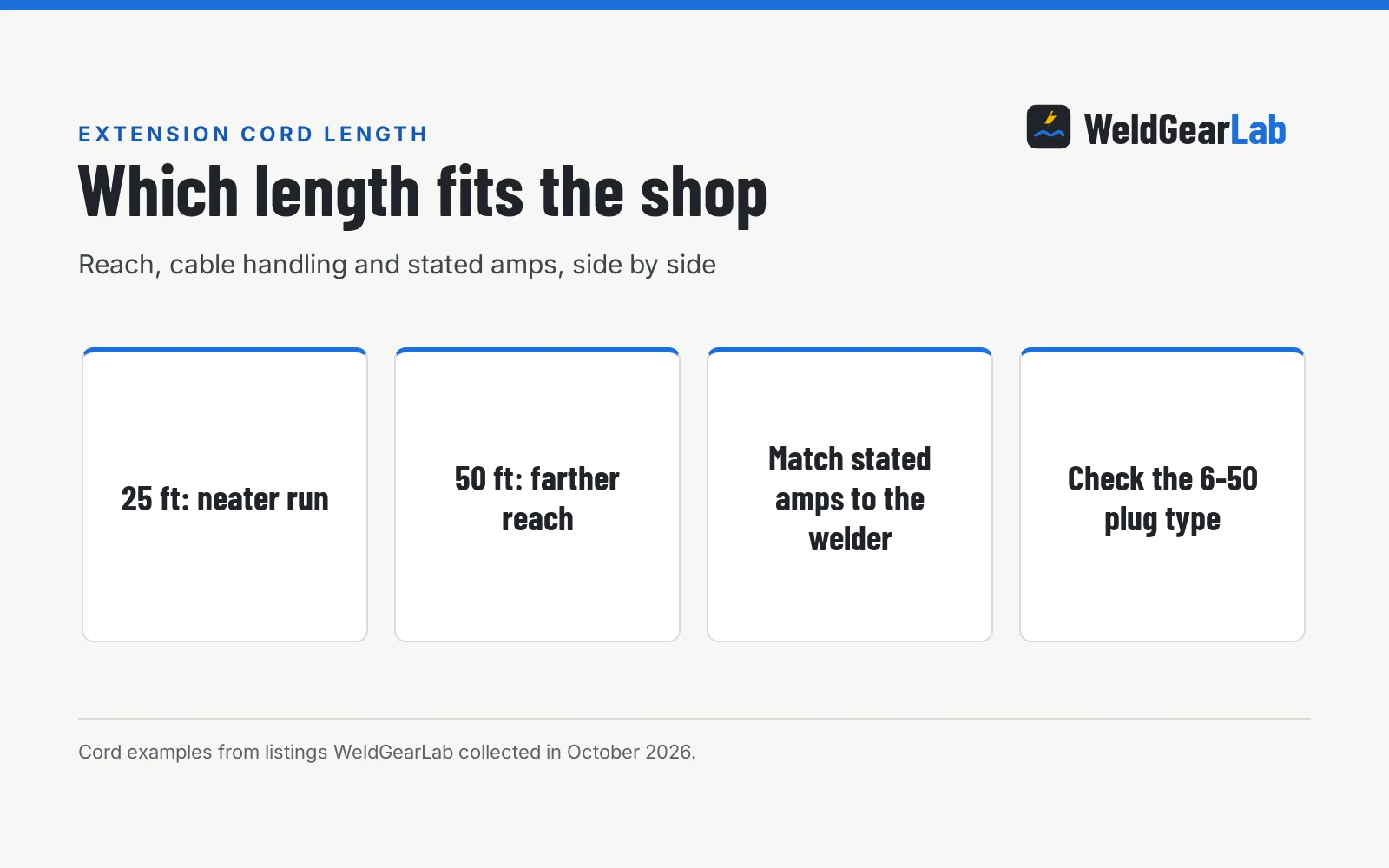
Buy an extension cord when the problem is distance to the outlet: the four examples below run 6, 10, 25 and 100 feet, all at 125V with 13 or 15 amp ratings. Buy welding cable when the problem is reach at the arc: longer leads from the machine to the work. Never plug a welder into a cord rated below the machine input amps, and never use a power cord as a stinger lead.
Extension cord examples
All four listings below are extension cords, ranked by their stated specs. The POWGRN leads on length and gauge: 100 feet of 12 AWG cord at 15 amps and 1875 watts, SJTW jacket, ETL and cETL listed, with an LED indicator and storage straps. The Tiffcofio runs 25 feet at 16 AWG and 13 amps with 1625 watts, ETL listed, waterproof, and a 2-year warranty, the only stated warranty of the four. The Vockjour runs 10 feet at 16 AWG and 13 amps with 1625 watts, ETL listed, waterproof, and a stated temperature range of -58°F to +158°F. The Amazon Basics is the basic indoor pick: 6 feet at 16 AWG and 13 amps, 125V, for tools and electronics near the bench.
Details worth checking on the listing
Beyond length and amps, the listings state small features that matter in a shop. The POWGRN has an LED indicator that lights when the cord is powered plus storage straps, and the Vockjour and POWGRN cords each passed a 1500V high voltage check; the maker also says to fully uncoil the cord during use rather than piling it up. The Vockjour adds hooks for hanging and a strain relief the maker rates for more than 20,000 bends, with polyethylene sheaths the listing calls weatherproof, flame retardant and abrasion resistant. The Tiffcofio uses V0-grade fire-resistant PVC that the maker says stays crack-free under long-term sun exposure, and it carries the only stated warranty of the four at 2 years. On the light end, the Amazon Basics accepts 2- or 3-prong device plugs and is aimed at media equipment and small tools, not outdoor work. Match these details to where the cord will live: a cord that hangs in the shop benefits from the Vockjour hooks, while a cord that runs across the yard uses the POWGRN 100-foot length.
FAQ for welders
Can I use an extension cord to power my welder?
Yes, if the cord rating covers the welder input amps. The POWGRN states 15 amps and 1875 watts; the Vockjour and Tiffcofio state 13 amps and 1625 watts, and the Amazon Basics states 13 amps at 125V with no wattage stated. Check the machine door chart or manual for the input amps before you plug in.
What gauge extension cord do I need for a welder?
The POWGRN states 12 AWG at 15 amps, and the Amazon Basics, Vockjour and Tiffcofio state 16 AWG at 13 amps. Match the gauge and amp rating to the machine input; longer runs favor heavier gauge.
Can I use a welding cable as an extension cord?
No. Welding cable carries welding current from the machine output studs and has no mains plug or socket ends. The four examples here are extension cords with NEMA 5-15 plug and socket ends for line voltage.
Are these cords waterproof?
The Vockjour, POWGRN and Tiffcofio state waterproof jackets. The Amazon Basics is listed for indoor use, with a vinyl jacket.
How long can an extension cord be?
The four examples run 6, 10, 25 and 100 feet. The POWGRN says to fully uncoil the cord during use and not to pile it up.
Related: best extension cord for portable welder, best MIG welder for hobbyist, and the metal fab tools hub. Also see our what size generator to run a MIG welder.